Workflow
支付
icon
Search documents
中国支付机构海外“拿牌”热潮涌动,积极拓展增量市场
Huan Qiu Wang· 2025-06-01 03:21
在海外拿牌的热潮中,全球支付平台PingPong也有亮眼表现。近日,PingPong宣布获得马来西亚中央银行正式批 准,成为中国首家在当地持有MSB牌照的To B(面向企业客户)跨境支付机构。继新加坡、印尼牌照之后, PingPong此次获得马来西亚牌照,将进一步扩大公司在"一带一路"共建国家和地区的业务布局,完善本地生态网 络建设。 截至目前,PingPong已拥有60多张全球支付牌照及许可证,其合规网络建设覆盖了中国内地、中国香港、美国、 加拿大、欧盟、英国、新加坡、印尼、马来西亚、澳大利亚、日本等众多国家和地区。凭借广泛的牌照覆盖, PingPong可支持各类企业在北美、欧洲、东亚、东南亚等主要贸易区域内实现安全便捷的跨境资金往来,帮助企 业有效应对全球市场波动,抓住新兴市场的机遇。 同样关注新兴市场机遇的还有Airwallex空中云汇。今年初,Airwallex空中云汇成功获得巴西央行颁发的支付牌 照,并完成对墨西哥持牌机构MexPago的战略收购,为进入拉美两大关键市场铺平了道路。 目前,Airwallex空中云汇已经在澳大利亚、新加坡、中国香港、中国内地、日本、新西兰、英国、欧洲、美国、 加拿大、 ...
Visa宣布与蚂蚁国际、Grab及腾讯合作探索AI商务发展
智通财经网· 2025-05-30 07:32
Core Insights - Visa is launching multiple innovative projects and strategic partnerships to enhance business in the Asia-Pacific region, focusing on AI-driven commerce solutions [1][2] - The Visa Intelligent Commerce initiative aims to open Visa's payment network to developers and engineers, facilitating the creation of the first generation of AI commerce models in the region [2] - Visa is expanding the application of stablecoins by providing on and off-ramps for stablecoin payment cards, allowing users to purchase stablecoins with fiat currency and use them within Visa's merchant network [2] Group 1 - Visa is collaborating with Ant International, Grab, and Tencent to explore AI business development and create a secure and seamless checkout experience [1] - The new AI-driven solutions will provide partners, including AI platforms, tech companies, banks, fintech firms, and merchants, with easier access to Visa's payment network [1][2] - Visa's AI agents will enable consumers to authorize AI to browse, select, purchase, and manage various tasks, requiring trust from both users and financial institutions [1] Group 2 - Visa Tokenised Asset Platform (VTAP) will support partners in issuing and managing tokenized assets linked to fiat currencies, enhancing programmable finance and cross-border transactions [3] - The Flex Credential initiative, launched in collaboration with Sumitomo Mitsui Banking Corporation and Sumitomo Mitsui Card Company, allows users to switch seamlessly between different payment methods, improving cash flow management [3] - Visa is set to expand its partner network for VTAP by 2026, further promoting the use of tokenized assets and stablecoin payments [3]
移卡获得美国MTL支付牌照,全球化战略继续提速
IPO早知道· 2025-05-30 01:22
Core Viewpoint - The company, Yika (9923.HK), has recently obtained the Money Transmitter License (MTL) from the Arizona Department of Financial Institutions, marking a significant step in its global expansion strategy [2]. Group 1: Licensing and Compliance - Yika has successfully acquired the MTL license, following its previous attainment of the Money Services Business (MSB) license, indicating recognition from U.S. financial regulators regarding its product compliance and overall strength [2]. - The process of obtaining the MTL license is complex and time-consuming, requiring prior application for the MSB license as a prerequisite for state-level MTL applications [2]. Group 2: Global Business Strategy - Since 2021, Yika has focused on overseas markets, actively applying for various licenses, including Hong Kong MSO, Singapore MPI, and U.S. MSB, to provide secure and efficient digital financial services globally [3]. - The company has launched a range of services such as local wallets, overseas wallets, credit cards, joint collection, foreign exchange, and cross-border remittance to enhance customer experience [3]. Group 3: Business Growth and Client Diversification - Yika's overseas business has shown remarkable growth, with a reported transaction volume exceeding 1.1 billion RMB in 2024, reflecting a nearly fivefold year-on-year increase [4]. - The client base has diversified, including well-known brands in various sectors such as automotive, luxury goods, beauty, and entertainment, which has strengthened the company's business resilience [4].
4月支付备付金连续回升,2.5万亿元是何水平?市场“出清”有何影响?
Bei Jing Shang Bao· 2025-05-29 11:52
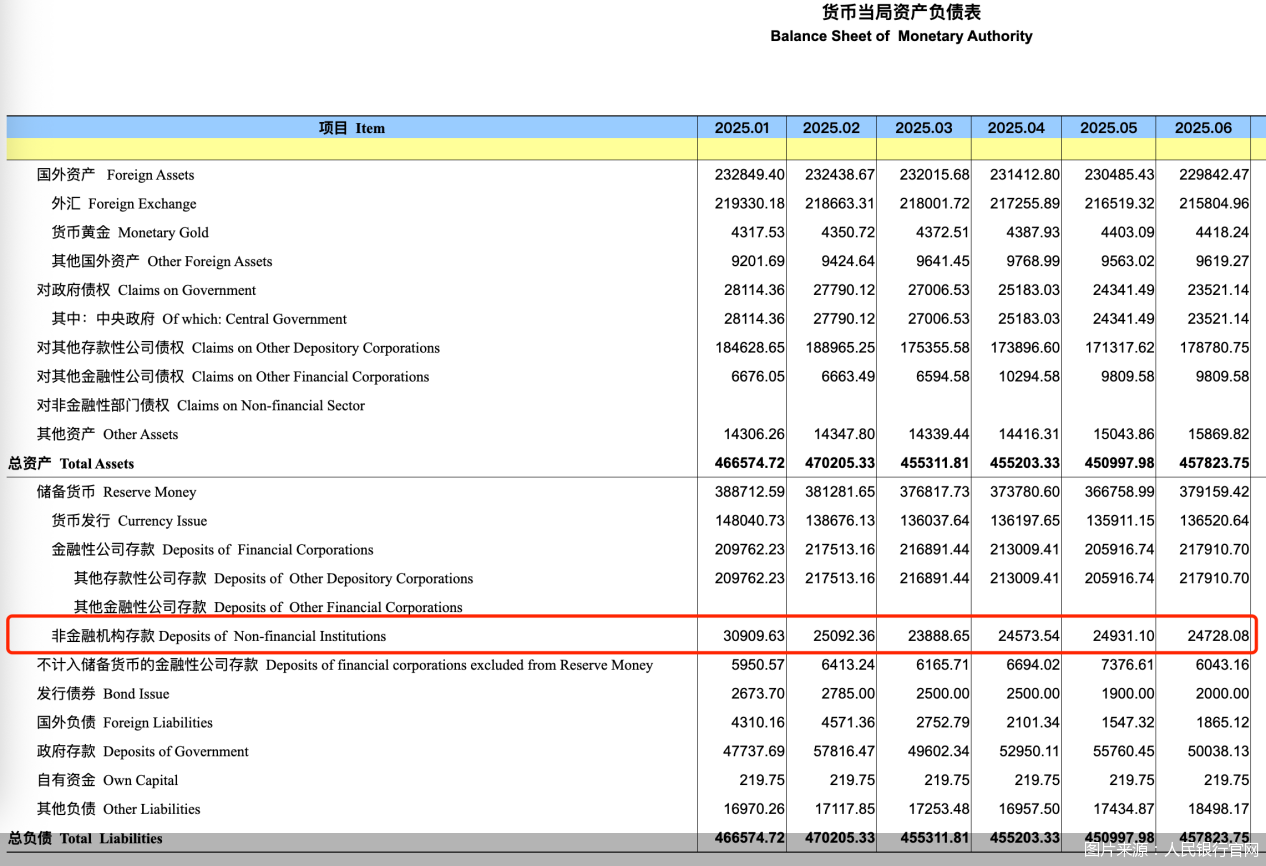
Core Viewpoint - The People's Bank of China has released the latest asset-liability statement, indicating a rise in non-financial institution deposits (payment institution reserve funds) to 24,573.54 billion yuan as of April 2025, up by 684.89 billion yuan from March 2025 [1] Group 1: Payment Institution Reserve Funds - As of January 2025, payment institution reserve funds exceeded 30,000 billion yuan, reaching a historical high of 30,909.63 billion yuan, but subsequently fell below 24,000 billion yuan in February and March before rebounding in April and May [2][3] - The current scale of payment institution reserve funds is maintained around 25,000 billion yuan, reflecting a cyclical fluctuation influenced by consumer demand and financial management needs [3][7] Group 2: Regulatory Environment - Since 2017, payment institutions have been required to implement centralized custody of customer reserve funds, with a 100% deposit requirement established from January 14, 2019 [3] - Recent penalties have been imposed on payment institutions for violations related to reserve fund management, highlighting ongoing regulatory scrutiny [4][6] Group 3: Market Dynamics - The number of licensed payment institutions has decreased, with 101 licenses revoked, leaving only 170 licensed institutions in the market, indicating a process of industry consolidation [4][7] - Despite the reduction in the number of institutions, the impact on reserve fund fluctuations is expected to be minimal, as over 90% of the reserve funds are concentrated in leading payment institutions [7]
三大股指,集体收涨
第一财经· 2025-05-29 08:15
Core Viewpoint - A-shares experienced a collective rise on May 29, with the Shanghai Composite Index closing at 3363.45 points, up 0.7%, and the Shenzhen Component Index and ChiNext Index also showing significant gains [1]. Market Performance - The sectors showing strong performance included cross-border payments, software development, medical services, digital currency, and Hongmeng concept stocks, while precious metals, glyphosate, and beauty care sectors declined [3]. - Specific sector performance included: - Electronic ID: +5.62% with a main capital inflow of 11.12 million - Cross-border payments (CIPS): +5.33% with a main capital inflow of 39.88 million - Software development: +4.48% with a main capital inflow of 31.08 million - Precious metals: -1.78% with a main capital outflow of 3.36 million [4]. Fund Flow - Main capital saw a net inflow into sectors such as computers, electronics, and automobiles, while there was a net outflow from banking and oil sectors [6]. - Notable individual stocks with net inflows included: - Shanzi Gaoke: 706 million - Sifang Jingchuang: 658 million - Zhongchao Holdings: 581 million - Stocks experiencing net outflows included: - Rongfa Nuclear Power: 732 million - Xuren Shares: 511 million - BYD: 396 million [6]. Institutional Insights - Everbright Securities noted that both internal and external factors contributed to improved sentiment in A-shares [8]. - Caitong Securities highlighted that the external environment has improved, allowing A-shares to realize potential benefits, with a focus on changes in trading volume being crucial for future market performance [8]. - CITIC Securities observed that the index rebounded at the 60-day moving average after a correction, with potential to challenge the 3400-point mark, particularly in growth sectors like autonomous driving and controllable nuclear fusion [8].
红薯厂面对收购谈判,一句灵魂拷问让对方变弱势方;某厂想退回一大厂的钱,结果还不起了;某大厂或布局线下支付丨鲸犀情报局Vol.11
雷峰网· 2025-05-29 00:20
Group 1 - Company A's owner, referred to as甲, initially rejected investment from prominent figures in the industry, opting instead for funding from乙, who later became a competitor [1] -乙's company, B, has been demanding data from A and has started competing in the e-commerce space, leading甲 to regret the investment and consider repaying it, although he currently cannot [1] Group 2 - B's e-commerce business has reportedly reached a top three scale within the industry, but the company is not satisfied with its growth rate [2] - To maintain growth, B has increased the proportion of e-commerce traffic, resulting in a rebound in growth rates, although this approach may negatively impact user experience [2] Group 3 - B attempted to acquire another company, referred to as the sweet potato factory, but the negotiation dynamics shifted unexpectedly, with the sweet potato factory's founder taking a dominant role in discussions [5] - The sweet potato factory's founder posed a challenging question to B's executives, causing them to falter in the negotiation [5] Group 4 - Company D has faced management turnover after hiring several executives from competitor E, with reports indicating that multiple hires have already left due to cultural misalignment [6][8] - D's historical strategies, such as aggressive pricing during the book war, highlight its competitive approach in the market [9][10] Group 5 - Company E is reportedly planning to enter the offline payment sector, potentially resolving licensing issues within the year [12] - E's transition from a content platform to e-commerce and now to payment services appears to be a strategic evolution [12] Group 6 - Company F has rapidly integrated Deepseek into its operations, benefiting from a significant investment in GPU computing power, including a multi-billion dollar order from NVIDIA [13][14] - F and E are noted to be among the companies with the largest GPU reserves in China [14] Group 7 - Company G is speculated to be preparing to enter the payment sector, having previously recruited payment product managers and poached employees from F's payment department [16][18] - G's interest in payment infrastructure aligns with its recent e-commerce initiatives [16] Group 8 - Company H has gained a substantial market share in Brazil, although there are concerns about the profitability of its operations in the region [19][20] - H's competitive position in the Americas has led to the loss of market share in other areas, raising questions about its overall financial performance [19][20]
“支付宝碰一下”生态持续扩大 产业链公司有望受益
Core Insights - "Alipay Tap" is expanding as a convenient payment method, with Pizza Hut launching the feature in over 300 stores in Shanghai and Hangzhou, enhancing customer engagement and satisfaction [1] - The feature has gained over 100 million users within 321 days of its launch, covering more than 400 cities and involving millions of merchants [1][2] - The technology behind "Alipay Tap" utilizes NFC (Near Field Communication), simplifying transactions and enhancing the payment experience by allowing users to complete payments without opening the app [2] Industry Trends - Experts predict that more businesses will adopt smart solutions like "Alipay Tap," making it a standard in the restaurant industry, with potential extensions into self-checkout and personalized recommendations as technology advances [2] - The China Council for the Promotion of International Trade indicates that payment innovations like "Alipay Tap" are crucial for consumer recovery, broadening consumption scenarios and enhancing payment convenience [2] Company Insights - Key suppliers for "Alipay Tap" include Lens Technology, Orbbec, and Fudan Microelectronics, with Fudan Microelectronics providing high-performance NFC chips [3] - Companies like Goodix Technology supply NFC/eSE chips to smartphone manufacturers, with over 200 million NFC-enabled smartphones shipped in China in 2024, driving demand for smart card modules [3] - Analysts believe that the NFC industry, represented by "Alipay Tap," is on an upward trajectory in China, with significant growth potential for related companies as the payment method becomes more widespread [3]
倒计时3天!金鼎奖·金融助力消费优秀案例评选火热进行中
Xin Lang Cai Jing· 2025-05-28 02:38
Group 1 - The "Jinding Award · Financial Support for Consumption Excellent Case Collection" activity is nearing its end, with only 3 days left for submissions [1] - The collection targets various financial institutions including banks, insurance companies, consumer finance companies, and payment institutions [1] - Categories for submission include innovative consumption scenarios, payment facilitation, consumer credit innovation, government-business collaboration, and green consumption promotion [1][2] Group 2 - Evaluation criteria for submissions include innovation, overall effectiveness, sustainability, and risk control [2] - The collection period is from now until May 30, 2025, with submissions to be sent to a specified email address [3] - The evaluation process involves expert review based on defined criteria, and awarded cases will be promoted through various media channels [3]
支付:打造技术与场景的协同
Bei Jing Shang Bao· 2025-05-27 13:39
Core Insights - Consumption is one of the key drivers of economic growth, with "boosting consumption" being a top priority in the government's work report for 2025 [1] - The payment industry plays a crucial role in facilitating consumption through technological innovation, scene embedding, and ecosystem construction [1] Payment Industry Overview - The payment industry is a primary battleground for promoting consumption, with 170 licensed payment institutions in China offering various services such as internet payments and prepaid card issuance [3] - Payment platforms enhance consumer engagement by improving transaction efficiency and offering exclusive discounts through partnerships with e-commerce and retail sectors [3][4] Government Initiatives and Consumer Engagement - Alipay has been a key platform for distributing government consumption vouchers in various regions, significantly boosting retail and dining consumption [3] - During the 2025 May Day holiday, UnionPay and Wanglian processed 23.439 billion transactions worth 7.64 trillion yuan, with overseas transactions increasing by 244.86% in volume and 128.04% in value compared to the previous year [4] Technological Innovations - Payment innovations, such as the introduction of "Alipay Tap," have significantly improved user experience, especially for vulnerable groups, reducing transaction times dramatically [5] - The digital yuan has expanded its usage and transaction scale, with 1.8 billion personal wallets opened and a total transaction amount of 7.3 trillion yuan by July 2024 [5][6] Market Trends and Future Outlook - The third-party payment industry in China continues to grow, with electronic payment transactions reaching 700.54 billion in volume and 85.146 trillion yuan in value in Q1 2024 [7] - Payment institutions are planning various initiatives to enhance payment convenience and support merchant operations, including fee waivers for international card transactions [7][8] Cross-Industry Collaboration - Companies are increasingly focusing on vertical scene development and integrating new technologies like AI into payment services [9] - The payment industry is expected to see more cross-industry collaborations, particularly in data utilization and ecosystem building [8][9]
未按规定采取有效风控措施!融宝支付又收罚单,此前因多项违规遭央行处罚
Sou Hu Cai Jing· 2025-05-27 02:13
Group 1 - The People's Bank of China (PBOC) imposed a fine of 130,000 yuan on Tianjin Rongbao Payment Network Co., Ltd. for failing to properly safeguard relevant materials and implement effective risk control measures [1] - Rongbao Payment, established in February 2011 and licensed for payment business in June 2012, focuses on internet and mobile phone payments, serving over 1,500 merchants across various sectors including e-commerce, logistics, and finance [1] - The company has expanded its capabilities, obtaining a Hong Kong MSO license in 2024 to enhance its cross-border payment services [2] Group 2 - In December 2023, Rongbao Payment faced a warning from the central bank and was fined 3.6156 million yuan for multiple violations, including account management and customer identity verification failures [2]