油气开采

Search documents
突破“渗透性—选择性”瓶颈新型纳滤膜实现盐湖镁锂高效分离
Zhong Guo Hua Gong Bao· 2025-09-29 03:51
Core Viewpoint - Lithium is a critical raw material for electric vehicle batteries, and China has abundant lithium resources, primarily found in salt lake brine. However, separating magnesium and lithium ions in high magnesium-lithium ratio brine is challenging due to the limitations of traditional polyamide nanofiltration membranes. A new interface polymerization strategy proposed by a research team from China University of Petroleum (East China) aims to enhance the separation efficiency of magnesium and lithium ions in such environments [1][2][3][4]. Group 1: Challenges with Traditional Nanofiltration Membranes - Traditional polyamide nanofiltration membranes face a trade-off between permeability and selectivity, making it difficult to achieve both high water flux and high lithium purity simultaneously [2]. - In high-salinity environments, such as those found in China's salt lake brine, the limitations of traditional membranes become more pronounced, necessitating significant freshwater dilution, which increases costs and complicates implementation in water-scarce regions [2]. Group 2: Innovative Interface Polymerization Strategy - The research team has developed an innovative interface polymerization strategy that allows for staged control of the reaction behavior of dual aqueous phase monomers, leading to precise regulation of membrane structure and improved separation performance [3]. - This new approach breaks away from the traditional use of a single aqueous phase monomer, enabling the construction of membranes tailored for specific separation needs, akin to assembling a "molecular sieve" wall with various functional components [3]. Group 3: Application Prospects and Industrial Transition - The new nanofiltration membrane technology holds promise for ensuring the security of national lithium resources, particularly in the context of the lithium supply chain for electric vehicles [4]. - The membrane's high permeability and selectivity can significantly reduce energy consumption, enhance processing capacity, and minimize equipment footprint and initial investment, while also streamlining the overall process and reducing operational costs [4]. - The technology is currently transitioning from laboratory to industrial application, with successful development of a new nanofiltration membrane capable of efficiently removing divalent cations from high-salinity solutions, addressing common issues in industrial water treatment [5].
中国海油9月26日获融资买入4369.65万元,融资余额14.06亿元
Xin Lang Cai Jing· 2025-09-29 03:24
9月26日,中国海油跌0.38%,成交额5.89亿元。两融数据显示,当日中国海油获融资买入额4369.65万 元,融资偿还6877.85万元,融资净买入-2508.20万元。截至9月26日,中国海油融资融券余额合计14.16 亿元。 融资方面,中国海油当日融资买入4369.65万元。当前融资余额14.06亿元,占流通市值的1.78%,融资 余额低于近一年10%分位水平,处于低位。 融券方面,中国海油9月26日融券偿还3800.00股,融券卖出2.81万股,按当日收盘价计算,卖出金额 74.47万元;融券余量36.42万股,融券余额965.13万元,低于近一年40%分位水平,处于较低位。 来源:新浪证券-红岸工作室 资料显示,中国海洋石油有限公司位于北京市东城区朝阳门北大街25号,香港花园道1号中银大厦65层, 成立日期1999年8月20日,上市日期2022年4月21日,公司主营业务涉及中国海洋石油有限公司是一家主 要从事原油和天然气的勘探、生产及销售的中国公司。该公司经营三个分部。勘探及生产分部从事常规 油气业务、页己油气业务、油砂业务和其他非常规油气业务。贸易业务分部从事原油转口贸易业务。公 司业务分部从事 ...

中国石油75载书写能源报国使命担当
Zhong Guo Hua Gong Bao· 2025-09-29 02:34
Core Viewpoint - China National Petroleum Corporation (CNPC) celebrates its 75th anniversary, marking significant historical achievements and a strategic transformation towards becoming a comprehensive international energy and chemical enterprise focused on "oil, gas, heat, electricity, and hydrogen" [1][2]. Group 1: Historical Milestones - CNPC's journey began in 1978 when China's crude oil production exceeded 100 million tons, positioning the country among the world's leading oil producers [1]. - The establishment of China National Petroleum and Natural Gas Corporation in 1988 marked a critical step towards modern enterprise systems [1]. - In 1998, CNPC was officially formed in response to national strategic restructuring [1]. Group 2: Current Operations and Achievements - CNPC has established a new supply structure with a production equivalent of 100 million tons each for domestic crude oil, domestic natural gas, and overseas oil and gas rights [2]. - The company has completed significant refining projects, including the Guangdong Petrochemical and Tarim ethane-to-ethylene projects, achieving an ethylene production capacity of over 10 million tons per year [2]. - CNPC operates nearly 20,000 gas stations nationwide, providing reliable support for economic operations and public needs [2]. Group 3: Green Transition and Innovation - The company is advancing its green and low-carbon transition by integrating renewable energy into its main business, with a three-step strategy of "clean replacement, strategic replacement, and green transition" [2]. - By 2024, CNPC's renewable energy development and utilization capacity is expected to account for 7% of its domestic energy supply [2]. - CNPC is enhancing its role as a national strategic technology force, achieving breakthroughs in deep oil and gas exploration technology and high-end chemical materials [2]. Group 4: Social Responsibility - CNPC actively participates in disaster relief, poverty alleviation, and rural revitalization efforts, demonstrating its commitment to social responsibility [3]. - The company has also provided support for major international events such as the Beijing Winter Olympics and Chengdu Universiade [3].

中曼石油拟全控昕华夏迪拜 海外版图扩张总资产达124.8亿
Chang Jiang Shang Bao· 2025-09-28 23:06
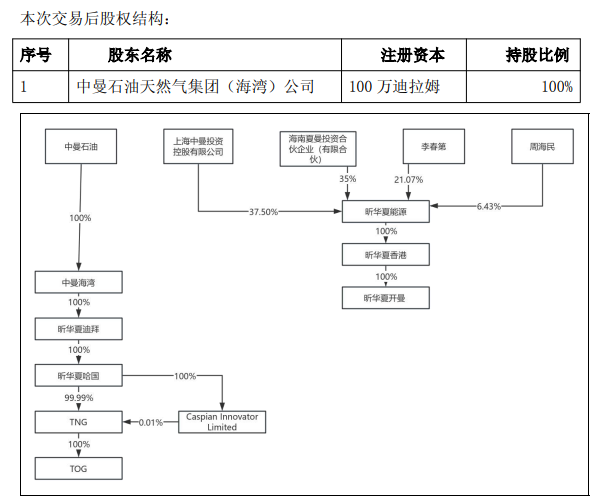
Core Viewpoint - Zhongman Petroleum (603619.SH) is initiating a significant acquisition plan to enhance its oil and gas resource volume and production rights by acquiring a 49% stake in Rising Energy International Middle East FZCO (referred to as "Xinhua Dubai") for 563 million yuan [1][2]. Group 1: Acquisition Details - The acquisition will allow Zhongman Petroleum's wholly-owned subsidiary, Zhongman Haiwan, to increase its ownership in Xinhua Dubai from 51% to 100%, thereby gaining full control over the key oil and gas assets in the Kengey block in Kazakhstan [2][3]. - The transaction is classified as a related party transaction, as the ultimate controlling party of the target is Li Chundi, the actual controller of Zhongman Petroleum [2][3]. - The Kengey block has a geological oil reserve of 64.41 million tons and an economically recoverable oil reserve of 5.9753 million tons, with natural gas reserves of 21.8 billion cubic meters, although gas extraction requires approval from Kazakhstan's energy department [3]. Group 2: Financial Performance - Zhongman Petroleum's total assets reached 12.48 billion yuan as of June 30, 2025, marking a 27.3% increase from the previous year, achieving a historical high [1][5]. - The company's revenue for 2022, 2023, and 2024 was 3.199 billion yuan, 3.732 billion yuan, and 4.135 billion yuan, reflecting growth rates of 81.56%, 16.67%, and 10.79% respectively [4]. - In the first half of 2025, the company reported a revenue of 1.981 billion yuan, a year-on-year increase of 3.29%, while net profit decreased by 29.81% to 300 million yuan [4][5]. Group 3: Business Expansion - Zhongman Petroleum has established a business model of "domestic foundation and overseas breakthroughs," with significant projects in both domestic and international markets [5]. - The company’s exploration and development segment generated 1.094 billion yuan in revenue, accounting for 55.22% of total revenue in the first half of 2025 [5]. - The company is actively expanding its overseas operations, with successful projects in Iraq, Kazakhstan, and Algeria, contributing to its growing international footprint [5].

新华社消息丨我国海底油气管道总长度突破10000公里
Xin Hua Wang· 2025-09-28 11:59
Core Viewpoint - The article discusses the recent developments in the financial sector, highlighting the impact of regulatory changes and market trends on investment opportunities and risks [1]. Group 1: Regulatory Changes - New regulations are being implemented that could significantly alter the landscape for investment banks, potentially increasing compliance costs and operational challenges [1]. - The regulatory environment is becoming more stringent, which may lead to a consolidation of smaller firms as they struggle to meet new requirements [1]. Group 2: Market Trends - There is a noticeable shift in investor sentiment towards sustainable and responsible investing, which is influencing the strategies of major financial institutions [1]. - Recent market volatility has prompted a reevaluation of risk management practices within investment banks, leading to a more cautious approach in deal-making [1]. Group 3: Financial Performance - Financial results from major banks indicate a mixed performance, with some reporting increased revenues while others face declining profits due to rising operational costs [1]. - The overall profitability of the sector is under pressure, with analysts predicting a challenging environment ahead as economic uncertainties persist [1].
中国最大的省,又升级了
虎嗅APP· 2025-09-26 14:56
Core Viewpoint - Xinjiang, as China's largest province by land area, is being positioned as a crucial hub for the Silk Road Economic Belt, enhancing its role in domestic and international dual circulation [5][30]. Economic Growth - Xinjiang's GDP has surged from 900 billion to over 2 trillion, with an average annual growth rate of 7% over the past decade, placing it in the first tier of economic growth [9][11]. - The province's foreign trade has seen significant growth, with imports and exports reaching 356.3 billion yuan from January to August this year, a year-on-year increase of 25.4%, surpassing provinces like Hunan and Shaanxi [13][15]. Key Economic Drivers - The three main factors driving Xinjiang's economic rise are: 1. **Foreign Trade**: Benefiting from geopolitical shifts, Xinjiang has become a major player in foreign trade, with a notable increase in trade volume over the past three years [12][15]. 2. **Energy Resources**: Xinjiang is a key area for energy production, leading the nation in oil and gas output, and ranking high in coal and renewable energy installations [17][18]. 3. **Agricultural Development**: The province has transformed into a significant agricultural hub, with a projected grain output of 46.6 billion jin in 2024, ranking 13th nationally, and achieving the highest grain yield per mu [20]. Strategic Positioning - Xinjiang is being redefined as a strategic point for national security and economic development, with five strategic roles outlined in the new planning: a gateway for Eurasian trade, a strategic support point for new development patterns, a national energy resource base, a key supplier of high-quality agricultural products, and a strategic security barrier [30][31]. Infrastructure Development - Major infrastructure projects are underway, including the new Tibet-Xinjiang railway and the Duku Highway, which will enhance connectivity and economic integration [32][38]. - Xinjiang is also expanding its airport network, with plans for 33 new civil airports, significantly increasing its transportation capacity [39][42].


油气开采板块9月26日涨0.23%,*ST新潮领涨,主力资金净流入2122.55万元
Zheng Xing Xing Ye Ri Bao· 2025-09-26 08:48
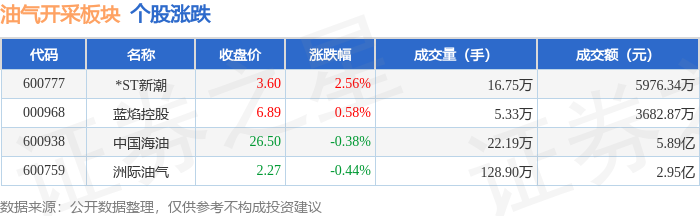
Group 1 - The oil and gas extraction sector increased by 0.23% compared to the previous trading day, with *ST Xinchao leading the gains [1] - On the same day, the Shanghai Composite Index closed at 3828.11, down 0.65%, while the Shenzhen Component Index closed at 13209.0, down 1.76% [1] - The closing prices and performance of key stocks in the oil and gas extraction sector are as follows: *ST Xinchao at 3.60 with a rise of 2.56%, Blue Flame Holdings at 6.89 with a rise of 0.58%, Yao Tu Chu at 26.50 with a decline of 0.38%, and Intercontinental Oil and Gas at 2.27 with a decline of 0.44% [1] Group 2 - The net inflow of main funds in the oil and gas extraction sector was 21.2255 million yuan, while retail investors experienced a net outflow of 33.945 million yuan [2] - The net inflow from speculative funds was 12.7195 million yuan [2]


气田采出水制氢研究项目签约
Zhong Guo Hua Gong Bao· 2025-09-26 02:58
Core Viewpoint - The collaboration between Dongfang Electric (Fujian) Innovation Research Institute and PetroChina Changqing Oilfield Research Institute marks a significant advancement in the field of hydrogen production from produced water in gas fields [1] Group 1: Project Overview - The project focuses on the research and demonstration of hydrogen production technology from produced water, addressing the complex composition and high treatment costs associated with over 3 million tons of produced water generated annually by Changqing Oilfield [1] - The collaboration aims to validate the stability and economic viability of the hydrogen production technology under scaled conditions, which is crucial for the integration of hydrogen energy with green and low-carbon development in oil and gas fields [1] Group 2: Technological Achievements - In May 2024, the research institute successfully expanded the seawater direct electrolysis hydrogen production technology to industrial wastewater, completing a field test in the Sulige gas field that operated stably for 330 hours [1] - The test achieved direct electrolysis of various types of produced water without purification, overcoming technical challenges and receiving certification from a third-party organization, establishing a leading position in the domestic market [1] Group 3: Future Implications - Successful implementation of the project will provide a key technological foundation for the integration of renewable energy consumption, wastewater utilization, and low-carbon transformation in China's oil and gas production areas [1]
反内卷在年内如何落地?
2025-09-26 02:28
Summary of Conference Call Records Industry or Company Involved - The conference call discusses the **反内卷 (anti-involution) policy** in the context of the **Chinese economy** for the year **2025**. Core Points and Arguments 1. **Policy Focus and Tools**: The 2025 anti-involution policy emphasizes technical implementation, with ministries primarily using supply-side tools to stabilize prices, such as the Ministry of Industry and Information Technology (工信部) and the National Development and Reform Commission (发改委) stabilizing PPI (Producer Price Index) and CPI (Consumer Price Index) [1][2][4] 2. **Three Main Goals**: The policy has three main objectives: - Stabilize PPI year-on-year growth to prevent worsening corporate debt risks - Maintain positive year-on-year growth in CPI - Optimize the structure of emerging industries [4][12] 3. **Constraints on Policy Implementation**: The implementation of policies is constrained by two main factors: the lack of demand-side interventions and the relatively loose macroeconomic environment in China [5][16] 4. **Impact of Electricity Prices**: An increase in electricity prices by 10% can lead to a 1.9% increase in overall PPI, indicating that electricity prices are a significant driver of PPI [8][10] 5. **Industry Selection for Price Stabilization**: When selecting industries for price stabilization, factors such as industry price elasticity and their ability to influence PPI are crucial. Six key industries (coal mining, oil and gas extraction, energy refining, chemicals, steel, and non-ferrous metals) are identified as having significant influence [9][10] 6. **Challenges in Emerging Industry Capacity Governance**: Governance of emerging industries faces challenges such as coordination difficulties and the need for comprehensive efforts across various departments [15][17] 7. **Future Expectations**: The implementation of the anti-involution policy is expected to focus on price stabilization and capacity governance, with a gradual improvement in corporate profitability anticipated as macroeconomic reforms take effect [16][17][18] Other Important but Possibly Overlooked Content 1. **CPI Stability**: The stability of CPI is heavily reliant on stabilizing pork prices, with current strategies focusing on long-term price stabilization rather than immediate measures [12][14] 2. **PPI and CPI Growth Rates**: Current PPI and CPI growth rates are influenced by low base effects, with core CPI targets showing stability but some sub-items deviating from expected trends [13][14] 3. **Political Will and Policy Tools**: The effectiveness of PPI stabilization is not only dependent on technical measures but also on political will, with current policy efforts being more focused on price control rather than quantity control [11][16]
溢价98.5%!中曼石油拟斥5.6亿元收购实控人旗下油气资产
Mei Ri Jing Ji Xin Wen· 2025-09-25 15:49
Core Viewpoint - The company Zhongman Petroleum plans to acquire a 49% stake in Rising Energy International Middle East FZCO for approximately 560 million RMB, aiming for full ownership of the company and its oil and gas assets in Kazakhstan [1][4][3]. Group 1: Acquisition Details - Zhongman Petroleum's wholly-owned subsidiary, Zhongman Haibay, will purchase the 49% stake from China Rising Energy International (Cayman) Co., Limited for 79.3183 million USD, equivalent to about 560 million RMB [4][6]. - Prior to the acquisition, Zhongman Haibay already held a 51% stake in Rising Energy, making it the controlling shareholder [6]. - The transaction is classified as a related party transaction due to the ownership structure, with the ultimate controlling party being Li Chundi, the actual controller of Zhongman Petroleum [2][7]. Group 2: Financial Implications - The independent directors of Zhongman Petroleum believe that the acquisition will enhance the company's oil and gas resource reserves, increase production, and ultimately improve financial performance [8]. - The valuation report indicates that the total equity value of Rising Energy is approximately 1.149 billion RMB, with a book value of 579 million RMB, resulting in a valuation increase of 570 million RMB, representing a 98.54% premium [10][11]. - The increase in value is primarily attributed to long-term equity investments, which saw a valuation rise from 392 million RMB to 963 million RMB, reflecting a 145.41% increase [11]. Group 3: Asset Overview - The project in question, the Jange oil and gas field, is located in southwestern Kazakhstan and is characterized as a medium-sized oil and gas field with developed surrounding infrastructure [12]. - According to a third-party assessment, the Jange oil field has a 2P (Proven and Probable) geological oil reserve of 64.41 million tons, with an economically recoverable reserve of 5.9753 million tons [12].