装备制造

Search documents
兖矿能源并购高端支架公司100%股权 破解同业竞争减少关联交易
Zheng Quan Shi Bao Wang· 2025-11-27 10:55
Core Viewpoint - Yanzhou Coal Mining Company plans to acquire 100% equity of Shandong Energy Equipment Group High-end Support Manufacturing Co., Ltd. for 345 million yuan, which is an associated transaction with its controlling shareholder, Shandong Energy Group [1][2] Group 1: Transaction Details - The acquisition price for the high-end support company is 345 million yuan [1] - The high-end support company was established in 2022 and specializes in manufacturing mining machinery and various equipment [1] - The high-end support company reported revenues of 551 million yuan and 544 million yuan for 2024 and January to September 2025, respectively, with net profits of 13.36 million yuan and 271,200 yuan [1] Group 2: Strategic Implications - The transaction aims to eliminate competition between Yanzhou Coal and the high-end support company, enhancing the integration of the equipment manufacturing sector [2] - It is expected to accelerate the intelligent construction of coal mines, supporting safe and efficient mining operations [2] - The acquisition will reduce related party transactions and lower procurement costs, maximizing overall efficiency [2]

中国首批领航级智能工厂集体亮相
Zhong Guo Xin Wen Wang· 2025-11-27 10:01
Core Insights - The first batch of 15 leading smart factories in China was unveiled at the World Intelligent Manufacturing Conference, marking a significant leap from digitalization and networking to intelligence in manufacturing [1][2] - These leading smart factories represent the highest level of the smart factory cultivation system and are distributed across key industries such as equipment manufacturing, raw materials, electronic information, and consumer goods [1] Industry Development - Since the launch of the smart factory cultivation initiative by six departments including the Ministry of Industry and Information Technology, over 7,000 advanced smart factories and more than 500 excellent smart factories have been established in China [1] - The newly established 15 leading smart factories are expected to lead a comprehensive transformation in innovation paradigms, production methods, and supply chain forms [1] Company Highlights - Notable achievements from the selected leading smart factories include: - XCMG improved global customization capabilities through AI-driven R&D and manufacturing, reducing order delivery cycles by 55% [2] - SAIC-GM-Wuling pioneered a new smart island manufacturing model, achieving a comprehensive equipment utilization rate of 98.8% [2] - Baosteel enhanced the efficiency of the entire process of silicon steel through AI-driven predictive manufacturing, resulting in a more than 50% reduction in finished product inventory [2] - Yangtze Optical Fibre constructed an integrated process system for rods and cables, shortening product development cycles from 12 months to 3 months [2] - The "Leading Action Plan" aims to deepen collaborative efforts and create world-class benchmark factories, contributing Chinese solutions and wisdom to global smart manufacturing development [2]
兖矿能源附属公司拟收购山能装备高端支架公司100%股权
Zhi Tong Cai Jing· 2025-11-27 09:43
Core Viewpoint - Yanzhou Coal Mining Company Limited (兖矿能源) plans to acquire 100% equity of Shandong Energy Equipment Group High-end Support Manufacturing Co., Ltd. for an estimated value of 345 million yuan, which will enhance its integration in the equipment manufacturing sector and promote the intelligent construction of coal mines [1] Group 1 - The acquisition is aimed at resolving industry competition issues [1] - The transaction will accelerate the integration layout of the equipment manufacturing industry [1] - The deal is expected to support the advancement of intelligent construction processes in coal mining [1]
兖矿能源(600188.SH)附属公司拟收购山能装备高端支架公司100%股权
智通财经网· 2025-11-27 09:40
Core Viewpoint - Yanzhou Coal Mining Company Limited plans to acquire 100% equity of Shandong Energy Equipment Group High-end Support Manufacturing Co., Ltd. for an assessed value of 345 million yuan, which will help eliminate industry competition and accelerate the integration of the equipment manufacturing sector, promoting the intelligent construction of coal mines [1] Group 1 - Yanzhou Coal's wholly-owned subsidiary, Yanzhou Donghua Heavy Industry Co., Ltd., is the entity making the acquisition [1] - The acquisition is aimed at resolving competition within the same industry [1] - The transaction is expected to enhance the integration layout of the equipment manufacturing industry [1] Group 2 - The deal will support the advancement of intelligent construction processes in coal mining [1]
我国首批,国家级名单公布,2家能源企业上榜!
中国能源报· 2025-11-27 09:36
Core Points - The first batch of leading intelligent factories in China has been officially announced, marking a significant leap towards intelligent manufacturing [1] - A total of 15 leading intelligent factories have been recognized, covering key industries such as equipment manufacturing, raw materials, electronic information, and consumer goods [1] - The Ministry of Industry and Information Technology stated that these factories integrate new-generation information technology, advanced manufacturing technology, and lean management concepts, representing the highest standards of intelligent manufacturing in China [1] Group 1 - The list of intelligent factories includes notable companies such as China Petroleum & Chemical Corporation and CNOOC (China National Offshore Oil Corporation) [1] - The 2025 cultivation list for leading intelligent factories features projects from various companies, including Baoshan Iron & Steel Co., Ltd. and Shanghai Aerospace Equipment Manufacturing Co., Ltd. [2] - The projects focus on advanced manufacturing techniques, such as high-end green silicon steel production and agile delivery of mobile cranes [2] Group 2 - Recent data indicates that over 7,000 advanced intelligent factories have been established in China [3] - Upgrades to hundreds of intelligent factories have resulted in an average reduction of product development cycles by 29%, an increase in production efficiency by nearly 22%, and a decrease in carbon emissions by approximately 20% [3]





打造智能制造“升级版” AI赋能汽车全产业链 生产线“变身”智造岛
Yang Shi Wang· 2025-11-27 08:29
Core Viewpoint - The Ministry of Industry and Information Technology, along with five other departments, has officially announced the first batch of 15 leading intelligent factories in China, which represent the highest standards of intelligent manufacturing in the country and are expected to drive the transformation and upgrading of the entire manufacturing sector [1][4]. Group 1: Overview of Leading Intelligent Factories - The first batch of 15 leading intelligent factories spans key industries such as equipment manufacturing, raw materials, electronic information, and consumer goods, covering China's advantageous sectors and strategic emerging industries [4]. - These intelligent factories integrate new-generation information technology, advanced manufacturing technology, and lean management concepts, representing the pinnacle of intelligent manufacturing in China [4]. Group 2: Innovative Manufacturing Models - The leading intelligent factories are exploring future manufacturing models around different aspects such as research and development, production, management, and services, leading to the formation of new models like shared manufacturing, extreme manufacturing, and island manufacturing [6]. Group 3: Case Study of Intelligent Vehicle Manufacturing - An intelligent vehicle manufacturing company in Liuzhou, Guangxi, has transformed its traditional assembly line into intelligent manufacturing islands, allowing for flexible production line reconfiguration based on demand [7][10]. - The company has implemented a layout with three major island groups and 16 process islands, enabling a modular approach to vehicle assembly [9]. Group 4: Efficiency Improvements - The company has achieved a full-process intelligent transformation using big data and AI, reducing the product development cycle from 420 days to 240 days and the product introduction cycle from 40 days to 15 days, while improving manufacturing efficiency by 30% and reducing vehicle body workshop changeover time by 67% [15]. Group 5: Future Development Initiatives - Starting in 2024, the Ministry of Industry and Information Technology and six other departments will launch a gradient cultivation action for intelligent factories, establishing a four-level cultivation system (basic, advanced, excellent, and leading) to explore future manufacturing models and create global benchmarks [17]. - Currently, China has over 7,000 advanced intelligent factories, with hundreds of factories reporting an average reduction of 29% in product development cycles, a nearly 22% increase in production efficiency, and a 20% reduction in carbon emissions after upgrades [19].
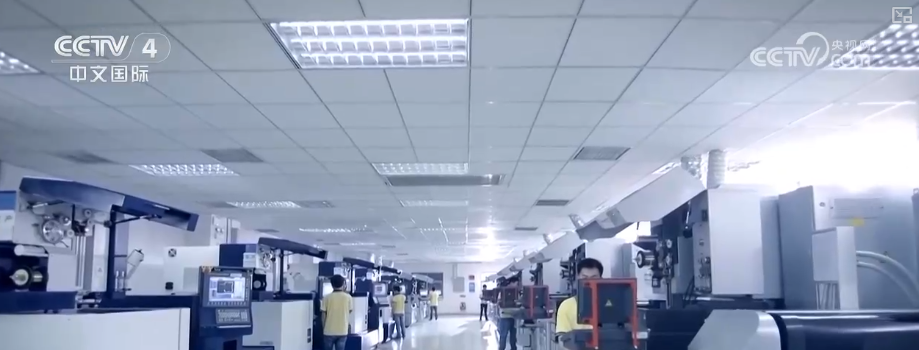
视频|涵盖装备制造等关键行业 我国首批15家领航级智能工厂名单公布
Yang Shi Xin Wen Ke Hu Duan· 2025-11-27 07:19
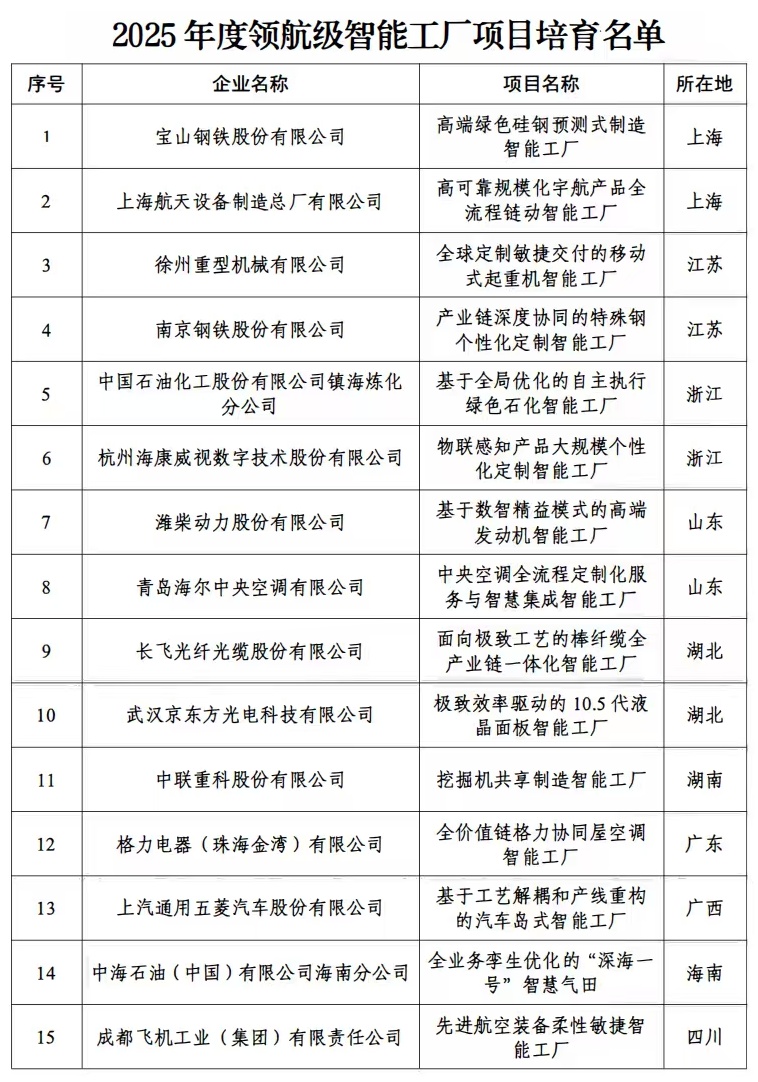
Core Insights - The Ministry of Industry and Information Technology, along with five other departments, has officially announced the first batch of leading intelligent factories in China, marking a significant transition from digitalization and networking to intelligence in manufacturing [2] Group 1: Intelligent Factory Announcement - A total of 15 leading intelligent factories have been recognized, spanning key industries such as equipment manufacturing, raw materials, electronic information, and consumer goods [2] - These intelligent factories integrate new-generation information technology, advanced manufacturing technology, and lean management concepts, representing the highest standards of intelligent manufacturing in China [2] Group 2: List of Recognized Factories - The recognized factories include: - Baoshan Iron & Steel Co., Ltd. - High-end green silicon steel predictive manufacturing intelligent factory, Shanghai - Shanghai Aerospace Equipment Manufacturing Co., Ltd. - High-reliability large-scale aerospace product full-process intelligent factory, Shanghai - Xuzhou Heavy Machinery Co., Ltd. - Global customized agile delivery mobile crane intelligent factory, Jiangsu - Nanjing Steel Co., Ltd. - Deeply collaborative special steel personalized customization intelligent factory, Jiangsu - Sinopec Zhenhai Refining & Chemical Company - Self-executing green petrochemical intelligent factory based on global optimization, Zhejiang - Hikvision Digital Technology Co., Ltd. - Large-scale personalized customization intelligent factory for IoT perception products, Zhejiang - Weichai Power Co., Ltd. - High-end engine intelligent factory based on digital and lean models, Shandong - Qingdao Haier Central Air Conditioning Co., Ltd. - Central air conditioning full-process customized service and smart integration intelligent factory, Shandong - Yangtze Optical Fibre and Cable Joint Stock Limited Company - Integrated intelligent factory for extreme process rod and cable, Hubei - Wuhan BOE Optoelectronics Technology Co., Ltd. - 10.5 generation liquid crystal panel intelligent factory driven by extreme efficiency, Hubei - Zoomlion Heavy Industry Science and Technology Co., Ltd. - Excavator shared manufacturing intelligent factory, Hunan - Gree Electric Appliances (Zhuhai Jinwan) Co., Ltd. - Full value chain collaborative air conditioning intelligent factory, Guangdong - SAIC-GM-Wuling Automobile Co., Ltd. - Automotive island-style intelligent factory based on process decoupling and production line reconstruction, Guangxi - CNOOC (China) Limited Hainan Branch - "Deep Sea No. 1" smart gas field with full business twin optimization, Hainan - Chengdu Aircraft Industrial (Group) Co., Ltd. - Flexible agile intelligent factory for advanced aviation equipment, Sichuan [3] Group 3: Progress in Intelligent Factory Construction - As of now, over 7,000 advanced intelligent factories have been established in China, with hundreds undergoing upgrades [3] - The average product development cycle has been shortened by 29%, production efficiency has increased by nearly 22%, and carbon emissions have been reduced by approximately 20% following the transformation of intelligent factories [3]
新疆首个装备制造业“共享工厂”启用
Ke Ji Ri Bao· 2025-11-27 03:34
Core Insights - The Xinjiang Avenue Special Equipment Co., Ltd. has officially launched its medium-thick plate container carrier project in Urumqi, marking a significant development in the automotive equipment sector in Xinjiang [1] - This project is the first "shared factory" in Xinjiang, aimed at bridging key gaps in the equipment manufacturing industry [1] Group 1 - The "shared factory" features advanced automation with over 85% automation rate, including fully automated equipment for cutting, welding, and logistics [1] - The project occupies 287 acres with a building area of approximately 110,000 square meters, focusing on critical components for dump trucks, mining trucks, and municipal sanitation vehicles [1] - The factory supports flexible customization for small batches and various products, facilitating rapid prototype development and innovation [1] Group 2 - Shaanxi Automobile Xinjiang Co., Ltd. anticipates that local sourcing rates will increase from 3% to 30% due to the shared factory, which will lower production costs for both manufacturers and heavy truck customers [2] - The Urumqi Economic and Technological Development Zone aims to leverage the shared factory to enhance local industries, targeting the introduction of 50 external cooperation enterprises within three years [2] - The initiative is part of a broader strategy to reshape the industrial system in Xinjiang, focusing on shared resources in research, technology, talent, and market access [2]
涵盖装备制造等关键行业 我国首批15家领航级智能工厂名单公布
中国基金报· 2025-11-27 02:42
Core Insights - The Ministry of Industry and Information Technology, along with five other departments, has officially announced the first batch of leading intelligent factories, marking a significant leap in China's smart manufacturing from digitization and networking to intelligence [2] - A total of 15 intelligent factories have been recognized, spanning key industries such as equipment manufacturing, raw materials, electronic information, and consumer goods [2] - These leading intelligent factories integrate new-generation information technology, advanced manufacturing technology, and lean management concepts, representing the highest standards of smart manufacturing in China [2] Group 1: List of Leading Intelligent Factories - Baoshan Iron & Steel Co., Ltd.: High-end green silicon steel predictive manufacturing intelligent factory located in Shanghai [3] - Shanghai Aerospace Equipment Manufacturing Co., Ltd.: High-reliability large-scale aerospace product full-process chain intelligent factory located in Shanghai [3] - Xuzhou Heavy Machinery Co., Ltd.: Global customized agile delivery mobile crane intelligent factory located in Jiangsu [3] - Nanjing Steel Co., Ltd.: Deeply collaborative special steel personalized customization intelligent factory located in Jiangsu [3] - Sinopec Zhenhai Refining & Chemical Company: Self-executing green petrochemical intelligent factory based on global optimization located in Zhejiang [3] - Hikvision Digital Technology Co., Ltd.: Large-scale personalized customization intelligent factory for IoT perception products located in Zhejiang [3] - Weichai Power Co., Ltd.: High-end engine intelligent factory based on digital lean model located in Shandong [3] - Qingdao Haier Central Air Conditioning Co., Ltd.: Full-process customized service and smart integration intelligent factory located in Shandong [3] - Yangtze Optical Fibre and Cable Joint Stock Limited Company: Integrated intelligent factory for extreme process rod fibre cable located in Hubei [3] - Wuhan BOE Optoelectronics Technology Co., Ltd.: 10.5 generation liquid crystal panel intelligent factory driven by extreme efficiency located in Hubei [3] - Zoomlion Heavy Industry Science & Technology Co., Ltd.: Excavator shared manufacturing intelligent factory located in Hunan [3] - Gree Electric Appliances (Zhuhai Jinwan) Co., Ltd.: Full value chain Gree collaborative air conditioning intelligent factory located in Guangdong [3] - SAIC-GM-Wuling Automobile Co., Ltd.: Automotive island-style intelligent factory based on process decoupling and production line reconstruction located in Guangxi [3] - CNOOC (China) Limited Hainan Branch: "Deep Sea No. 1" smart oilfield optimized for all business processes located in Hainan [3] - Chengdu Aircraft Industrial (Group) Co., Ltd.: Flexible agile intelligent factory for advanced aviation equipment located in Sichuan [3] Group 2: Achievements in Smart Factory Construction - Currently, over 7,000 advanced intelligent factories have been established in China [3] - After upgrading and transforming hundreds of intelligent factories, the average product development cycle has been shortened by 29% [3] - Production efficiency has improved by nearly 22% on average, and carbon emissions have been reduced by nearly 20% [3]

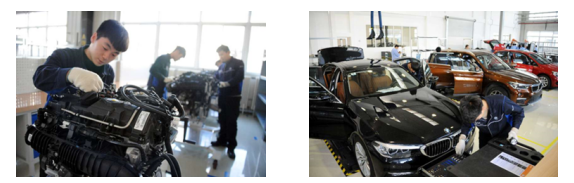
辽宁职教:为老工业基地振兴注入“硬核动能”
Xin Hua Wang· 2025-11-27 02:11
Core Viewpoint - Liaoning's vocational education is deeply integrated into regional development, serving as a driving force for revitalizing the old industrial base and enhancing skill training for local industries [2][16]. Group 1: Integration of Vocational Education and Industry - Vocational education in Liaoning is closely aligned with the needs of revitalizing the old industrial base, focusing on developing skilled talent as a key component of economic growth [2]. - The collaboration between vocational schools and industries has led to significant improvements, such as a technical team from Liaoning Mechanical and Electrical Vocational Technical College solving a major production issue for an electronics company, resulting in a 30% reduction in equipment costs [3]. - Liaoning Mechanical and Electrical Vocational Technical College has established a professional group layout that includes two provincial-level industry-education integration communities, conducting vocational skills training for 21,000 people annually [6]. Group 2: Cultural Heritage and Skills - Liaoning vocational education is becoming a vital platform for the transmission of traditional culture, with programs that combine old crafts with modern design, leading to successful products in the market [8][11]. - The development of non-heritage related courses has resulted in the training of over 1,200 traditional culture inheritors, contributing to a cultural industry revenue increase of over 300 million yuan [11]. Group 3: Social Impact and Community Development - Vocational education in Liaoning is addressing social needs by establishing quality vocational schools in remote areas, providing practical skills that directly benefit local communities [12]. - The establishment of rural revitalization colleges has created a model where vocational training is closely tied to local industries, resulting in significant income increases for local farmers [12]. Group 4: International Collaboration and Expansion - Liaoning is leveraging its geographical advantages to promote vocational education internationally, with initiatives like the "Mozi Workshop" in various countries, training thousands of skilled workers to meet local industry needs [13][15]. - The establishment of an overseas industry college alliance has facilitated the training of nearly 10,000 skilled talents abroad, promoting Chinese vocational education standards globally [15]. Group 5: Quality Improvement and Future Outlook - Over the past six years, funding for vocational education quality improvement in Liaoning has doubled, with the compliance rate of educational institutions rising from 29.65% to 83.53% [16]. - The ongoing reforms in vocational education are expected to produce more skilled talents, contributing to the comprehensive revitalization of Liaoning [16].