
汽车经销商

Search documents
超50%汽车经销商亏损
第一财经· 2025-08-19 16:46
Core Viewpoint - The domestic automotive market is experiencing a mild recovery in consumption due to policies promoting vehicle scrappage and replacement, but intense competition has led to price cuts, worsening the financial situation of dealers [3][4]. Group 1: Dealer Financial Performance - In the first half of 2025, the loss ratio among automotive dealers rose to 52.6%, with only 29.9% reporting profits [3]. - Only 30.3% of dealers met their sales targets, with 29% of dealers achieving less than 70% of their goals [3]. - New car sales losses are the biggest challenge for dealers, with 74.4% experiencing price inversion, and 43.6% of dealers facing price inversions exceeding 15% [3][4]. Group 2: Profitability by Vehicle Type - Independent dealers of new energy vehicles performed better than traditional fuel vehicle dealers, with profit ratios of 42.9% for new energy dealers compared to 25.6% for traditional dealers [4]. - Traditional fuel vehicle dealers face severe losses due to price inversions, while new energy dealers struggle with low after-sales value and long investment recovery periods [4]. Group 3: Dealer Satisfaction and Manufacturer Relations - Dealers reported a significant decline in satisfaction with manufacturers due to reduced rewards for achieving basic targets and an imbalance between effort and return [4][5]. - The automotive industry faces four major issues: imbalanced target setting by manufacturers, distorted rebate systems, collapsed pricing structures, and damaged support services [5]. - Manufacturers need to optimize the rebate cycle and improve clarity on rebate percentages to help dealers better calculate their actual earnings [5].


超50%汽车经销商亏损
Di Yi Cai Jing· 2025-08-19 15:29
Group 1 - The after-sales segment remains the largest contributor to gross profit for dealers, despite challenges in new car sales [1] - In the first half of the year, only 30.3% of dealers met their sales targets, with 29% of dealers achieving less than 70% of their goals [1] - The loss in new car sales is a significant challenge for dealers, with 74.4% experiencing some degree of price inversion, and 43.6% facing price inversions exceeding 15% [1] Group 2 - Independent dealers of new energy brands are performing better than those of traditional fuel vehicle brands, with profit ratios of 42.9% versus 25.6% respectively [2] - Many dealers are shifting to new energy brands, citing lower commission rates but compensating with higher sales volume [2] - The industry faces liquidity issues for dealers, particularly traditional fuel brand dealers suffering from severe losses due to price inversion [2] Group 3 - Four major associations in the Yangtze River Delta have called for manufacturers to address the operational difficulties faced by dealers, highlighting issues such as imbalanced target setting and a distorted rebate system [3] - The rebate cycle from manufacturers to dealers is often 2-3 months, with some exceeding 3 months, complicating cash flow for dealers [3] - Only a few manufacturers provide full cash rebates to dealers, with many using complex rebate structures that hinder accurate calculations of received rebates [3]
2025年上半年汽车经销商生存报告:超半数亏损,价格“倒挂”成主要症结
Zheng Quan Shi Bao Wang· 2025-08-19 09:11
Core Insights - The domestic automotive consumption showed a mild recovery in the first half of 2025, driven by vehicle scrappage and trade-in policies, but many dealers are facing a "revenue without profit" dilemma [1][2] Group 1: Dealer Performance - Only 30.3% of surveyed dealers met their sales targets in the first half of 2025, with 29.0% of dealers achieving less than 70% of their targets [1] - The survival status of automotive dealers worsened, with 52.6% reporting losses, 17.5% breaking even, and 29.9% making profits [1] - Among new energy independent brand dealers, 42.9% reported profits, while traditional fuel vehicle brand dealers had only 25.6% reporting profits [1] Group 2: Pricing and Cash Flow Issues - 74.4% of dealers experienced varying degrees of price "inversion," with 43.6% facing price inversions exceeding 15% [2] - The issue of price inversion is leading to negative cash flow for some dealers, increasing the risk of bankruptcy if liquidity issues are not addressed [2] Group 3: Profitability and Margins - The gross profit contribution from new car sales is -22.3%, while after-sales and financial insurance contribute 63.8% and 36.2% respectively [3] - New energy independent brand dealers show better profitability in new car sales, with a gross profit contribution of 16.8% [3] - Dealers' outlook for 2025 indicates expectations of slight growth or stability, which is less optimistic than previous assessments [3]
新丰泰集团(01771.HK)拟8月29日举行董事会会议批准中期业绩
Ge Long Hui· 2025-08-19 09:00
Core Viewpoint - New Feng Tai Group (01771.HK) announced that it will hold a board meeting on August 29, 2025, to approve the publication of its interim results for the six months ending June 30, 2025, and to consider the proposal for an interim dividend, if any [1] Summary by Relevant Categories - **Company Announcement** - The board meeting is scheduled for August 29, 2025 [1] - The agenda includes the approval of the interim results announcement for the six months ending June 30, 2025 [1] - The meeting will also consider the proposal for an interim dividend [1]
调查显示上半年汽车经销商亏损比例升至52.6%,仅三成完成上半年销售目标
Xin Hua Cai Jing· 2025-08-19 00:01
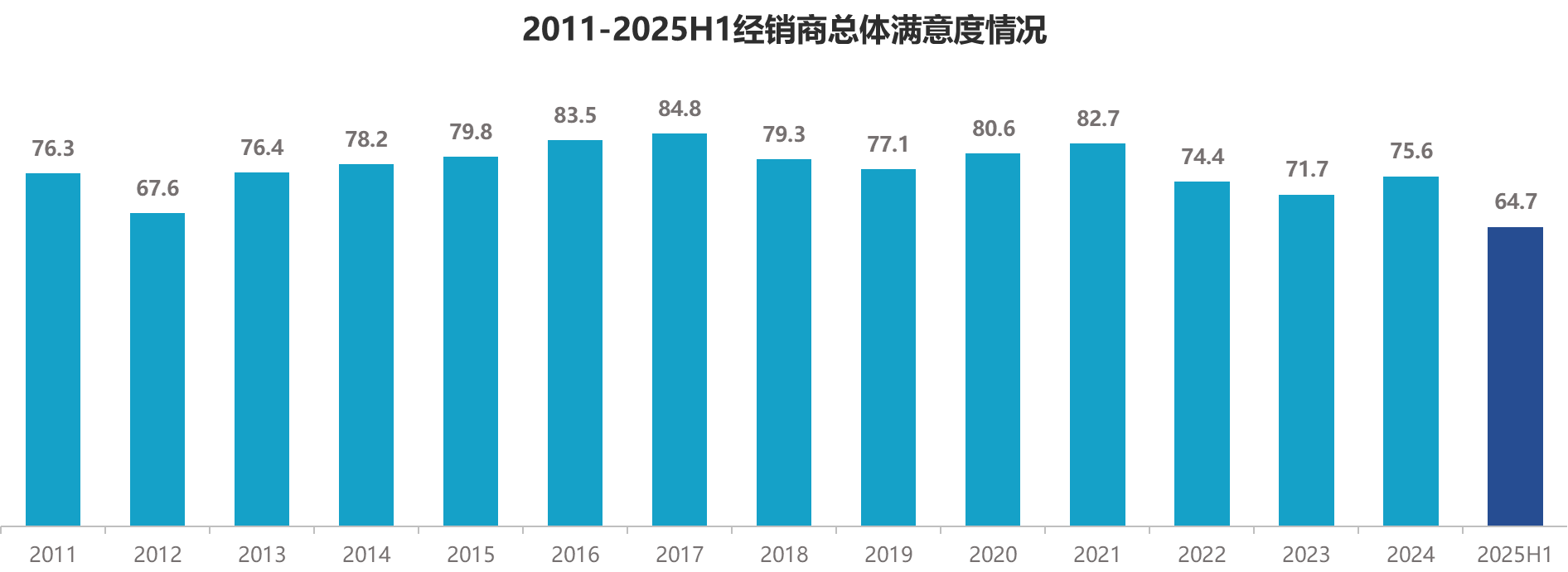
Core Insights - The survival status of automotive dealers in China has significantly deteriorated in the first half of 2025, with only 30.3% achieving their sales targets, and over 52.6% reporting losses [1][2][4] Group 1: Sales Performance - Only 30.3% of automotive dealers met their sales targets in the first half of 2025, with 29.0% of dealers achieving less than 70% of their targets [2] - Among different brand categories, luxury brands performed slightly better than joint venture and independent brands, with a higher percentage of dealers meeting their targets [2] Group 2: Pricing Issues - Over 74.4% of automotive dealers faced varying degrees of price inversion, with 43.6% experiencing price inversions exceeding 15% [3] - Price inversions have severely impacted dealers' cash flow, particularly for traditional fuel brand dealers, leading to significant losses in new car sales [3] Group 3: Profitability Challenges - The proportion of automotive dealers reporting losses rose to 52.6% in the first half of 2025, with only 29.9% reporting profits [4] - The gross profit contributions from new car sales, after-sales, and financial insurance were -22.3%, 63.8%, and 36.2% respectively, indicating a continued loss in new car sales [4] - Independent brand dealers in the new energy sector fared better than traditional fuel brand dealers, with 42.9% reporting profits compared to 25.6% for traditional brands [4] Group 4: Dealer Satisfaction - Overall satisfaction among automotive dealers has declined, with a score of 64.7, reflecting increased operational pressures [5] - Dealers reported dissatisfaction with new car and used car business performance due to high target expectations and insufficient support from manufacturers [5] - After-sales service satisfaction has also decreased, attributed to declining service visits and increasing parts pricing [5]
对厂家满意度创新低!上半年汽车经销商承压:亏损比例上升至52.6% 仅三成完成销售目标
Mei Ri Jing Ji Xin Wen· 2025-08-18 14:56
Core Insights - The satisfaction score of automotive dealers towards manufacturers has significantly declined in the first half of 2025, reaching the lowest level in nearly 14 years due to multiple operational pressures and increased price inversion [1][4]. Group 1: Dealer Performance - In the first half of 2025, 74.4% of automotive dealers experienced varying degrees of price inversion, with nearly half facing price inversions exceeding 15% [4]. - Only 30.3% of dealers met their sales targets, while 29.0% had a target completion rate below 70% [4]. - The profitability situation among dealers worsened, with 52.6% reporting losses, while only 29.9% were profitable [9]. Group 2: Brand Comparison - Dealers of new energy independent brands performed better than those of traditional fuel vehicle brands, with profitability rates of 42.9% for new energy brands compared to 25.6% for traditional brands [9]. - The loss rate for traditional fuel vehicle brand dealers was approximately 58.6%, indicating a significant financial strain [9]. Group 3: Market Dynamics - The domestic automotive market showed mild recovery due to policies promoting vehicle scrappage and replacement, but intense competition led to a situation where increased sales did not translate into higher revenues or profits [12]. - Manufacturers have implemented various rebate structures for dealers, but the complexity and length of rebate cycles have created challenges for dealers in accurately calculating and utilizing these rebates [12]. Group 4: Future Outlook - Dealers anticipate a trend of slight growth or stability in 2025, with only 49% expecting an increase in annual sales, a decrease from expectations at the end of 2024 [12].
中升控股(00881.HK)拟8月28日举行董事会会议批准中期业绩
Ge Long Hui· 2025-08-18 09:02
Group 1 - The company, Zhongsheng Holdings (00881.HK), announced a board meeting scheduled for August 28, 2025, to consider and approve the interim results for the six months ending June 30, 2025, and to discuss the distribution of an interim dividend, if any [1]

永达汽车(03669.HK):计提大额减值 甩掉历史包袱轻装上阵
Ge Long Hui· 2025-08-17 10:56
Company Situation - The company announced a one-time non-cash impairment of approximately 3.5 billion yuan related to underperforming 4S stores, goodwill, intangible assets from dealership agreements, and long-term assets, indicating no significant ongoing impairment risks in the future [1] - This substantial impairment is expected to help the company optimize asset quality and eliminate future risks associated with goodwill and intangible asset impairments, laying a foundation for focusing on the transition to new energy, improving operational efficiency, and enhancing profit quality [1] - The company currently has sufficient cash on hand, indicating strong risk resistance and a solid foundation for sustainable development, although new car sales are significantly impacted by declining demand in the luxury car market [1] Shareholder Returns - The company places a high emphasis on shareholder returns, having repurchased 32.06 million shares for approximately 78 million HKD, representing about 1.7% of total share capital, with an average repurchase price of 2.41 HKD [2] - Since 2021, the company has consistently increased its dividend payout ratio, with a cash dividend of 240 million yuan expected in 2024, achieving a payout ratio of around 120% [2] - The company plans to maintain mid-term dividends at no less than the same period in 2024, indicating a commitment to enhancing shareholder returns through dividends and share buybacks [2] Industry Outlook - The company is actively advancing its transition to new energy, with 35 new energy brand outlets expected by the end of 2024, accounting for 16% of total outlets, and has established partnerships with several new energy brands [2] - In the first half of 2025, the company secured 30 new energy brand authorizations and opened 7 new outlets, with independent new energy vehicle sales and maintenance revenue increasing by approximately 49% and 76% year-on-year, respectively [2] - The ongoing trend of dealership exits in the industry is expected to benefit leading dealers by increasing market concentration and providing access to more resources from vehicle manufacturers and after-sales customers [2] Profit Forecast and Valuation - The company maintains a rating of outperforming the industry, although profit forecasts for 2025 and 2026 have been adjusted to -3.242 billion yuan and 231 million yuan, respectively, due to impairment impacts and weak luxury car demand [3] - Given the company's structural transition towards new energy brands, profitability is expected to take time to improve, and with sufficient impairment provisions for goodwill and intangible assets, a P/B valuation approach is adopted [3] - The current stock price corresponds to 0.3x the estimated P/B for 2025, with a target price of 3.0 HKD, reflecting a 44% upside potential based on a P/B of 0.54x for 2025 [3]
和谐汽车涨超22% 机构看好汽车经销商加码海外 公司已在海外开设100家比亚迪门店
Zhi Tong Cai Jing· 2025-08-14 06:54
Core Viewpoint - H harmonious Automotive (03836) saw a significant stock increase of over 22%, reaching 2.1 HKD with a trading volume of 17.036 million HKD, following the announcement of a proposed sale of 45% of its restructuring capital to its controlling shareholder, Feng Changge [1] Group 1: Company Developments - The proposed sale involves the company's overseas new energy vehicle distribution business [1] - H harmonious Automotive has accelerated its global expansion strategy in 2023, establishing partnerships with leading Chinese new energy vehicle brands such as BYD and Tengshi, and has opened 100 BYD stores in just two years [1] Group 2: Industry Insights - According to Guotai Junan Securities, domestic new energy vehicles have been experiencing rapid growth overseas due to cost and product advantages [1] - The increased operations of domestic dealers abroad are expected to help create a closed-loop industrial chain for Chinese new energy vehicles, enhancing their bargaining power in the long term [1]

港股异动 中升控股(00881)涨超3% “反内卷”政策提振经销商盈利改善 公司受惠于经销网络优化
Jin Rong Jie· 2025-08-04 04:00
Core Viewpoint - Zhongsheng Holdings (00881) has seen a stock price increase of over 3%, currently at 13.49 HKD, with a trading volume of 42.95 million HKD. The rise is attributed to recent government policies aimed at curbing irrational competition in the automotive industry, particularly in the context of electric vehicles [1]. Group 1: Government Policies - The Chinese government has introduced a series of "anti-involution" policies to address overcapacity and worsening price competition in the electric vehicle sector [1]. - These measures, along with structural reforms at the corporate level, are expected to lead to a turning point in the industry by 2026 [1]. Group 2: Analyst Insights - Morgan Stanley has raised the target price for Zhongsheng Holdings to 20 HKD, citing benefits from the optimization of its dealership network [1]. - UBS noted that the recent rise in automotive dealership stock prices is linked to the anti-involution policies, which are anticipated to improve new car sales profit margins [1]. - The market is speculating on industry consolidation due to news of dealership closures, and investors are taking the opportunity to buy undervalued stocks [1].