个人冰雪装备

Search documents
韦伯咨询:2025年中国个人冰雪装备行业专题调研与深度分析报告
Sou Hu Cai Jing· 2026-01-02 04:47
Core Insights - The report titled "2025 China Personal Snow Equipment Industry Special Research and In-Depth Analysis" provides a comprehensive analysis of the personal snow equipment industry, covering policy planning, market demand, competitive landscape, key provincial developments, leading companies' operational status, and investment opportunities [1] Group 1: Industry Overview - The personal snow equipment industry is defined with basic concepts, product characteristics, and classifications [3] - The industry features seasonal cycles and various operational models, along with a detailed history and technological advancements [4] Group 2: Policy and Planning - The report outlines major policies and standards governing the personal snow equipment industry, including top-level planning and local government implementations [4] - Specific support policies and incentives are discussed, such as financial funding, innovation support, and tax reductions for products and companies [4] Group 3: Market Demand and Operations - An analysis of market supply and demand reveals overall production capacity, consumption scale, and price trends within the industry [5] - The report also examines import and export conditions, detailing the overall trade landscape and specific product categories [5] Group 4: Competitive Landscape - The competitive barriers in the industry include technological, financial, and brand-related challenges [6] - A detailed analysis of the competitive landscape highlights major market players and their positions in various segments [6] Group 5: Key Enterprises Analysis - The report provides in-depth analysis of key enterprises, including their main business operations, financial performance, strategic planning, and competitive positioning in the personal snow equipment sector [6][7][8] Group 6: Future Trends and Investment Opportunities - Future trends in the personal snow equipment industry are projected, focusing on policy changes, product development, and technological advancements [8] - Investment opportunities are identified across various segments and regions, emphasizing key players in the supply chain [8]

预见2025:《2025年中国个人冰雪装备行业全景图谱》(附市场现状、竞争格局和发展趋势等)
Qian Zhan Wang· 2025-12-13 02:09
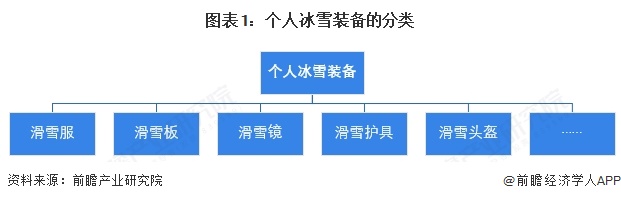
Industry Overview - The ice and snow equipment refers to various specialized devices, instruments, and supporting products designed for ice and snow sports, covering a full product system from personal sports gear to large facilities [1] - The current market in China has developed a comprehensive system of 15 categories of ice and snow equipment, catering to both competitive and recreational activities [1] Industry Chain Analysis - The upstream of the personal ice and snow equipment industry includes raw material supply, such as metals (steel, aluminum) and fibers (carbon fiber, glass fiber) [2] - The midstream focuses on the manufacturing of personal ice and snow equipment, producing items like skis, ski boots, and protective gear [2][5] - The downstream consists of sales channels, including sports stores, specialty shops, e-commerce platforms, and ski resorts [2][5] Market Size and Growth - The personal ice and snow equipment market in China is projected to reach approximately 8.2 billion yuan in 2024, driven by a significant increase in participation in ice and snow sports [17] - The participation rate for the 2024-2025 ice and snow season among residents aged 18 and above is estimated at 12.87%, with 144 million people engaging in folk ice and snow activities [16] Competitive Landscape - The competitive landscape is characterized by four main categories of companies: specialized ski equipment manufacturers, high-end international brands, outdoor product companies, and those involved in ice and snow tourism [29] - The Northeast region of China, particularly Heilongjiang, Jilin, and Liaoning, is identified as having the richest ice and snow resources, making it a key area for ice and snow sports [26][27] Policy Support - The Chinese government has implemented various policies to support the development of the ice and snow industry, including plans to enhance facilities and services by 2027 and to promote ice and snow sports participation [14][15] - The government aims to achieve a total scale of the ice and snow economy reaching 1.2 trillion yuan by 2024, with a focus on integrating ice and snow sports into broader economic activities [14] Future Trends - The market for personal ice and snow equipment is expected to grow to approximately 18 billion yuan by 2030, with a strong compound annual growth rate anticipated [30]
【行业深度】洞察2025:中国个人冰雪装备行业竞争格局及排名情况(附市场集中度、竞争派系、战略集群等)
Qian Zhan Wang· 2025-11-23 06:08
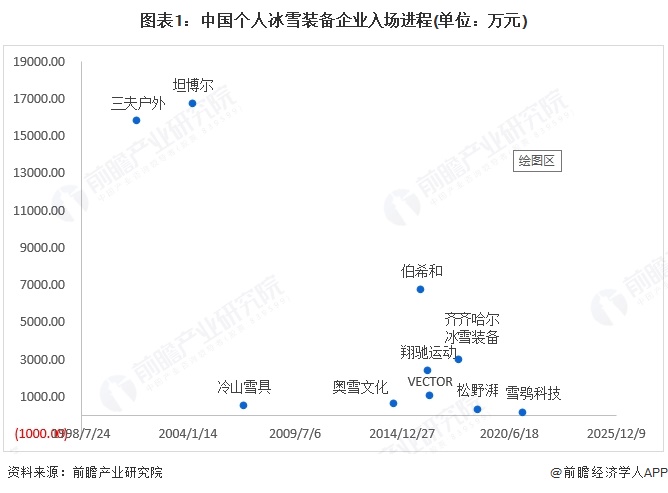
Core Insights - The article discusses the competitive landscape and market dynamics of the personal snow equipment industry in China, highlighting the entry of various companies and their strategic positioning [1][10]. Industry Overview - The personal snow equipment market in China has seen early entrants like Tanshan and Sanfu Outdoor, established in 1999 and 2001 respectively, with registered capital of 880 million and 150 million yuan [1]. - Decathlon entered the market in 2003 with a registered capital of 1 billion yuan, expanding from apparel to outdoor sports [1][2]. - The market began to grow in 2004 with the rise of skiing as a leisure activity, leading to the entry of companies like Tanboer and Cold Mountain Snow Equipment [1]. Competitive Landscape - The industry can be categorized into four competitive factions: 1. Companies specializing in snow equipment (e.g., Songyoupai, Tanboer) 2. High-end foreign brands (e.g., Burton, Decathlon) 3. Outdoor product companies with snow equipment as a segment (e.g., Tanshan, Anta) 4. Companies involved in snow-related tourism and training [3][5]. Strategic Clusters - The market leaders are international brands with over 40 years of experience, focusing on high-end snow equipment [7]. - Market challengers primarily sell through e-commerce platforms, targeting mid-range consumers during the snow season, with revenues in the million yuan range [7]. - Market followers have low specialization and revenue, often involved in snow tourism and training [8]. Market Concentration - The overall market concentration in the personal snow equipment industry is low, with a fragmented structure and limited market share for leading brands [10]. - International brands focus on high-end segments, while domestic brands are mostly small to medium-sized, relying on cost advantages but facing challenges in technology and brand development [10]. Competitive Dynamics - The competitive environment is complex, with low bargaining power for suppliers and strong bargaining power for consumers due to high product homogeneity [12]. - The threat of new entrants is significant, particularly in the low-end market where barriers to entry are low [12]. - Existing companies engage in intense competition, primarily through price wars in the low-end market, while high-end brands compete on technology and brand differentiation [12].
【最全】2025年个人冰雪装备行业上市公司全方位对比(附业务布局汇总、业绩对比、区域布局、业务规划等)
Qian Zhan Wang· 2025-11-12 06:08
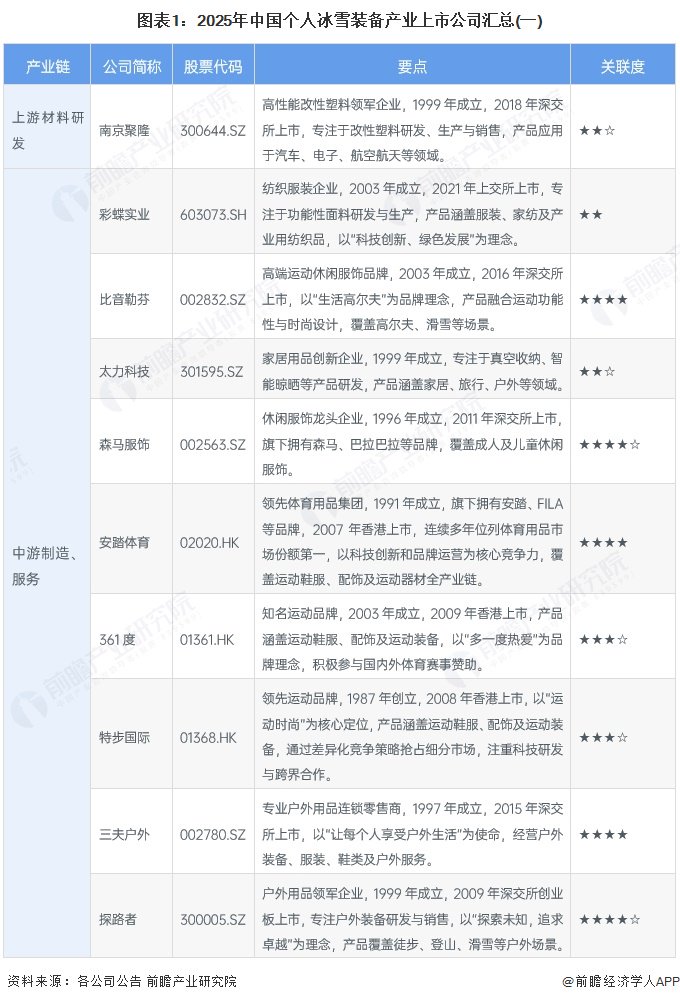
Core Insights - The article discusses the landscape of the personal snow equipment industry in China, highlighting the limited number of listed companies and their focus on outdoor sports and ice facility construction [1][5]. Company Overview - Major listed companies in the personal snow equipment sector include Sanfu Outdoor, Ternua, Anta, Inpace, Shuhua Sports, Xinlong Health, and Huali Technology, among others [1]. - The industry is divided into two main categories: companies focusing on outdoor sports equipment (e.g., Anta, Ternua) and those specializing in ice facility construction (e.g., Inpace) [1]. Financial Performance - Anta Sports leads in revenue with 42.2 billion yuan and a gross margin of 63.4%, attributed to its multi-brand strategy and strong profitability in snow-related business [3][4]. - Bi Yin Le Fen achieves the highest gross margin at 75.9% due to its high-end positioning, while Sanfu Outdoor maintains a gross margin of 58.6% from its specialized snow equipment [3][4]. - Other companies like Ternua and Semir have moderate gross margins, with Inpace and Shuhua Sports showing average margins [3]. Revenue and Profitability Metrics - In the first half of 2025, Anta Sports reported a revenue of 42.27 billion yuan, while other companies like 361 Degrees and Tebu International reported revenues of 6.26 billion yuan and 7.5 billion yuan, respectively [4]. - The earnings per share (EPS) varied significantly, with Anta at 2.77 yuan and Ternua at 0.38 yuan, while companies like Ternua and Inpace reported lower EPS figures [12]. Regional Market Focus - Companies are strategically located in regions rich in snow resources, with Anta, Sanfu Outdoor, and Ternua focusing on the Beijing-Tianjin-Hebei and Northeast areas, while others like Tebu and Inpace target East China and North China [5][7]. - Internationally, companies are expanding into Southeast Asia, Europe, and the Middle East to meet the growing demand for snow equipment [5][7]. Future Business Plans - Companies like Anta, 361 Degrees, and Tebu are increasing R&D investments in snow equipment and enhancing their international presence [15]. - Sanfu Outdoor plans to expand its snowfield store network and strengthen partnerships with ski clubs and event organizations [15]. - Inpace and Shuhua Sports are focusing on upgrading ice facilities and services, while Huali Technology is developing VR snow products [15].