
中式米饭快餐

Search documents
进入“20元时代”,中式米饭快餐没有退路
虎嗅APP· 2026-02-01 09:08
Core Viewpoint - The Chinese rice fast food industry is undergoing a significant paradigm shift in 2026, characterized by intense competition and a focus on profitability amidst rising costs and consumer rationality [4][6]. Group 1: Industry Challenges - The primary challenge for Chinese rice fast food brands remains profitability, with industry leaders like Chaoyixing reporting a mere 0.7 yuan profit on a 10 yuan meal [7]. - Rising costs for ingredients, labor, and rent, combined with a return to rational consumer spending, are squeezing profit margins, leading to a "thin profit" environment [8][9]. - The average consumer spending in the rice fast food sector has decreased from 29.7 yuan in 2022 to 27.5 yuan in 2025, with current average spending around 24 yuan [15]. Group 2: Competitive Strategies - Brands are shifting towards "all-day, all-customer, all-capable" models to attract a wider customer base and enhance profitability [5][10]. - Successful adaptations include diversifying product offerings and optimizing store formats, such as self-service models and expanded menu items to cater to different meal times and customer preferences [10][11]. - The introduction of new product lines, like "DIY" options, has proven effective in attracting both existing and new customers, as seen with brands like Yuyou and Laoxiangji [12]. Group 3: Pricing Dynamics - The industry is entering a "20 yuan era," with aggressive price reductions becoming a norm as brands compete for market share [13][14]. - Major brands have implemented significant price cuts, with Dami Xiansheng reducing its pricing from 4.6 yuan to 3.28 yuan per two [16]. - The trend indicates that if average spending exceeds 25 yuan, customer acquisition and retention will become increasingly difficult [17]. Group 4: Expansion and Market Dynamics - The market for Chinese rice fast food is projected to reach 277 billion yuan in 2024, with a potential to exceed 300 billion yuan in 2025, driven by ongoing consumer demand [21]. - While some brands are rapidly expanding, others are slowing down their growth due to the challenges of scaling operations effectively [23][25]. - Successful expansion requires a robust organizational structure and supply chain management, as evidenced by the struggles of brands like Nanchengxiang and Chaoyixing in new markets [25][26]. Group 5: Future Outlook - The next decade for the Chinese rice fast food industry will focus on a multi-faceted approach that emphasizes freshness, transparency, intelligence, low pricing, and health [27]. - Brands that can balance cost management with quality and customer experience will likely thrive in this competitive landscape [28][29].

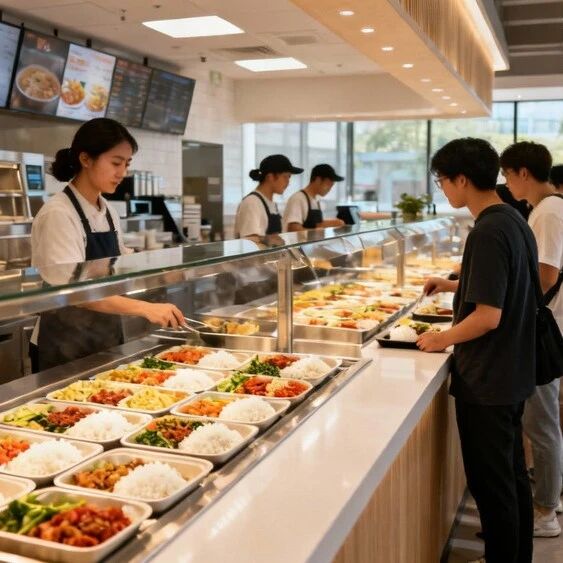
进入“20元时代”,中式米饭快餐没有退路
3 6 Ke· 2026-01-28 13:09
Core Insights - The competition logic in the Chinese rice fast food sector is undergoing significant changes, with a shift towards a "paradigm shift" in 2026, emphasizing profitability amidst rising costs and intense competition [2][4][10] - The industry is moving towards a model that focuses on maximizing store efficiency and profitability rather than rapid expansion [5][9] Group 1: Market Dynamics - The market is experiencing fierce competition with both established brands and new entrants, leading to a scenario where profitability is increasingly difficult to achieve [2][4] - The average consumer spending in the Chinese rice fast food sector has decreased, with figures showing a drop from 29.7 yuan in 2022 to 27.5 yuan by August 2025 [10][11] - The current mainstream price range for Chinese rice fast food is between 20 to 25 yuan, indicating a trend towards lower pricing [10][11] Group 2: Business Strategies - Brands are adopting a "full-time, full-customer, all-capable store" model to attract a wider customer base and enhance profitability [3][7] - Innovations such as self-service models and diverse product offerings are being implemented to cater to different consumer needs and maximize store utilization [8][9] - The introduction of technology, such as smart cooking machines, is being leveraged to reduce labor costs and improve food quality [18] Group 3: Expansion Challenges - The expansion of Chinese rice fast food brands is entering a "deep water zone," with a projected market size of 2.77 trillion yuan in 2024, growing at 10.1% [19] - While some brands are rapidly expanding, others are slowing down due to the challenges of scaling operations effectively [20][21] - Successful expansion requires a robust organizational capability and a deep understanding of local market dynamics, as evidenced by the varied experiences of different brands [22][23] Group 4: Future Outlook - The next decade for Chinese rice fast food will focus on a multi-faceted approach that includes freshness, transparency, intelligence, low pricing, and health [24] - Brands that can maintain a balance between cost and quality while adapting to consumer demands will likely survive and thrive in this competitive landscape [24]
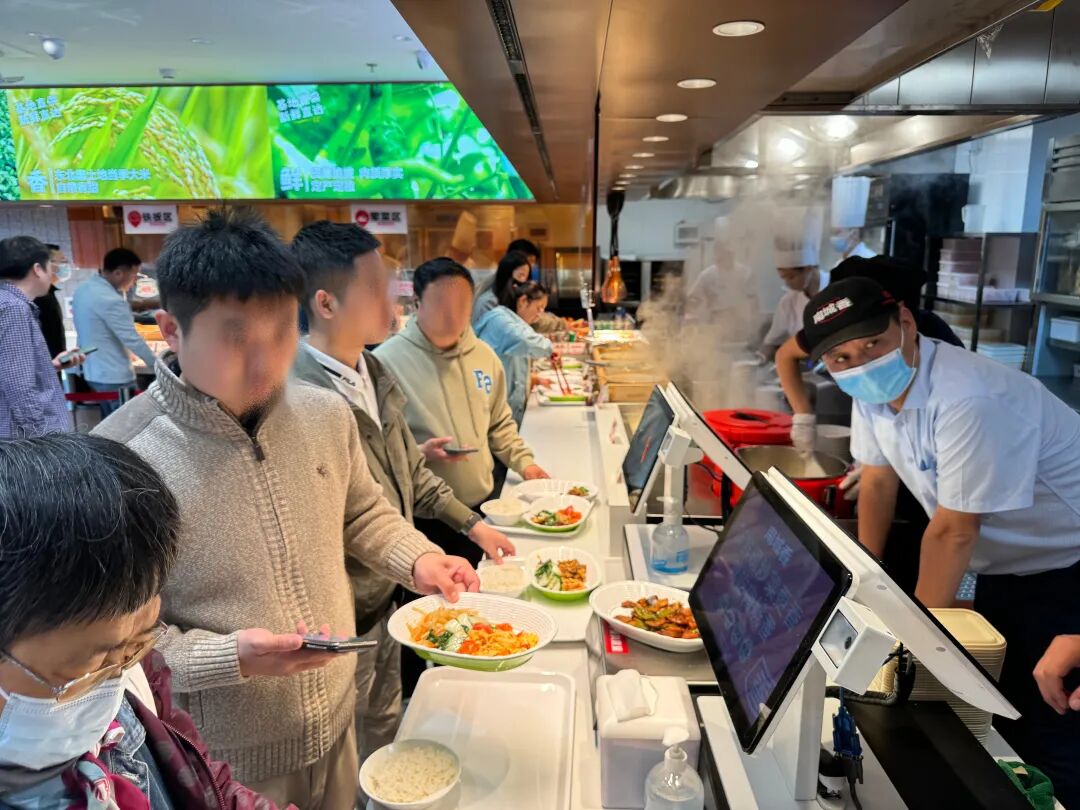
研判2025!中国中式米饭快餐行业市场政策、产业链、发展现状、竞争格局及发展趋势分析:19-40岁消费群体占比高达86.7%[图]
Chan Ye Xin Xi Wang· 2025-06-05 01:42
Overview - The demand for fast, convenient, and nutritionally balanced dining options is increasing among consumers, leading to a growing preference for Chinese rice fast food, which meets these needs [1][12] - The market size of China's Chinese rice fast food industry is projected to reach 277 billion yuan in 2024, with a year-on-year growth of 10.23% [1][12] Market Policies - The Chinese government has issued several policies to support the development of the restaurant industry, including guidance on promoting traditional food production areas and enhancing service consumption [3][4] - Policies aim to improve the standardization, convenience, modernization, and branding of the restaurant sector, providing a favorable environment for the growth of the Chinese rice fast food industry [3] Industry Chain - The upstream of the Chinese rice fast food industry includes suppliers of agricultural products such as rice, vegetables, and meat, as well as suppliers of cooking equipment and packaging materials [5][8] - The downstream consists of individual and corporate consumers whose demand directly influences the industry's development [5] Development Status - The Chinese rice fast food industry is characterized by its quick service, standardization, and high cost-performance ratio, making it popular among consumers [1][12] - The industry is experiencing a shift towards fresh, stir-fried options as consumers increasingly value freshness over pre-prepared meals [1][12] Competitive Landscape - The Chinese rice fast food market is highly fragmented, with numerous small to medium-sized street vendors, although brand concentration has been increasing due to capital investment [14][16] - Major players in the industry include Lao Niang Jiu, Anhui Laoxiangji, and Xiangcunji, among others, with a significant presence in various regions [14][16] Industry Trends - Future trends indicate a shift towards branding and chain operations, with companies focusing on brand image and product quality to attract consumers [20] - The diversification of product offerings is expected, with the introduction of snacks, noodles, and beverages to cater to varying consumer preferences [20]
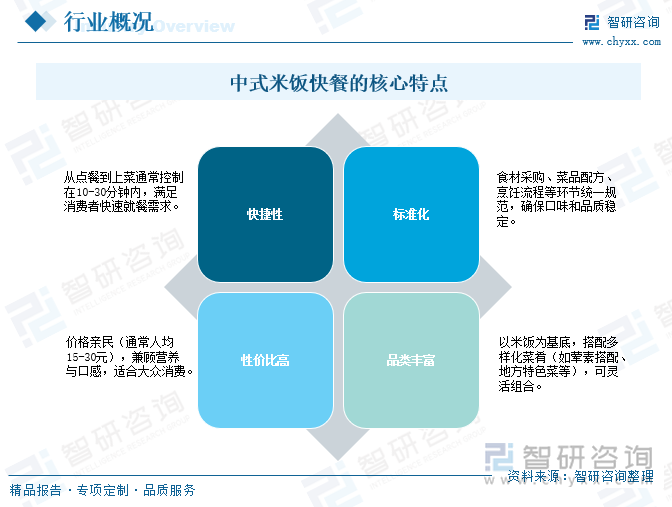
健康与品质驱动行业新变革 中式米饭快餐市场今年规模有望突破3000亿元
Zhong Guo Chan Ye Jing Ji Xin Xi Wang· 2025-05-19 22:32
Core Insights - The Chinese rice fast food market is experiencing significant growth, with the market size expected to exceed 300 billion yuan this year, following a 10.2% year-on-year increase to 277 billion yuan last year [2][3] - Consumer demand is shifting towards healthier and higher-quality options, prompting brands to accelerate product iterations to meet market changes [1][3] Market Overview - The Chinese rice fast food sector holds a crucial position in the restaurant market, with 880,000 stores nationwide as of April this year, and the East China region accounting for 37.8% of the total [2] - The demographic composition shows that male consumers represent 54.1%, while female consumers account for 45.9%, with the primary consumer group being aged 19-35 [2] Consumer Trends - There is a growing emphasis on the freshness of ingredients, value for money, and diverse menu options among consumers, reflecting a shift from merely filling hunger to seeking health and quality [3] - The fast-paced lifestyle of consumers drives the demand for quick and convenient dining options, which the Chinese rice fast food sector effectively meets [3] Industry Challenges - The industry faces challenges such as fluctuating raw material costs, rising labor costs, and increasing rent for prime locations, which compress profit margins [4] - Balancing product standardization with personalization remains a challenge, as the need for consistent quality conflicts with the desire for unique flavors [4] Industry Innovations - Brands are responding to health and quality demands by accelerating product innovation, incorporating smart technology, and optimizing supply chains [5] - The integration of seasonal ingredients and regional specialties into menus is becoming a trend, enhancing the traditional Chinese dining experience [6] Future Outlook - The Chinese rice fast food industry is expected to maintain a positive growth trajectory, with potential breakthroughs in product innovation, service enhancement, and operational optimization [6]