
秸秆饲料

Search documents
“秸”尽所能,江西这个传统农业大区实现生态、经济双赢
Zhong Guo Xin Wen Wang· 2026-02-04 10:06
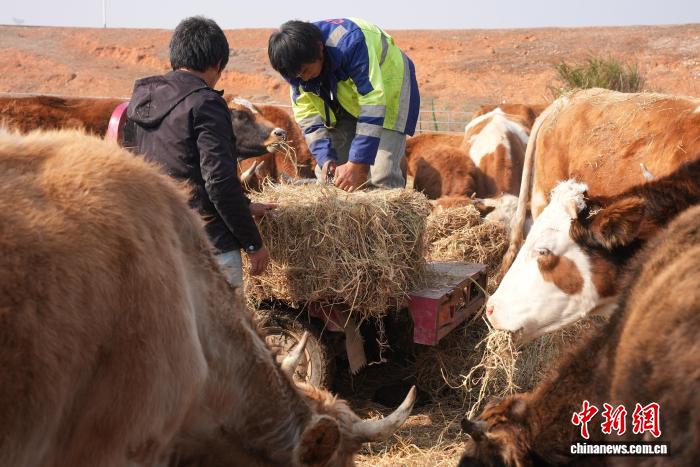
Core Viewpoint - The article highlights the effective utilization of agricultural straw in Jiangxi Province, particularly in Nanchang, where local cooperatives and companies are transforming waste straw into valuable feed and other products, thereby reducing costs and promoting environmental sustainability [1][5]. Group 1: Company Initiatives - The Haoyou Planting and Breeding Cooperative is processing rice straw into feed blocks, addressing the issue of winter feed shortages for cattle and reducing costs by approximately 300,000 yuan annually for raising over 150 cattle [1][3]. - Jiangxi Hengrang Ecological Agricultural Technology Co., Ltd. is focused on high-value utilization of straw, developing biodegradable rice seedling trays that increase seedling survival rates and yield by nearly 300 jin per mu for double-crop rice [4]. - The company is also working on a soil conditioner derived from straw, aimed at improving soil quality and addressing issues like soil acidification and heavy metal pollution [4]. Group 2: Industry Trends - Nanchang's New District is leveraging straw resource abundance by implementing a "government guidance + market operation" model to develop straw collection and processing enterprises, achieving over 95% utilization rate of straw in the region by 2025 [5]. - The district has established five agricultural enterprises as key players in straw comprehensive utilization, promoting local fertilizer and feed applications [5].

首场“委员通道”上,他们说了这些干货
Xin Lang Cai Jing· 2026-02-02 20:06
Group 1: Oil Tea Industry Development - The oil tea industry is being diversified to enhance its economic potential, with a focus on high-end skincare products [12][13] - The comprehensive utilization rate of oil tea fruit resources has increased from less than 20% to over 50% through technological advancements [13] - The initiative has led to an increase in annual income of over 20,000 yuan for more than 40,000 farming households [13] Group 2: Engineering Machinery Export - Hunan has initiated a remanufacturing system reform for engineering machinery, addressing legal and quality control challenges [14] - The province has saved over 85 million yuan in costs and reduced processing time by two months through innovative legal measures [14] - Over 3 billion yuan worth of remanufactured equipment has been exported from Hunan in the past two years [15] Group 3: Youth Talent Attraction - Hunan's "Wisdom Hunan, Talent Gathering" initiative has successfully attracted 43,000 job seekers from 235,000 resumes received [16] - The province offers substantial support for entrepreneurship, including three years of free office space and various financial incentives [16] - There are currently 425 entrepreneurial incubation bases in Hunan, with nearly 4,000 projects initiated by university students [16] Group 4: Minor Protection and Mental Health - A collaborative approach involving families, schools, and communities is being promoted to support the mental health of students [17] - A proposal for a coordinated care network for vulnerable children has been implemented, with support from multiple government departments [17] - The focus for the upcoming sessions will be on enhancing student safety through improved legal and community support mechanisms [17] Group 5: Straw Utilization for Rural Revitalization - The comprehensive utilization of straw is seen as a key ecological and economic strategy for rural areas [18] - Hunan produces over 36 million tons of straw annually, with initiatives in place to reduce environmental impact and enhance farmer income [18] - The province has established 1,195 collection points and 1,372 utilization entities to promote diverse applications of straw [18] Group 6: Hunan-Hong Kong Cooperation - Efforts are being made to strengthen economic ties between Hunan and Hong Kong, focusing on sectors like traditional Chinese medicine and finance [19] - A recent exchange led to six enterprises signing agreements, showcasing the potential for collaboration [19] - The ongoing strategy aims to facilitate the integration of resources, technology, and talent between the two regions [20]

秸秆“翻身记”
Xin Lang Cai Jing· 2026-01-10 23:42
Core Viewpoint - The transformation of straw from an ecological burden into an industrial asset is driving economic growth and sustainability in Longyan, Fujian Province, showcasing a successful model of agricultural innovation and resource utilization [1][2][3]. Group 1: Economic Impact - Farmers like Gong Hongyuan are now earning approximately 1,800 yuan per acre from straw sales, which contributes to an annual income increase of about 15,000 yuan, representing nearly 10% of the income from one acre of rice [3]. - The local agricultural model has shifted from burning straw to utilizing it for feed production, with the purchase price for straw set at around 600 yuan per ton, significantly lower than the average cost of 1,400 yuan for purchased feed [4][6]. Group 2: Policy Support - The government has allocated 7.22 million yuan in special funds for 2024-2025 to support straw utilization, including subsidies for purchasing key equipment and for the construction of storage and transportation facilities [5]. - Local policies provide financial incentives for farmers to adopt straw recycling practices, with subsidies ranging from 60 to 80 yuan per acre for straw utilization in fertilizer and feed production [5]. Group 3: Sustainable Practices - The introduction of a "straw-feed-fertilizer" cycle is being promoted, with local farmers benefiting from reduced feed costs and improved soil quality through straw incorporation [7][8]. - The establishment of a local resource processing and consumption loop is being reinforced, ensuring that the feed produced from straw is utilized by local livestock farmers, thus stabilizing the market and reducing dependency on external supplies [7].
秸秆“变身记”!看广东如何玩转农业“循环魔法”
Nan Fang Nong Cun Bao· 2025-12-31 09:34
Core Viewpoint - The article discusses the transformation of agricultural waste, specifically straw, into valuable resources in Guangdong, showcasing a closed-loop agricultural model that enhances sustainability and economic benefits [2][6][9]. Group 1: Agricultural Transformation - Straw, once considered waste, is now being utilized as animal feed, providing nutritional value for livestock [2][14]. - Livestock waste is processed and returned to the fields as fertilizer, contributing to soil vitality [3][25]. - The closed-loop system connects planting and breeding, where straw is converted into feed, livestock produce waste that becomes fertilizer, and the cycle continues [7][8][31]. Group 2: Economic and Environmental Benefits - The closed-loop model has led to significant cost savings, with annual savings of approximately 14 million yuan in feed costs, 4 million yuan in wastewater treatment costs, and 2 million yuan in reduced fertilizer purchases, totaling over 20 million yuan in economic benefits [45]. - The model has also eliminated the burning of straw and direct discharge of livestock waste, improving environmental conditions in fields and rivers [47][49]. - The integration of advanced agricultural machinery has increased efficiency in straw collection and processing, making the system more sustainable [58][60]. Group 3: Policy and Community Engagement - The development of this model has been supported by local policies, with the establishment of standardized straw feed production bases and investment in agricultural technology [36][38]. - Community involvement has been crucial, with local farmers participating in land leasing and crop rotation, revitalizing previously abandoned land [67][72]. - The initiative has created over 170 jobs, providing additional income for local residents and enhancing community engagement in sustainable practices [64][66]. Group 4: Future Prospects - Research institutions are collaborating with local enterprises to develop customized feed formulations and enhance the nutritional value of straw-based feed [80][83]. - The market potential for "ecological meat" produced from livestock fed with straw is growing, as consumers are willing to pay a premium for healthier, sustainably raised products [85][86]. - The ongoing transformation in Guangdong's agricultural practices represents a shift towards high-quality agricultural development, emphasizing resource utilization and sustainability [92][93].

“秸”尽所能!河南发布行动方案让废秸秆变身“金宝贝”
合成生物学与绿色生物制造· 2025-09-21 07:34
Core Viewpoint - The article discusses the comprehensive utilization of crop straw in Henan Province, emphasizing the establishment of a robust network for straw collection, storage, transportation, and utilization, aiming for a stable comprehensive utilization rate of over 93% by 2027 [2][3]. Summary by Sections Action Plan Overview - The Henan Provincial Government has issued an action plan for the comprehensive utilization of crop straw from 2025 to 2027, focusing on enhancing the resource value of straw [2]. Key Tasks - **Task 1**: Establish high-standard farmland areas for straw return, focusing on improving soil fertility in major grain-producing regions [3]. - **Task 2**: Develop a straw feed utilization industry, particularly in major cattle-raising cities like Luoyang and Nanyang [3]. - **Task 3**: Build a comprehensive network for straw collection, storage, transportation, and utilization, ensuring land use for storage facilities [3]. Industry Alliance and Innovation - **Task 4**: Form a straw comprehensive utilization industry alliance, collaborating with universities and research institutions to create an information platform for straw utilization [4]. - **Task 5**: Explore new pathways for high-value transformation of straw, including the production of edible fungi substrates and green methanol, while enhancing agricultural machinery for straw utilization [4]. Policy Support - **Task 6**: Increase policy support for straw utilization projects, encouraging financial institutions to innovate credit products and reduce guarantee fees for small enterprises [4].

打造“五个一”秸秆利用新格局
He Nan Ri Bao· 2025-06-18 23:31
Core Viewpoint - Henan Province is focusing on the comprehensive utilization of straw resources, aiming to enhance agricultural sustainability and reduce carbon emissions through innovative practices and collaborative efforts among various sectors [1][2][3] Group 1: Straw Resource Utilization - Henan Province generates approximately 100 million tons of straw annually, ranking second in the country [1] - In 2024, the province's straw collection potential is estimated at 78.96 million tons, with wheat, corn, peanuts, and rice straw accounting for 96.48% of the total [1] - The total straw utilization in the province is projected to be 74.51 million tons, maintaining a comprehensive utilization rate above 93%, with fertilizer and feed utilization accounting for 74.4% and 21.3% respectively [1] Group 2: Development Strategies - The province is implementing a "one area, one belt, one network, one alliance, one road" strategy to enhance straw utilization [2][3] - "One area" refers to the establishment of high-standard farmland demonstration zones that integrate various agricultural practices and technologies [2] - "One belt" focuses on developing a straw-to-feed industry belt in key livestock regions, enhancing the straw feed storage system and supporting technology upgrades [2] - "One network" aims to create a standardized straw collection and storage network across the province, ensuring comprehensive coverage [2] - "One alliance" involves forming a straw utilization industry alliance to facilitate collaboration and information sharing among government, enterprises, and other stakeholders [2] - "One road" emphasizes the development of high-value straw utilization pathways, including edible fungi substrates and eco-friendly materials [3]
“秸”尽其用折射现代农业密码(人民时评)
Ren Min Ri Bao· 2025-05-12 22:10
Core Viewpoint - The transformation of straw from a waste product to a valuable resource reflects a significant shift in development concepts, strong support from technological innovation, and precise guidance from national policies, contributing to the establishment of a modern agricultural industry system [1][3]. Group 1: Straw Utilization - The annual production of crop straw in China has reached 867 million tons, with a collection capacity of 733 million tons, resulting in a comprehensive utilization rate of 88.3% [1]. - Straw is now being repurposed into fertilizers, animal feed, energy, and even industrial raw materials, marking a significant advancement in modern agriculture [1][3]. - The utilization of straw as animal feed has seen rapid growth, with an annual utilization rate increasing by approximately 2 percentage points, reaching 173 million tons [2]. Group 2: Technological and Policy Support - The integration of straw return to the field with soil cultivation practices enhances soil organic matter content and improves water and nutrient retention [2]. - The "Accelerating the Construction of an Agricultural Power Plan (2024-2035)" emphasizes the need for a full-chain approach to upgrading the agricultural industry system, with straw utilization exemplifying this upgrade [3]. - The central government's policy supports the comprehensive utilization of straw, aiming for its high-value application and continuous exploration of its potential [4]. Group 3: Environmental and Economic Impact - Straw is being utilized as a clean energy source through methods such as direct combustion, pyrolysis gasification, and biogas production, contributing to energy structure optimization and ecological protection [3]. - Innovative uses of straw, such as serving as a substrate for mushroom cultivation, have opened new avenues for farmers to increase their income and expanded the agricultural industry chain [3]. - The shift from burning straw to fully utilizing it represents a critical step towards achieving a sustainable agricultural model and enhancing overall agricultural efficiency [2][3].