
医疗仪器及器械

Search documents
出口韧性的“来源”?
Sou Hu Cai Jing· 2025-12-09 00:39
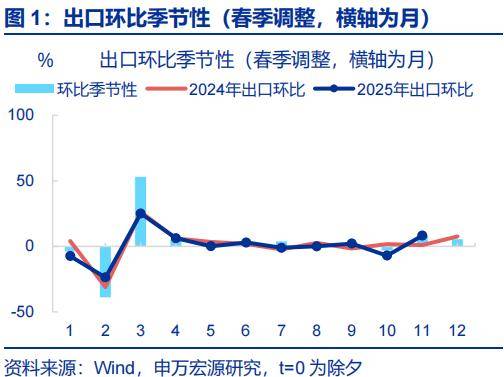
Core Viewpoint - The significant rebound in November exports is primarily attributed to the dissipation of short-term supply disruptions rather than an improvement in external demand [2][7][30] Export Analysis - November exports increased by 5.9% year-on-year (YoY) in USD terms, a notable recovery from a decline of 1.1% in October, driven by factors such as increased working days and the reduction of "production rush" effects [2][6][7] - The increase in working days in November (up by 2 days YoY) and the tapering off of the "production rush" phenomenon contributed significantly to the export rebound [2][7] - Exports to emerging economies showed a marked recovery in November, with exports to Africa and Latin America rising by 17.1 percentage points (pct) and 12.8 pct respectively, despite no significant improvement in demand from these regions [2][11] - The export of goods such as food, steel, and auto parts, which had seen significant declines in October, rebounded in November, with respective increases of 34 pct, 18.7 pct, and 13.6 pct [3][18] Import Analysis - Imports also showed a recovery in November, with a YoY increase of 1.9%, up by 0.9 pct from the previous month [3][25] - Processing trade imports surged by 9.2 pct to 13.9%, exceeding previous growth levels, indicating a rebound in supply conditions [3][25] - Major commodities like crude oil and electromechanical products saw improved import growth rates, with crude oil imports increasing by 8.4 pct to 8.1% [3][25][51] Future Outlook - The easing of supply disruptions, combined with ongoing improvements in external demand and China's competitive export advantages, is expected to support exports for the remainder of the year [4][30] - The potential for improved exports to the U.S. is bolstered by the easing of tariffs and the likelihood of inventory replenishment in the U.S. market [4][30] - Continued industrialization in emerging markets is anticipated to drive demand for imported production materials, further supporting China's export of intermediate and capital goods [4][30] Regular Tracking - In November, both exports and imports showed signs of recovery, with notable increases in consumer electronics and light industrial products [5][37] - Capital goods exports exhibited mixed results, with intermediate goods like auto parts and integrated circuits showing growth [5][40] - Exports to non-U.S. developed economies and emerging markets increased, while exports to the U.S. declined [5][47][48]

数据点评 | 出口骤降的“隐藏线索”?(申万宏观·赵伟团队)
赵伟宏观探索· 2025-11-08 00:00
Core Viewpoint - The decline in October exports is not primarily due to weakened external demand but rather short-term supply disruptions, which are now dissipating [3][10][65]. Export Analysis - October exports fell significantly, with a year-on-year decrease of 1.1%, down from a previous value of 8.3%, and a forecast of 3.2%. The month-on-month decline was 7.1%, which is worse than the seasonal average of 3.2% [2][9][10]. - The drop in exports is influenced by a high base effect, but the decline in exports to emerging economies, such as ASEAN and Africa, indicates a more complex situation. For instance, exports to ASEAN decreased by 4.7 percentage points to 11%, and to Africa by 46.1 percentage points to 10.5% [3][10][11]. - The reduction in working days in October, which was three days fewer than the previous month, exacerbated supply constraints. The "production rush" phenomenon observed in September ended, leading to a significant drop in exports of goods that had previously surged [3][18][27]. Import Analysis - October imports also saw a decline, with a year-on-year decrease of 6.4% to 1%. This decline was particularly notable in processing trade imports, which fell from 12% in September to 4.6% in October [4][23][66]. - The import of mechanical and electrical products decreased significantly, with a drop of 7.6% to 2.5%. The largest declines were seen in automatic data processing equipment and integrated circuits [4][54][66]. Future Outlook - With the easing of trade tensions between China and the U.S., and the dissipation of supply disruptions, it is expected that export growth may recover in November. The export performance to developed economies is showing divergence, with exports to the U.S. improving while those to Europe and the UK are declining [5][67]. - The ongoing industrialization and urbanization in emerging markets are expected to drive demand for imported production materials, which may support China's exports of intermediate and capital goods [5][67]. Regular Tracking - In October, both exports and imports experienced declines. The export of consumer electronics fell sharply by 11.1 percentage points to -1.7%, with mobile phones seeing a significant drop of 14.7 percentage points to -16.6% [6][68]. - Capital goods exports showed mixed results, with general machinery exports declining by 33.9 percentage points to -9.1%, while shipbuilding exports increased by 25.7 percentage points to 68.4% [6][42][68].

10月外贸数据点评:出口骤降的“隐藏线索”?
Shenwan Hongyuan Securities· 2025-11-07 10:14
Group 1: Export Data Overview - October exports decreased by 1.1% year-on-year, significantly lower than the expected 3.2% and previous value of 8.3%[1] - The month-on-month decline in exports was 7.1%, which is worse than the seasonal average decline of 3.2%[2] - Exports to emerging markets like ASEAN and Africa saw significant drops, with ASEAN exports down 4.7 percentage points to 11% and African exports down 46.1 percentage points to 10.5%[2] Group 2: Import Data Overview - October imports increased by 1% year-on-year, below the expected 4.1% and previous value of 7.4%[1] - The month-on-month decline in imports was 6.4 percentage points, reflecting supply disruptions[3] - Processing trade imports fell from 12% in September to 4.6% in October, indicating significant supply disturbances[3] Group 3: Supply Chain and Economic Factors - The decline in exports is attributed more to short-term supply disruptions rather than weakening external demand[2] - A reduction in working days in October (down 3 days compared to the previous month) exacerbated supply issues, particularly following the National Day holiday[2] - High-frequency export chain production indicators fell to -0.2%, aligning with the overall export decline of -1.1%[2] Group 4: Future Outlook - With easing US-China trade tensions and the expected recovery in supply, November exports are anticipated to rebound[4] - Exports to developed economies are showing a mixed performance, with US exports improving while those to the EU and UK are declining[4] - The ongoing industrialization and urbanization in emerging markets are expected to drive demand for intermediate and capital goods imports from China[4]
前7个月长三角地区进出口总值同比增长5.4%
Xin Hua Cai Jing· 2025-08-15 06:32
Core Insights - The Yangtze River Delta region achieved an import and export value of 9.59 trillion yuan in the first seven months of this year, marking a 5.4% increase compared to the same period last year, and accounting for 37.3% of the national total, an increase of 0.7 percentage points year-on-year [1] Group 1: Export Performance - The export value of electromechanical products from the Yangtze River Delta reached 3.64 trillion yuan, reflecting a year-on-year growth of 9.4% [1] - Exports of electric vehicles, high-end equipment, and integrated circuit products increased by 43.9%, 10.2%, and 20.1% respectively [1] Group 2: Import Trends - Imports of food, medical instruments and equipment, and daily chemical products related to people's livelihoods grew by 4.8%, 10.1%, and 1.9% respectively in the first seven months [1] Group 3: Trade Partnerships - The Yangtze River Delta's trade with ASEAN reached 1.51 trillion yuan, a year-on-year increase of 17.5%, making ASEAN the largest trading partner [1] - Trade with countries involved in the Belt and Road Initiative amounted to 4.77 trillion yuan, up 10.3% year-on-year [1] - Trade with other members of the Regional Comprehensive Economic Partnership (RCEP) totaled 3.02 trillion yuan, reflecting an 8.9% increase [1] - Trade with African countries reached 499.47 billion yuan, showing a year-on-year growth of 15.2% [1] Group 4: Role of Private Enterprises - Private enterprises in the Yangtze River Delta played a significant role in foreign trade, with an import and export value of 5.35 trillion yuan, a year-on-year increase of 9.5%, accounting for approximately 55.8% of the total trade value, an increase of 2.1 percentage points from the previous year [1]