
医疗研究

Search documents
淋巴管特定变化可帮助识别侵袭性口腔癌
Xin Lang Cai Jing· 2026-02-23 08:23
Core Insights - A new study from the University of Turku in Finland identifies specific changes in the lymphatic system that can help doctors early detect aggressive and high-recurrence risk oral cancers [1][2] - The research analyzed samples from approximately 300 Finnish early-stage oral cancer patients, revealing an increase in dividing lymphatic endothelial cells in tumor tissues, which correlates with higher recurrence and mortality risks [1] - The study emphasizes the importance of early identification of aggressive cancers to potentially reduce recurrence and mortality through treatment [1] Group 1 - The study found that the number of dividing lymphatic endothelial cells in cancer patients is significantly higher than in healthy individuals, indicating a potential biomarker for aggressive oral cancer [1] - Current early treatment for oral cancer primarily relies on surgery, but there is a lack of reliable methods for selecting adjuvant therapies [1] - Identifying new biomarkers could enable more effective treatment for high-risk patients while sparing those with better prognoses from unnecessary severe side effects of adjuvant therapies [1] Group 2 - The research findings have been published in the journal Cell Reports Medicine, with plans to explore the predictive value of related protein markers in other cancer types [2] - According to global cancer databases, approximately 188,000 deaths from oral cancer occurred worldwide in 2022, highlighting the significance of improving early detection methods [3]
我国研究显示这类严重罕见病或无需终身治疗
Xin Lang Cai Jing· 2026-02-21 08:58
Core Insights - A recent multi-center study published in the American Journal of Hematology indicates that some patients with idiopathic multicentric Castleman disease (iMCD-TAFRO) may not require long-term maintenance therapy after achieving remission [1] Group 1: Study Findings - The study involved 27 patients with iMCD-TAFRO who maintained stable conditions after stopping treatment, with a median follow-up of 31 months [1] - Out of these, 23 patients continued to show stable conditions, and 20 patients achieved complete remission [1] - The study predicts that the proportion of patients maintaining stable conditions after stopping treatment is 96.3% at 6 months, 85.2% at 1 year, and 85.2% at 3 years [1] Group 2: Clinical Implications - The findings suggest that for some iMCD-TAFRO patients who achieve biochemical complete remission, attempting to stop treatment could be a viable clinical option [1]
韩媒:韩国健康预期寿命跌至70岁以下
Huan Qiu Shi Bao· 2026-02-09 23:00
Group 1 - The core point of the article highlights that South Korea's "healthy life expectancy" has fallen below 70 years for the first time in nearly a decade, raising concerns about chronic disease management and health inequality [1][2] - In 2022, the healthy life expectancy in South Korea was reported at 69.89 years, a decline from 70.93 years in 2020, marking a continuous decrease over two years and breaking a long-term trend of stability above 70 years since 2014 [1][2] - The South Korean government has set a target of 73.3 years for healthy life expectancy by 2030, but the current figure is nearly three years short of this goal [1] Group 2 - The increase in chronic diseases, such as hypertension and diabetes, is identified as a significant factor contributing to the decline in healthy life expectancy, with these diseases accounting for 78.8% of the nation's mortality [2] - Poor lifestyle habits, including a decrease in breakfast consumption from 51.4% to 46.8% over three years, are exacerbating health risks, leading to a rise in chronic disease incidence among younger populations aged 30 to 40 [2] - The COVID-19 pandemic has negatively impacted healthy life expectancy due to reduced physical activity and the emergence of long-term health issues related to the virus [2] Group 3 - There is a widening gap in healthy life expectancy between different income groups in South Korea, with the top 20% earning group having a healthy life expectancy of 72.7 years, compared to only 64.3 years for the bottom 20%, a disparity that has increased from 6.7 years in 2012 to 8.4 years in 2022 [3] - Lower-income groups are more exposed to health risks such as smoking, alcohol consumption, and chronic diseases, while also facing disadvantages in access to medical resources and health management [3] - In response to the decline in healthy life expectancy and related issues, the South Korean government aims to prioritize "extending healthy life expectancy and improving health equity" through policies aimed at reducing smoking and alcohol use and promoting physical activity [3]
国际最新研究:全球近40%新增癌症病例或与可改变风险因素相关
Xin Lang Cai Jing· 2026-02-04 13:20
Core Insights - A recent study published in the journal Nature Medicine indicates that nearly 40% of new cancer cases globally in 2022 may be linked to modifiable risk factors [1][2] - The research, conducted by the International Agency for Research on Cancer (IARC) and the World Health Organization (WHO), emphasizes the importance of reducing tobacco use, certain infections, and alcohol consumption as key preventive measures against cancer [1][2] Summary by Categories Global Cancer Burden - Cancer remains a leading cause of disease and death worldwide, with varying burdens across different regions due to exposure to modifiable risk factors [1] - The study estimated the cancer burden attributable to 30 modifiable risk factors, using data from 185 countries and 36 cancer types in 2022 [1] Key Findings - Out of 18.7 million new cancer cases globally in 2022, approximately 7.1 million cases (37.8%) were attributable to modifiable risk factors, with smoking (15.1%), infections (10.2%), and alcohol consumption (3.2%) being the primary contributors [2] - Lung cancer, stomach cancer, and cervical cancer accounted for nearly half of these preventable cases [2] Regional Variations - For women globally, infections such as human papillomavirus (HPV) and Helicobacter pylori were the largest cancer risk factors, associated with 11.5% of cases; for men, smoking was the largest risk factor, linked to 23.1% of cases [2] - Significant regional differences were noted, with sub-Saharan African women having the highest proportion (38.2%) of cancer burden related to modifiable risk factors, while North African and West Asian women had the lowest (24.6%) [2] - East Asian men showed a high correlation of 57.2% of cancer cases with modifiable risk factors, compared to 28.1% in men from Latin America and the Caribbean [2] Implications for Cancer Prevention - The findings highlight potential opportunities for cancer prevention, including smoking cessation, infection prevention, and tailored prevention strategies for different countries [2] - The study calls for improved monitoring systems and more detailed data, especially in low- and middle-income countries, to enhance the accuracy of future estimates and inform policy-making [2]
专访新加坡学者:猪是尼帕病毒“放大器”,但中国猪群感染风险极低
Di Yi Cai Jing· 2026-01-30 01:56
Core Viewpoint - The risk of widespread transmission of the Nipah virus, particularly in the context of the recent outbreak in India, is considered very low according to experts [1][2]. Group 1: Nipah Virus Overview - Nipah virus outbreaks occur sporadically in India and Bangladesh, with monitoring in place for individuals showing symptoms who have visited these regions [2]. - The natural host of the Nipah virus is the Pteropus fruit bat, primarily found in South and Southeast Asia, with evidence of the virus or its close relatives detected in bats in southern China [2]. Group 2: Transmission Risks - The transmission of Nipah virus to humans can occur through three main pathways: "bat-animal-human," "bat-human," and "human-human," with pigs often acting as an intermediate host [2][3]. - Cultural practices in India and Bangladesh are identified as significant risk factors for transmission, while the risk of infection in pig populations in Singapore and China is considered extremely low [3]. Group 3: Clinical Challenges - Diagnosing Nipah virus infections is challenging due to the difficulty in recognizing symptoms, which can lead to delays in controlling outbreaks [5]. - Rapid diagnostic methods such as PCR testing are crucial for identifying cases, especially since symptoms can overlap with other infectious diseases [5][6]. Group 4: Response Measures - Establishing rapid detection and diagnostic platforms is essential for addressing potential infections, and culling infected animal populations remains the most effective response strategy [6].
新型人工智能模型可通过睡眠数据预测疾病
Xin Hua She· 2026-01-14 06:55
Core Insights - An AI model named SleepFM has been developed by researchers at Stanford University to predict the risk of approximately 130 diseases based on a single night's sleep data, including heart disease, dementia, and certain cancers [1][2] - The model was trained using data from 65,000 participants, totaling nearly 600,000 hours of polysomnography data, marking the first use of AI to analyze such a large dataset of sleep information [1] Group 1 - The SleepFM model utilizes polysomnography, which records various physiological signals related to sleep, making it the "gold standard" for sleep assessment [1] - The training data includes records from 35,000 individuals at the Stanford Sleep Center, who have had their sleep and health monitored over 25 years [2] - The model has shown exceptional predictive capabilities for diseases such as Parkinson's, dementia, developmental delays, and cardiovascular diseases, with high accuracy in predicting prostate, breast, and skin cancers [2] Group 2 - Previous research on sleep and disease often focused on single indicators and specific diseases, neglecting the complexity of sleep physiology [2] - The new findings indicate that AI models can understand the "language" of sleep data, enabling flexible and efficient disease prediction [2]
苏北人民医院临床药理研究中心通过专业备案检查
Xin Hua Ri Bao· 2026-01-07 19:18
Core Insights - The Suzhou Northern People's Hospital Clinical Pharmacology Research Center successfully passed the professional filing inspection for its bioequivalence testing specialty, marking a significant advancement in the hospital's clinical trial capabilities and contributing to the high-quality development of regional drug clinical trials [1][2]. Group 1: Inspection and Achievements - The Clinical Pharmacology Research Center underwent its first on-site inspection by experts from the Jiangsu Provincial Drug Supervision Administration on November 11-12, 2025, demonstrating thorough preparation by the research team led by Professor Shu Yusheng [1]. - The center currently has 28 drug clinical trial specialties and 41 medical device clinical trial specialties, capable of undertaking various clinical trial projects [1]. Group 2: Future Plans and Development - Following the successful filing of the bioequivalence testing specialty, the center aims to enhance its clinical trial quality management system and promote standardized processes, thereby elevating the hospital's research and clinical trial standards [2]. - Since its establishment in December 2023, the center has adhered to national regulations and quality management standards, with a facility covering approximately 3,600 square meters, equipped with 72 beds and 2 emergency beds [2]. - The center's research team consists of 16 staff members, including 10 with senior titles and 2 with intermediate titles, and features members from national and provincial drug clinical trial expert databases [2]. Group 3: Next Steps - The center plans to actively advance the filing application for its Phase I drug clinical trial specialty, aiming to undertake more high-quality innovative drug Phase I clinical trial projects [3].
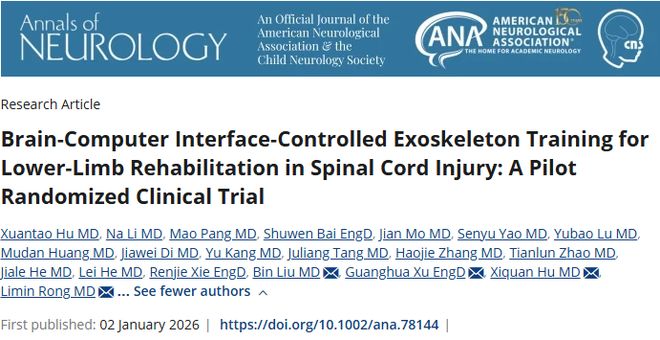
脑机接口首次被证实:显著提升脊髓损伤患者下肢运动能力
Nan Fang Du Shi Bao· 2026-01-07 03:42
Core Insights - The exploration of clinical applications related to brain-computer interfaces (BCI) is gaining traction in multiple hospitals across the country, with neurorehabilitation being a prominent area of focus [1] - A recent randomized controlled clinical study from Sun Yat-sen University Third Hospital provides preliminary evidence that BCI significantly enhances rehabilitation outcomes compared to traditional methods [3] Group 1: Clinical Research Findings - The study published in the prestigious journal Annals of Neurology confirms that BCI-controlled exoskeleton training significantly improves lower limb motor abilities and depressive symptoms in patients with spinal cord injury (SCI) [3] - The research systematically evaluates the dual role of BCI-controlled lower limb exoskeleton training in motor function recovery and cortical plasticity reconstruction for SCI patients [3] - Initial results indicate that SCI patients, even in early recovery stages, exhibit good neural interface adaptability, with BCI control accuracy reaching 95.2% and response times as short as 1.15 seconds, comparable to healthy controls [3] Group 2: Intervention Outcomes - After a 4-week intervention, the BCI-controlled exoskeleton training group (B+E) showed significantly better outcomes in key functional indicators such as lower extremity muscle strength (LEMS), walking speed (10MWT), walking endurance (6MWT), and depression scores (HADS-D) compared to the exoskeleton-only group (E) [5] - Electrophysiological analysis revealed significant enhancements in event-related desynchronization (ERD) in the μ/β band within the midline motor cortex region (FCz-Cz-CPz) for the B+E group, indicating structural remodeling of cortical networks [6] Group 3: Mechanism of Action - Unlike traditional passive training, the BCI system establishes a closed-loop pathway through real-time decoding of movement intentions and driving gait execution, significantly enhancing patients' subjective sense of participation in gait control [9] - This study provides the first evidence supporting the efficacy of BCI-controlled exoskeleton training over traditional methods in improving motor and emotional disorders in SCI patients, proposing a novel rehabilitation strategy centered on "brain-controlled driving and neural remodeling" [9] Group 4: Research Collaboration and Funding - The research was led by a team from Sun Yat-sen University Third Hospital in collaboration with Xi'an Jiaotong University, with multiple authors contributing to the study [10] - The study received funding from the National Natural Science Foundation and key research and development projects in Guangzhou [10]

苏州冰晶智能医疗科技有限公司获“A轮”融资,金额数千万人民币
Sou Hu Cai Jing· 2026-01-04 02:36
Group 1 - The core point of the article is that Suzhou Ice Crystal Intelligent Medical Technology Co., Ltd. has recently completed a Series A financing round, raising tens of millions of RMB, with participation from investment institutions that achieved excellent results in the Sichuan centralized procurement [1] - Suzhou Ice Crystal Intelligent Medical Technology Co., Ltd. was established in 2021 and is located in Suzhou, focusing on research and experimental development [1] - The company has a registered capital of approximately 6.87 million RMB and has completed its Series A financing by 2026, with the transaction amount being tens of millions of RMB [1] Group 2 - The company has made investments in 7 other enterprises and holds 12 trademark registrations and 24 patents, along with 18 administrative licenses [1] - The shareholders of Suzhou Ice Crystal Intelligent Medical Technology Co., Ltd. include Zhang Jihong and several limited partnership investment firms [1]
北京科研团队绘出全球首张中国“脑地图”
Xin Lang Cai Jing· 2026-01-03 22:20
Core Insights - A research team in Beijing has successfully created the world's first brain map specifically for the Chinese population, establishing normal reference values for 228 core brain structures, which can significantly enhance the diagnostic accuracy for neurodegenerative diseases like Alzheimer's and Parkinson's [1][2] Group 1: Research and Development - The study was a collaboration between Beijing Tiantan Hospital and Beijing Normal University, involving 105 research centers across the country, collecting nearly 28,000 high-quality MRI data samples, including over 24,000 from healthy individuals and more than 3,900 from patients with brain diseases [1] - The findings were published in the international journal Nature Neuroscience and have entered the clinical pilot phase [1] Group 2: Clinical Application - The brain map allows for precise reflection of the developmental, mature, and aging changes in the brains of the Chinese population, addressing the limitations of using Western population data which may lead to diagnostic biases [1][2] - An individualized brain health assessment system based on this research has been piloted at Tiantan Hospital, serving over 1,000 patients, and is capable of evaluating cognitive and motor functions, predicting drug and surgical efficacy, and warning of disability progression risks [2] Group 3: Future Directions - Future plans include integrating multimodal imaging, blood biomarkers, and genetic data to develop a comprehensive multimodal brain atlas system for the Chinese population, further advancing the precision diagnosis and treatment of major brain diseases [2] - The research has been patented and partnerships with several medical imaging companies have been established for clinical applications in brain health assessment and disease diagnosis [2]