家装零售

Search documents
美国30年期抵押贷款平均利率三年半来首次跌破6%!经济学家“泼冷水”:住房供应短缺仍掣肘楼市复苏
智通财经网· 2026-02-27 06:51
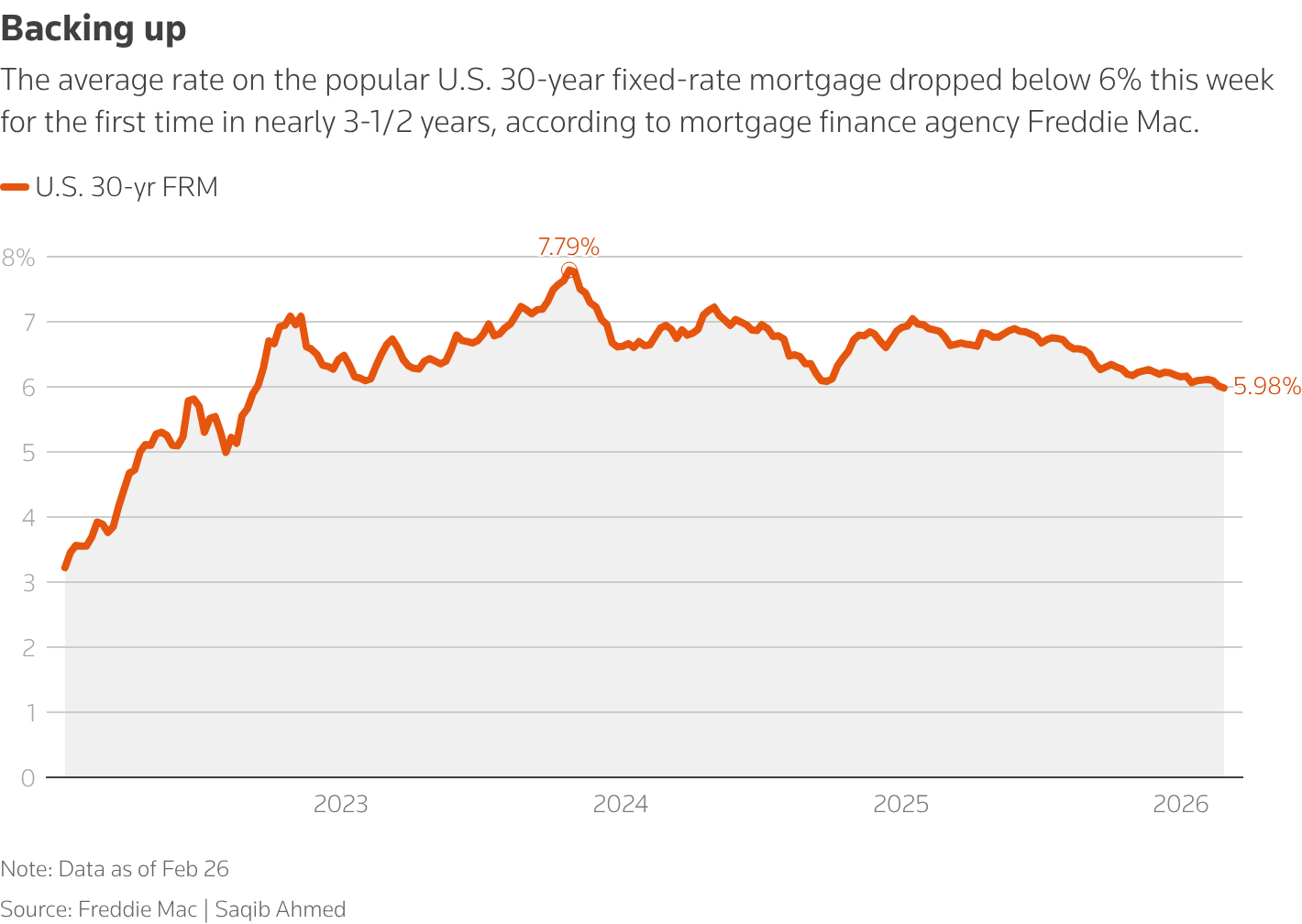
Group 1: Mortgage Rates and Housing Market - The average 30-year mortgage rate in the U.S. has fallen below 6% for the first time in three and a half years, currently at 5.98%, down from 6.01% last week and significantly lower than 6.76% a year ago [1][4] - Economists suggest that the drop in mortgage rates may be temporary and that an increase in housing supply is necessary to significantly boost housing demand [1][4] - The shortage of available homes, particularly for first-time buyers, continues to challenge the housing market, with inventory levels for existing homes remaining below pre-pandemic levels [4] Group 2: Economic and Political Context - The U.S. housing market has become a sensitive political issue, with President Trump facing pressure to address living costs ahead of the November midterm elections [4] - Trump has proposed measures to improve housing affordability, including directing the Federal Housing Finance Agency to purchase $200 billion in mortgage-backed securities [4] - Economists express skepticism about whether these mortgage purchases will significantly improve housing affordability [4] Group 3: Market Reactions and Company Performance - The decline in mortgage rates has led to an increase in refinancing activity, with some banks reporting a nearly 22% year-over-year increase in mortgage applications [5] - However, home improvement retailer Lowe's comments about ongoing pressures from interest rates and economic uncertainty have negatively impacted the stock prices of housing-related companies, with Lowe's stock dropping 5.6% [6] - Other companies in the housing sector, such as Lennar and D.R. Horton, also experienced significant stock declines, reflecting broader concerns about consumer confidence and housing turnover rates [6]


劳氏财报超预期,销售逆势增长超10%
Xin Lang Cai Jing· 2026-02-25 13:33
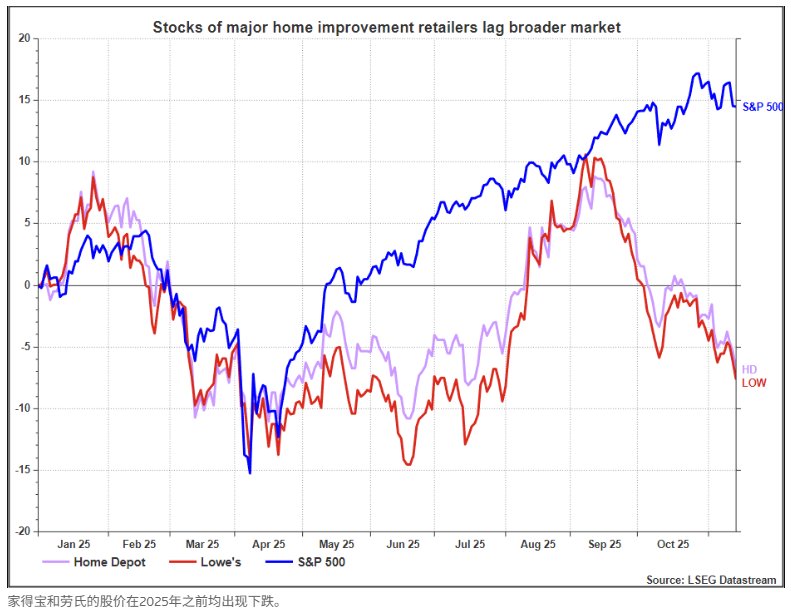
Core Viewpoint - Despite a sluggish real estate market, Lowe's reported quarterly revenue and profit that exceeded Wall Street expectations, with quarterly sales increasing by over 10% year-on-year [1][4]. Group 1: Financial Performance - The company expects total sales for the fiscal year to be between $92 billion and $94 billion, representing a growth of approximately 7% to 9% compared to the previous year [1][4]. - Adjusted earnings per share for the year are projected to be between $12.25 and $12.75, which is below the analyst consensus estimate of $12.95, leading to a decline in pre-market stock price [1][5]. - For the fourth fiscal quarter, adjusted earnings per share were $1.98, surpassing the expected $1.94, while revenue was $20.58 billion, exceeding the forecast of $20.34 billion [5]. Group 2: Sales and Growth Drivers - Same-store sales increased by 1.3%, significantly higher than the StreetAccount forecast of 0.2%, attributed to the expansion of the professional customer base, online sales, home improvement services, and strong holiday season performance [5]. - The company is focusing on controllable factors, including ongoing efficiency initiatives, to maintain market share despite challenges in the macro housing market [1][4]. Group 3: Strategic Initiatives - Lowe's has expanded its business targeting contractors and professional customers through acquisitions, which typically provide more stable revenue sources. Notable acquisitions include Foundation Building Materials for approximately $8.8 billion and Artisan Design Group for about $1.33 billion [5]. - To attract consumers delaying home purchases, Lowe's has launched a third-party e-commerce platform to diversify product offerings, leveraged social media influencers for increased exposure, and revived children's programs to engage young families [5]. Group 4: Stock Performance - As of Tuesday's close, Lowe's stock has risen nearly 16% year-to-date, significantly outperforming the S&P 500's approximately 1% increase during the same period [6]. - Over the past year, Lowe's stock has increased by about 15%, closely aligning with the S&P 500's approximately 16% gain [6].
家得宝(HD.US) Q4 可比销售额超预期增0.4% 经济“寒潮”下家装需求仍显韧性
Zhi Tong Cai Jing· 2026-02-24 12:57
Core Viewpoint - Home Depot's key sales metrics exceeded expectations due to steady demand, but macro challenges remain [1] Group 1: Financial Performance - In Q4, Home Depot reported revenue of $38.2 billion, a year-over-year decline of 3.8%, but exceeded expectations by $1 billion [1] - Adjusted earnings per share were $2.72, surpassing expectations by $0.20 [1] - Same-store sales increased by 0.4%, outperforming average expectations [1] Group 2: Market Conditions - Despite high interest rates and ongoing inflation concerns, demand for home renovation projects remains stable [1] - The company gained market share, with e-commerce achieving double-digit growth for three consecutive quarters [1] - There are early positive signs in the housing market, such as a decrease in mortgage rates and stable median home prices over the past year [1] Group 3: Future Outlook - Home Depot projects total sales growth of approximately 2.5% to 4.5% for FY2026, lower than the previous estimate of 4.06% [1] - Same-store sales growth is expected to be between 0% and 2.0% [1] - CFO Richard McPhail noted that customers have been hesitant to invest in large renovation projects for three years due to increasing uncertainty regarding housing affordability and layoff risks [1] Group 4: Strategic Initiatives - Home Depot is focusing on its faster-growing professional contractor business, which has higher spending than regular customers [3] - The company is expanding its digital business and enhancing shopping experiences with artificial intelligence [3] - To address tariff impacts, Home Depot is implementing a sourcing diversification strategy [3] Group 5: Competitive Landscape - Home Depot is the latest large retailer to report earnings in the current reporting season, with major competitor Lowe's set to release its earnings soon [3] - Walmart provided a cautious outlook, citing a fluid economic backdrop, but noted that consumer spending habits remain consistent [3]
华尔街最新押注的是具有人工智能免疫力的“光环”公司
阿尔法工场研究院· 2026-02-24 04:05
Core Viewpoint - Investors are shifting towards companies that are likely to remain resilient amid the AI revolution, favoring "hard asset, low obsolescence" firms like McDonald's and ExxonMobil, while abandoning those perceived as potential victims of AI disruption [1] Group 1: Market Trends - The S&P 500 index has seen strong performance in industrial, materials, utilities, and consumer staples sectors, significantly outperforming the broader market, while the information technology sector has declined [1] - The consumer staples sector achieved its best year-to-date performance ever as of February 20 [1] - A recent example includes AI company Anthropic's release of tools that led to a market value evaporation of approximately $300 billion in software and financial data sectors [2] Group 2: Investment Behavior - Investors are increasingly avoiding sectors they believe face significant disruption threats, leading to a rotation towards "real economy stocks" [2] - There is a notable divergence within the same industry, as seen with Delta Airlines' stock rising by 5.4% while Expedia's stock fell by 23% during the same period [3] - Despite the recent sell-off, there remains a strong influx of investment into the AI sector, with companies like Seagate and Western Digital performing well in the S&P 500 [3] Group 3: Future Outlook - Upcoming earnings reports from key players like Nvidia, Salesforce, and Home Depot are anticipated to be critical in assessing the AI investment landscape [4] - The recent volatility and concerns over excessive spending by large tech companies indicate an evolution in the AI investment frenzy, with a shift towards more discerning investment strategies [4]

创科实业跌超3% 大客户家得宝业绩逊预期 高盛料公司下半年收入增长或放缓
Zhi Tong Cai Jing· 2025-11-21 07:34
Core Viewpoint - The stock of Techtronic Industries (00669) has dropped over 3% following disappointing quarterly results from its major customer, Home Depot, which reflects a weak U.S. housing market and reduced consumer demand for home improvement products [1] Group 1: Company Performance - Techtronic Industries' stock fell by 3.5%, trading at HKD 85.4 with a transaction volume of HKD 332 million [1] - Citigroup noted that Home Depot's performance is indicative of the U.S. consumer market dynamics, and since Techtronic's business focus is on the professional sector, which accounts for about 70% of its total sales, they maintain their forecasts for the company this year [1] - Goldman Sachs expects Techtronic Industries to maintain resilient sales in the second half of the year, but revenue growth may slow down from 7% in the first half to 3% in the second half due to adjustments in the Milwaukee product line and autumn promotional activities [1] Group 2: Market Outlook - Home Depot has lowered its full-year performance guidance due to ongoing weakness in the U.S. housing market [1] - Citigroup believes that if Home Depot's performance does not meet expectations, leading to a decline in Techtronic's stock price, it could present a buying opportunity for investors [1] - Goldman Sachs maintains its forecast for Techtronic Industries' full-year revenue growth at 5% year-on-year, despite the anticipated slowdown in the second half [1]

美国消费健康状况风向标本周揭晓:家得宝(HD.US)、劳氏(LOW.US)财报将释放重要信号
Zhi Tong Cai Jing· 2025-11-18 07:01
Group 1 - Home Depot and Lowe's are expected to report slight sales growth in their upcoming quarterly earnings, providing insight into market conditions and consumer spending on home improvement and DIY projects [1] - The companies face higher raw material costs due to tariffs imposed by the Trump administration, but a temporary pause on tariffs for Chinese goods may offer short-term relief [1] - The actual tariff rate borne by American consumers has surged to 17.9%, the highest level since 1934, adding pressure to household budgets [1] Group 2 - Analysts predict Home Depot's same-store sales will grow by 1.5% in the third quarter, compared to a decline of 1.3% in the same period last year [3] - Lowe's is expected to see a 1% increase in same-store sales, up from a 1.1% decline in the previous year [4] - The stock prices of Lowe's and Home Depot have dropped approximately 16% and over 11% respectively in the past 12 months, while the S&P 500 index has risen by 15% [3] Group 3 - Demand for home improvement is anticipated to be led by professional customers, while DIY customers are expected to engage in smaller projects [6] - Home Depot and Lowe's are increasing their focus on professional contractors and builders to offset weak DIY demand during a sluggish real estate market [6] - Lowe's has made significant acquisitions, including a $1.33 billion purchase of Artisan Design and an almost $8.8 billion acquisition of Foundation Building Materials, while Home Depot announced a $4.3 billion acquisition of GMS [6]
家得宝(HD.US)将对GMS(GMS.US)收购要约期限延长至9月3日
Zhi Tong Cai Jing· 2025-08-25 13:35
Core Viewpoint - Home Depot (HD.US) has extended the cash offer deadline for acquiring all outstanding shares of GMS (GMS.US) to September 3, 2025, at a price of $110 per share, with approximately 29.3 million shares (77% of total shares) already tendered by the original deadline [1] Group 1: Acquisition Details - The acquisition was initially announced on June 29, 2025, and requires approval from Canadian regulatory authorities [1] - More than half of the outstanding shares must be tendered for the acquisition to be completed [1] Group 2: Company Overview - Home Depot operates over 2,353 stores across the US, Canada, and Mexico, with more than 800 branches and 325 distribution centers, employing over 470,000 people globally [1] - The merger is expected to create a large network with over 1,200 locations and more than 8,000 delivery vehicles, capable of completing thousands of job site deliveries daily [1] Group 3: Financial and Operational Aspects - Broadridge Corporate Issuer Solutions, LLC is acting as the depositary for the offer, while D.F. King & Co., Inc. serves as the information agent [1]

大摩:家得宝(HD.US)二季报支撑股价上涨预期 重申“增持”评级
Zhi Tong Cai Jing· 2025-08-21 07:13
Core Viewpoint - Morgan Stanley maintains an "Overweight" rating for Home Depot (HD.US) following its Q2 2025 earnings report, with a target price of $415, indicating a positive outlook for the company's stock price due to signs of revenue growth and a recovering real estate market [1][2]. Group 1: Earnings Performance - Home Depot's Q2 2025 earnings support a bullish scenario, with same-store sales increasing for the third consecutive quarter after eight quarters of decline, reflecting a bottoming out of the real estate market and the gradual fading of COVID-19 impacts [1][2]. - Excluding hurricane impacts, same-store sales showed a slight decline of 0.4%, but the average sales per transaction increased by 1.4%, indicating that tariffs have not yet affected sales [2]. - The quality of earnings per share (EPS) for Q2 2025 is considered decent, although EBIT and EPS were slightly below expectations due to higher-than-expected sales and administrative expenses offsetting improved gross margins [2]. Group 2: Future Outlook - Projections for EPS in 2026 and 2027 are expected to remain stable, with same-store sales growth anticipated at 3.6% for 2026 and 4% for 2027, leading to EPS estimates of approximately $16.30 and $17.85, respectively, reflecting annual growth rates of about 9% and 10% [3]. - Home Depot's reaffirmation of guidance for same-store sales and EPS for 2025 suggests no changes in expectations for the second half of the year, with improving inventory conditions indicating moderate upside potential [3].
分析师看好家得宝(HD.US)竞购GMS(GMS.US):有望助力布局专业市场
智通财经网· 2025-06-23 12:46
Group 1 - Home Depot (HD.US) has made an acquisition offer for GMS (GMS.US), following a previous cash offer from QXO (QXO.US) at $95.20 per share, valuing GMS at approximately $5 billion including debt [1] - Evercore ISI analyst Greg Melich noted that acquiring GMS aligns with Home Depot's strategy to expand its complex professional customer business, tapping into a total addressable market (TAM) of $1 trillion [1] - Home Depot previously acquired SRS for $18 billion earlier this year to enhance its professional ecosystem and increase market share, particularly in complex project areas [1] Group 2 - GMS's stock price surged by 33% last week due to the acquisition news [2] - Analyst Badsha Chowdhury indicated that a successful acquisition would create a "giant" in the housing and construction industry, noting that despite relatively low cash flow, GMS's balance sheet is strong enough to handle current geopolitical uncertainties [2]
朱啸虎看中的90后清华学霸,等待救援
创业邦· 2025-06-06 09:47
Core Viewpoint - The article discusses the financial crisis faced by the company "Zhu Fan Er" and the reasons behind its funding chain breakdown, highlighting the challenges in the home decoration industry and the impact of government policies on its business model [10][11][38]. Group 1: Company Background - "Zhu Fan Er" was founded in October 2015, initially focusing on light renovations for rental properties, and later expanded into media content, community e-commerce, and offline retail [4][33]. - The company received over 300 million yuan in funding across seven rounds from notable investors, including Jinsha River Venture Capital and Innovation Works [6][34]. Group 2: Financial Crisis - As of May 28, 2025, "Zhu Fan Er" publicly faced a funding crisis, with halted renovations, suspended work, and a closure of its mall, leading to a debt of approximately 100 million yuan, including over 20 million yuan owed to contractors [8][9][38]. - The CEO, Liu Xianran, attributed the funding chain breakdown to the low-profit nature of the renovation and group purchase business models, exacerbated by the introduction of a government subsidy policy that made competitors' offerings significantly cheaper [11][13]. Group 3: Business Model Challenges - The company’s group purchase model, which previously allowed it to offer prices 10%-15% lower than major platforms, became unviable after the government subsidy policy led to competitors offering prices 25%-30% lower [13][15]. - Liu Xianran explained that the company’s cash flow shifted from tens of millions of yuan in inflows to negative cash flow, resulting in a loss of 100 million yuan in cash over six months due to the policy changes [15][11]. Group 4: Operational Insights - The operational costs for the company were high, with a break-even point of 24 million yuan per month for its Beijing store, which required significant gross margins and incurred substantial expenses for rent, salaries, and marketing [15][11]. - Despite the financial turmoil, Liu Xianran and the company are actively seeking new investments and support from industry partners to avoid bankruptcy [9][38].