
工业阀门和泵制造

Search documents
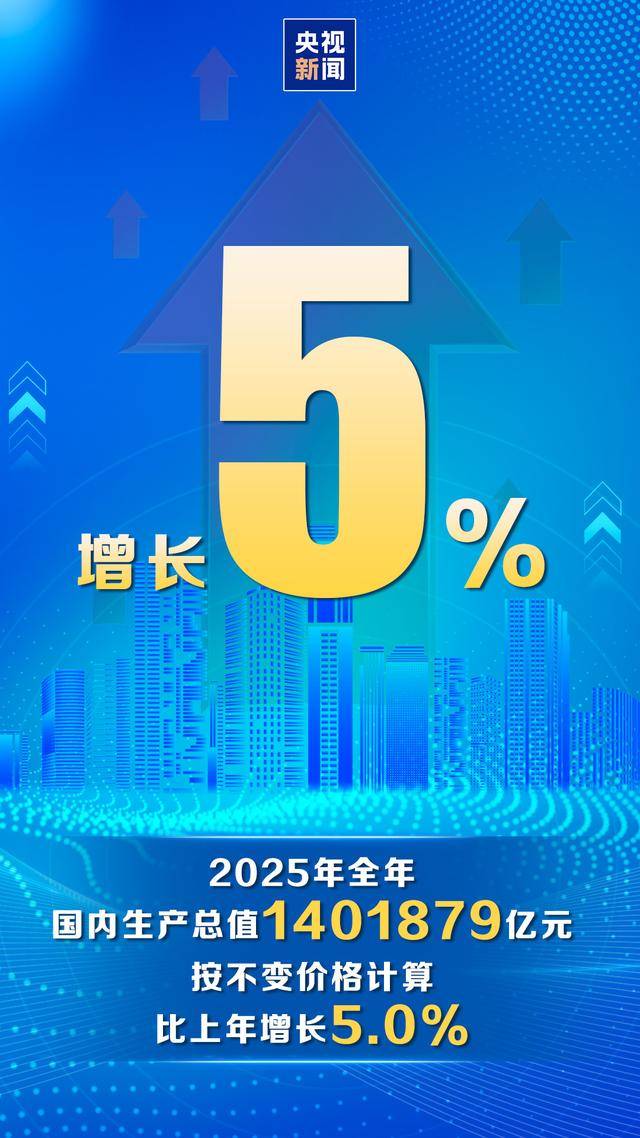
国际锐评丨看懂这个“5.0%”的含金量与新机遇
Sou Hu Cai Jing· 2026-01-19 14:42
Group 1 - China's economy demonstrates strong resilience and stability, providing significant opportunities for multinational companies amid a complex external environment [1][4] - The GDP growth target of 5.0% for 2025 is seen as a solid achievement, marking a milestone with GDP surpassing 140 trillion yuan, contributing approximately 30% to global economic growth [1][4] - Major international organizations have raised their growth forecasts for China, indicating a positive outlook from global capital, including firms like JPMorgan and BlackRock increasing their investments in Chinese assets [1][4] Group 2 - The growth is attributed to China's innovation-driven development strategy and effective government policies that have stimulated domestic demand, with consumer spending contributing over 50% to economic growth [4] - Key economic indicators show stability, with the CPI remaining flat, urban unemployment averaging 5.2%, and record high foreign exchange reserves exceeding $3.3 trillion [4][5] - China's industrial base remains solid, with foreign companies benefiting from a stable market environment, as evidenced by a 4.1% increase in sales revenue for companies like KSB [5] Group 3 - The total value of imports and exports grew by 3.8%, with per capita disposable income increasing by 5.0%, highlighting the robust market potential [5][7] - High-tech manufacturing's value added rose to 17.1%, and the R&D investment intensity surpassed the OECD average for the first time, reflecting a strong focus on innovation [5][7] - Nearly 70% of multinational companies express confidence in their future in China, with 94% committed to investing in the Chinese market, indicating a favorable business climate [8]

【国际锐评】看懂这个“5.0%”的含金量与新机遇
Sou Hu Cai Jing· 2026-01-19 14:31
Group 1 - China's economy is showing strong resilience and is expected to achieve a GDP growth of 5.0% in 2025, marking a significant milestone as it surpasses 140 trillion yuan [1][2] - The contribution of China's economy to global growth is projected to reach around 30%, with major international organizations raising their growth forecasts for China [1][2] - The implementation of innovation-driven development strategies and precise government policies have played a crucial role in promoting high-quality economic growth, with final consumption contributing over 50% to economic growth [2][3] Group 2 - China's industrial sector remains stable, with all three major industries showing growth despite external challenges, and the average urban unemployment rate is stable at 5.2% [2][3] - The total value of goods imports and exports increased by 3.8%, and the actual growth of per capita disposable income for residents was 5.0% [3][4] - High-tech manufacturing's value added has risen to 17.1%, and the growth of digital product manufacturing value added was 9.3% [3][4] Group 3 - Nearly 70% of multinational companies express confidence in their development prospects in China over the next 3 to 5 years, with 94% committed to investing in the Chinese market [5][6] - China's market is viewed as a stable anchor and a source of future innovation, prompting companies to increase their investments in the region [4][5] - The ongoing reduction of the negative list for market access and the expansion of visa-free travel are facilitating trade and cooperation, enhancing China's attractiveness to foreign businesses [4][6]
下一个五年 这两个字更重要
Zhong Guo Xin Wen Wang· 2025-10-28 00:14
Group 1 - The core viewpoint emphasizes that "expanding high-level opening-up" has been elevated in importance within China's 14th Five-Year Plan, reflecting a proactive choice amid geopolitical risks and trade protectionism [1][2] - The opening-up is primarily aimed at promoting China's own development, with a target of reaching a goods trade scale of $6.16 trillion and service trade exceeding $1 trillion by 2024 [2][3] - High-level opening-up has become a strong driving force for China's economic development [3] Group 2 - The nature of opening-up is undergoing a structural transformation, shifting from merely removing barriers to establishing rules [4][5] - China is transitioning from being a follower to a leader in global standards and rules, particularly in fields like artificial intelligence, quantum computing, and advanced manufacturing [5][6] - The next five years will see strategic deployments in three pillars of trade: goods, services, and digital trade [6][7] Group 3 - Emerging fields such as service trade and digital trade are becoming new frontiers for high-level opening-up [7][8] - Technologies like artificial intelligence and digital tools are reshaping traditional trade organization and resource allocation, enhancing certainty and resilience in opening-up [8] Group 4 - China's opening-up strategy is diversifying and is no longer reliant on a single market, with increasing trade with Belt and Road Initiative countries and significant growth in trade with ASEAN following the RCEP agreement [9] - The emphasis on "active" opening-up indicates a shift from compliance-based to a more proactive approach, enhancing foreign investment confidence [9][10] - The total foreign direct investment in China from 2021 to May 2025 is projected to reach 4.7 trillion yuan, surpassing the total during the previous five-year plan [9][10] Group 5 - Investment in China is becoming a necessity for multinational companies, with foreign firms expressing increased confidence in the Chinese market due to the emphasis on opening-up and innovation [10] - China's high-level opening-up not only drives its own development but also plays a stabilizing role in global connectivity, creating a mutually beneficial rule system for broader market access and investment opportunities [10]
国际锐评丨中国“新”引擎为世界注入新动能
Yang Shi Xin Wen Ke Hu Duan· 2025-10-26 01:51
Group 1 - The 20th Central Committee of the Communist Party of China emphasizes the importance of high-level technological self-reliance and the development of new quality productivity, which has garnered significant international attention [1][2] - The focus on "new quality productivity" reflects China's commitment to high-quality development and the role of technology in driving this transformation, which is seen as a guiding direction for global development [1][2] - Over the past five years, China's high-tech industry has grown to over 500,000 companies, with 26 of the world's top 100 technology innovation clusters located in China, indicating a strong emphasis on innovation-driven economic growth [1][2] Group 2 - The strategic layout for developing new quality productivity during the 14th Five-Year Plan includes strengthening original innovation, integrating technological and industrial innovation, and advancing digital transformation [2][3] - China aims to leverage its large market of over 1.4 billion people and 400 million middle-income individuals to enhance traditional industries through digital technologies and foster new industries in fields like quantum and biotechnology [2][3] - Foreign companies operating in China, such as KSB and Dassault Systèmes, are experiencing significant growth and investment opportunities due to the clear policy direction provided by the Central Committee [3][4] Group 3 - China's contribution to global economic growth has averaged around 30% over the past five years, with significant advancements in emerging industries like artificial intelligence and renewable energy [4] - The integration of industrial and technological advancements in China is expected to create more opportunities for global collaboration and drive other countries towards digital, intelligent, and green transformations [3][4] - Companies like BYD are expanding their global footprint, with their electric vehicles reaching 116 countries, contributing to sustainable development and creating job opportunities through industrial upgrades [3][4]