生物科技与制药

Search documents
国泰海通|医药:美国医药调研及JPM大会后反馈
国泰海通证券研究· 2026-02-06 12:17
Macro and Industry Environment - The policy uncertainty has temporarily settled, and significant clinical data continues to be released, leading to a notable recovery in risk appetite for innovative drugs. The biotech and pharmaceutical sectors in the US stock market are expected to strengthen significantly by Q4 2025, with improved investor sentiment towards innovative drug investments in 2026 [1] - There has been heightened activity in MNC BD transactions around the JPM conference, with an increasing share and capability of Chinese innovative drug assets in global transactions, indicating their growing attractiveness in the global innovation ecosystem [1] Oncology - The certainty around PD-1/VEGF dual antibodies is rising, transitioning from "mechanism validation" to "clinical and industrial resonance." Multiple MNCs are advancing several global Phase III trials for high-value indications like NSCLC, with approvals and data readouts expected to be key catalysts within the year [1] - The Pan-RAS precision therapy is advancing systematically for pancreatic cancer and NSCLC in first-line, second-line, and combination therapies, with critical Phase III data anticipated in 2026, marking a significant realization period for this direction [1] Weight Management and Metabolism - In the context of limited insurance coverage and high out-of-pocket costs for obesity indications in the US, the cash-pay population is becoming a significant source for the GLP-1 market expansion. Pharmaceutical companies are actively enhancing accessibility through direct sales platforms, pricing adjustments, and multi-channel distribution to unleash demand elasticity [2] - The small nucleic acid approach in weight management represents a mid-term upgrade variable, with its potential to improve weight loss quality and fat distribution when combined with GLP-1, possibly evolving weight management treatment from a "single hormone-driven" to a "multi-pathway regulation" model [2] Autoimmunity - The concentration risk of MNC's major products in the autoimmune sector is becoming evident, with increasing reliance on a few blockbuster products. The income concentration risk is gradually surfacing against the backdrop of patent cycles and intensifying competition [2] - Incremental opportunities are emerging from two main paths: the new generation antibody platforms (dual antibodies/multi-antibodies, B cell depletion, etc.) are expected to yield dense POC data readouts in 2026, potentially triggering a new round of BD and asset revaluation [2] - The trend towards oral formulations is becoming clearer, with the long-term medication nature of autoimmune diseases providing natural advantages in adherence and differentiated competition for oral dosage forms. Various technological routes such as BTK, TYK2/JAK, oral PROTAC, oral cyclic peptides, and PDE4 are worth continuous tracking [2] CNS - The core investment theme in the CNS field remains focused on the advancement of A β monoclonal antibody treatment from early symptom populations to preclinical AD. Eli Lilly's Donanemab-related Phase III data is expected to be a key catalyst for opening up the "early intervention" market space [3] - Previous data indicates that populations with low to moderate tau and earlier stages show better efficacy and safety windows. Additionally, next-generation A β therapies, represented by Roche's Trontinemab, are expected to achieve stronger clearance effects and better safety at lower doses and shorter treatment durations, potentially raising the ceiling for AD treatment [3] - Systemic delivery of small nucleic acids and other new pathways are seen as supplementary directions, reflecting innovations in mid- to long-term delivery methods [3]


港股科技投资迎来新“坐标”港交所科技100指数发布 联想、宁德时代等入选
智通财经网· 2025-12-09 10:25
Core Viewpoint - The Hong Kong Stock Exchange (HKEX) has launched the HKEX Technology 100 Index, marking its first technology-focused stock index for Hong Kong stocks [1][2] Group 1: Index Composition and Criteria - The HKEX Technology 100 Index includes the largest 100 technology companies listed on the Hong Kong Stock Exchange, covering sectors such as artificial intelligence, biotechnology, electric vehicles, information technology, internet, and robotics [1] - Component stocks must meet specific liquidity and R&D growth criteria: an average daily trading volume of at least HKD 20 million over the past six months and either R&D spending exceeding 3% of revenue or revenue growth exceeding 5% over the past two years [1][2] - Notable companies included in the index are Tencent Holdings, Alibaba Group, BYD Company, and Meituan, among others [1] Group 2: Index Calculation and Adjustment - The index uses a free-float market capitalization weighting method, with a maximum weight of 12% for any single component stock [2] - Component stocks will be adjusted biannually in June and December, with data cut-off dates on the last trading day of April and October each year [2] - Stocks with an average daily trading amount below HKD 20 million over the past six months or those ranking in the bottom 10% by trading volume will be excluded [2] Group 3: Market Implications - The index aims to identify technology stocks with market momentum and growth potential, which may enhance the development of related products in the mainland Chinese market [2] - It addresses the strong demand from mainland investors for opportunities in the Hong Kong technology sector, aligning with the investment needs of southbound capital [2]






港股科技投资迎来新“坐标”港交所科技100指数发布 联想(00992)、宁德时代(03750)等入选
智通财经网· 2025-12-09 10:22
Core Viewpoint - The Hong Kong Stock Exchange (HKEX) has launched the Hong Kong Stock Exchange Technology 100 Index, marking its first technology-focused stock index [1] Group 1: Index Composition and Criteria - The Technology 100 Index includes stocks that meet specific liquidity and R&D growth criteria: an average daily trading volume of at least HKD 20 million over the past six months and R&D expenditure accounting for over 3% of revenue or revenue growth exceeding 5% over the past two years [1][2] - Selected companies include major players such as Tencent Holdings, Alibaba Group, CATL, Lenovo Group, Xiaomi Group, BYD, Meituan, SMIC, and WuXi AppTec [1] Group 2: Index Methodology - The index is calculated using a free-float market capitalization weighting method, with a maximum weight of 12% for any single constituent [2] - Constituents will be reviewed and adjusted biannually in June and December, with data cut-off dates on the last trading day of April and October [2] - The index aims to select technology stocks with market interest and growth potential, catering to the demand from mainland investors for technology investment opportunities in the Hong Kong market [2]

港股科技投资迎来新“坐标”港交所科技100指数发布 腾讯、联想、宁德时代等入选
Ge Long Hui· 2025-12-09 10:17
Core Viewpoint - Hong Kong Exchanges and Clearing Limited (HKEX) has launched the Hang Seng Tech 100 Index, the first index for Hong Kong stocks, which tracks the performance of the largest 100 technology companies listed on the Hong Kong Stock Exchange [1] Group 1: Index Composition and Criteria - The Hang Seng Tech 100 Index includes companies that meet specific liquidity and growth criteria: a minimum average daily trading volume of HKD 20 million over the past six months and either R&D expenditure accounting for over 3% of revenue or revenue growth exceeding 5% over the past two years [1][2] - Selected companies include major players such as Tencent Holdings, Alibaba Group, BYD Company, and Xiaomi Group, among others [1] - The index covers six innovation themes: artificial intelligence, biotechnology and pharmaceuticals, electric vehicles and smart driving, information technology, internet, and robotics [1] Group 2: Index Methodology and Adjustments - The index uses a free-float market capitalization weighting method, with a cap of 12% on the weight of any single constituent [1] - Constituents are reviewed and adjusted biannually, with data cut-off dates at the end of April and October each year [1] Group 3: Liquidity and Fundamental Requirements - The index has strict liquidity and fundamental requirements: securities with an average daily trading amount below HKD 20 million or ranking in the bottom 10% by trading volume will be excluded [2] - Companies with R&D spending below 3% of revenue or revenue growth below 5% over the past two fiscal years will also be excluded, although companies listed under Chapter 18A or 18C may be exempt from these fundamental requirements [2] - This design aims to select technology stocks with market interest and growth potential, facilitating the development of related products in the mainland Chinese market and meeting the demand for technology investments from mainland investors [2]
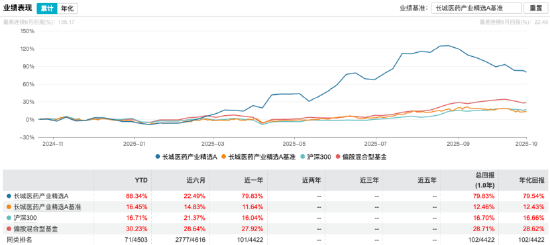
长城医药产业精选A三季度涨15%,加仓信达生物、三生制药,基金经理梁福睿:当前创新药个股极具性价比
Xin Lang Ji Jin· 2025-10-23 07:52
Core Insights - The report highlights the performance of the Changcheng Pharmaceutical Industry Selected Mixed A Fund, which has shown significant growth in equity scale, particularly in the technology sector, despite recent market adjustments [1][3]. Performance Analysis - As of October 22, 2025, the fund's unit net value is 1.7983, with a cumulative return of 79.83% since its establishment on October 22, 2024, and a year-to-date increase of 88.34% [1][3]. - The fund has experienced a notable decline of -8.81% over the past month and -14.29% over the last three months, indicating challenges faced by the pharmaceutical sector, especially in the innovative drug field during the third quarter [3][4]. Portfolio Composition - The top ten holdings of the fund have a combined market value of 1.313 billion, heavily concentrated in the innovative drug sector, which differs from the asset allocation logic of technology funds [4]. - The top three holdings include Innovent Biologics, 3SBio, and Hotgen Biotech, with a clear focus on biotechnology and innovative pharmaceutical companies [5]. Investment Strategy - The fund manager, Liang Furui, noted that the A/H market saw multiple sectors rise, primarily driven by technology and precious metals, with an average daily trading volume in the A-share market exceeding 2 trillion [5]. - Despite the strong performance of technology sectors, innovative drugs have entered a correction phase due to significant gains in the first half of the year and negative impacts from TMT-focused capital outflows [5][6]. - Liang Furui emphasized that many innovative drug stocks are now highly cost-effective, suggesting a shift towards selecting individual stocks with genuine competitive advantages as the sector moves into an "individual alpha phase" [6]. Future Outlook - The focus will be on increasing the weight of stocks with global competitiveness and scarcity in core pipelines, balancing long-term potential, drug certainty, and international market viability [6].