航天航空装备

Search documents
独角戏 | 谈股论金
水皮More· 2026-03-11 10:33
Market Overview - The A-share market saw all three major indices rise today, with the Shanghai Composite Index up 0.25% to close at 4133.43 points, the Shenzhen Component Index up 0.78% to 14465.41 points, and the ChiNext Index up 1.31% to 3349.53 points. The total trading volume in the Shanghai and Shenzhen markets reached 25.285 billion, an increase of 1.114 billion from the previous day [1][2]. Index Performance - Despite the rise in indices, the majority of individual stocks experienced declines, with a median drop of 0.50%. A total of 1955 stocks rose while 3157 stocks fell. The strong index performance was primarily driven by heavyweight stocks, particularly in the Shenzhen market, where "Ning Wang" (Ningde Times) surged 5.45%, positively impacting BYD and Sunshine Power [2][3]. Sector Analysis - The oil and gas sector rebounded today, while sectors such as aerospace equipment and semiconductor technology stocks faced adjustments. The performance of heavyweight stocks, including major banks and state-owned enterprises, provided support to the indices, but did not lead to a broad market rally [2][3]. International Market Context - Internationally, U.S. indices showed a pattern of rising and then retreating, with moderate declines. In the Asia-Pacific region, the Nikkei Index rose 1.43% and the Korean Index rose 1.40%, while the Hang Seng Index opened high but closed down 0.24% due to a cooling off of the "shrimp farming" concept related to AI tools [3][4]. Conclusion - The market dynamics reflect a scenario where heavyweight stocks are influencing index performance, while the majority of individual stocks are underperforming. The contrasting movements of key stocks, referred to as "Wang Bu Jian Wang" (King does not see King), highlight the divergence in market behavior [4].


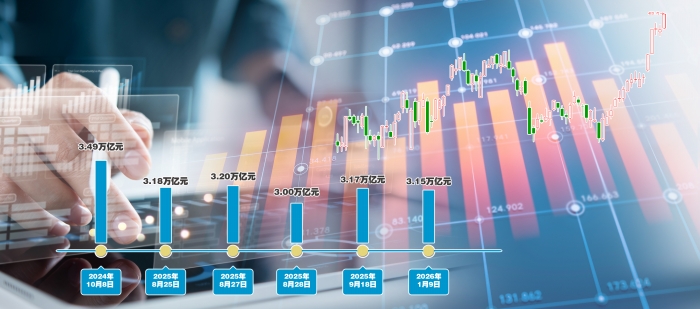
沪指强势攀升站上4100点A股单日成交额第6次突破3万亿元
Shang Hai Zheng Quan Bao· 2026-01-09 18:38
Market Overview - The A-share market continues its strong upward trend, with the Shanghai Composite Index successfully surpassing the 4100-point mark, reaching its highest level since July 2015 [2] - A-share daily trading volume exceeded 3 trillion yuan for the sixth time in history, signaling strong bullish sentiment in the market [2][3] Index Performance - Major indices closed in the green, with the Shanghai Composite Index rising by 0.92% to 4120.43 points, the Shenzhen Component Index up 1.15% to 14120.15 points, and the ChiNext Index increasing by 0.77% to 3327.81 points [3] - Since the beginning of 2026, the Shanghai Composite Index has accumulated a rise of 3.82%, while the Shenzhen Component Index has increased by 4.40% [3] Margin Trading - The margin trading balance in A-shares has surpassed 2.6 trillion yuan, reaching a historical high of 26206.09 billion yuan, indicating a strong enthusiasm for leveraged funds [4] - On January 8, the margin trading transaction volume was 3126.04 billion yuan, accounting for 11.05% of the total A-share trading volume [4] Sector Focus - The commercial aerospace sector has seen significant growth, with companies like Galaxy Electronics and China First Heavy Industries achieving consecutive gains [6] - The AI application sector is also thriving, with companies like Yidian Tianxia reaching historical highs and benefiting from recent positive developments in AI technology [6] - The humanoid robot concept has shown strong performance, particularly with Fenglong Co., which has experienced an 11-day consecutive rise due to a major acquisition by UBTECH Robotics [6] Commodity Prices - The non-ferrous metals sector is performing well, with small metal concepts rising sharply, as evidenced by the price increases of tungsten products [7] Institutional Insights - Despite major indices reaching new highs, approximately 90% of individual stocks have not yet surpassed their highest closing prices from September 2024 to the end of 2025, indicating a concentrated market rally [8] - Various sectors, including non-ferrous metals, military industry, and AI computing, have seen stocks break previous highs, while technology growth and consumer sectors remain below their peaks [8]