航空运输服务

Search documents
迪拜国际机场2025年接待旅客9520万人次
Jin Rong Jie· 2026-02-11 04:16
Core Insights - Dubai International Airport (DXB) is projected to receive 95.2 million passengers by 2025, reflecting a year-on-year growth of 3.1% [1] Group 1 - The expected passenger volume for DXB in 2025 is 95.2 million [1] - The growth rate of 3.1% indicates a steady increase in passenger traffic [1]
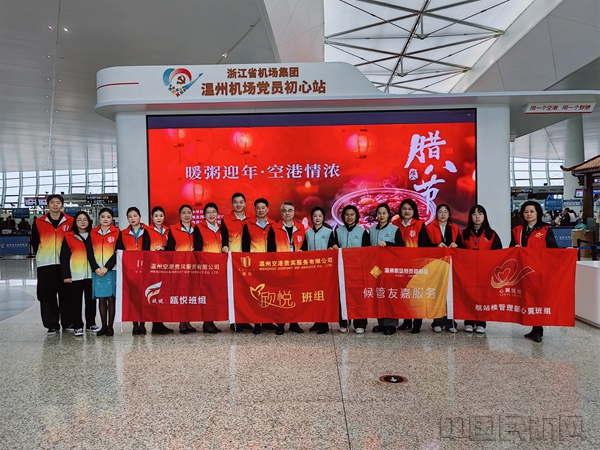
温州空港贵宾服务有限公司腊八暖心服务护航春运
Zhong Guo Min Hang Wang· 2026-01-26 08:07
Core Viewpoint - The event "Warm Porridge Welcomes the Year, Airport Affection Deepens" was organized by Zhejiang VIP Company in collaboration with various local organizations to provide warmth and support to travelers and frontline workers during the holiday season [1][3]. Group 1 - The event took place on January 26, coinciding with the traditional Laba Festival, at the T2 terminal of Wenzhou Airport, where volunteers distributed Laba porridge and offered travel assistance [1][2]. - The initiative combined traditional cultural practices with travel support, receiving positive feedback from travelers who appreciated the "home-like warmth" during their journeys [2][3]. - The activity was led by party organizations and highlighted the responsibility of airport units in community service and travel assurance, with plans for continued collaboration to enhance traveler experiences during the Spring Festival travel season [4].

华夏时评:央企大手笔重组,国资从“做大”到“做强”
Hua Xia Shi Bao· 2026-01-09 13:16
Core Viewpoint - The restructuring of China Petroleum and Chemical Corporation (Sinopec) and China Aviation Oil Group marks a significant step in the acceleration of state-owned enterprise (SOE) reforms, aligning with the goals set forth in the 14th and 15th Five-Year Plans [2][3] Group 1: Restructuring and Reform - The restructuring of Sinopec and China Aviation Oil is part of a broader trend of strategic mergers among central enterprises, with six groups of ten SOEs undergoing strategic restructuring during the 14th Five-Year Plan [2] - This merger integrates the entire industrial chain from crude oil refining to aircraft refueling, enhancing energy security for the aviation industry and boosting international competitiveness in aviation fuel [2] Group 2: Characteristics of the 15th Five-Year Plan - The 15th Five-Year Plan is characterized by four overlapping phases: strategic function enhancement, deep transformation, risk prevention, and seizing opportunity windows [3] - Central enterprises are expected to elevate their strategic capabilities and support the modernization of China while focusing on reform and innovation to achieve quality and efficiency improvements [3] Group 3: Key Tasks for Central Enterprises - Central enterprises must focus on effective investment expansion, particularly in key areas such as infrastructure, energy resource security, and emerging industries, to support domestic demand and stabilize employment [4] - The restructuring of Sinopec and China Aviation Oil aligns with the goals of ensuring energy resource supply and fostering development across the industrial chain [4] Group 4: Future Development and Innovation - Central enterprises are positioned as key players in national technological innovation and will focus on developing new productive forces, particularly in artificial intelligence, new energy, and advanced manufacturing [5] - The challenge lies in nurturing emerging and future industries that are large enough, fast-growing, and promising, as part of the ongoing transformation to strengthen and optimize state-owned enterprises [5]


中国石化与中国航油实施重组,释放哪些信号?
Zhong Guo Hua Gong Bao· 2026-01-09 09:40
Core Viewpoint - The restructuring of China Petroleum & Chemical Corporation (Sinopec) and China Aviation Oil Holding Company marks the first major state-owned enterprise (SOE) restructuring in 2026, signaling the beginning of deeper reforms in China's state-owned economy [1] Group 1: Restructuring Details - The merger aims to enhance the integration of aviation fuel production and sales, allowing Sinopec to streamline its operations and improve inventory management, thereby reducing costs and increasing efficiency [2] - The restructuring is expected to strengthen the competitive position of SOEs in the global market, particularly in response to complex international environments [1][2] Group 2: Market Potential - With the rapid development of new energy sources, demand for aviation kerosene is projected to grow, with estimates suggesting a need of approximately 50 million tons by 2030, reflecting an average annual growth rate of about 4% during the 14th Five-Year Plan [2] - China has the potential for significant growth in air travel frequency, currently at 0.6 trips per person per year, compared to developed countries, indicating a robust future demand for aviation fuel [2] Group 3: Sustainable Aviation Fuel (SAF) - The restructuring will facilitate the entire supply chain for sustainable aviation fuel (SAF), positioning the companies to capitalize on the global shift towards low-carbon solutions [3] - Sinopec is recognized as the first Asian company to develop and commercialize bio-jet fuel production technology, while China Aviation Oil plays a crucial role in the promotion and application of SAF [3]
2026央企重组“第一枪”,巨头崛起!
Zhong Guo Dian Li Bao· 2026-01-09 06:15
Core Viewpoint - The merger between Sinopec and China Aviation Oil marks a significant move in the energy sector, aiming to create a new giant in "green aviation fuel" while enhancing supply security and low-carbon competitiveness in the aviation industry [1][4]. Group 1: Merger Details - The merger was approved by the State Council on January 8, 2026, positioning Sinopec as the world's largest refining company and China Aviation Oil as Asia's largest aviation fuel service provider [1][2]. - China Aviation Oil has been involved in discussions regarding a merger since October 2025, with Sinopec identified as the potential acquirer of all its assets and operations [2][3]. - The merger is expected to streamline operations by reducing intermediaries and lowering supply costs, creating a strategic complementarity between the two companies [3][4]. Group 2: Market Context - The global aviation industry is experiencing a strong recovery, with aviation fuel demand projected to reach 389 million tons in 2025, a 3.9% increase year-on-year [2]. - By 2040, China's aviation fuel consumption is forecasted to grow from 3,928 million tons in 2024 to 7,500 million tons, highlighting the increasing demand for aviation fuel [3][4]. - The merger aims to enhance the competitiveness of China's aviation fuel sector, which currently faces challenges compared to integrated international oil companies like Shell and ExxonMobil [4][5]. Group 3: Green Transition - The merger is seen as a strategic move to strengthen the sustainable aviation fuel (SAF) industry, which is crucial for reducing carbon emissions in the aviation sector [5][6]. - Sinopec is recognized as a pioneer in SAF production in China, with its products already tested on domestic aircraft, offering a potential for over 50% reduction in carbon emissions compared to traditional aviation fuel [5][6]. - The collaboration between Sinopec and China Aviation Oil is expected to enhance R&D, industrialization, and international trade in SAF, promoting its adoption and continuous improvement [5][6].
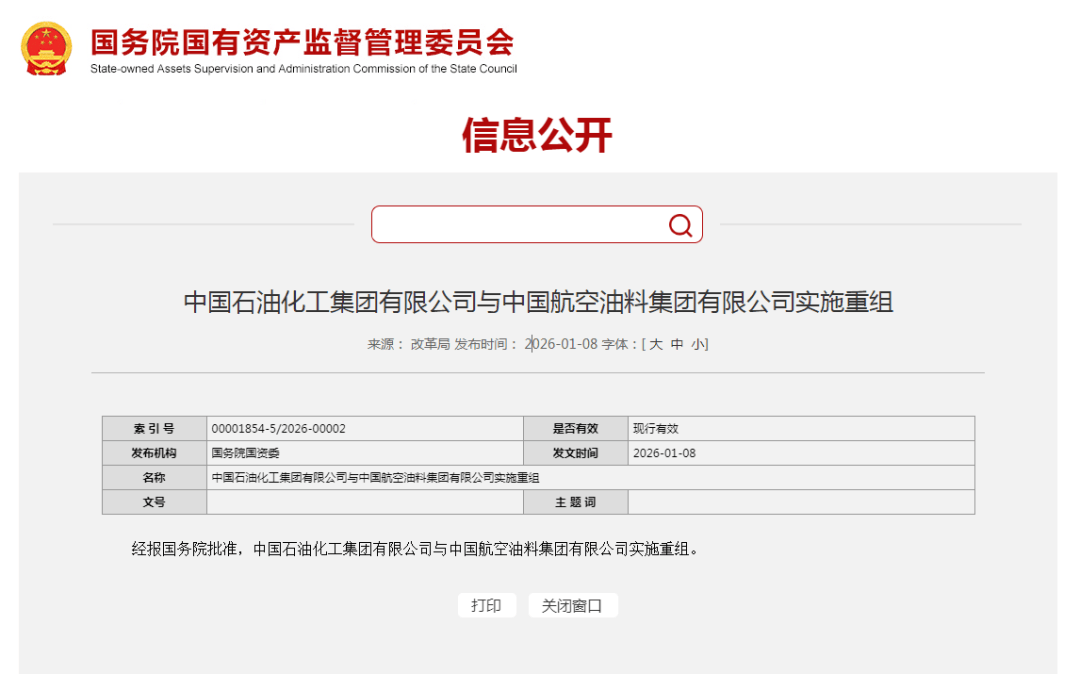
2026年央企重组首单落地 中国石化“签手”中国航油
Ren Min Wang· 2026-01-09 05:57
Core Viewpoint - The restructuring of China Petroleum & Chemical Corporation (Sinopec) and China Aviation Oil Group (China Aviation Oil) is expected to enhance the competitiveness of China's aviation fuel industry and promote a green and low-carbon transition in the aviation sector [2][4]. Group 1: Company Overview - Sinopec is the world's largest refining company and China's largest aviation fuel producer, covering the entire energy industry chain including oil and gas exploration, refining, and equipment manufacturing [4]. - China Aviation Oil is Asia's largest integrated aviation fuel supply chain company, involved in procurement, transportation, storage, testing, sales, and refueling services [4]. Group 2: Strategic Implications - The merger is anticipated to lower aviation fuel supply costs and create a synergistic effect between refining and aviation fuel sectors, avoiding homogeneous competition [4][5]. - The restructuring aligns with the national strategy to optimize state-owned enterprises and enhance their core competitiveness, potentially leading to further professional integration across various sectors [5][6]. Group 3: Environmental Considerations - The partnership is expected to accelerate the commercialization of sustainable aviation fuel (SAF), aiding the aviation industry in achieving carbon reduction goals [5]. - The focus on low-carbon development in the civil aviation sector is increasingly important in response to global climate change, with SAF being a key measure for carbon emission reduction [4][5]. Group 4: Future Outlook - Future central enterprise restructuring will prioritize enhancing core competitive capabilities rather than merely increasing asset size, focusing on resilience and security in supply chains [6]. - The integration will likely delve into specific critical segments of the industry and high-end niche markets, fostering an open and collaborative industrial ecosystem [6].
“绿色航油”巨头崛起!中国石化、中国航油官宣重组
Zhong Guo Dian Li Bao· 2026-01-09 05:50
Core Viewpoint - The merger between China Petroleum & Chemical Corporation (Sinopec) and China Aviation Oil Group (China Aviation Oil) marks a significant strategic move in the energy sector, aiming to create a new giant in "green aviation fuel" while enhancing fuel supply security for the aviation industry and increasing low-carbon competitiveness in international markets [1][5][7]. Group 1: Merger Details - The merger was approved by the State Council and is seen as a collaboration between the world's largest refining company and Asia's largest aviation fuel service provider [1][3]. - China Aviation Oil is the largest integrated aviation fuel service provider in Asia, while Sinopec is the largest aviation fuel producer in China, covering various sectors including oil and gas, logistics, and aviation [3][4]. - The merger is expected to streamline operations and reduce costs by eliminating intermediaries, thus enhancing the efficiency of the entire supply chain from refining to distribution [4][6]. Group 2: Market Context - The global aviation industry is experiencing a strong recovery, with a projected demand for aviation fuel of 389 million tons in 2025, reflecting a year-on-year increase of 3.9% [3][4]. - By 2040, China's aviation fuel consumption is expected to grow from 39.28 million tons in 2024 to 75 million tons, indicating a significant increase in demand [4][6]. - The merger is a strategic response to the competitive landscape dominated by integrated oil and gas companies like Shell and ExxonMobil, which have established advantages in the aviation fuel market [6][7]. Group 3: Green Transition - The merger is positioned as a critical step towards enhancing the competitiveness of China's aviation fuel industry and promoting green transformation [5][7]. - Sustainable aviation fuel (SAF) is recognized as a key pathway for reducing carbon emissions in the aviation sector, with global SAF consumption projected to reach 1.8 million tons by 2030 [7]. - Sinopec is noted for being one of the first companies in China to produce SAF, which can reduce carbon emissions by over 50% compared to traditional aviation fuel [7][8]. Group 4: Strategic Implications - This merger is part of a broader initiative to optimize the layout of state-owned enterprises and concentrate state capital in critical industries related to national security and economic lifelines [8]. - The restructuring aligns with the strategic goals set forth by the State-owned Assets Supervision and Administration Commission (SASAC) to enhance the core functions and competitiveness of state-owned enterprises [8].
国新证券每日晨报-20260109
Guoxin Securities Co., Ltd· 2026-01-09 03:46
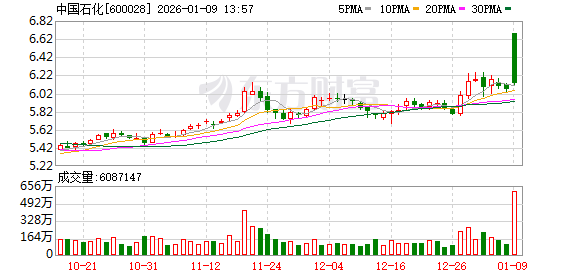
Domestic Market Overview - The domestic market experienced a slight decline with the Shanghai Composite Index closing at 4082.98 points, down 0.07%, and the Shenzhen Component Index at 13959.48 points, down 0.51% [1][5] - Among 30 sectors, 19 saw gains, with notable increases in defense, media, and real estate, while non-bank financials, non-ferrous metals, and banking sectors faced significant declines [1][5] - The total trading volume for the A-share market was approximately 282.63 billion yuan, showing a slight decrease from the previous day [1][5] Overseas Market Overview - The U.S. stock indices showed mixed results, with the Dow Jones rising by 0.55% and the Nasdaq falling by 0.44%, while Nvidia dropped over 2% [2][5] - Chinese concept stocks mostly rose, with Century Internet increasing by nearly 11% [2][5] Key News - China Petrochemical Corporation and China Aviation Oil Corporation are undergoing a merger, which is expected to enhance operational efficiencies and reduce supply costs in the aviation fuel sector [11][12][14] - Gold has reportedly surpassed U.S. Treasury bonds to become the world's largest reserve asset for the first time in 30 years, with a value of approximately 3.93 trillion USD compared to 3.88 trillion USD in U.S. bonds [10][17][18] - The Ministry of Industry and Information Technology convened a meeting to discuss the regulation of competition in the energy storage battery industry, aiming to address irrational competition and ensure sustainable development [19][20]
央企“巨无霸”重组启幕!超2000亿元航空燃油市场或将重构
Zheng Quan Shi Bao· 2026-01-08 22:53
Group 1 - The core viewpoint of the news is the restructuring of Sinopec and China Aviation Oil, which is expected to reshape the trillion-level energy and chemical market and enhance the competitiveness of state-owned enterprises [1][4][5] - The restructuring is seen as a response to the historical turning point in China's refined oil consumption, driven by the rapid development of the new energy vehicle industry and the electrification of end-use energy [2][3] - Sinopec's integration with China Aviation Oil aims to create a vertically integrated supply chain from refinery to wing, enhancing operational resilience and market competitiveness [4][6][7] Group 2 - The aviation fuel market is projected to grow, with China expected to consume approximately 40 million tons of aviation fuel in 2024, reflecting a 13% year-on-year increase [3] - The restructuring may lead to a redistribution of market share among major energy state-owned enterprises in the aviation fuel segment, providing Sinopec with new growth opportunities [3][6] - The integration is anticipated to improve the stability of aviation fuel supply for airlines, potentially reducing transaction costs and maximizing efficiency [6][9] Group 3 - The restructuring is part of a broader trend of state-owned enterprise consolidation aimed at optimizing the layout of state-owned economies and enhancing operational efficiency [5][8] - There are concerns among airlines regarding the potential impact on their bargaining power and cost control due to the consolidation of aviation fuel supply [9][10] - The restructuring may prompt a reevaluation of market strategies among airlines, especially if it leads to a dominant player in the aviation fuel market [9][10]
经国务院批准,中国石化集团与中国航油集团实施重组
Sou Hu Cai Jing· 2026-01-08 20:22
Group 1 - China Petroleum & Chemical Corporation (Sinopec) was established in July 1983 and restructured in July 1998, becoming a large integrated energy and chemical group with a registered capital of 326.5 billion RMB [1] - China National Aviation Fuel Group (China Aviation Oil) was formed in 2002 and is the largest aviation fuel service provider in Asia, involved in procurement, transportation, storage, testing, sales, and refueling [1] - The merger between Sinopec and China Aviation Oil is expected to enhance the resilience of the aviation fuel supply chain and ensure energy security for the aviation industry [1] Group 2 - The collaboration between Sinopec and China Aviation Oil aims to strengthen China's international competitiveness in the aviation fuel industry, which currently lags behind major global players like Shell and BP [2] - The merger is anticipated to promote the high-quality development of sustainable aviation fuel (SAF), addressing the challenges of carbon emissions in the aviation sector [2] - Sinopec is recognized as one of the earliest companies in China to produce SAF, while China Aviation Oil plays a crucial role in the promotion and application of SAF [2]