软件与半导体

Search documents
开普云2026年2月2日跌停分析
Xin Lang Cai Jing· 2026-02-02 06:07
Group 1 - The core viewpoint of the news is that Kaipu Cloud (sh688228) experienced a significant stock decline, hitting the limit down price of 195.84 yuan, with a drop of 20% and a total market capitalization of 13.23 billion yuan [1] Group 2 - The reasons for the stock decline include poor operating performance, with a forecasted net profit attributable to shareholders declining by 139%-158% in 2025, resulting in a loss of 8-12 million yuan, indicating significant operational difficulties [2] - The company is facing challenges in its business transformation from traditional software to a dual-driven model of "AI + semiconductor storage," with concerns about the synergy of the acquired semiconductor storage business and risks associated with cross-industry integration [2] - There is a market disconnect as the stock price reached a historical high on January 27, 2026, following the introduction of new AI applications, but the subsequent poor performance suggests that the previous price increase may have been driven by market speculation, leading to a necessary price correction [2] - Increased financing and margin trading activity had previously heightened market interest and trading volume, but the backdrop of poor performance may lead to greater stock price volatility and pressure as funds exit the stock [2]

华尔街大行集体唱多博通(AVGO.US) 大摩称其短期拐点已现 上调目标价至462美元
智通财经网· 2025-12-12 15:40
Core Viewpoint - Broadcom (AVGO.US) has garnered significant attention on Wall Street following its latest earnings report and guidance, receiving high praise from multiple investment banks, despite a subsequent drop in stock price due to investor concerns over potential margin pressures [1] Group 1: Earnings Performance - The company's quarterly performance was described as "very strong," with a notable short-term upward potential for earnings, as the number of clients increased from three to five [1] - Broadcom's AI-related revenue continues to exceed expectations, driven by positive developments related to TPU v7, although this advantage is somewhat offset by weakness in non-AI semiconductor business [1] - The overall revenue and earnings per share guidance provided by the company significantly surpassed previous forecasts, with AI revenue guidance for the January quarter exceeding expectations by approximately 20% [1] Group 2: Analyst Insights - Morgan Stanley analyst Joseph Moore maintained an "Overweight" rating on Broadcom, raising the target price from $443 to $462 based on the company's performance [1] - Moore expressed caution regarding large orders from Anthropic, which include approximately $10 billion in orders and an additional $11 billion in follow-up orders, noting that this sales model could significantly lower Broadcom's overall gross margin [2] - Jefferies analyst Blayne Curtis also raised Broadcom's target price, highlighting the ongoing expansion of the company's AI narrative and the signing of a fifth unnamed client for a multi-year custom XPU project [3] Group 3: Future Outlook - The management indicated that the backlog of AI orders deliverable within the next 18 months is approximately $73 billion, suggesting potential revenue decline risks in the first half of 2027 [3] - Despite concerns about the sustainability of the business model, particularly regarding future orders from Anthropic, there is optimism about securing new orders in the upcoming period [3] - Wells Fargo analyst Aaron Rakers emphasized the accelerating momentum in Broadcom's AI business, raising the target price from $345 to $410 based on the growth in order backlog [4]

浪潮旗下两款产品入选2025年第二批“山东制造·齐鲁精品”名单
Qi Lu Wan Bao· 2025-12-11 06:19
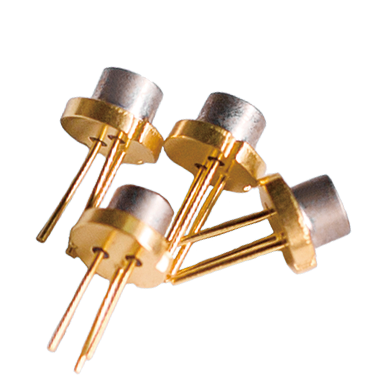
Core Insights - Shandong Province has announced the second batch of "Shandong Manufacturing. Qilu Quality" public list for 2025, with products from Inspur's semiconductor division and Inspur General Software Co., Ltd. successfully selected for their quality and technological strength [1] Group 1: Semiconductor Division - The single-chip device, 650TO low-power laser, is a core component in the optoelectronic field and is the first domestically produced high-reliability red laser to achieve mass supply [3] - The 650TO laser operates at a specific wavelength of 650nm, featuring high integration, stable performance, low power consumption, strong application adaptability, and high reliability, making it suitable for diverse fields such as medical health, biometric identification, measurement sensors, and display lighting [3] - The product has reached domestic leading and international advanced levels in key indicators like luminous efficiency and high-temperature reliability, with successful applications in medical detection equipment, security sensors, industrial measurement instruments, and micro-projection displays [3] Group 2: Inspur General Software Co., Ltd. - The Inspur Haiyue Intelligent ERP, built on the self-developed Haiyue large model as the AI core, integrates cutting-edge cloud-native technologies such as microservices and containerization [5] - It offers a "unified backbone, flexible endpoints" business architecture, creating an end-to-end financial and operational management platform that covers various fields including finance, treasury, shared services, performance, supply chain, assets, and intelligent manufacturing [5] - The ERP system is widely used across multiple industries such as manufacturing, energy, finance, construction, pharmaceuticals, chemicals, grain storage, water services, and mining, holding the top market share in China's group management software, HCM software, and SCM software [5] - Inspur aims to maintain a "high standard zero defect" quality philosophy, focusing on customer-centricity and striving to create high-quality products and services that deliver greater value to customers and society [5]


透视当前海外三大风险点:基本面、降息预期和AI泡沫
Guo Tai Jun An Qi Huo· 2025-11-24 10:03
Report Industry Investment Rating No relevant content provided. Core Viewpoints of the Report - The core driver of the current overseas market's macro headwinds is the technology sector, with risks shifting from the abstract "AI bubble" to more specific concerns such as AI investment sustainability, debt - financing, and return on investment [34]. - The US economic fundamentals maintain a certain level of resilience. Employment is weak but not rapidly deteriorating. Manufacturing shows resilience due to potential interest - rate cuts and low inventory levels. The financial indicators at the US stock index level do not indicate systemic risks [97]. - For the short - term, the market should be moderately optimistic but avoid core technology stocks in the medium - term. In the equity market, attention should be paid to domestic consumption, public utilities, raw materials, medical, and financial sectors, and within the technology sector, focus on companies with realized performance. In the commodity market, pay attention to the industry logic and the allocation window for precious metals with less impact from macro - narratives [97]. Summary by Relevant Catalogs 1. Market Performance and Underlying Logic - Since November, the global market has been affected by geopolitical, macro, and industrial factors. The technology sector leads the Risk - on sentiment, while the equity market turns defensive. There is a lack of effective hedging assets, and the year - end market micro - liquidity is poor [2]. - The volatility in the overseas market stems from three key points: the state of the economic fundamentals, short - term (December) and long - term (2026) interest - rate cut expectations, and concerns about the sustainability, debt - financing, and return on investment of AI [4]. 2. Economic Fundamentals 2.1 US Economic Fundamentals - The September non - farm payroll data exceeded market expectations. The labor supply increased, the unemployment rate rebounded slightly, and the wage growth rate rebounded year - on - year. The employment situation remained weak but did not deteriorate rapidly, maintaining a "low - layoff, low - hiring" state [5][7]. - Regional Federal Reserve manufacturing survey indicators improved, indicating some resilience in the manufacturing sector. However, the consumer confidence index dropped significantly, and the daily - frequency consumer spending trend was weak, suggesting weak consumer sentiment and consumption momentum [8][10][12]. - Inventories declined rapidly from the third to the fourth quarter, and the inventory - to - sales ratios decreased. The year - on - year growth rates of manufacturing and wholesale inventories reached new lows, and the new order - to - inventory ratio was high, providing potential support for commodity prices [15]. 2.2 Non - US Economies - The economic surprise indices of China, the US, and the Eurozone showed that Chinese data dropped significantly, the Eurozone's economic data improved slightly, and US data was distorted due to missing information. The Eurozone's economic momentum slowed down, with a weak manufacturing sector but high service - sector sentiment. Chinese macro - economic indicators declined across the board in consumption, investment, and production [16][18][20]. - The outlook for major economies at the end of 2026 shows that the US real GDP year - on - year growth rate will be 1.8%, remaining basically the same as this year, while the growth rates of China, the Eurozone, and Japan will be lower than this year [22]. 3. Monetary Policy - The Fed's attitude has become more cautious since the September FOMC meeting. The probability of a December interest - rate cut has rebounded to 63%, but the expected benchmark interest rate at the end of next year remains at 3.00 - 3.25%, with limited change. The "hawkish" pricing is mainly reflected in the December FOMC meeting, and there is still an expected 75bp of interest - rate cuts next year [25][26]. - Interest - rate cut expectations are more of a background factor rather than the core driver of the recent global market decline. The stability of US Treasury yields and the divergence between bond and equity volatilities indicate that the risks do not originate from the same source [29]. 4. "AI Bubble" and Related Risks - The high - rating corporate bond issuance scale in 2025 has rapidly increased, exceeding the 2021 historical high, with software, semiconductor, and internet companies accounting for the majority. Since September, leading technology companies have increased their bond issuance, shifting their capital expenditure from self - owned funds to debt financing [30]. - At the US stock index level, the market's health has some flaws, but the fundamentals of the US stock market are still relatively healthy. Comparing with the "dot - com bubble" in terms of financial indicators, the current debt - to - asset and debt - to - profit ratios at the index level are stable, and the ROIC - WACC difference has not reached a turning point, which can be compared to the 1997 period [35][46]. - The storm center is the leading technology companies. The CAPEX/operating cash flow of the "Magnificent Seven" in the current AI wave has reached a level comparable to that of representative companies in 1997. Among them, Microsoft, Google, Amazon, Meta, and Oracle have a significantly higher ratio, while Nvidia and Apple have relatively lower ratios and healthier financial indicators [50][54]. - Leading technology companies issued over $200 billion in bonds in 2025 for AI infrastructure investment. The average annual maturing debt in the next five years is $71 billion, with a cumulative scale of $355 billion. The debt refinancing demand of some companies is relatively rigid [59]. - Since the second half of 2025, the "Magnificent Seven" companies have successively experienced ROIC inflection points, indicating that investment income is starting to lag behind investment costs. The revenue growth rate of leading technology companies has also begun to slow down, similar to the situation between 1996 - 1997 during the "dot - com bubble" [60][67]. 5. Analysis of the Hong Kong Stock Market - The adjustment of the Hong Kong stock market since November is mainly due to the drag of "liquidity + sentiment" on valuation. The fundamentals of the molecular end (earnings) are still strong, while the denominator end (liquidity and risk preference) is under pressure from factors such as domestic and overseas liquidity disturbances and the "AI bubble" discussion in the US [76]. - The domestic liquidity pressure is expected to ease gradually in early 2026. The Hong Kong stock market's technical indicators have shown some safety margins, but the market risk preference is still fragile. The reversal of other factors may be challenging in the short term, but the improvement of domestic liquidity in early 2026 may lead to a spring rally [88]. - In the short term, it is recommended to focus on consumer sectors that have underperformed this year or defensive sectors such as banks and telecommunications. In the medium term, a barbell strategy should be adopted for Chinese - funded stocks, focusing on the non - ferrous metals sector, technology themes (AI and innovative drugs), and anti - involution (industry concentration increase and leading company profit improvement) [92].
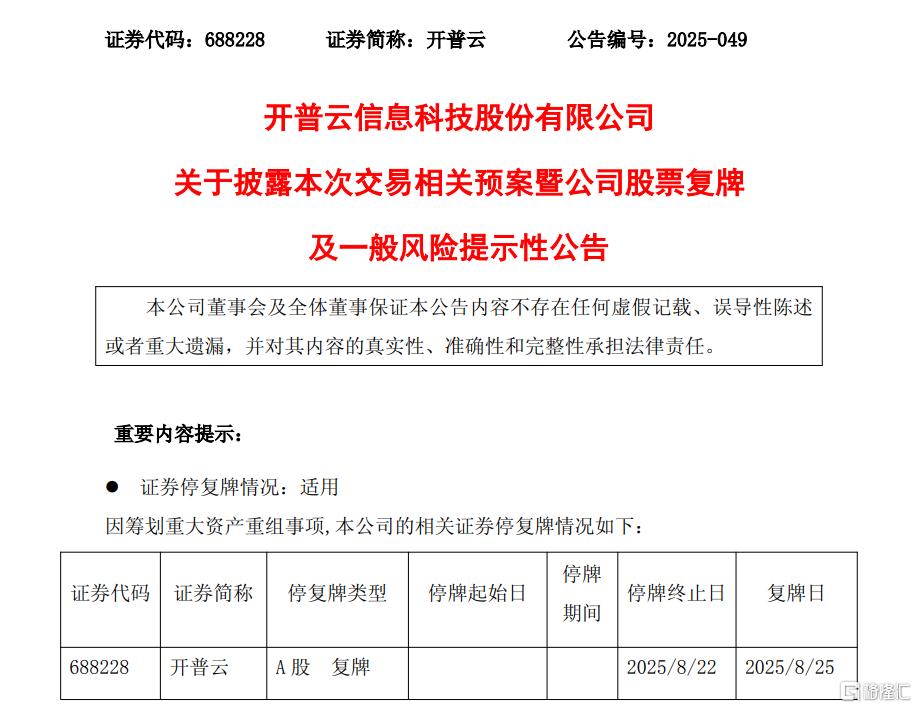
跨界存储业务!开普云拟购买南宁泰克70%股权,复牌首日20cm涨停
Ge Long Hui A P P· 2025-08-25 01:47
Core Viewpoint - The company, Kaipu Cloud, announced a significant asset restructuring plan to acquire 100% equity of Nanning Taike Semiconductor Co., Ltd. from Shenzhen Jintaike Semiconductor Co., Ltd. through a combination of cash payment and share issuance, aiming to gain control over the storage product business of Shenzhen Jintaike [1][5]. Group 1: Acquisition Details - The acquisition will occur in two steps: first, Kaipu Cloud will purchase 70% of Nanning Taike's equity through cash payment, after which Shenzhen Jintaike will transfer all operational assets and personnel related to the storage product business to Nanning Taike [6]. - In the second step, Kaipu Cloud plans to issue shares to acquire the remaining 30% equity of Nanning Taike, while also raising funds from no more than 35 specific investors to support the transaction and related business activities [6][5]. - Upon completion of the acquisition, Nanning Taike will become a subsidiary of Kaipu Cloud, expanding its business scope to include storage products, thereby enhancing the company's competitive edge and market influence [6][7]. Group 2: Financial Impact - In 2024, Nanning Taike's total revenue was reported at 2.366 billion, which is 3.83 times that of Kaipu Cloud's revenue of 618 million [9]. - The projected revenue for Nanning Taike in the first half of 2025 is 1.313 billion, with a total revenue of 2.366 billion for 2024, indicating a significant growth trajectory for the company [10]. - The acquisition is expected to optimize Kaipu Cloud's asset quality and enhance its total assets and revenue, thereby strengthening its operational capabilities [10]. Group 3: Shareholder Changes - On August 22, Kaipu Cloud's controlling shareholder Wang Min notified the company of a share transfer agreement with Shenzhen Wugufengdeng Semiconductor Partnership, involving the transfer of 13.9965 million shares, accounting for 20.73% of the total share capital, at a price of 52.64 per share, totaling 737 million [10]. - This share transfer will not trigger any mandatory tender offer obligations and will not result in changes to the company's control or its actual controlling shareholder [11].