
输电

Search documents
印度考虑取消,专家:中企应高度谨慎
中国能源报· 2026-01-10 10:11
Core Viewpoint - India is considering lifting restrictions on Chinese companies participating in government contract bids, indicating a balance between security concerns and economic pragmatism in its efforts to accelerate economic growth and infrastructure development [1][2]. Group 1: Policy Changes - The Indian Finance Ministry plans to remove a five-year restriction on Chinese companies bidding for government contracts, although the final decision rests with the Prime Minister's Office [1]. - This potential policy shift aims to restore competition in government contracts and expedite public project execution, reflecting a gradual warming of India-China relations [2]. Group 2: Economic Implications - The restrictions imposed after the 2020 India-China border conflict significantly reduced the contract amounts awarded to Chinese companies, leading to shortages of related materials and delays in project timelines in India [1]. - For instance, limitations on importing electrical equipment from China hindered India's goal to increase thermal power capacity to 307 GW over the next decade [1]. Group 3: Strategic Considerations - Despite the potential lifting of restrictions, India is expected to maintain some limitations on Chinese investments in sensitive sectors, with ongoing security reviews for strategic projects [2]. - Experts suggest that for India to genuinely enhance cooperation with China, it must adopt a fair and welcoming approach towards Chinese investments, ensuring a safe and stable investment environment for Chinese companies [2].


印度考虑取消,专家:中企应高度谨慎
Huan Qiu Wang· 2026-01-10 07:05
Core Viewpoint - India is considering lifting the five-year restriction on Chinese companies participating in government contract bidding, indicating a balance between security concerns and economic pragmatism in its relationship with China [1][2]. Group 1: Government Policy Changes - The Indian Ministry of Finance plans to remove restrictions on Chinese companies bidding for government contracts, which were implemented after the 2020 India-China border conflict [1]. - The restrictions have significantly reduced the contract amounts awarded to Chinese companies and led to shortages of related materials in India [1]. - Several Indian government departments have proposed easing the restrictions on Chinese bidders to accelerate infrastructure projects [1]. Group 2: Economic Implications - The move to lift restrictions aims to restore competition in the government contract sector and expedite public project execution, particularly in sectors like power transmission and renewable energy [2]. - Indian officials view the easing of restrictions as a pragmatic step to support domestic economic priorities, reflecting a gradual warming of India-China relations [2]. Group 3: Security Considerations - Despite the potential lifting of restrictions, India is expected to maintain some limitations on Chinese investments in sensitive sectors and continue security reviews for strategic projects involving Chinese capital [2]. - National security considerations will still guide decisions regarding foreign companies' access to critical infrastructure and public contracts in India [2]. Group 4: Expert Opinions - Experts suggest that Chinese companies should remain cautious regarding the news, as India's past unilateral restrictions have hindered its own economic development [2]. - To genuinely enhance India-China cooperation, India must open its market and adopt a fair and friendly attitude towards Chinese investments and enterprises [2].
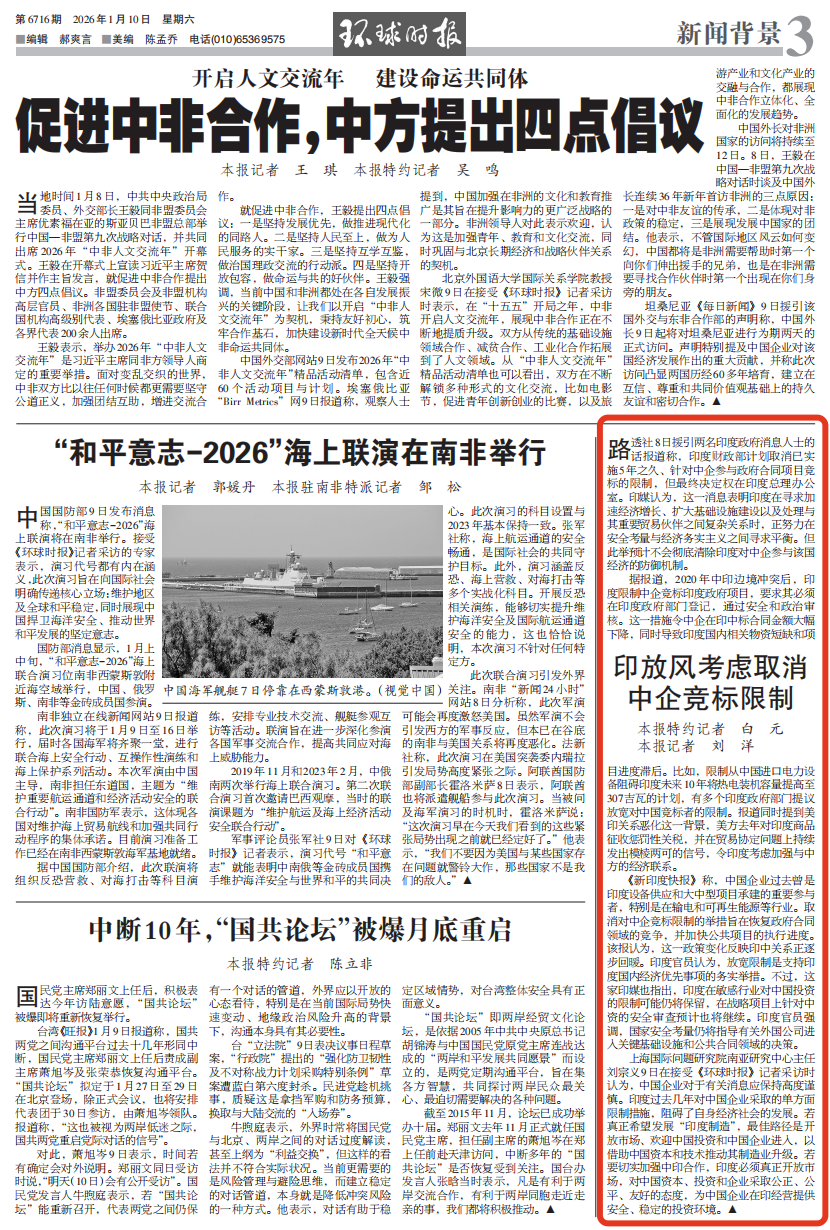
印度放风考虑取消中企竞标限制,专家:中企对于有关消息应保持高度谨慎
Huan Qiu Shi Bao· 2026-01-09 22:37
Group 1 - The Indian government plans to lift restrictions on Chinese companies participating in government contract bidding, which have been in place for five years, indicating a shift towards balancing security concerns with economic pragmatism [1][2] - Following the 2020 India-China border conflict, restrictions led to a significant decrease in contract amounts awarded to Chinese firms, causing shortages of related materials and delays in project timelines in India [1] - The lifting of restrictions aims to restore competition in the government contract sector and accelerate the execution of public projects, reflecting a gradual warming of India-China relations [2] Group 2 - Indian officials believe that easing restrictions is a pragmatic move to support domestic economic priorities, although limitations on Chinese investments in sensitive sectors are likely to remain [2] - Experts suggest that for India to genuinely enhance cooperation with China, it must open its market and adopt a fair and friendly attitude towards Chinese capital and enterprises, providing a secure investment environment [2]
国家发展改革委:抓紧推动新资产类型REITs项目实现首单上市
Shang Hai Zheng Quan Bao· 2025-11-11 16:57
Group 1 - The article emphasizes the active promotion of market expansion and capacity enhancement, focusing on increasing the submission and recommendation of mature asset types and facilitating the listing of new asset types to gradually include various assets suitable for issuance, thereby promoting steady market growth [1] - It highlights the importance of strengthening specialized coordination services, guiding localities to establish a sound REITs coordination service mechanism for private investment projects, and accelerating the resolution of difficulties and issues in the cultivation of private investment projects [1] - The article discusses the continuous improvement of work efficiency, promoting the institutionalization, standardization, and normalization of project recommendation and issuance, while ensuring the quality of underlying assets [1] Group 2 - The document outlines measures to encourage private capital participation in specific projects requiring national approval, such as railways, nuclear power, and water supply, emphasizing the need for specialized feasibility studies to assess the viability of private investment [2] - It encourages and supports private capital involvement, suggesting that the specific shareholding ratio for private enterprises can exceed 10% for eligible projects, thereby signaling a strong commitment to promoting private investment [2] - The article stresses the importance of early-stage research and demonstration regarding the introduction of private capital, providing more opportunities for private investment participation [2]
我国多措并举促进民间投资发展
Yang Shi Wang· 2025-11-11 12:24
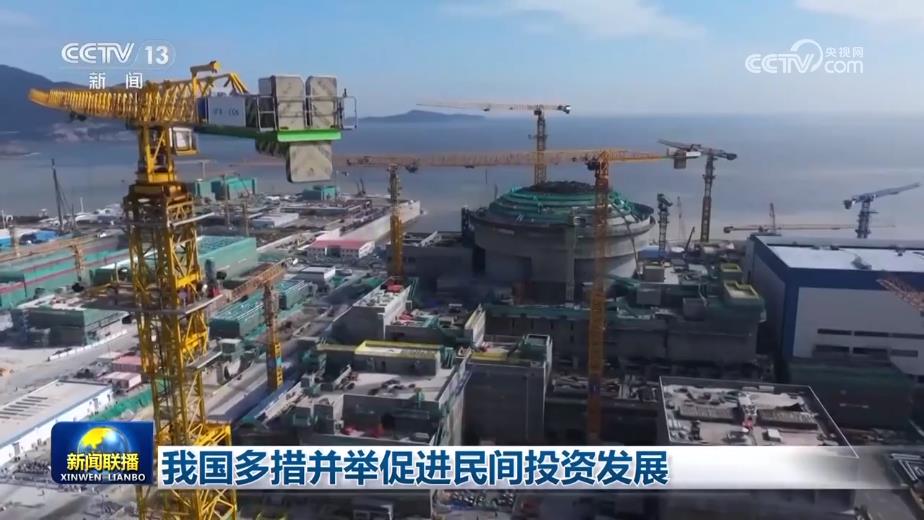
Group 1 - The Chinese government will implement multiple measures to promote private investment development [1] - Central budget investment will be utilized to actively support eligible private investment projects [1] - A national investment and financing comprehensive service platform will be established to enhance connectivity with national financing credit service platforms, ensuring more precise credit resource allocation to private enterprises [1] Group 2 - Policies will be enhanced to attract private capital into the energy sector, including nuclear power, hydropower, and cross-regional direct current transmission projects [3] - Continuous deepening of energy market reform will be pursued to accelerate the establishment of a unified national energy market system, improving mechanisms and regulatory frameworks for private enterprise participation in energy investments [3] Group 3 - Digital transformation will be leveraged to further promote private investment, with the construction of a comprehensive digital empowerment platform [5] - The collaborative transformation of the industrial chain will drive small and medium-sized enterprises into the transformation ecosystem, expanding new effective investment spaces [5]
国家发展改革委:民间资本参与重点领域项目持股比例可在10%以上
Xin Hua Cai Jing· 2025-11-11 08:44
Core Viewpoint - The National Development and Reform Commission (NDRC) has introduced measures to encourage private investment in key sectors, allowing private capital to hold more than 10% in specific projects, signaling a strong push for private sector involvement in infrastructure development [1][2]. Summary by Relevant Sections Key Areas of Focus - The policy emphasizes participation in key sectors such as railways, nuclear power, hydropower, and oil and gas pipelines, which require national approval [1][2]. Profitability Considerations - The targeted projects are primarily foundational, public welfare, and long-term in nature, with some expected to yield returns, thus attracting private investment [2]. Special Feasibility Studies - There is a requirement for special feasibility studies to assess the viability of private capital participation in these key projects, which must be detailed in feasibility reports or project applications [2]. Practical Considerations - The policy acknowledges the diversity of projects and the varying willingness and capability of private enterprises, suggesting that the specific shareholding ratio should be determined based on actual project conditions and private sector interest [2]. Increased Shareholding Support - For projects that meet certain conditions, the shareholding ratio for private capital can exceed 10%, with examples indicating that some nuclear power projects have seen private participation rates as high as 20% [2]. Inclusive Support for Various Economic Entities - The NDRC aims to support all types of economic entities in project construction, promoting complementary advantages among different ownership structures for mutual development [3].
国家发改委:将推动细化民间资本参与项目建设的具体要求
Zhong Guo Xin Wen Wang· 2025-11-11 08:28
Core Viewpoint - The National Development and Reform Commission (NDRC) has introduced measures to encourage private capital participation in key sectors, allowing for a shareholding ratio of over 10% in certain projects [1][2]. Group 1: Key Areas of Focus - The policy specifically targets projects requiring national approval in sectors such as railways, nuclear power, hydropower, and oil and gas pipelines, emphasizing the importance of these areas [1]. - Projects in these sectors are primarily foundational, public welfare-oriented, and long-term, with some expected to yield certain returns, making them attractive for private investment [2]. Group 2: Implementation Requirements - There is a requirement for specialized feasibility studies to assess the viability of private capital participation in these key projects, which must be detailed in feasibility reports or project applications [2]. - The determination of specific shareholding ratios should consider the actual circumstances of each project, the willingness and capability of private enterprises, and relevant policy requirements [2]. Group 3: Future Directions - The NDRC plans to work with industry authorities and local governments to refine the specific requirements for private capital participation in project construction, ensuring effective policy implementation [3].
国家发改委:项目前期阶段就论证引入民间资本参与 为其提供更多参与机会
Zheng Quan Shi Bao Wang· 2025-11-11 07:27
Core Viewpoint - The National Development and Reform Commission (NDRC) has introduced measures to promote private investment in various sectors, emphasizing the need for early-stage feasibility studies to include private capital participation [1] Group 1: Policy Measures - The newly released measures require special feasibility studies for projects needing national approval, particularly in sectors like railways, nuclear power, hydropower, and oil and gas pipelines, to assess the viability of private capital involvement [1] - The measures encourage private capital participation and suggest determining specific equity ratios based on project specifics, private enterprise willingness, and relevant policy requirements [1] Group 2: Investment Opportunities - For eligible projects, private capital can hold more than 10% equity, with some nuclear power projects allowing private participation up to 20% [1] - The NDRC aims to foster collaboration among various ownership types to leverage their respective advantages and promote mutual development in key project areas [1]
印度尼西亚达南塔拉主权财富基金与日本国际协力银行签署谅解备忘录,后者将联合资助印尼可再生能源及输电项目。
news flash· 2025-07-11 07:13
Core Viewpoint - The Indonesia Investment Authority (INA) has signed a memorandum of understanding with the Japan International Cooperation Agency (JICA) to jointly fund renewable energy and transmission projects in Indonesia [1] Group 1: Company Initiatives - The partnership aims to enhance Indonesia's renewable energy sector through collaborative funding efforts [1] - JICA's involvement signifies a commitment to support Indonesia's transition towards sustainable energy solutions [1] Group 2: Industry Impact - This collaboration is expected to boost investment in Indonesia's renewable energy infrastructure, aligning with global trends towards sustainable energy [1] - The initiative reflects a growing interest from international entities in financing renewable energy projects in Southeast Asia [1]