
钼矿开采

Search documents
手握国内证载规模最大单体钼矿开采权,钼业龙头盛龙股份今日上市
梧桐树下V· 2026-03-31 02:14
Core Viewpoint - Molybdenum (Mo) is a scarce strategic mineral essential for various industries, including steelmaking, aerospace, and new energy, with its market demand steadily increasing as China's manufacturing sector transitions towards high-end, intelligent, and green development [1]. Group 1: Company Overview - Shenglong Mining Group Co., Ltd. (stock code: 001257) has become a cornerstone enterprise for the stable operation of China's molybdenum industry chain, leveraging its unique resource reserves and production capacity [1]. - The company is primarily engaged in the production of molybdenum concentrate and molybdenum iron, with significant backing from the local government [2]. Group 2: Resource Advantages - As of the end of 2024, Shenglong holds five large and medium-sized molybdenum mining rights, with the Nanni Lake molybdenum mine being the largest single molybdenum mine in China, boasting a production capacity of 16.5 million tons per year [4]. - The company has a molybdenum metal reserve of 710,500 tons, accounting for approximately 9.1% of the national total, with significant potential for future resource integration and development [5]. Group 3: Cost Structure and Technology - The Nanni Lake and Songxian Angou molybdenum mines are open-pit mines, which provide advantages such as lower mining costs and higher safety conditions compared to underground mines [6]. - Shenglong is enhancing its competitiveness through technological innovation, implementing a smart mining system based on "5G + big data" to optimize mining processes and reduce operational costs [6][7]. Group 4: Market Dynamics - The demand for molybdenum is expected to grow due to its critical role in high-performance steel production and the expansion of applications in emerging industries such as wind energy and electric vehicles [10]. - The global supply of molybdenum is constrained, with Shenglong projected to produce 10,600 tons in 2024, representing 9.64% of China's total output, thus playing a crucial role in the supply chain [11]. Group 5: Sales Strategy and Financial Performance - Shenglong employs a flexible sales strategy that includes online bidding and long-term agreements with major state-owned enterprises, ensuring a stable customer base and revenue growth [14]. - The company has shown consistent revenue growth from 1.911 billion yuan in 2022 to an expected 3.503 billion yuan in 2025, with net profits also increasing significantly during the same period [15]. Group 6: Future Development Plans - The company plans to raise 1.6813 billion yuan through its IPO to fund projects aimed at expanding production capacity and enhancing technological capabilities [16]. - Shenglong is also focusing on resource integration and storage expansion, with plans to develop a high-performance molybdenum materials project to transition from primary products to high-end materials [18]. Conclusion - As a leading player in the domestic molybdenum industry, Shenglong is well-positioned to leverage its resource advantages, technological innovations, and favorable market conditions to achieve significant growth and contribute to the stability of China's molybdenum supply chain [19].


钼价格|钼市开门红!钼精矿价格涨80元
Xin Lang Cai Jing· 2026-02-24 05:10
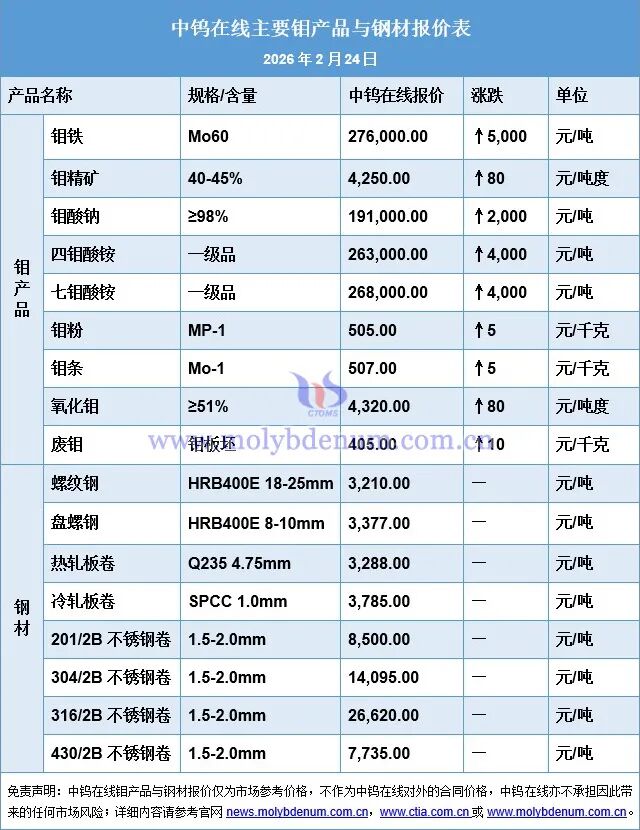
Group 1: Molybdenum Market Overview - The domestic molybdenum market experienced a positive start after the holiday, with most product prices significantly increasing. Molybdenum concentrate prices rose by approximately 80 yuan/ton, molybdenum iron prices increased by about 5,000 yuan/ton, and molybdenum powder prices went up by around 5 yuan/kg [1][4]. - Key factors influencing the molybdenum market include a reduction in molybdenum product imports during the Spring Festival and a decrease in production from domestic manufacturers, both contributing to rising prices. Additionally, international molybdenum prices fluctuated significantly during the holiday period [1][4]. Group 2: Steel Inventory Data - According to the China Iron and Steel Association, the steel inventory of key statistical steel enterprises reached 15.11 million tons in early February 2026, an increase of 400,000 tons (2.7%) compared to the previous period, and a rise of 970,000 tons (6.9%) since the beginning of the year [2][5]. - Year-on-year comparisons show a decrease of 1.1 million tons (6.8%) compared to the same period last year, and a reduction of 1.02 million tons (6.3%) compared to two years ago. Regionally, steel inventories increased in Northeast (350,000 tons), Northwest (40,000 tons), Southwest (30,000 tons), and Central South (240,000 tons) regions, while inventories decreased in North China (160,000 tons) and East China (110,000 tons) [2][6].
金钼股份:拟以17.31亿元收购金沙钼业24%股权
Bei Ke Cai Jing· 2026-01-16 04:56
Group 1 - The core point of the article is that Jinmoly Co., Ltd. announced the acquisition of a 24% stake in Anhui Jinsan Molybdenum Co., Ltd. from Zijin Mining for a consideration of 1.731 billion yuan [1] - After the transaction, Jinmoly will hold a 34% stake in Jinsan Molybdenum, while Zijin Mining (or its wholly-owned subsidiary) will hold 60% [1] - The purpose of the acquisition is to strengthen resource security, consolidate industry influence, and accelerate the development and construction of the Shapinggou Molybdenum Mine [1] Group 2 - The transaction does not constitute a related party transaction and does not require submission for shareholder meeting approval [1]


金堆城钼业股份有限公司关于收购参股公司部分股权的公告
Shang Hai Zheng Quan Bao· 2026-01-15 17:54
Transaction Overview - The company will acquire a 24% stake in Anhui Jinsuo Molybdenum Co., Ltd. from Zijin Mining Group Co., Ltd. for a total consideration of RMB 173,087 million, resulting in the company holding a 34% stake in Jinsuo Molybdenum after the transaction [2][4] - The transaction does not constitute a related party transaction and is not classified as a major asset restructuring under relevant regulations [2][3] Board Decision - The company's board of directors approved the acquisition on January 14, 2026, and the transaction does not require shareholder approval [5] Shareholder and Financial Information - Zijin Mining's major shareholder is Minxi Xinghang State-owned Assets Investment and Operation Co., Ltd., holding 22.88% of the shares, with the actual controller being the Finance Bureau of Shanghang County, Fujian Province [6] - Jinsuo Molybdenum holds mining rights for the Shapinggou Molybdenum Mine, with a total molybdenum metal resource of 2.1 million tons and a planned development scale of 10 million tons of molybdenum ore per year [8] Purpose of the Transaction - The acquisition aims to enhance the company's resource security and industry influence while accelerating the development of the Shapinggou Molybdenum Mine to realize resource value and investment returns [13] Impact on the Company - The acquisition aligns with the company's strategic development and will not significantly impact its daily operations or financial status [14]
金钼股份拟17.31亿元收购参股公司金沙钼业24%股权
Zhi Tong Cai Jing· 2026-01-15 13:24
Core Viewpoint - The company, Jinchuan Group Co., Ltd. (金钼股份), announced the acquisition of a 24% stake in Anhui Jinsan Molybdenum Co., Ltd. (金沙钼业) from Zijin Mining Group Co., Ltd. (紫金矿业) for a consideration of 1.731 billion yuan, increasing its total ownership in Jinsan Molybdenum to 34% [1] Group 1 - The acquisition aims to leverage the advantages of molybdenum industry development and enhance resource security, thereby strengthening the company's influence in the industry [1] - The transaction is also intended to accelerate the development and construction of the Shapingou Molybdenum Mine, allowing the company to realize resource value and obtain investment returns sooner [1]
27亿元钼矿项目落地构建政银企全链条保障
Zhong Guo Jing Ji Wang· 2025-12-05 08:45
Group 1 - The Dashi River Molybdenum Mine project in Dunhua City, Jilin Province, has officially entered the systematic and large-scale implementation phase with a total investment of 2.7 billion yuan [1] - The project aims to upgrade the industrial structure of the Northeast old industrial base through a tripartite support system involving government guidance, financial support, and professional construction [1] - Molybdenum, referred to as "industrial vitamin," is crucial for high-end manufacturing and new energy sectors, with applications in steel, machinery, petrochemicals, and aerospace [1] Group 2 - A project development framework agreement has been signed between the Dunhua City government and Jilin Dashi River Molybdenum Co., Ltd., focusing on systematic development based on principles of equality, mutual benefit, legality, and long-term stability [2] - The construction will encompass mining engineering, mineral processing plant, supporting facilities, tailings utilization, and ecological restoration of the mining area [2] - The city government will provide comprehensive support in project approval, land coordination, and policy alignment, while the enterprise will leverage its financial, technical, and management strengths for investment, construction, and long-term operation [2]
紫金矿业(601899):业绩再创新高,黄金板块迎来重估
Minsheng Securities· 2025-10-20 06:26
Investment Rating - The report maintains a "Recommended" rating for the company [3][5]. Core Views - The company achieved record high performance in Q3 2025, with significant growth in both revenue and net profit driven by rising gold prices and production [1][2]. - The gold segment has become the largest profit contributor, with a gross profit margin of 45.7% in Q3 2025, surpassing the copper segment [2][25]. - The company is focused on continuous exploration and resource expansion, alongside strategic acquisitions to enhance production capabilities [3]. Summary by Sections 1. Event - The company released its Q3 2025 report, showing a revenue of 254.2 billion yuan, a year-on-year increase of 10.33%, and a net profit of 37.864 billion yuan, up 55.45% year-on-year [1][8]. 2. Revenue and Profit Growth - In Q3 2025, the company reported a revenue of 86.489 billion yuan, an 8.1% increase year-on-year, and a net profit of 14.572 billion yuan, reflecting a 57.1% year-on-year growth [1][2]. 3. Profitability Breakdown - The gross profit margin for the company increased to 24.93% in the first three quarters of 2025, driven by rising prices of key metals [23]. - The gold segment's gross profit margin increased significantly, contributing to the overall profit growth [25]. 4. Cost and Expenses - The company experienced a 5.35 billion yuan increase in operating expenses in Q3 2025, with total expenses reaching 38.51 billion yuan [35]. 5. Non-Recurring Profits - Non-recurring profits increased by 6.91 billion yuan in Q3 2025, primarily due to fair value changes and asset disposals [45][51]. 6. Cash Flow - The company reported a net cash inflow from operating activities of 23.278 billion yuan in Q3 2025, indicating strong cash flow generation [58]. 7. Project Progress - The company successfully spun off its subsidiary, Zijin Gold International, which listed on the Hong Kong Stock Exchange, raising approximately 28.7 billion HKD [15].
再推钼:扰动持续,价格坚定看多
2025-08-06 14:45
Summary of Key Points from the Conference Call Industry Overview - The conference call focuses on the molybdenum industry, highlighting supply disruptions and price forecasts for 2025 [1][3][4]. Core Insights and Arguments - **Supply Disruptions**: Domestic and international molybdenum supply is disrupted, affecting approximately 15,000 tons of metal globally, which is about 5%-6% of total supply. The domestic impact is around 11%-13% due to major mines in central China and Codelco's mine in South America being offline [1][3][7]. - **Price Outlook**: The expectation is for molybdenum prices to rise due to traditional demand peaks from August to October, compounded by supply issues. Despite recent price drops, the ongoing supply disruptions are anticipated to push prices higher [4][5][17]. - **Demand Stability**: Manufacturing and energy-related steel demand remains stable and is expected to grow, supporting molybdenum prices during peak demand seasons [5][12]. - **Inventory Levels**: Current wood market inventory is about 4,000 tons, which is higher than the previous year but still tight relative to the expected demand increase in 2025 [10][11]. Additional Important Content - **Military Demand**: Molybdenum's demand in the military sector is about 5%-10% under normal conditions, but could increase significantly in the event of armed conflict or strategic stockpiling [2][14]. - **Resistance to Price Increases**: Steel mills are resisting price hikes despite profitability and low inventory levels, indicating limited effectiveness of their resistance due to the upcoming demand peak [9][12]. - **Strategic Metal Performance**: The strategic metals sector, including molybdenum, is performing well, with price expectations between 5,000 and 5,500 yuan, and potential market capitalization growth for companies like Jinchuan Group [15][17]. - **Company-Specific Insights**: Guocheng Mining is positioned well due to its dual focus on molybdenum and lithium, with significant growth potential in its mining operations [16]. Conclusion - The molybdenum market is facing significant supply challenges that are expected to drive prices up in the near term. Demand from both traditional sectors and potential military applications adds complexity to the market dynamics. The overall outlook remains positive for molybdenum prices, supported by stable demand and strategic inventory management.
盛龙股份深交所主板IPO“已问询” 公司保有钼金属量约占全国钼资源储量的9.10%
智通财经网· 2025-06-09 23:31
Core Viewpoint - Shenglong Mining Group Co., Ltd. is applying for listing on the Shenzhen Stock Exchange, aiming to raise 1.53 billion yuan, and is recognized as a leading molybdenum company in China [1] Company Overview - Shenglong Mining is primarily engaged in the production, processing, and sales of molybdenum-related products, with a focus on molybdenum concentrate and ferromolybdenum [1] - The company is expected to produce 10,600 tons of molybdenum metal in 2024, accounting for 9.64% of China's total molybdenum production [1][2] Mining Assets - The company operates the Nanni Lake Molybdenum Mine, the largest single molybdenum mine in China, with a production capacity of 16.5 million tons per year [2] - Shenglong holds five large and medium-sized molybdenum mining rights, with a total molybdenum metal reserve of 710,500 tons, representing 9.10% of the national molybdenum resource reserves [2] Product Quality and Market Position - The company's products are known for their low impurity levels and high potential for deep processing, with major clients including China Baowu Steel, Shandong Steel, and others [3] - Shenglong plans to establish a project with an annual production capacity of 20,000 tons of high-performance molybdenum materials to enhance its competitive edge [3] Financial Performance - In 2022, 2023, and 2024, the company reported revenues of approximately 1.911 billion yuan, 1.957 billion yuan, and 2.864 billion yuan, respectively, with net profits of 452 million yuan, 725 million yuan, and 754 million yuan [5] - As of December 31, 2024, the total assets are projected to be 6.890 billion yuan, with a debt-to-asset ratio of 9.34% [6]

推钼:价格继续看涨,重视股价低位布局机会
2025-06-04 01:50
Summary of Conference Call on Molybdenum Market Industry Overview - The conference call focuses on the molybdenum industry, discussing price trends, supply-demand dynamics, and investment opportunities in related companies such as Jinchuan Group and Guocheng Mining [1][18]. Key Points and Arguments Molybdenum Price Trends - Molybdenum prices have recently increased from 32,000 RMB per ton in early April 2025 to over 38,000 RMB per ton, marking an approximate 20% rise [2][16]. - The price drop earlier in 2025 was attributed to inventory accumulation and increased production guidance from companies like Antofagasta and Freeport, leading to a supply expectation adjustment [1][4]. Supply and Demand Dynamics - Global molybdenum supply is expected to rise from 278,000 tons in 2024 to 290,000 tons in 2025, with a demand increase from 320,000 tons to 330,000 tons, resulting in a supply-demand gap of about 40,000 tons [3][13]. - Current inventory levels are at historical lows, down over 30% year-on-year, indicating no large-scale accumulation, which supports future price increases [1][5][6]. Steel Industry Impact - The steel industry accounts for 85%-90% of molybdenum demand, with steel mill procurement increasing by approximately 6% year-on-year in the first five months of 2025 [8][9]. - Special steel and military sectors have shown strong performance, with growth rates exceeding 20%-30%, while stainless steel production has declined by about 30% [9][12]. Special Applications and Future Demand - The wind power and shipbuilding industries are contributing approximately 2% to molybdenum demand growth, with structural steel usage adding another 1-2% [10][11]. - Military demand for molybdenum is expected to rise due to increased stockpiling, especially during significant conflicts [12][14]. Price Forecast and Investment Opportunities - Molybdenum prices are projected to reach 45,000 RMB to 50,000 RMB per ton in 2025, driven by improved steel mill profitability and ongoing supply constraints [3][16]. - Companies like Jinchuan Group and Guocheng Mining are expected to see significant stock price increases, with potential growth of over 50% if market conditions remain favorable [18][20]. Conclusion - The molybdenum market is characterized by tight supply conditions, strong demand from the steel and military sectors, and favorable pricing trends, making it an attractive area for investment in related companies [1][19].