Music Technology

Search documents
深度|老派音乐平台退场,ACE 开启 AI 原生音乐新时代
Z Potentials· 2026-03-20 10:04
Core Insights - The article highlights the rapid emergence of AI-generated music, indicating that it has already established a foothold in the market, with at least six AI or AI-assisted music projects appearing on various charts by 2025 [2] - The focus of competition in the music industry is shifting from copyright ownership to content organization and distribution, marking a critical window for the next generation of platforms [3] - ACE is positioned to conquer the AI music creation market by integrating into professional workflows rather than targeting casual consumers first, thereby defining the quality boundaries of the platform [4] Group 1: ACE's Strategic Approach - ACE Studio 2.0, launched in December 2025, expands from an AI vocal workstation to an all-in-one AI music studio, integrating AI vocals, instruments, generation, and editing into a cohesive system [4] - The platform's success is attributed to its deep understanding of professional workflows, which allows it to gain trust from high-profile users and continuously refine its model based on their feedback [6] - ACE's approach is to attract professional creators who can provide high-quality feedback, which is essential for the platform's evolution and aesthetic service [6] Group 2: Ecosystem Development - ACE has developed an open ecosystem through its open-source model ACEStep, which aims to create a collaborative environment for developers and diversify the music model landscape [9] - The ACEStep initiative has garnered significant attention, with over 12,000 stars on GitHub and a community of over 2,300 active developers, making it one of the most vibrant open-source communities in the music model field [9] - ACE Music, launched in February 2026, explores new consumption experiences by allowing both self-generated and third-party AI-generated music to be distributed, challenging traditional music consumption frameworks [10] Group 3: Future Outlook - ACE's strategic timeline shows a clear path: focusing on self-developed models in 2025, validating the professional creation entry with Studio 2.0, and extending into ecosystem and distribution with ACEStep and ACE Music in 2026 [11] - The article suggests that as AI music generation becomes more commonplace, the true scarcity will lie in high-quality creator feedback, personalized user assets, and the ability to organize vast amounts of content for consumption [14] - ACE's strategy is not just about being a superior generator but about reconfiguring the entire music creation, model, and distribution process into a cohesive platform [14]


X @Bloomberg
Bloomberg· 2026-03-19 07:49
The administrator of Native Instruments is nearing a sale of the music technology firm after its private credit lenders shied away from a takeover https://t.co/CH2O0r99yO ...
Auddia Showcases Discovr Radio at 2026 SXSW with Live Demo Listening Events and Brand Activation within the Artist Lounge
Globenewswire· 2026-03-09 10:00
Core Insights - Auddia Inc. has launched its brand activation for Discovr Radio at the 2026 SXSW Conference, aiming to enhance music promotion for artists through AI technology [1][4] - The company has received over 5,000 music submissions since the MVP launch of Discovr Radio, indicating strong initial engagement [4] Group 1: Event Details - Auddia will host six Demo Listening Events at SXSW, allowing artists to present their music to industry professionals for real-time feedback [2][3] - Each event can accommodate 150 to 200 attendees, open to all SXSW participants and over 1,000 showcasing artists [2] Group 2: Company Objectives - The mission of Auddia is to connect listeners, artists, and the radio ecosystem through data-driven discovery, providing guaranteed exposure and performance insights [5] - The company aims to accelerate artist onboarding and expand awareness of its music promotion engine through live demonstrations at SXSW [4][5] Group 3: Technology and Innovation - Auddia's proprietary AI platform is designed to transform how consumers engage with audio content, including AM/FM radio and podcasts [6] - Discovr Radio is positioned as the first music-promotion platform that guarantees exposure to radio listeners [6]


谷歌,再掀AI战火
财联社· 2026-02-19 02:10
Core Viewpoint - Google has launched its advanced music generation model, Lyria 3, through the Gemini application, allowing users to create 30-second music clips from text or images, enhancing creative possibilities in music production [1][4]. Group 1: Product Features - Gemini can transform a user's idea or uploaded photo into a high-quality song within seconds, providing a unique tool for music creation [1]. - The Lyria 3 model is designed to enhance the quality of music for short videos on platforms like YouTube through the Dream Track feature [4]. - All generated tracks include a subtle watermark using SynthID technology, ensuring that the origin of the music can be traced back to AI creation or editing [4]. Group 2: Market Impact - Following the announcement, Spotify's stock price fell nearly 5%, indicating market concern over the potential impact of Google's new music generation capabilities [5]. - Analysts suggest that while Google's model may not directly threaten Spotify, it could compel the platform to accelerate the introduction of AI mixing features [7]. - The integration of audio creation tools into mobile applications is expected to enhance Google's competitiveness in consumer products [7]. Group 3: Industry Reception - The music industry has been cautious about generative AI tools, with many professionals viewing them as a threat to business models and intellectual property [8]. - Google emphasizes that its system includes safeguards to prevent direct appropriation of specific artists' works, using real musicians only as broad sources of creative inspiration [8].


谷歌(GOOGL.US)再掀AI战火:Gemini上线音乐模型 一句话即可生成歌曲
智通财经网· 2026-02-19 00:20
Core Insights - Google announced the launch of its advanced music generation model, Lyria 3, integrated into the Gemini application, allowing users to create 30-second music clips from text or images [1] - The model aims to enhance creative possibilities by enabling users to upload content for inspiration, and it includes features for generating songs that match specific moods [1] - Lyria 3 has been launched in the U.S. and is gradually being rolled out to creators in other regions, with a focus on improving the quality of music for YouTube Shorts [1] Company Impact - Following the announcement, shares of Spotify experienced a nearly 5% decline, while Sirius XM also saw a drop [2] - Analysts suggest that while Google's music generation model may not pose an immediate threat to Spotify, it could compel the platform to expedite the introduction of AI remix features [4] - The integration of audio creation tools into mobile applications is expected to enhance Google's competitive edge in consumer products [4] Industry Considerations - The music industry has approached generative AI tools with caution, as many professionals view them as potential threats to business models and intellectual property [4] - Google emphasized that its system includes safeguards to prevent the direct appropriation of specific artists' works, ensuring that any generated music is inspired broadly rather than directly copying [4]


AGMH Announces Strategic Trifecta: RWA Tokenization, Mass Production of Kraken All-Flash AI Servers, and MusicDog.ai Partnership to Build Full-Stack AI + Web3 Ecosystem
Globenewswire· 2026-02-18 12:50
Core Viewpoint - AGM Group Holdings Inc. is strategically positioning itself to transition from an AI hardware supplier to a comprehensive AI + Web3 ecosystem platform through initiatives in Real World Asset (RWA) tokenization, mass production of Kraken All-Flash AI Servers, and a partnership with MusicDog.ai [1][2][5] Group 1: RWA Financing - The company signed a Memorandum of Understanding (MOU) with Amber Premium to explore RWA tokenization of its real-world assets, including high-performance servers and data center assets [3] - This partnership aims to leverage Amber Premium's blockchain technology to activate new asset tokenization pathways [3] Group 2: Kraken Servers - AGM launched the ValleyVerse Kraken All-Flash Cluster Storage Server, designed for generative AI and high-performance computing, featuring ultra-high IOPS and superior scalability [4] - The company plans to achieve mass shipments of Kraken servers in Q2 2026, generating revenue through direct sales and partnerships [6] Group 3: MusicDog.ai Partnership - A Letter of Intent (LOI) was signed with MusicDog.ai to enhance collaboration in three areas: cash flow improvement, hardware revenue realization, and computing power for AI music applications [5] - The partnership aims to develop audio-specific ASICs and explore blockchain-based copyright mechanisms for AI-generated music [6] Group 4: Strategic Vision - The CEO emphasized the integration of RWA, Kraken servers, and MusicDog.ai as part of a broader strategy to drive AI innovation and build a Web3 ecosystem [6] - The company is focused on creating a sustainable strategic value for shareholders through its "Cash Flow + Hardware Infrastructure + AI Smart Applications" model [2][7]


音乐界也有“通货膨胀”了
虎嗅APP· 2026-02-05 14:27
Core Viewpoint - The article discusses the impact of AI and platforms on the music industry, highlighting the phenomenon of "music inflation" where the number of songs vastly outnumbers listeners, leading to devaluation of music and income challenges for individual musicians [5][8]. Group 1: AI Music Production - As of the end of 2024, China's digital music library is expected to reach 263 million songs, with AI music platforms generating millions of songs monthly [5][7]. - The efficiency and low cost of AI music production have led to an oversupply of songs, resulting in a supply-demand imbalance in the music market [9][8]. - AI music creation relies on statistical patterns rather than emotional or artistic inspiration, producing music that aligns with popular trends rather than genuine creativity [12][15]. Group 2: Accessibility and Equality in Music Creation - The barriers to music creation have been significantly lowered, allowing anyone with basic tools to become a "composer," thus democratizing music production [16][18]. - This "artistic equality" benefits many small businesses and content creators who require functional music for various purposes without the need for expensive licensing [22]. Group 3: Economic Implications - The demand for "functional" music has led to a decrease in the fees paid for music production, as AI-generated music can replace traditional composers at a fraction of the cost [25][26]. - The competition in the music industry has intensified, with the cost of music production nearing zero, shifting the focus to gaining attention and streams rather than artistic merit [27][28]. Group 4: Attention Economy and Consumption Patterns - The rise of AI music has transformed music consumption from enjoying full songs to consuming short snippets, leading to a phenomenon where songs become mere background material for other media [32][34]. - This shift has resulted in a loss of collective cultural memory, as listeners may remember catchy snippets but forget the artists or full songs [36][38]. Group 5: Algorithmic Influence on Music - AI music and platform algorithms create a self-reinforcing system where AI-generated content fuels algorithmic recommendations, leading to a homogenization of music [41][44]. - The success of music now heavily depends on its alignment with algorithmic preferences, sidelining traditional evaluation methods like radio play and music reviews [45].

AI音乐进入“工业化”阶段 昆仑天工发布Mureka V8音乐大模型
Xin Hua Cai Jing· 2026-01-29 22:57
Core Viewpoint - Kunlun Tiangong officially launched the Mureka V8 music model, asserting that "good AI music is a new genre" [2][3] Group 1: Technological Advancements - The V8 version is considered a significant leap in the evolution of the model, marking a maturity in the industrial application of AI music [2] - The advancements are attributed to the deepening of the MusiCoT technology system, larger parameter training, and effective application of reinforcement learning [2] - The model can now understand and generate music with complete logic, emotional progression, and memorable points, moving beyond mere sound segment splicing [2] Group 2: User and Industry Perspectives - From a user perspective, AI music offers a more immediate, personal experience with lower barriers to participation, akin to how photography democratized image capturing [3] - The industry is witnessing three positive trends: mainstream record companies authorizing music libraries for AI training, musicians integrating AI into their creative workflows, and major music streaming platforms establishing AI creation portals [3] - The collaboration framework suggests that while initial inspiration and core expression rely on human creativity, AI can efficiently handle subsequent stages of music production [3] Group 3: Strategic Vision and Ecosystem - Kunlun Tiangong aims to build a value network for the AI music era through a "model-product-platform-ecosystem" strategy [4] - The consumer-facing app is designed to create an interactive music community, while the AI Studio targets professional creators as an intelligent creative partner [4] - Collaborations with traditional record companies signify the integration of AI creative capabilities into mainstream production and distribution systems [4] Group 4: Challenges and Optimism - AI music faces challenges in consensus building, particularly regarding copyright and profit distribution, which are essential for sustainable industry development [5] - Despite concerns, there is optimism that more efficient creative tools will expand the market and benefit a broader range of creators, similar to the impact of streaming on the music industry [5] - The goal of AI music is not to replace traditional methods but to lower creative barriers and enhance the quality of works, fostering a synergy between technology and art [5]


Auddia Launches Discovr Radio, Redefining Artist Discovery in Radio Streaming and Provides Update on Merger
Prism Media Wire· 2026-01-20 11:01
Core Viewpoint - Auddia Inc. has launched Discovr Radio, an AI-powered platform aimed at transforming artist discovery in radio streaming, with a focus on integrating music directly into AM/FM streaming feeds during ad slots, enhancing listener engagement and artist exposure [2][4][5]. Group 1: Product Launch and Features - Discovr Radio will officially launch on January 20, 2026, starting with a pilot group of approximately 300 customers, with plans for weekly onboarding of additional users based on the growth of Auddia's faidr app [3][4]. - The platform utilizes Auddia's proprietary AI Placement Engine to match songs to listeners based on contextual, behavioral, and listening data, ensuring guaranteed plays while maintaining a seamless listening experience [4][5]. - An integrated Artist Portal will provide artists and labels with performance analytics, listener engagement insights, and detailed reporting on plays, skips, likes/dislikes, and cost-per-play [6]. Group 2: Strategic Goals and Expansion - The goal of Discovr Radio is to align the interests of listeners, artists, and the radio ecosystem by combining AI-driven placement, guaranteed plays, and transparent analytics, creating a scalable discovery engine [7]. - The initial pilot phase aims to refine platform performance and gather insights from early customers, with plans for expansion as the user base of faidr grows [7]. Group 3: Merger Update - Auddia is progressing in its merger discussions to form a new holding company named McCarthy Finney, which will focus on delivering AI and web3 capabilities to its subsidiaries, including Auddia [8]. - The non-binding Letter of Intent (LOI) for the merger has been extended through the end of January to facilitate the completion of the process, with plans to file a comprehensive S-4 after executing a binding merger agreement [8].

从冷门歌手到热门金曲,AI音乐成了?
Tai Mei Ti A P P· 2025-12-11 06:37
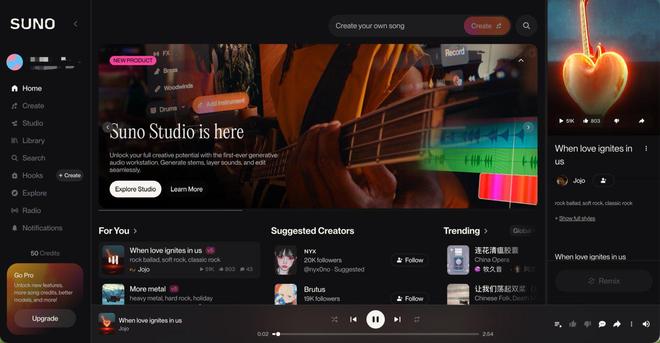
Core Insights - The rise of AI-generated music has transitioned from novelty to mainstream, with significant engagement on platforms like Bilibili and Douyin, where related content has garnered millions of views [1][2] - AI music has evolved from simple imitation to a more sophisticated creation process, utilizing deep learning models to generate original compositions across various genres [2][4] - The commercial potential of AI music is being realized, with notable success stories such as the AI song "Walk My Walk," which has generated substantial revenue through streaming platforms [7][9] Group 1: AI Music Development - AI music has undergone a "full-stack upgrade," moving from basic imitation to complex creation involving composition, arrangement, and lyrics generation [2][5] - New AI music generation models, such as Suno V3 and Mureka, allow users to create high-quality music quickly and across different genres [4][5] - The emergence of various AI tools has transformed the music production landscape, enabling a one-stop creative platform for users [5][6] Group 2: Commercialization and Market Dynamics - The direct monetization of AI music is evident, with platforms like Spotify providing revenue opportunities for artists based on streaming numbers [7][9] - AI-generated artists are gaining attention from record labels, leading to increased valuations and contracts for AI music creators [9][11] - Despite the potential, the domestic market for AI music remains conservative, with challenges in monetization and platform policies limiting revenue generation for creators [11][13] Group 3: Challenges and Future Outlook - The AI music industry faces significant challenges, including copyright issues and a supply-demand imbalance, with an overwhelming number of songs generated but limited consumer willingness to pay [25][26] - Technical limitations in AI music generation, particularly in non-Latin languages like Chinese, hinder broader acceptance and usability [28][29] - Optimism remains among industry professionals regarding the future of AI music, with expectations that it will lower creative barriers and enhance musical diversity [29]