
PC Manufacturing

Search documents
The PC Collapse Has a Winner -- and It's Not Who You Think
The Motley Fool· 2026-03-10 09:38
Core Viewpoint - The PC market is facing significant challenges due to rising memory prices driven by the AI boom, which is impacting both OEMs like HP and creating opportunities for competitors like Apple. Group 1: Market Dynamics - Windows 10's end-of-life in late 2025 is expected to affect around 1 billion PCs, particularly in the business sector [1] - The demand for DRAM and NAND chips for AI infrastructure is leading to a scarcity of components for the PC market, resulting in increased prices [2] - Gartner predicts a 17% surge in PC prices this year, leading to a 10.4% decline in PC shipments in 2026 [3] Group 2: Impact on HP - HP's memory and storage costs are projected to account for approximately 35% of its PC bill of materials, up from 15%-18% in the previous quarter [5] - HP has limited options to mitigate rising memory prices, which may force the company to lower profit margins or ship PCs with less memory [6] - Despite a year-over-year revenue increase of 11% in Personal Systems, HP's operating margins are expected to remain below long-term targets due to rising input costs [8] Group 3: Opportunities for Apple - Apple is leveraging the situation by introducing the MacBook Neo at a competitive price of $599, which is challenging for other OEMs like HP to match [11] - The MacBook Neo features 8GB of unified RAM and a 256GB SSD, providing a solid entry-level experience [12] - By targeting budget-conscious consumers and the education market, Apple aims to expand its Mac install base and capture market share from Windows PCs [13][14] Group 4: Broader Implications for Apple - While Apple may gain market share in the PC sector, it will also face higher memory costs for its other devices, potentially stretching upgrade cycles for products like the iPhone [15][16] - The memory chip shortage poses a near-term challenge for Apple, but the aggressive launch of the MacBook Neo could set the stage for future growth in its Mac business [16]



US stocks: US stocks notch monthly declines on combined AI, tariff, geopolitical uncertainty
The Economic Times· 2026-02-28 04:23
Market Overview - All three major indexes ended lower, with the Dow logging its biggest weekly drop since November, driven by uncertainty over costs and disruptions related to artificial intelligence, revived tariff uncertainties, and geopolitical tensions [1][5] - The S&P 500 lost 30.49 points (0.44%) to close at 6,878.91 points, the Nasdaq Composite fell 204.74 points (0.92%) to 22,673.65, and the Dow Jones Industrial Average decreased by 521.69 points (1.05%) to 48,977.51 [5] Earnings and Corporate Performance - Corporate America is projected to see over a 14% gain in earnings for the fourth quarter, indicating a strong earnings season despite market volatility [2][5] - Financial stocks experienced declines due to concerns over potential losses related to the collapse of UK mortgage provider Market Financial Solutions Ltd, affecting banks like Barclays, Jefferies, and Wells Fargo [5] Sector Performance - Defensive sectors such as consumer staples, healthcare, and utilities outperformed during the session, indicating a risk-off environment where investors are favoring stability over growth [4][5] - Tech shares continued to decline, with concerns over AI impacting chip and software stocks, including Nvidia, which extended its previous drop despite solid earnings [5] Economic Indicators - A hotter-than-expected Producer Price Index reading has reinforced expectations that the U.S. Federal Reserve is unlikely to cut interest rates in the near term [5] - The market is experiencing a shift, with defensive areas gaining strength while cyclical growth sectors lag [5] Company-Specific Developments - Zscaler reported a wider net loss in the second quarter, leading to a significant drop in its stock price [5] - Netflix's stock rose after its decision to exit the competition for Warner Bros Discovery, while Paramount Skydance, the likely buyer, saw its shares close sharply higher [5] - Block's stock surged after announcing it would cut nearly half its workforce to integrate AI into its operations [5] - Dell's shares increased after the company projected that revenue from its AI-optimized servers business would double by fiscal year 2027 and promised to return more cash to shareholders [5]


Dow tumbles 500 points as growing AI anxiety, hot inflation rattle Wall Street
New York Post· 2026-02-27 16:50
Market Overview - Wall Street's main indexes experienced significant declines, with the Nasdaq and S&P 500 facing their steepest monthly drop since March 2025 due to AI-related concerns and inflation data [1] - The Dow Jones Industrial Average fell nearly 500 points, or 1%, to 49,011, while the S&P 500 and Nasdaq dropped by 0.6% and 0.7%, respectively [2] Technology Sector - Technology stocks faced selling pressure amid worries over high valuations and uncertain returns from substantial AI investments [1] - Nvidia's stock decreased by 2% after a more than 5% drop in the previous session, indicating shaky risk sentiment towards AI-related investments [3] - Zscaler's shares plummeted by 14% following a report of a wider net loss in the second quarter [6] Inflation and Economic Indicators - US producer prices rose more than expected, suggesting potential inflation increases in the coming months, which negatively impacted risk appetite [6][8] - UBS reduced its recommended allocation to US equities to neutral, citing high valuations and lower sensitivity of US corporate earnings to global growth [6] Company-Specific Developments - Netflix's stock increased by 9% after its decision to exit the competition for Warner Bros. Discovery, while Warner Bros. Discovery's stock fell by 2% [9] - Paramount Skydance's shares rose by 4.7% after acquiring valuable TV and film assets [9] - Jack Dorsey's Block saw a 16% surge after announcing a significant workforce reduction to integrate AI into its operations [9] - Dell's stock climbed by 16.6% as it projected that revenue from its AI-optimized servers business would double by fiscal year 2027 and committed to returning more cash to shareholders [10]

US Stocks: Dell shares jump 17%, hit 3-month highs on forecast it will double AI server revenue
The Economic Times· 2026-02-27 15:03
Core Viewpoint - Dell Technologies is experiencing a significant surge in its stock price due to strong forecasts for its AI server business and strategic financial maneuvers, including a 20% increase in cash dividends and a $10 billion share repurchase program [1][7]. Financial Performance - Dell's shares jumped 17.5% following the announcement of expected AI server revenue growth of 103%, reaching approximately $50 billion by fiscal 2027 [7]. - The stock is trading at $142.31, marking a three-month high and on track for its largest one-day increase in nearly two years [1][7]. Market Expectations - At least seven Wall Street brokerages have raised their price targets for Dell, with J.P. Morgan projecting a 36% increase to $165 over the next year [3][7]. - The overall AI infrastructure market is expected to see investments of at least $630 billion this year, benefiting companies like Dell [7]. Competitive Position - Dell maintains a leadership position in AI compute for Tier 2 Cloud and Enterprises, allowing it to better manage operating margins and earnings despite cyclical challenges [4][7]. - The company is navigating rising memory chip costs more effectively than competitors such as HP Inc and Lenovo Group, although these costs may impact its gaming PC segment [5][7]. Industry Trends - Market researcher TrendForce has revised its forecast for Dynamic Random Access Memory price growth to 90% to 95% for the first quarter of 2026, indicating rising costs in the semiconductor market [7].
Dell shares jump on forecast it will double AI server revenue
Reuters· 2026-02-27 12:47
Core Viewpoint - Dell Technologies forecasts that its AI server revenue will double by fiscal 2027, reflecting a significant increase in demand for AI infrastructure [1] Group 1: Financial Performance - Dell's AI server revenue is expected to grow by 103% to approximately $50 billion in fiscal 2027 [1] - The company plans to increase cash dividends by 20% and initiate a $10 billion share repurchase program [1] - Dell's shares rose 11% in premarket trading, reaching $135.17, the highest level in over two months [1] Group 2: Market Position and Competition - Dell is positioned as a leader in AI compute for Tier 2 Cloud and Enterprises, which enhances its ability to manage operating margins and earnings [1] - Competitors like HP and Lenovo are struggling with market share, particularly in the context of rising memory chip costs [1] - Dell's shares have significantly outperformed those of HP and Lenovo over the past year [1] Group 3: Industry Trends - The data center equipment sector is expected to see at least $630 billion in spending this year, driven by the rapid expansion of AI [1] - Market researcher TrendForce has revised its first-quarter 2026 Dynamic Random Access Memory price growth rate to between 90% and 95% [1]

China's Lenovo warns of PC shipment pressure from memory shortage
Reuters· 2026-02-12 07:28
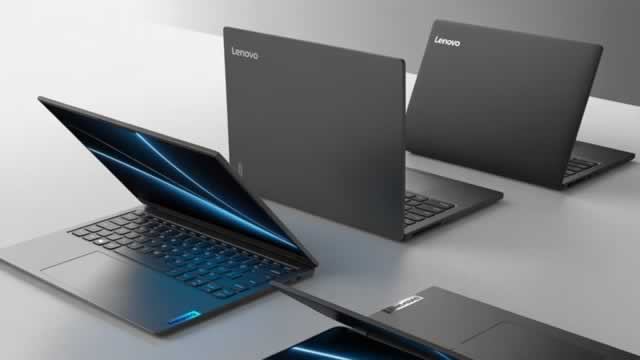
Core Viewpoint - Lenovo warns of increasing pressure on PC shipments due to a worsening memory-chip shortage, which is impacting margins and production targets in the industry [1] Financial Performance - Lenovo's third-quarter revenue increased by 18% to $22.2 billion, surpassing expectations of $20.6 billion [1] - Net profit decreased by 21% to $546 million, affected by a $285 million restructuring charge [1] - Adjusted net profit, excluding one-time items and non-cash charges, rose by 36% to $589 million [1] Business Segments - The PC, tablet, and smartphone segment, which constitutes about 70% of total revenue, reported a revenue increase of 14.3% [1] - The digital infrastructure group, including the AI server business, grew by 31% despite an operating loss of $11 million due to investments in AI capabilities [1] - Lenovo's AI server business experienced high-double-digit revenue growth, driven by strong demand and deployment of Nvidia-based solutions [1] Strategic Focus - Lenovo is shifting its focus towards the AI inference market, anticipating that this market will triple by 2028 [1] - The company has introduced new enterprise servers for AI inference workloads in collaboration with AMD [1]

China's Lenovo Q3 profit falls 21%, beats estimates on strong revenue
Reuters· 2026-02-12 04:26
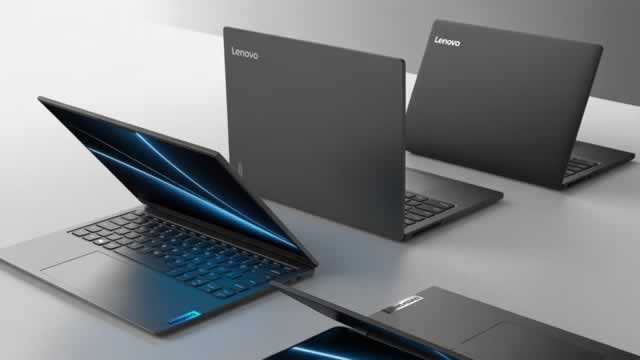
Group 1 - Lenovo Group reported a 21% drop in third-quarter profit, with net profit attributable to shareholders falling to $546 million, surpassing analyst expectations of $451.29 million [1] - Revenue for the quarter rose 18% year-on-year to $22.2 billion, exceeding expectations of $20.6 billion, driven by strong demand related to artificial intelligence [1] - Adjusted net profit, excluding one-off items and non-cash charges, increased by 36% to $589 million [1]
IDC:2025年第四季度全球PC出货量达7640万台 同比增长9.6%
智通财经网· 2026-01-13 05:45
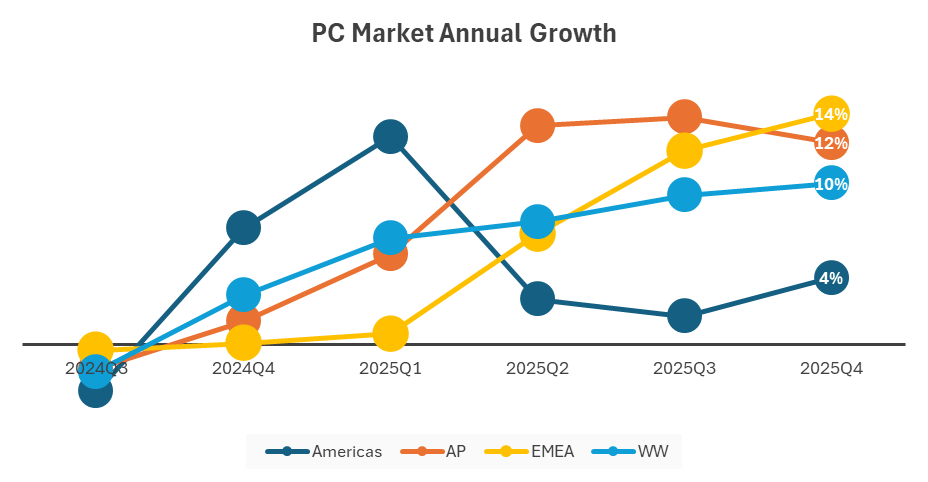
Core Insights - The global PC shipments are projected to grow by 9.6% year-over-year in Q4 2025, reaching 76.4 million units, marking a strong end to a turbulent year for the PC market [1][5] - Factors influencing the PC market include the end of Windows 10 support driving upgrade demand, uncertainties around tariff policies leading to preemptive inventory stocking, and a tightening memory supply impacting pricing and availability [1][2][4] Market Overview - The PC market is expected to experience significant volatility in the coming year due to rapid changes in the memory market, with potential price increases and adjustments in average memory configurations to extend existing inventory usage [2][4] - The average selling price (ASP) of PCs is anticipated to rise in 2026 as manufacturers prioritize mid-to-high-end product supply to cope with increasing component costs, particularly memory prices [4] Company Performance - Lenovo led the market in Q4 2025 with shipments of 19.3 million units, capturing 25.3% market share, reflecting a 14.4% increase from Q4 2024 [5] - HP Inc. and Dell Technologies followed with shipments of 15.4 million (20.1% market share, up 12.1%) and 11.7 million (15.3% market share, up 18.2%) units respectively [5] - Apple and ASUS reported shipments of 7.1 million (9.3% market share, up 0.2%) and 5.4 million (7.1% market share, up 10.9%) units respectively [5] Yearly Shipment Data - Total PC shipments for 2025 reached 284.7 million units, an 8.1% increase from 263.3 million units in 2024 [6] - Lenovo maintained a leading position with 70.8 million units shipped in 2025, holding 24.9% of the market, while HP Inc. and Dell Technologies shipped 57.5 million (20.2% market share) and 41.1 million (14.4% market share) units respectively [6]

Lenovo: Undervalued, But Surging Memory Prices Threaten Margins And End-User Demand
Seeking Alpha· 2025-12-09 00:14
Core Viewpoint - Lenovo is frequently impacted by various macroeconomic concerns, which affects its stock performance [1] Group 1 - Lenovo is categorized as a stock that is often hindered by ongoing macroeconomic issues [1]


存储芯片价格每十天翻倍,2026款PC或全面涨价至少20%
Jin Shi Shu Ju· 2025-12-04 05:44
Core Viewpoint - The demand for AI hardware is causing a significant shortage of traditional storage chips, leading major PC manufacturers to plan price increases of at least 20% for their 2026 models due to rising component costs [2][3]. Group 1: Supply Chain and Pricing - The shortage of storage is attributed to major manufacturers like Samsung, SK Hynix, and Micron shifting production capacity towards high-bandwidth memory (HBM), which is crucial for AI accelerators, thereby constricting the supply of mainstream PC components such as DDR5 and LPDDR5 DRAM and SSDs [3][6]. - Wholesale prices for wafers have surged since late September, with reports indicating that storage prices have nearly doubled every ten days in early Q4 [3]. - Major PC brands are expected to face a supply bottleneck, with procurement managers estimating that next year's storage availability may only meet about half of the demand [3][5]. Group 2: Inventory Management and Market Strategy - To mitigate the impact of rising costs and supply constraints, PC brands are planning significant price hikes for next year's models while accelerating inventory clearance and phasing out older products [4]. - The tightening supply has been evident since early this year, as major storage suppliers have begun to phase out DDR4 production in favor of more profitable AI storage [4]. Group 3: Market Outlook and Forecasts - The storage supply bottleneck is negatively impacting industry forecasts, with IDC and Gartner both revising down their PC shipment predictions for 2026 [5]. - If the storage shortage persists, actual production may fall short of expectations, with some models potentially facing production cuts or temporary halts [5]. - The imbalance in production capacity between HBM and traditional PC DRAM is expected to continue into next year, making 2026 one of the most expensive product cycles in recent years if major suppliers do not expand mainstream storage capacity [6].