
《梦三国2》

Search documents
杭产网游百舸争流
Mei Ri Shang Bao· 2026-02-13 01:35
Core Insights - The article highlights the growing global influence of Chinese video games, showcasing titles like "Black Myth: Wukong" and "Yanyun Sixteen Sounds" as cultural ambassadors for China, reflecting a shift in how Chinese games are perceived internationally [1][2] - The success of these games is attributed to their unique cultural elements, which resonate with foreign players and encourage them to explore Chinese culture [2][3] - The article emphasizes the supportive ecosystem in Hangzhou, where local policies and resources are fostering the growth of the gaming industry and encouraging companies to expand internationally [5][6][7] Group 1: Game Development and Cultural Impact - "Black Myth: Wukong" and "Yanyun Sixteen Sounds" are examples of how Chinese games are gaining popularity globally, with "Yanyun Sixteen Sounds" achieving over 15 million overseas players within a month of its release [2] - The cultural elements embedded in these games, such as "martial arts" and "jianghu," are intriguing to international players, prompting them to engage with Chinese philosophies and traditions [2][3] - "Nirvana in Fire" has successfully transformed historical narratives into interactive experiences, allowing players to immerse themselves in a living representation of ancient Chinese culture [3] Group 2: Industry Growth and Supportive Policies - Hangzhou's gaming industry has a long history of international expansion, with companies like Deyuan Network experiencing over a decade of growth and cultural export [4] - The local government has introduced supportive policies, such as subsidies for game development and localization, which are crucial for companies aiming to enter global markets [5][6] - The establishment of the Hangzhou (Yuhang) Gaming and E-sports Innovation Development Center has attracted numerous gaming companies, providing them with resources and support to navigate international challenges [7][8]

《梦三国》“独木难支”,电魂网络上市近十年首现年度预亏
Guo Ji Jin Rong Bao· 2026-01-21 12:37
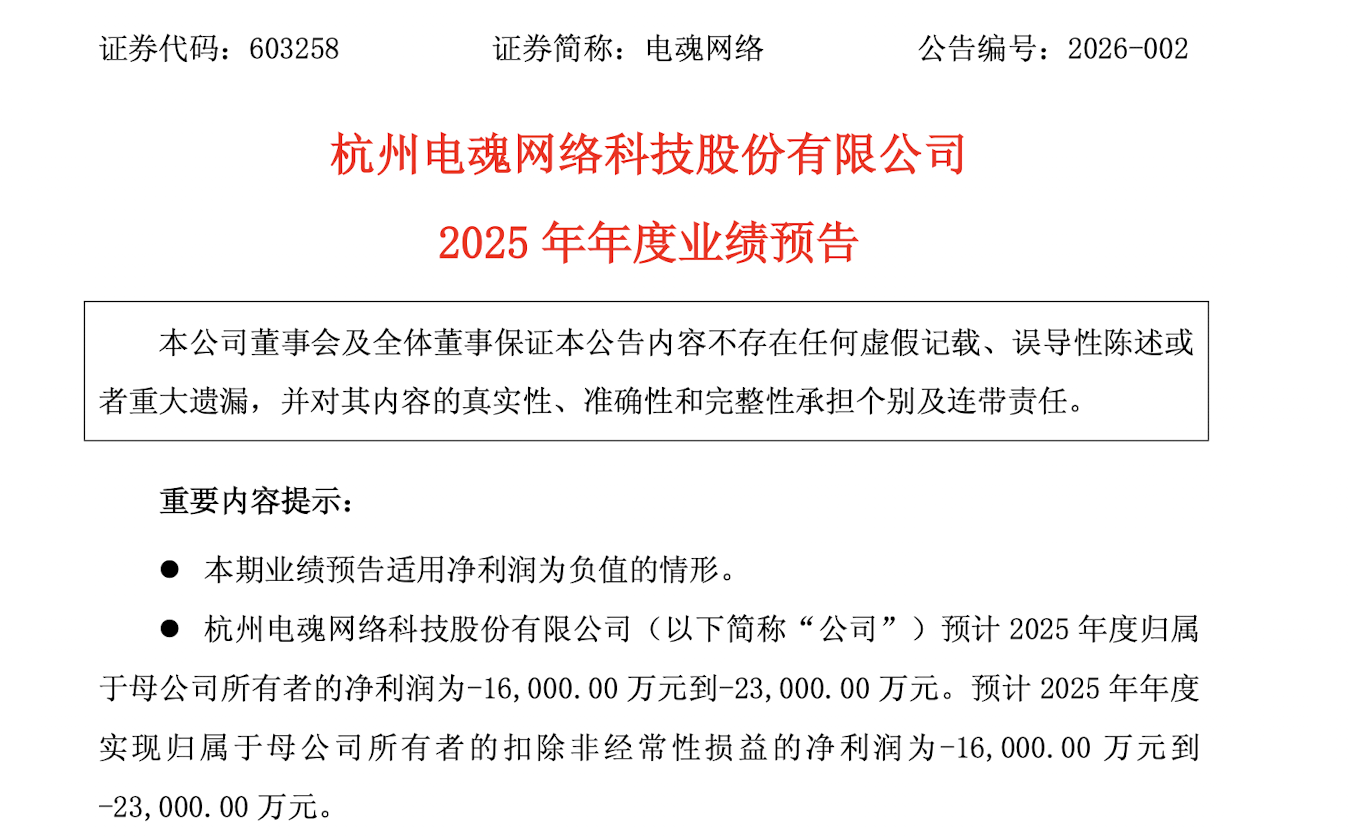
Core Viewpoint - The company, Dianhun Network, is expected to report a net profit loss of between 160 million to 230 million yuan for the year 2025, marking its first annual loss since its listing in October 2016 [1][4]. Group 1: Financial Performance - The company's revenue and net profit have been declining since 2020, with revenues of 1.024 billion yuan and a net profit of 395 million yuan in 2020, dropping to 551 million yuan and 30.58 million yuan respectively by 2024 [5]. - For the first three quarters of 2025, the company reported revenues of 293 million yuan, a year-on-year decrease of 29.08%, and a net loss of 30.515 million yuan, a year-on-year decline of 140.83% [5]. Group 2: Reasons for Performance Decline - The primary reason for the expected loss is the significant decline in game recharge flow from the wholly-owned subsidiary, Xiamen Youdong Network Technology Co., Ltd., which has adversely affected the company's profits and led to a notable impairment of goodwill [4]. - The company has also experienced a substantial decrease in revenue from existing games, further impacting its financial performance [4]. Group 3: Product and Market Context - Dianhun Network is known for its flagship product, the RPG-based online game "Dream of the Three Kingdoms," which has been well-received since its launch in 2009 and has contributed significantly to the company's past success [4]. - Despite attempts to launch new titles such as "Barbarian Battle 2," "Meet the Dragon 2," and "Cultivation Era" to revitalize its product lineup, these new releases have not met market expectations, continuing the trend of declining performance [5].

电魂网络三股东拟减持背后:《梦三国》独力难撑,上半年由盈转亏
Guo Ji Jin Rong Bao· 2025-09-29 13:07
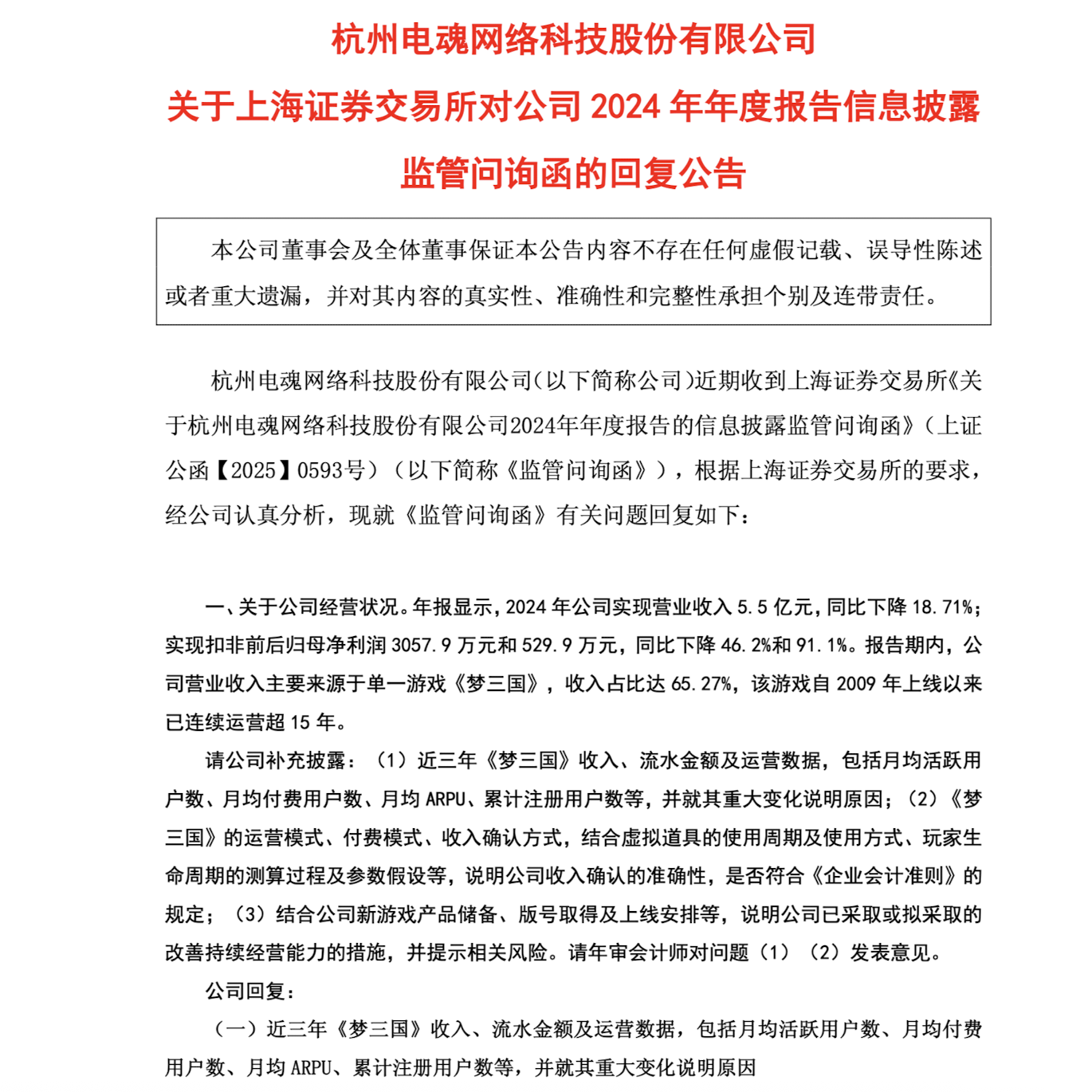
Group 1 - The core point of the news is that multiple shareholders and executives of Dianhun Network plan to reduce their holdings due to personal financial needs, amidst the company's declining performance [1][2] - The company reported a significant drop in revenue and net profit over the years, with revenue decreasing from 10.24 billion in 2020 to 5.51 billion in 2024, and net profit dropping from 3.95 billion to 305.8 million in the same period [2][3] - The decline in performance is attributed to the decreasing revenue and user engagement of its core product, the online game "Dream of Three Kingdoms," which has seen a drop in both its revenue and active user base [3][6] Group 2 - The company has faced scrutiny from the Shanghai Stock Exchange regarding its reliance on "Dream of Three Kingdoms" for revenue, which has raised concerns about its sustainability [4] - The latest financial report indicates that in the first half of 2025, the company's revenue fell by 28.69% to 1.94 billion, resulting in a net loss of 9.34 million, a significant decline from a profit of 59.31 million in the same period last year [6][7] - Despite attempts to diversify its product offerings, such as launching mobile versions and new games, the company has not successfully established a new revenue-generating product, with "Dream of Three Kingdoms" still accounting for 65.27% of total revenue [7]
电魂网络三股东拟减持背后:《梦三国》独力难撑,上半年由盈转亏……
Guo Ji Jin Rong Bao· 2025-09-29 12:36
Core Viewpoint - The announcement of share reduction by executives and shareholders of Dianhun Network highlights the company's ongoing financial struggles, marked by declining revenues and profits, particularly from its flagship game "Dream of Three Kingdoms" [1][2][3] Group 1: Share Reduction Announcement - Dianhun Network's executives, including Director Yu Xiaoliang, Secretary Zhang Jiliang, and CFO Wu Xiaojun, plan to reduce their shareholdings due to personal financial needs, with reductions amounting to 391.81 million shares (1.61% of total shares), 22,500 shares (0.01%), and 25,000 shares (0.01%) respectively [1] - The reduction period is set from October 29, 2025, to January 28, 2026, with prices determined by market conditions [1] Group 2: Financial Performance - Dianhun Network has experienced a continuous decline in performance, with revenues dropping from 10.24 billion yuan in 2020 to 5.51 billion yuan in 2024, and net profits decreasing from 3.95 billion yuan to 305.8 million yuan in the same period [2][6] - The company reported a net loss of 9.34 million yuan in the first half of 2025, a significant decline from a profit of 59.31 million yuan in the same period the previous year, attributed to reduced game recharge income [6] Group 3: Product Dependency and Market Challenges - The core product "Dream of Three Kingdoms" has seen a decline in both revenue and user engagement, with monthly active users dropping to 566,400 (a 3.9% decrease) and monthly paying users down by 26.15% to 64,200 in 2024 [6][7] - The company has struggled to introduce new successful products, with attempts to launch mobile versions and other games yielding lackluster market responses, leaving "Dream of Three Kingdoms" as the primary revenue source, accounting for 65.27% of total revenue [7]
电竞行业迎来风口 中国本土市场正在形成优势
Xin Hua Wang· 2025-08-12 05:54
Core Insights - The inclusion of esports in the upcoming Hangzhou Asian Games has sparked increased investment interest in the industry, with projections indicating a growth in esports viewership to 574 million in 2023 and 641 million by 2025, alongside global esports revenue reaching nearly $1.8 billion in 2023 [1] Group 1: Industry Development - The 2023 Asian Games will feature four esports events from Tencent, highlighting the need for standardized talent selection and operational systems in the esports industry [2] - The selection criteria for esports national training teams will align with traditional sports, emphasizing not only technical skills but also personal conduct [2] - The development of esports venues will follow new reference standards due to the unique requirements of esports compared to traditional sports [3] Group 2: Business Model and Profitability - The esports industry in China is currently facing challenges in achieving profitability across the entire value chain, with most revenue coming from game developers, while event operators and esports clubs struggle to reach stable profit levels [4] - Consumer spending in esports is rapidly increasing, with significant portions of users spending between 101 to 500 yuan (31.1%) and 501 to 2000 yuan (29.8%) on virtual items and merchandise [4] Group 3: International Expansion - Various countries, including Germany, Brazil, and South Korea, have begun to support the esports industry through funding and strategic initiatives [5] - Chinese gaming companies are increasingly hosting mobile esports events globally, with the Asian Games featuring games developed by Chinese firms, which will enhance the influence of mobile esports [6] - The Chinese esports industry aims to explore overseas market opportunities, focusing on content development and technological innovation to promote Chinese culture and narratives globally [6]

