《鲸鱼马戏团》

Search documents
纪念|贝拉·塔尔:我希望,看完我的电影你能变得更强大
Xin Lang Cai Jing· 2026-01-07 09:57
Core Viewpoint - The passing of Béla Tarr, a renowned Hungarian director, at the age of 70 has deeply affected the film community in Europe and worldwide, with tributes highlighting his significant contributions to cinema and the enduring relevance of his work [1][3]. Group 1: Career Highlights - Béla Tarr was born on July 21, 1955, in Pécs, Hungary, and was introduced to the arts at a young age due to his parents' involvement in theater [4]. - He directed nine feature films throughout his career, including notable works such as "Sátántangó," "The Turin Horse," and "The Whalebone Circus," which are characterized by long takes, slow narratives, and black-and-white imagery [3][11]. - His film "The Turin Horse," released in 2011, is considered his final work, encapsulating themes of life's burdens and monotony [15]. Group 2: Influence and Legacy - Tarr's unique filmmaking style has inspired many contemporary filmmakers, including Gus Van Sant and László Nemes, who have acknowledged his influence on their work [3][19]. - He founded a film school called "film.factory" in Sarajevo, where he aimed to liberate students' creativity rather than impose traditional educational structures [17][19]. - Despite his passing, Tarr's films continue to resonate, challenging audiences and provoking thought about human values and societal issues [1][3].

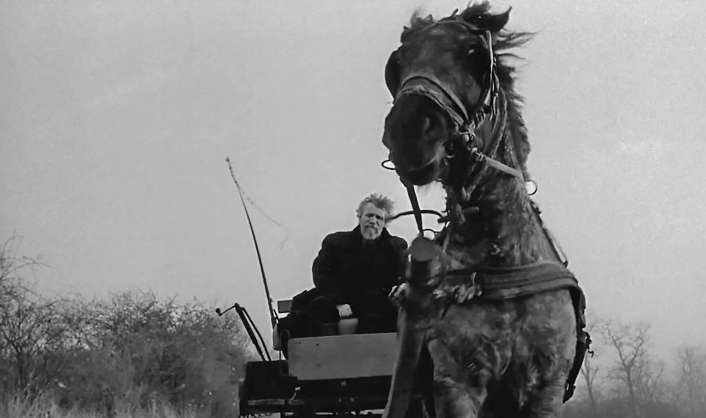
骑着“都灵之马”的拉斯洛
Bei Jing Ri Bao Ke Hu Duan· 2025-10-20 22:45
Core Points - The Nobel Prize in Literature for 2025 was awarded to Hungarian author Krasznahorkai László for his compelling and visionary literary works that reaffirm the power of art amidst apocalyptic fears [3] - Krasznahorkai's writing style is characterized by long sentences and massive paragraphs, creating a literary world that reflects existential themes and human history from myth to the Cold War [4][6] - His works often explore themes of decay and despair, as seen in the film adaptation of his novel "The Turin Horse," which depicts a slow, inevitable decline over six days [5][10] Group 1 - Krasznahorkai's narratives are deeply intertwined with Nietzschean philosophy, questioning the fragility of daily order and the persistence of chaos in human existence [5][8] - The structure of "Satan's Tango" mirrors a tango dance, illustrating a dystopian narrative where hope is placed in false prophets, ultimately leading to a reflection on creation and destruction [7] - The character Valushka in "The Melancholy of Resistance" symbolizes the struggle against corruption and ignorance, representing a critique of societal norms [7][8] Group 2 - Krasznahorkai's writing serves as a prophetic narrative, examining the details of human survival in apocalyptic settings, while also embedding a sense of skepticism [6][9] - The concept of eternal recurrence, as presented in his works, challenges readers to confront the cyclical nature of existence and the inevitability of despair [8][10] - The author emphasizes that decay is not an end but a warning, urging individuals to face the fragility of life and the potential for transformation [10]
够“狠”的诺奖得主,其实中国人并不陌生
3 6 Ke· 2025-10-10 07:50
Core Viewpoint - The awarding of the 2025 Nobel Prize in Literature to Hungarian author László Krasznahorkai is seen as a recognition of his profound literary contributions that resonate with themes of human existence and the power of art in times of despair [1][3][12]. Group 1: Author Background and Works - László Krasznahorkai is known for significant literary works such as "Satan's Tango" and "The World is Advancing," and has also contributed to screenwriting for films like "The Turin Horse" [3][12]. - His interest in Chinese culture is notable, having traveled to China in the 1990s to retrace the steps of the poet Li Bai, reflecting his appreciation for Eastern classical culture [4][9]. - Krasznahorkai's writing style is characterized by long, complex sentences and a postmodern approach, often exploring dark themes and human flaws [13][26]. Group 2: Themes and Literary Style - His works frequently address the duality of hope and despair, illustrating the cyclical nature of human existence [7][8]. - The overarching theme in Krasznahorkai's literature is the exploration of a "disordered world," with a focus on the essence of existence itself, rather than merely political commentary [14][18]. - Critics describe his style as powerful and bleak, often employing black humor to convey deeper existential questions [16][20]. Group 3: Reception and Impact - The recognition of Krasznahorkai with the Nobel Prize is viewed as a significant endorsement of serious literature, particularly in the context of Eastern European literary contributions [24][25]. - His works have been translated into Chinese, making them accessible to a broader audience, and fostering a connection between Chinese and Eastern European readers [12][14]. - The complexity and depth of his writing present challenges for readers, suggesting that engagement with his work requires a serious commitment [24][30].