
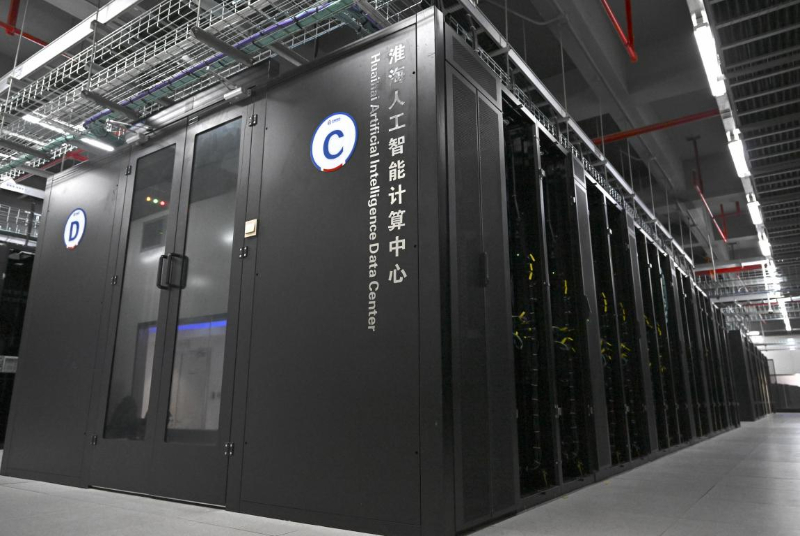
万卡智算集群

Search documents
“1590 EFLOPS”意味着什么?
Xin Hua Wang· 2026-01-23 01:28
Core Insights - China's intelligent computing power has exceeded 1590 EFLOPS, ranking among the top globally, which significantly supports the rapid development of the artificial intelligence industry [5][10] - The construction of 42 "Wanka" intelligent computing clusters has been completed, which are essential for addressing the increasing demand for AI computing power [9][10] Computing Power Overview - Computing power refers to the ability to process data, impacting various aspects of daily life, such as smart speakers, electronic payments, and personalized online shopping [3] - FLOPS (Floating Point Operations Per Second) is a standard measure of computing capability, with EFLOPS representing 1 quintillion operations per second [4] Growth and Projections - China's intelligent computing power is projected to reach 725.3 EFLOPS by 2024, up from 416.7 EFLOPS in 2023, indicating a robust growth trajectory [5] - The total computing power in China has been growing at an annual rate of approximately 30%, driven by the rapid advancement of artificial intelligence [8] Types of Computing Power - Computing power is categorized into three types: basic computing power, intelligent computing power, and supercomputing power, each serving different applications [7][8] - Intelligent computing power is crucial for complex data analysis and AI tasks, enabling efficient processing of massive datasets [8] Infrastructure Development - The Chinese government emphasizes the importance of building advanced information infrastructure, with a focus on maintaining technological leadership [10] - Major telecommunications operators have invested over 10 billion yuan in building "Wanka" clusters, significantly increasing their intelligent computing capacity [9]

工业经济向新向优发展
Jing Ji Ri Bao· 2026-01-23 00:59
Group 1 - The core message emphasizes the commitment of the industrial and information sectors to achieve new industrialization, with a focus on quality improvement and reasonable growth in the industrial economy, achieving a year-on-year industrial added value growth of 5.9% in 2025 [1] - The manufacturing sector is expected to maintain its position as the world's largest for 16 consecutive years, with the manufacturing value added as a stable proportion of GDP [1] - The telecommunications business volume is projected to grow by 9.1% year-on-year, contributing over 40% to economic growth, thus playing a stabilizing role in the economy [1] Group 2 - By 2025, the number of artificial intelligence companies in China is expected to exceed 6,000, with the core industry scale anticipated to surpass 1.2 trillion yuan [1] - AI applications are increasingly integrated into key industries such as steel, non-ferrous metals, electricity, and telecommunications, enhancing product development, quality inspection, and customer service [1] - The digital industry is projected to generate approximately 38.3 trillion yuan in revenue and 3.1 trillion yuan in profit by the end of 2025, reflecting cumulative growth of about 39.5% and 48.4% respectively since the end of the 13th Five-Year Plan [2]
人工智能企业超6000家 建成全球规模最大信息基础设施——工业经济向新向优发展
Jing Ji Ri Bao· 2026-01-22 23:03
Core Insights - The Chinese government is committed to achieving new industrialization, with confidence in maintaining a stable and positive industrial economy through 2026 [1] Group 1: Industrial and Economic Performance - In 2025, the industrial added value above designated size is expected to grow by 5.9% year-on-year, with the manufacturing added value maintaining a stable share of GDP [1] - The contribution of the industrial and information sectors to economic growth exceeds 40%, acting as a stabilizing force for the economy [1] Group 2: Artificial Intelligence Development - By 2025, the number of artificial intelligence companies in China is projected to exceed 6,000, with the core industry scale expected to surpass 1.2 trillion yuan [1] - AI applications are increasingly integrated into key industries such as steel, non-ferrous metals, electricity, and telecommunications, enhancing product development, quality inspection, and customer service [1] Group 3: Digital Industry Growth - By the end of 2025, the revenue of China's digital industry is estimated to reach approximately 38.3 trillion yuan, with profits of 3.1 trillion yuan, reflecting cumulative growth of about 39.5% and 48.4% respectively since the end of the 13th Five-Year Plan [2] - The government aims to accelerate technological innovation and application empowerment in the digital industry, while enhancing standard leadership and ecological construction [2] Group 4: Infrastructure Development - China has established 4.838 million 5G base stations, covering all towns and 95% of administrative villages, with 5G networks extending to over 330 cities [2] - The intelligent computing power scale has exceeded 1,590 EFLOPS, positioning China among the global leaders in supporting rapid AI industry development [2]
工信部:一批领航级智能工厂将亮相
Bei Jing Shang Bao· 2026-01-21 16:04
Core Insights - Artificial intelligence has penetrated over 70% of business scenarios in leading factories, with the Ministry of Industry and Information Technology (MIIT) supporting leading enterprises to explore future manufacturing models and cultivate a batch of leading factories to drive overall industry transformation [1][3][6]. Group 1: Development of Smart Factories - A total of over 35,000 basic-level, over 8,200 advanced-level, and over 500 excellent-level smart factories have been established, along with 15 leading-level smart factories [2]. - The first batch of 15 leading factories showcased at the 2025 World Intelligent Manufacturing Conference have made beneficial explorations in manufacturing models, achieving an average production efficiency increase of 29% and a reduction in product defect rates by 47% [3]. - The leading factories have developed over 6,000 vertical domain models and facilitated the large-scale application of over 1,700 key intelligent manufacturing equipment and industrial software [3]. Group 2: Strategic Initiatives - The cultivation of leading-level smart factories is a strategic measure to seize opportunities in industrial intelligence development and build future manufacturing competitive advantages [4]. - Starting in 2024, MIIT will launch a gradient cultivation action for smart factories, establishing a four-level system to meet the transformation needs of manufacturing enterprises of different scales and foundations [5]. - The goal is to create a flexible supply network that enhances the efficiency of industrial resource utilization and strengthens China's core position in the global supply chain [5]. Group 3: 6G Technology Development - The first phase of 6G technology trials has been completed, with over 300 key technology reserves formed, and the second phase of trials has recently commenced [8]. - China has built the world's largest and most advanced information infrastructure, with 5G standard essential patent declarations accounting for 42% globally [8]. - The number of 5G base stations has reached 4.838 million, covering all towns and 95% of administrative villages, with over 12 billion 5G users [8].