5G基站

Search documents
中兴通讯(000063) - 2026年3月30日投资者关系活动记录表
2026-03-31 01:50
Group 1: Financial Performance - In 2025, the company's revenue reached 629 billion CNY, a year-on-year increase of 10.4%, marking the best performance in four years [2] - The company's revenue structure shifted from "7-2-1" to "2-1-1," indicating a diversified growth model [3] - The computing power business achieved a 150% year-on-year revenue growth, accounting for nearly 25% of total revenue [4] Group 2: Strategic Direction - The company is committed to the "Connection + Computing Power" dual-drive strategy, focusing on becoming a leader in network connectivity and intelligent computing [4] - The company aims to maintain strategic stability and enhance quality and profitability through resource optimization and ecological collaboration [5] - The focus on AI is evident, with the company developing a full-stack AI solution covering chips, computing infrastructure, large models, and applications [6] Group 3: Market Position and Challenges - The company remains a leading supplier in the domestic network equipment market despite a 10.6% decline in network business revenue due to reduced domestic 5G investment [22] - The company faces challenges in profit margins due to rising raw material costs, particularly in storage [21] - The company is adapting to the AI-driven transformation of operators, focusing on new opportunities in computing power and AI applications [23] Group 4: Technological Advancements - The company has made significant investments in 6G technology, focusing on AI integration and satellite communication as core applications [24] - The company has developed over 30 key technologies in the 6G field, including advancements in AI and wireless technology [25] - The company is leveraging its extensive experience in communication technology to enhance its satellite payload capabilities [27] Group 5: Product Development and Innovation - The company plans to strengthen its terminal product innovation, particularly in AI-native smartphones and gaming devices [5] - The company has launched the AI-native Nubia M153 smartphone, showcasing its commitment to integrating AI into consumer products [4] - The company aims to enhance its product offerings by focusing on scenario-based integration and innovation in terminal products [5]

美国特别竞争研究项目:《中美技术竞争中谁领先、谁落后及未来走向》
欧米伽未来研究所2025· 2026-03-19 15:40
Core Viewpoint - The SCSP report highlights the competitive landscape between the U.S. and China in key technology sectors, indicating a complex, fluid, and uncertain multi-dimensional competition rather than a clear-cut dominance by either side [2]. Group 1: China's Strengths - China leads in four strategic technology areas: advanced batteries, advanced manufacturing, commercial drones, and 5G infrastructure, with high confidence ratings [4]. - In the battery sector, China's manufacturing capacity reached 1,705 GWh in 2023, compared to the U.S. at 93 GWh, marking an 18-fold difference. China controls 80% of global lithium-ion battery component shipments and holds about 60% of the global electric vehicle battery market [4]. - China accounts for approximately 35% of global manufacturing output, while the U.S. is at about 12%. The number of industrial robots deployed by Chinese companies in 2023 matches the total of all other countries combined [5]. - China has deployed over 4 million 5G base stations, averaging 206 per 100,000 people, compared to the U.S. with about 100,000 base stations or 77 per 100,000 people. By 2024, China is expected to have over 1 billion 5G users, covering 88% of its mobile users [5]. Group 2: U.S. Strengths - The U.S. maintains a lead in artificial intelligence, quantum computing, semiconductors, fusion energy, and internet platforms, relying on foundational research breakthroughs and private sector innovation [6]. - In AI, U.S. private investment reached $67.2 billion in 2023, compared to China's $7.76 billion, a nearly 9-fold difference. Most foundational AI models have originated from U.S. private companies [6]. - The semiconductor sector is rated as "U.S. leading, high confidence," with the CHIPS Act expected to drive over $400 billion in private investment, projecting that the U.S. will hold 28% of global advanced logic chip capacity by 2032 [7]. Group 3: Structural Weaknesses - A recurring structural pattern is observed: U.S. innovation versus Chinese commercialization. The U.S. holds 39% of global biotechnology patents but has seen a shift in the production side, with Chinese companies supplying about 17% of U.S. active pharmaceutical ingredients (APIs) [9]. - In synthetic biology, the U.S. market is valued at $16.3 billion compared to China's $1.05 billion, yet China controls 70% of global fermentation capacity, highlighting a significant production bottleneck for U.S. firms [10]. - DJI dominates the global consumer drone market with over 90% share, raising national security concerns for the U.S. as it lacks comparable domestic alternatives [10]. Group 4: Strategic Recommendations - The report suggests establishing a "Technology Competition Council" to unify strategic direction and coordinate responses across departments, addressing the misalignment between private sector focus and government priorities [11]. - The trajectory of fusion energy illustrates the competitive dynamics, with the U.S. currently leading but facing significant investment from China, which may narrow the gap in the coming years [12].


全国人大代表、中国铁塔董事长张志勇:建议在老旧小区改造中进一步推进智能化基础设施建设
Mei Ri Jing Ji Xin Wen· 2026-03-09 10:24
Group 1: Core Recommendations - The chairman of China Tower, Zhang Zhiyong, proposed three key recommendations during the two sessions in 2026, focusing on the construction of new information infrastructure in coastal areas, promoting efficient data flow, and enhancing smart infrastructure in old residential area renovations [2][3][9] - Zhang emphasized the need for a systematic and forward-looking layout of new information infrastructure to support the development of the marine economy, addressing current shortcomings in marine communication coverage and intelligent application levels [3][4] Group 2: Integrated Communication Network - The first recommendation is to plan an integrated communication network covering air, land, sea, and space, enhancing the sharing of equipment and facilities, and improving intelligent applications in marine scenarios [4][5] - The goal is to achieve "full coverage, seamless connection, safety, and demand-based scheduling," with a focus on top-level design and comprehensive planning for communication networks and perception systems [4] Group 3: Data Flow Efficiency - Zhang highlighted the importance of data as a new production factor and strategic resource, noting issues such as inefficient data circulation mechanisms and insufficient supply capabilities [7][8] - Recommendations include improving data openness, enhancing high-quality data set construction, and strengthening data security capabilities to ensure smooth and efficient data flow [8][6] Group 4: Smart Infrastructure in Old Residential Areas - Zhang pointed out that the renovation of old residential areas is crucial for improving residents' quality of life, but current smart infrastructure is often added as an afterthought rather than integrated into the planning [9][10] - He proposed establishing a communication coverage coordination mechanism and ensuring that network guarantees are included in renovation standards, with a focus on key areas like elevators and underground parking [11][12]

中兴通讯(000063):盈利能力短期承压,算力领域实现跨越式增长
CMS· 2026-03-08 12:37
Investment Rating - The report maintains a "Strong Buy" rating for the company [3] Core Views - The company's revenue for 2025 reached 133.895 billion yuan, a year-on-year increase of 10%, while net profit attributable to shareholders decreased by 33% to 5.618 billion yuan [1][8] - The company's profitability is under short-term pressure, with a significant decline in net profit due to various factors, including a decrease in revenue from operator networks and changes in product mix [7] - The company has achieved a leap in the computing power sector, with revenue growth of approximately 150% year-on-year, contributing to 24.6% of total revenue [7] - The company is actively responding to the slowdown in domestic 5G investment and is focusing on global expansion, maintaining a leading competitive position in core products [7] Financial Data and Valuation - Total revenue is projected to grow from 121.299 billion yuan in 2024 to 196.738 billion yuan in 2028, with a compound annual growth rate (CAGR) of approximately 14% [8][14] - The company's net profit is expected to recover from 5.618 billion yuan in 2025 to 8.696 billion yuan by 2028, reflecting a growth rate of 18% [8][14] - The price-to-earnings (PE) ratio is projected to decrease from 31.8 in 2025 to 20.6 in 2028, indicating a potential improvement in valuation [15]
通信行业双周报(2026、2、13-2026、2、26):5GSA发展进入拐点-20260227
Dongguan Securities· 2026-02-27 09:10
Investment Rating - The report rates the communication industry as "Overweight," indicating that the industry index is expected to outperform the market index by more than 10% over the next six months [45]. Core Insights - The global mobile core network market is projected to grow by 15% year-on-year by 2025, with 5G core networks expected to capture approximately 50% of the market share, marking a turning point in the development of 5G Standalone (SA) technology [20][41]. - The industry is transitioning from network coverage construction to a "capability competition," focusing on end-to-end optimization and commercial monetization, with significant regional performance disparities [41]. - The report highlights the ongoing technological iteration and policy benefits, with new growth drivers emerging from AI, quantum communication, and low-altitude economy sectors [41]. Summary by Sections 1. Communication Industry Market Review - The communication sector has seen a cumulative increase of 4.39% over the past two weeks (February 13-26), outperforming the CSI 300 index by 4.24 percentage points, ranking fifth among 31 primary industries [12][13]. - The sector has recorded a year-to-date increase of 8.55%, surpassing the CSI 300 index by 6.46 percentage points [12]. 2. Industry News - The report mentions several key developments, including the upcoming release of AI glasses by Qianwen at the 2026 Mobile World Congress [17]. - A global report indicates that the 5G SA technology has moved beyond the "declaration" phase into a focus on practical execution [19]. - Dell'Oro Group forecasts a significant growth in the mobile core network market, driven by the expansion of 5G SA networks [20]. - Omdia reports that the deployment of AI infrastructure is impacting the telecommunications industry, leading to shortages in memory chips and copper materials [21]. 3. Company Announcements - Changying Tong announced a 29.53% year-on-year increase in net profit for 2025, driven by enhanced production capabilities [24]. - Guangxun Technology's application for a private placement has been approved by the Shenzhen Stock Exchange [25]. 4. Industry Data Updates - As of December 2025, the mobile phone user base is approximately 1.827 billion, reflecting a year-on-year increase of 2.04% [27]. - The length of optical cable lines reached about 74.99 million kilometers, with a year-on-year growth of 2.89% [30]. - By December 2025, the number of 5G base stations reached 4.838 million, accounting for 37.6% of the total mobile base stations [38]. 5. Communication Sector Weekly Perspective - The report suggests focusing on companies that align with the themes of "technology commercialization, policy catalysis, and earnings certainty," recommending stocks such as China Mobile, China Telecom, ZTE, and others [41][42].
36万亿债务压顶!美国霸权倒计时,中国或将在2028成全球经济第一
Sou Hu Cai Jing· 2026-02-11 11:47
Group 1 - The U.S. national debt is approaching $36 trillion, significantly impacting the economy and diverting funds from infrastructure and education to debt repayment [2] - The rapid growth of debt since the 2008 financial crisis has resulted in an average debt burden of over $100,000 per American [2] - Economists warn that rising interest rates could lead to an additional annual interest expenditure of over $300 billion, further constraining other spending areas [4] Group 2 - The debt issue is a long-term result of policies such as large tax cuts and military spending, which have exacerbated the fiscal deficit [5] - The hollowing out of the manufacturing sector has led to a significant loss of factory jobs, dropping from over 17 million in 2000 to over 12 million currently, increasing reliance on imports [8] - The wealth gap is widening, with the top 1% holding 30% of the wealth while the bottom 50% only possess 2.4%, leading to decreased social mobility [8] Group 3 - Political gridlock between the two parties has stalled infrastructure legislation, further hindering economic growth [10] - China's rapid economic development is projected to surpass the U.S. GDP by 2028, accelerated by a more stable recovery from the pandemic [10][12] - China's manufacturing output has grown significantly, accounting for nearly 30% of global production, enhancing its competitiveness in global trade [12] Group 4 - The U.S. military spending accounts for 40% of global military expenditure, but involvement in conflicts has increased debt without yielding long-term benefits [14] - China's Belt and Road Initiative has invested $1.3 trillion in over 150 countries, enhancing its influence and support in developing nations [14][16] - China's high savings rate and investment in infrastructure, such as high-speed rail and renewable energy, contribute to its economic resilience [17][19] Group 5 - China's patent applications account for 38% of the global total, significantly aiding its technological advancement [19] - The U.S. faces challenges from its reliance on consumer spending, which constitutes 70% of its economy, while China focuses on long-term development [19] - The transition to green energy is progressing rapidly in China, with significant investments in renewable energy technologies [19] Group 6 - Some analysts believe that China's rise to surpass the U.S. may not be straightforward due to demographic challenges and a potential slowdown in growth rates [21] - China's debt levels have increased since the 2000s, posing a risk to its economic stability [23] - The U.S. dollar's status as a reserve currency is at risk if confidence wanes, which could lead to volatility in global financial markets [25] Group 7 - Future geopolitical tensions are expected to intensify, with the U.S. potentially using alliances to pressure China [27] - Economic strength is central to national competition, with both the U.S. and China facing internal challenges that could impact their global standing [27]

构建网络空间命运共同体迈向新阶段
Xin Lang Cai Jing· 2026-02-08 21:39
Core Viewpoint - The article emphasizes China's commitment to building a community of shared future in cyberspace, highlighting its role in global governance and cooperation in the digital realm, particularly for developing countries [1][2][5]. Group 1: Development Initiatives - China has signed digital economy cooperation memorandums with 26 countries and has 33 "Silk Road e-commerce" partner countries as of August 2025, showcasing its efforts in international digital collaboration [2]. - Chinese enterprises are actively involved in building digital infrastructure, including 5G bases, data centers, and smart cities, contributing to projects like the "China-ASEAN Information Port" and the "Digital Silk Road" [2]. - Huawei's global digital inclusion initiative, launched in 2019, has implemented digital skills training programs in hundreds of schools worldwide, aiding in the development of digital talent [2]. Group 2: Security Framework - China's approach to cybersecurity is based on a comprehensive and cooperative security perspective, promoting consensus and collaboration among nations [3]. - The country has released several strategic documents, including the "National Cybersecurity Strategy" and the "Global Data Security Initiative," reflecting its commitment to multilateral cooperation and opposition to unilateral security practices [3]. - By 2025, China aims to establish partnerships with 294 computer emergency response organizations across 87 countries and regions to enhance data security and personal information protection [3]. Group 3: Collaborative Pathways - China advocates for multilateral cooperation, emphasizing dialogue and practical collaboration to address global digital governance challenges [4]. - The establishment of the World Internet Conference International Organization in 2022 has increased representation and voice for developing countries in global governance [4]. - Initiatives like the "China-ASEAN Digital Governance Cooperation" and the "China-Africa Internet Development and Cooperation Forum" aim to enhance digital transformation in partner regions [4]. Group 4: Future Directions - The article outlines a vision for a fair, open, and secure cyberspace, focusing on enhancing the voice of developing countries within the UN framework for cyberspace governance [5][6]. - It emphasizes the importance of multi-stakeholder participation in international dialogues, encouraging contributions from various sectors, including technology and civil society [6]. - The promotion of the "Digital Silk Road" aims to improve digital infrastructure and security, particularly for developing nations, while fostering local talent through training and knowledge exchange [6].
爱立信和诺基亚在中国,销售额断崖式下跌
半导体芯闻· 2026-02-06 10:12
Core Viewpoint - The article discusses the significant decline in sales and market share of Ericsson and Nokia in the Chinese 5G market due to geopolitical tensions and shifts in customer spending patterns, highlighting the challenges faced by Western telecom suppliers in China [3][5][7]. Group 1: 5G Infrastructure in China - China has built 4.83 million 5G base stations by the end of November, with an increase of 579,000 from the previous year, surpassing the total number installed in Europe since the technology's inception [2]. - The expected explosive growth in 5G spending in China makes it an attractive market for companies like Ericsson and Nokia, especially compared to the more regulated European market [2]. Group 2: Sales Decline of Ericsson - Ericsson's revenue from Chinese customers fell sharply from nearly $1.8 billion in 2019 to approximately $0.798 billion in 2025, representing a decline of over 40% [3]. - The company's market share in China has significantly decreased, with its revenue from the region accounting for only 3% of total sales in the latest quarterly report [3]. - In 2021, Ericsson's sales in China nearly halved to about $1.1 billion, attributed to geopolitical actions against Huawei and ZTE [3]. Group 3: Nokia's Market Challenges - Nokia's market share in China is reported to be only 3% as of 2025, with a significant drop in revenue from nearly €2.2 billion ($2.6 billion) in 2019 to about €1.1 billion ($1.3 billion) in 2025 [4][5]. - The company has hinted at a complete exit from the Chinese mobile communications market, citing national security concerns [5]. - Nokia's revenue in the Greater China region is projected to decline by 19% to €913 million ($1.08 billion) by 2025, which is only 42% of the revenue from seven years ago [5]. Group 4: Strategic Moves and Workforce Reduction - Nokia's acquisition of its subsidiary Nokia Shanghai Bell for €501 million ($592 million) aims to simplify its operations in China while potentially reducing expenditures [6]. - Both Ericsson and Nokia have significantly reduced their workforce in China, with Ericsson's employee count dropping from approximately 14,000 in mid-2021 to about 9,500 by the end of the previous year [7]. - The anticipated exit of both companies from the Chinese market raises concerns about their future in the global 6G market, as Chinese operators invest rapidly in mobile network technology [7].



中新网评:以小故事见大时代,用正能量筑同心圆
Zhong Guo Xin Wen Wang· 2026-02-05 07:29
Core Viewpoint - The article highlights the "2025 China Positive Energy Network Boutique Collection and Broadcasting Activity," emphasizing the theme "You and I Striving, China Advancing," which aims to promote positive energy in the online space as the country approaches significant milestones in its development [1][2]. Group 1: National Development Achievements - The year 2025 marks the completion of the "14th Five-Year Plan" and is a crucial year for advancing towards the second centenary goal, with significant projects like the "Deep Sea No. 1" gas field and the "Hualong One" nuclear power unit contributing to China's energy transition [2]. - The total number of 5G base stations has surpassed 4 million, indicating the gradual realization of a digitally interconnected China [2]. Group 2: Stories of Ordinary People - Numerous inspiring stories of ordinary individuals have emerged, such as a 97-year-old retired teacher who has volunteered for over 20 years to tutor left-behind children, and a village leader who organized an emergency evacuation during a landslide [3]. - Young volunteers, like a rescue team member who has participated in nearly a thousand rescue missions, exemplify the spirit of dedication and service in contemporary society [3]. Group 3: Building a Positive Online Environment - The article emphasizes the importance of creating a clean and positive online environment, where stories of ordinary heroes and national achievements foster a culture of virtue and aspiration among netizens [4]. - The initiative encourages collective participation in promoting positive energy through impactful online content, aiming to document the great era and contribute to the construction of a modern socialist country [4].
5G基站超483万,现存5G相关企业超82.6万家
Huan Qiu Wang· 2026-02-03 05:51
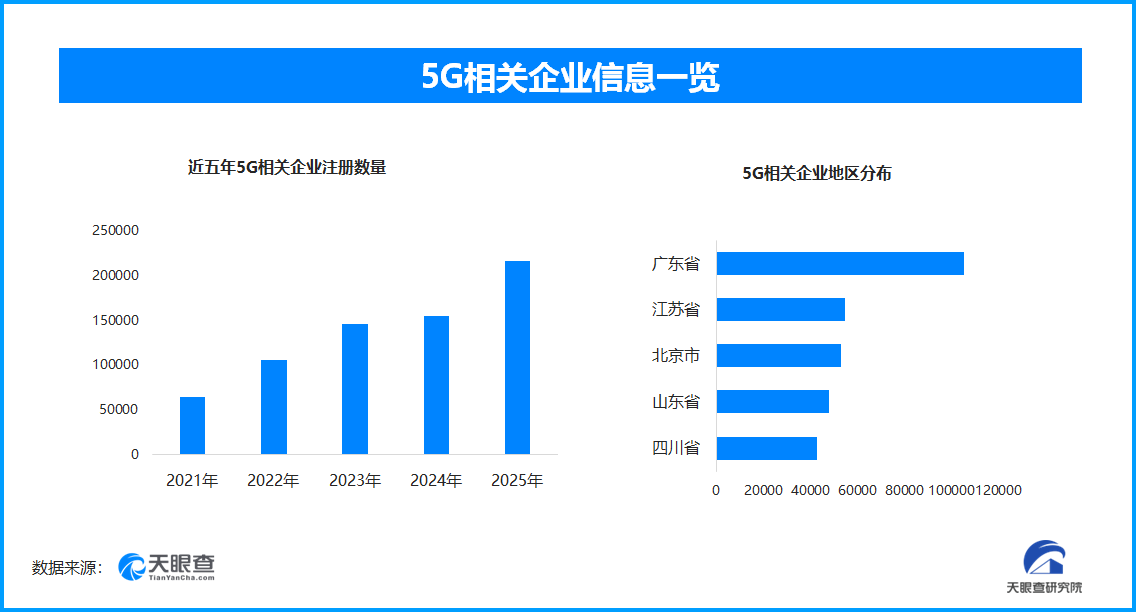
Group 1 - The core viewpoint of the articles highlights the rapid expansion and integration of 5G technology into various sectors of the economy, with significant growth in infrastructure and user adoption [1][2] - By the end of 2025, the number of 5G base stations in China is projected to reach 4.838 million, accounting for 37.6% of mobile phone base stations, with an average of 34.4 stations per 10,000 people, exceeding the "14th Five-Year Plan" target by 8.4 stations [1] - The number of 5G users in China has reached 1.204 billion, contributing to the flourishing of application ecosystems and innovative business models [1] Group 2 - There are over 826,000 existing 5G-related enterprises in China, with approximately 216,000 new registrations expected by 2025, indicating a consistent annual growth trend in the number of 5G-related companies [2] - The top regions for 5G-related enterprises are Guangdong, Jiangsu, and Beijing, with over 105,000, 54,000, and 53,000 companies respectively, followed by Shandong and Sichuan [2] - Comprehensive risk assessments of partners are becoming standard practice to prevent project delays, technology leaks, and commercial risks [2]