
专用齿轮

Search documents
人形机器人产业链全景浮现,这些北交所、新三板公司已卡位布局
Xin Jing Bao· 2026-01-09 06:53
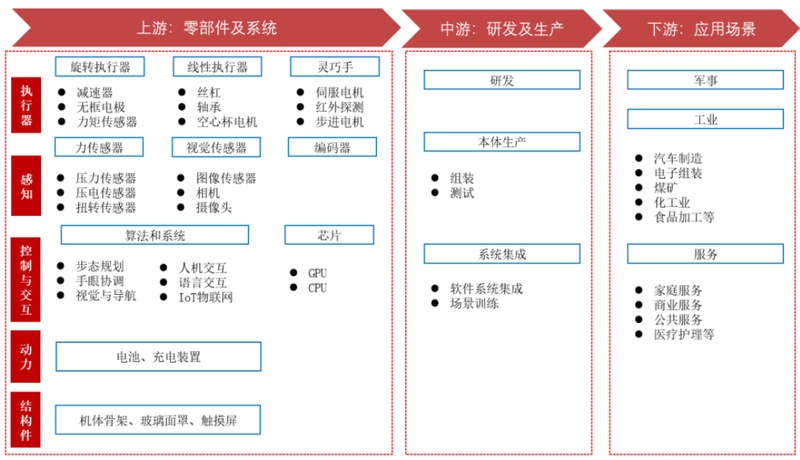
Group 1 - The humanoid robot industry and core component sectors are attracting significant investment focus, with 25 companies listed on the Beijing Stock Exchange (BSE) having a total market value close to 90 billion yuan as of January 8, 2026 [1][4][6] - The BSE humanoid robot companies primarily focus on upstream components such as motors, batteries, bearings, and sensors, while only one company, China Machinery Science Group's Jike Co., is involved in midstream system integration [6][9] - The humanoid robot industry is expected to transform human production and lifestyle, becoming a new engine for economic growth, with the industry chain divided into upstream core components, midstream manufacturing, and downstream application providers [4][6] Group 2 - Guangdong Liwang New Energy Co. has signed a contract with Tsinghua University Shenzhen International Graduate School to develop high-power lithium-ion batteries for humanoid robots, aiming to capture market opportunities in the high-end battery sector [2] - Zhejiang Jiezong Technology Co. has partnered with Hangzhou Yunshe Technology Co. to develop specialized gears for humanoid and quadruped robots, focusing on performance and cost advantages [3] - Sichuan Tianlian Robot Co. has announced potential strategic cooperation with Baisheng Intelligent, indicating ongoing collaboration in the humanoid robot sector [3][9] Group 3 - As of January 8, 2026, 20 out of the 25 humanoid robot companies on the BSE have a market value exceeding 2 billion yuan, with five companies surpassing 5 billion yuan [9] - Over 40% of the humanoid robot companies on the BSE have a price-to-earnings (P/E) ratio below 40, indicating potential investment attractiveness [9] - The average net profit of the humanoid robot companies over the past three years is in the tens of millions, with several companies exceeding 100 million yuan in average net profit [9]


北交所科技成长产业跟踪第五十八期(20260104):电动化浪潮驱动汽车产业链升级,关注机器人业务延伸、智能驾驶订单落地等公司
Hua Yuan Zheng Quan· 2026-01-05 05:59
Investment Rating - The report suggests a focus on the automotive industry, particularly in areas such as robotics, solid-state batteries, and intelligent driving for 2026 [2][32]. Core Insights - The total market capitalization of automotive stocks on the Beijing Stock Exchange increased by 70% in 2025, with notable stock price increases for companies like Kaiter Co., which saw a rise of 178% [2][21]. - In 2025, China's automotive production and sales reached 31.23 million and 31.12 million units respectively, reflecting year-on-year growth of 11.9% and 11.4% [7][10]. - The report highlights five key trends for 2026 in the automotive sector: (1) localization of core components for robotics, (2) technological breakthroughs in battery segments, (3) transformation and upgrading of electric vehicle components, (4) intelligent driving sensors and electronic systems, and (5) innovative applications of lightweight materials [32][34]. Summary by Sections Automotive Industry Overview - In the first eleven months of 2025, China's automotive production and sales maintained double-digit year-on-year growth, with significant contributions from the collaboration across the supply chain [7][8]. - The report notes that the sales of new energy vehicles accounted for 47.5% of total new car sales during the same period, with production and sales of 14.91 million and 14.78 million units respectively, marking growth rates of 31.4% and 31.2% [8][11]. Market Performance - The median price-to-earnings (P/E) ratio for automotive stocks on the Beijing Stock Exchange increased from 22.07X to 35.26X, a growth rate of 60% [21][23]. - The report indicates that the median market capitalization of automotive stocks rose from 34.134 billion yuan to 58.024 billion yuan [21][23]. Key Companies and Trends - Companies such as Sanxie Electric and JunChuang Technology are highlighted for their potential in the robotics sector, particularly in humanoid robots [32][33]. - The report emphasizes the importance of solid-state batteries as a core direction for future battery technology, with companies like YuanHang Precision and NaKonoer being noted for their advancements [32][34]. - The shift towards lightweight materials in the automotive industry is also discussed, with companies like HeChang Polymer and JiYuan Precision being recognized for their innovative approaches [34].