
个人信贷

Search documents
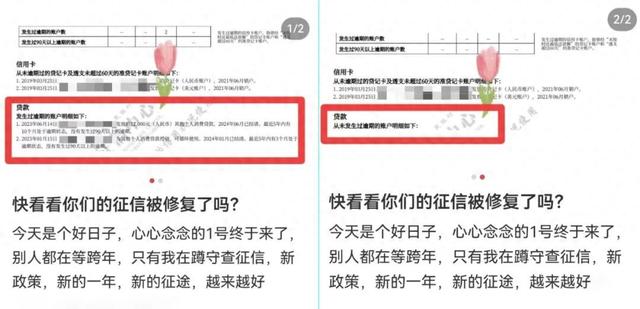
央行信用修复新政落地!网友晒图:我的贷款逾期记录“清零”了
Xin Lang Cai Jing· 2026-01-03 07:56
Core Viewpoint - The People's Bank of China has implemented a "one-time credit repair policy" aimed at helping individuals with damaged credit histories to restore their credit status efficiently, thereby supporting economic recovery [1][9]. Group 1: Policy Implementation - The one-time credit repair policy allows individuals with overdue loans of up to 10,000 yuan that occurred between January 1, 2020, and December 31, 2025, to have their overdue records removed if they repay by March 31, 2026 [1][5]. - Users have reported successful updates to their credit reports, with some seeing overdue records drop from two to zero [1]. Group 2: Conditions for Eligibility - The policy applies only to personal credit overdue information displayed in the central bank's credit system [5]. - Individuals must repay their overdue debts in full by March 31, 2026, to qualify for the removal of overdue records [5][10]. - The policy is not applicable to new overdue information generated after December 31, 2025 [5]. Group 3: Nature of Credit Repair - The removal of overdue records does not equate to the deletion of the underlying data; it simply makes the records invisible while maintaining the integrity of the credit management system [6][7]. - The policy emphasizes that active repayment is a prerequisite for credit repair, reinforcing the importance of fulfilling repayment obligations [6][7]. Group 4: Implications for Individuals and Financial Institutions - The policy aims to alleviate the long-term consequences of credit issues, encouraging individuals to rectify their credit status and improve their financial opportunities [11]. - Financial institutions may benefit from this policy as it encourages borrowers to repay overdue debts, potentially improving asset quality and expanding their customer base [11].

江阴农商银行以特色经营作答金融“五篇大文章”
Jiang Nan Shi Bao· 2025-11-23 13:19
Core Insights - Jiangyin Rural Commercial Bank is addressing the homogenization challenges in the financial industry through "characteristic operations" and aims to reshape its growth logic while achieving high-quality development [1] Group 1: Technology Innovation - The bank has implemented the "Science and Technology Innovation Jiangyin" strategy, focusing on technology finance as a strategic priority, aiming to become a regional innovation "enabler" [3] - As of September 2025, the bank has covered 64% of over 3,700 key technology innovation enterprises in Jiangyin, with a credit coverage of 30% and a total credit scale of 16.93 billion [3] - The loan balance for technology enterprises stands at 15.976 billion, with loans to "specialized, refined, distinctive, and innovative" enterprises amounting to 9.553 billion [3] Group 2: Green Finance - The bank has integrated green finance into its overall development strategy and initiated a pilot program for green branches, with Changjing Branch designated as a green branch [5] - The Changjing Branch has launched a green industry upgrade project in the Wujiaba area, involving a total investment of 500 million, with the branch providing a credit of 35 million, of which 10 million has been utilized [5] - The project is part of the Jiangyin Changjing Shunfeng Dyeing Park initiative, aimed at promoting the green and clean transformation of dyeing enterprises [5] Group 3: Support for Private Enterprises - The Zhouzhuang Branch serves as a pilot for supporting the private economy, conducting industry research and focusing on two core sectors: new metal materials and new energy [7] - The bank offers tailored financial products for private enterprises, including supply chain financing for metal new materials and green credit for new energy companies [7] - As of October 2025, the Zhouzhuang Branch has 413 corporate loan accounts, an increase of 65 from 2024, and 359 inclusive loan accounts, an increase of 66 from 2024 [7]

【西街观察】大厂出海不讲老故事
Bei Jing Shang Bao· 2025-10-19 14:28
Core Insights - The trend of Chinese companies expanding overseas is becoming a standard business model, focusing on digital services like cloud computing, financial payments, personal credit, and food delivery [1] - The approach of these companies has shifted from manufacturing to branding and ecosystem development, aiming to provide comprehensive systems and solutions rather than just individual products [1] - The overseas expansion is seen as a way to enhance core business ceilings and as an opportunity for growth in untapped markets, especially in light of increasing domestic competition [1] Group 1 - The overseas market is viewed as a new opportunity for Chinese companies to achieve globalization and overcome domestic market pressures [1] - Despite the potential for high revenue, the overseas market presents challenges such as intense competition and complex regulations [2] - Chinese enterprises are evolving from traditional manufacturing to "smart manufacturing," requiring innovation and adaptation to local markets [3] Group 2 - The transformation of large companies, digital infrastructure, and service ecosystems marks a new phase in the overseas expansion of Chinese enterprises [4] - Companies must prepare for unexpected challenges and develop strategies to build user trust and navigate local competition [4] - The search for the next successful Chinese company in the vast overseas market is intensifying, with global competitors and capital markets closely monitoring developments [4]