中国手机

Search documents
韩国芯片赢麻了,利润增长两倍多,净利过万亿,被质疑联手涨价
Sou Hu Cai Jing· 2026-01-14 16:56
Core Viewpoint - The profits of South Korea's two major memory chip companies are expected to surge significantly by 2025, reversing the profit decline trend of the country's largest smartphone manufacturer, indicating a strong performance in the memory chip sector [1][3]. Group 1: Profit Forecast - The two major South Korean memory chip companies are projected to earn over 300 trillion Korean won (approximately 1.4 trillion RMB) in profits by 2025, which is 75% higher than the annual revenue of China's largest tech company and over 20 times its net profit [3]. - One company is expected to see a profit increase of 2.5 times, while the other is projected to grow by 2.2 times [1]. Group 2: Price Surge and Market Dynamics - The significant profit increase in 2025 is attributed to a sharp rise in memory chip prices, particularly DRAM, with the price of a 16GB memory module increasing from 400 RMB to 1000 RMB, a rise of 1.5 times [3]. - The price surge is driven by the demand for HBM chips used in AI applications, which has diverted production capacity away from DRAM chips, leading to a tightening supply and skyrocketing prices [3]. Group 3: Competitive Landscape - There are speculations that the price increase may be influenced by a coordinated effort among U.S., South Korean, and Japanese memory chip companies, reminiscent of past price-fixing allegations against South Korean firms [5]. - As global memory chip prices rise, Chinese memory chip companies are also benefiting, reversing their previous losses and potentially allowing for increased investment in R&D to catch up technologically with U.S. and South Korean firms [5]. Group 4: Impact on Consumer Electronics - The surge in memory chip prices is expected to negatively impact the smartphone and PC industries, with estimates suggesting a significant reduction in memory capacity for Chinese smartphones, particularly in the mid-range segment, which may revert to 4GB from the previously common 12GB [5]. - This reduction in memory capacity, combined with the use of outdated processors in low-end smartphones, may lead to decreased sales, pushing consumers towards flagship or second-hand models instead [7].

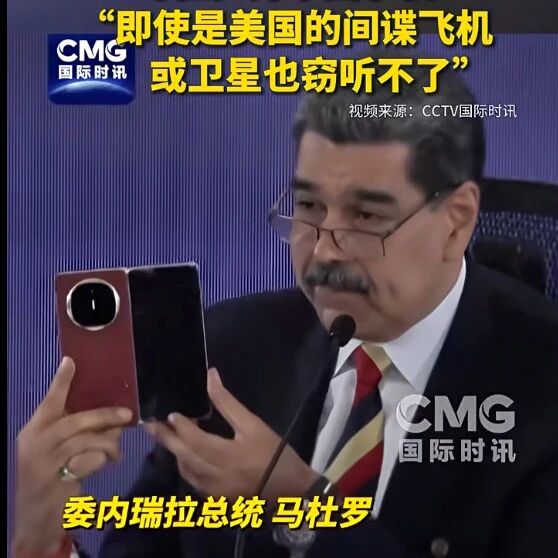
委瑞内拉总统马杜罗展示他的中国手机:表示这是世界上最好的手机!
Xin Lang Cai Jing· 2026-01-04 14:06
Core Viewpoint - Venezuelan President Maduro showcased his Chinese smartphone, claiming it to be the best in the world [1] Group 1 - The demonstration of the smartphone highlights the growing influence of Chinese technology in international markets [1] - Maduro's endorsement may reflect a strategic partnership between Venezuela and China, particularly in technology [1]

马杜罗秀中国手机,“美国也窃听不了”
券商中国· 2025-09-02 10:31
Group 1 - Venezuelan President Maduro condemned the US government's attempts to exert extreme pressure on Venezuela through military means during a press conference held in Caracas on September 1 [1] - Maduro showcased a Chinese smartphone, claiming it to be the best in the world and stated that "the Americans cannot eavesdrop" on it [1]
奔走于中国—中亚合作的“双向车道”(侨界关注)
Ren Min Ri Bao Hai Wai Ban· 2025-06-12 22:48
Core Insights - The relationship between China and Central Asian countries has seen significant growth and vitality, with increased trade and cultural exchanges being highlighted as key developments [8]. Group 1: China-Kazakhstan Relations - The introduction of a visa exemption agreement in 2023 has led to the establishment of multiple direct flight routes between China and Kazakhstan, facilitating easier business travel [10]. - Chinese products are increasingly popular in Kazakhstan, with local consumers showing a preference for Chinese goods, leading to a rise in cross-border shopping activities [10]. - The upcoming second China-Central Asia Summit is expected to further enhance practical cooperation between China and Kazakhstan [10]. Group 2: China-Tajikistan Relations - There has been a notable increase in Chinese enterprises investing in Tajikistan, particularly in international trade and construction sectors [12]. - A shift from "sitting merchants" to "traveling merchants" is observed, with Chinese companies now conducting market research and adapting their offerings to local needs [12]. - Cultural exchanges, such as the establishment of a Chinese library in Tajikistan, are seen as vital for enhancing mutual understanding and cooperation [13]. Group 3: China-Uzbekistan Relations - The "Two Zones and One Park" industrial technology zone project is underway, aimed at attracting Chinese investments in green energy and high-end manufacturing [14]. - The growing presence of Chinese nationals in Uzbekistan reflects the strengthening ties between the two countries, with local governments eager to collaborate with Chinese businesses [15]. - Plans for establishing vocational training schools and promoting traditional Chinese medicine in Uzbekistan indicate a commitment to long-term bilateral cooperation [16].

48小时内,美国对华连开3枪,特朗普圈定新战场,逼中企摘牌退市
Sou Hu Cai Jing· 2025-05-06 12:27
Group 1 - The article discusses the recent aggressive actions taken by the U.S. government against China, highlighting a series of statements and actions from President Trump that indicate a shift in strategy towards China amidst ongoing trade tensions [1][3][4] - Trump's comments about the historical significance of U.S.-China relations reflect a frustration with China's competitive advantage, suggesting that American companies are struggling to compete with Chinese manufacturing [4][14] - The U.S. Republican lawmakers' push to delist 25 Chinese companies, including Alibaba, from U.S. exchanges under the pretext of national security concerns is seen as a tactic to capitalize on falling stock prices of Chinese firms [6][16] Group 2 - The proposed 100% tariffs on imported films by the U.S. government is viewed as a misguided attempt to protect the American film industry, which is perceived to be losing ground to Chinese films [8][11] - The article argues that the U.S. is failing to recognize the changing dynamics of global trade and competition, as evidenced by the success of Chinese films and products in international markets [9][19] - The ongoing trade war is characterized as a detrimental strategy for the U.S., with American consumers bearing the brunt of increased prices due to tariffs, while Chinese companies adapt and thrive [14][17]