
中国种子

Search documents
“中国粮”主要用上了“中国种”
Ren Min Ri Bao· 2026-01-21 23:31
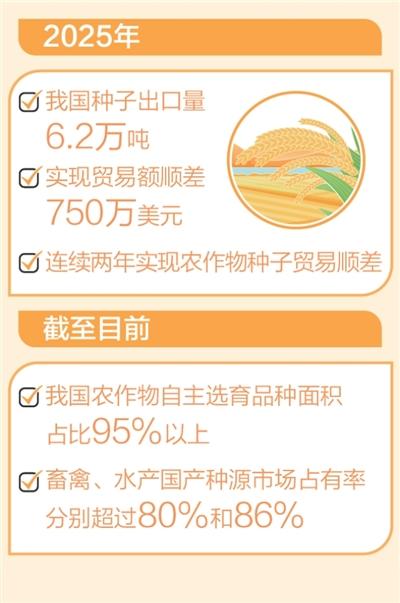
Core Viewpoint - The latest data from the Ministry of Agriculture and Rural Affairs indicates that by 2025, China's seed export volume will reach 62,000 tons, achieving a trade surplus of $7.5 million, marking the second consecutive year of surplus in crop seed trade following the first surplus in 2024 [1] Group 1: Seed Export and Trade Surplus - By 2025, China's hybrid rice seed exports are projected to be 36,000 tons, a 90% increase compared to ten years ago, with cotton seed exports nearing 17,000 tons [1] - Currently, over 95% of the area for independently bred crop varieties in China is accounted for, with domestic market shares for livestock and aquatic seed sources exceeding 80% and 86%, respectively [1] Group 2: Agricultural Innovation and International Cooperation - China's hybrid rice and other seed varieties have been exported to over 50 countries and regions, showcasing the country's agricultural innovation and international cooperation [1] - The seed industry revitalization action has achieved all its five-year effectiveness goals, with significant improvements in the yield and quality of major crops like rice and wheat [2] Group 3: Technological Advancements in Seed Industry - The past five years have seen the implementation of key technological breakthroughs in seed sources, including major projects in biological breeding and genetic improvement of livestock, establishing world-class biological genetic resource banks [4] - The "14th Five-Year Plan" emphasizes the need for continued innovation in the seed industry, aiming to enhance the quality and availability of high-yield, green, and specialized seeds to ensure food security in China [4]

端稳中国饭碗!农作物自育品种超95%
Xin Hua She· 2025-12-12 03:31
Core Insights - The "14th Five-Year Plan" emphasizes the implementation of seed industry revitalization actions, with significant improvements in seed source security and domestic breeding varieties accounting for over 95% of crop varieties [1] - The seed industry has transitioned from reliance on foreign imports to achieving over 80% and 85% market share for domestic sources in livestock and aquatic products, respectively [1] - The "15th Five-Year Plan" aims to further enhance the innovation and competitiveness of China's seed industry, with a focus on transforming agricultural genetic resources into innovation advantages [3] Group 1 - The seed industry is likened to the "chip" of agriculture, highlighting the historical dependency on foreign imports for key breeding stock, which posed risks to domestic supply and increased production costs [1] - Since the implementation of the "Seed Industry Revitalization Action Plan" in July 2021, there have been breakthroughs in breeding research, resulting in the development of several urgently needed crop varieties [1] - A comprehensive national agricultural genetic resource survey has been completed, establishing three national gene banks that rank first in the world in terms of resource preservation [1] Group 2 - A favorable environment for innovation and protection has been established, with revisions to the Seed Law and Plant Variety Protection Regulations, leading to a 20% decrease in seed-related legal cases compared to 2020 [2] - For the first time in 2024, China's seed export value is expected to exceed import value, achieving a trade surplus, with exports reaching over 40 countries [2] - The industry is focusing on accelerating the identification of agricultural genetic resources and enhancing support for breeding efforts to ensure food security [3]
和音:守护天下粮安的中国担当
Ren Min Ri Bao· 2025-10-19 05:09
Core Points - China emphasizes food security as a top priority in governance, aiming to ensure the food supply for over 1.4 billion people while contributing to global food security efforts [1][2][3] - The global hunger rate reached 8.2% last year, with 673 million people struggling with hunger, highlighting the urgent need for international cooperation to achieve the UN's 2030 goal of "zero hunger" [1][2] - China's grain production is projected to exceed 1.4 trillion jin in 2024, an increase of 74 billion jin since 2020, with per capita grain availability reaching 500 kg, surpassing the international safety line of 400 kg [2] Group 1 - China has implemented a national food security strategy since the 14th Five-Year Plan, focusing on enhancing agricultural technology and land use to strengthen food security [2] - As a founding member of the UN Food and Agriculture Organization (FAO), China has transitioned from a recipient of technical assistance to a core contributor, providing the most funding and expertise under the South-South Cooperation framework [2][3] - China collaborates with over 140 countries and regions, promoting more than 1,000 agricultural technologies and training over 14,000 hybrid rice specialists [2] Group 2 - China actively participates in global agricultural governance, advocating for international cooperation in food security and contributing to initiatives like the Global Alliance Against Hunger and Poverty [3] - The country aims to maintain stability in global food supply chains and engage in poverty alleviation efforts, fostering a collective international approach to food security [3] - China is committed to supporting the UN FAO and advancing the 2030 Sustainable Development Agenda, focusing on enhancing the welfare of people worldwide [3]
“种”出中国中亚农业合作新未来
Shan Xi Ri Bao· 2025-09-08 00:39
Core Viewpoint - The article highlights the successful agricultural collaboration between China and Central Asian countries, particularly focusing on wheat breeding and technology transfer, which enhances local agricultural productivity and fosters international cooperation [1][4][5]. Group 1: Agricultural Collaboration - Zhang Zhengmao, a wheat breeding expert, has been actively involved in agricultural projects in Kazakhstan since 2017, leading multiple teams to introduce advanced Chinese agricultural technologies [2][4]. - The collaboration between China and Kazakhstan leverages their respective agricultural strengths, with China providing expertise in wheat breeding and cultivation techniques to address local challenges [5][11]. - Zhang's team has developed over 120 high-quality wheat varieties tailored for Kazakhstan, achieving yield increases of up to 60% compared to local varieties [5][10]. Group 2: International Engagement - The establishment of agricultural technology demonstration parks in Kazakhstan and Uzbekistan has facilitated knowledge exchange and practical training for local farmers, enhancing their trust in Chinese agricultural practices [11][12]. - The recent international academic conference in Samarkand allowed for deeper exchanges between agricultural experts from various countries, expanding China's agricultural cooperation footprint [7][8]. - The Yangling Demonstration Zone has built 14 overseas agricultural technology demonstration parks, conducting over 110 comparative trials of superior crop varieties [10][13]. Group 3: Youth and Education - The partnership between Northwest A&F University and Kazakhstan's agricultural research institutions aims to foster talent in food science and engineering, with students like Aimu bridging cultural and educational gaps [14][18]. - The presence of over 500 international students at Northwest A&F University signifies the growing educational ties and the potential for future agricultural innovation in Central Asia [19]. - The establishment of the China-Central Asia Agricultural "Belt and Road" Joint Laboratory reflects the commitment to collaborative research and development in agricultural technology [18].