种业科技创新

Search documents
理响中国|创意图解:小种子迸发大能量!一图读懂中国种业硬核突破
Huan Qiu Wang· 2026-02-03 05:16
Core Viewpoint - China's seed industry is experiencing significant growth, with exports surpassing imports for the first time in 2024, marking a continuous trade surplus in agricultural seeds for two consecutive years [1][2]. Group 1: Export and Trade Performance - By 2025, China's seed export volume is projected to reach 62,000 tons, achieving a trade surplus of 7.5 million USD [2]. - China has exported seeds to over 50 countries and regions, including hybrid rice, cotton, and vegetable seeds [4]. Group 2: Domestic Production and Market Share - Domestic breeding varieties of livestock and poultry, as well as crops, account for over 95% of the cultivated area, with market shares exceeding 80% for certain categories [3]. - The area of independently bred corn varieties increased from 91% in 2020 to 94%, while vegetables rose from 87% to 91% [8]. Group 3: Technological Innovation and Development - The seed industry is entering a phase of significant breakthroughs, with a focus on technological innovation and the establishment of multiple national and regional innovation platforms [16][18]. - The "14th Five-Year Plan" emphasizes the importance of breeding innovation and resource aggregation to enhance seed supply capabilities [19]. Group 4: Future Goals and Strategic Plans - The "14th Five-Year Plan" aims to achieve major breakthroughs in the seed industry, with a focus on quality, cost reduction, and specialized varieties to ensure food security [19].


创意图解:小种子迸发大能量!一图读懂中国种业硬核突破
Xin Lang Cai Jing· 2026-02-03 04:21
Core Viewpoint - China's seed industry is experiencing significant growth, with exports surpassing imports for the first time in 2024, indicating a strong international competitiveness and a solid foundation for the revitalization of the seed industry [1][2]. Group 1: Export and Trade Performance - In 2025, China's seed export volume is projected to reach 62,000 tons, achieving a trade surplus of 7.5 million USD [2]. - China has maintained a trade surplus in agricultural seed for two consecutive years, reflecting the increasing strength of its seed industry [2]. Group 2: Domestic Seed Development - Over 95% of domestic crop varieties are independently bred, with market shares exceeding 80% for poultry and over 80% for aquatic species [3]. - The area of independently bred corn varieties increased from 91% in 2020 to 94%, while vegetable varieties rose from 87% to 91% [8]. Group 3: International Cooperation and Innovation - China's hybrid rice seeds have been exported to over 50 countries and regions, showcasing the global reach of its agricultural innovations [4]. - The seed industry is becoming a new highlight in agricultural international cooperation, with significant breakthroughs in various crop varieties [10]. Group 4: Technological Advancements - The seed industry is entering a phase of technological innovation, with a multi-layered innovation system being established to support the use of Chinese seeds in domestic agriculture [12]. - Major projects and collaborative efforts are underway to enhance core technologies in breeding and improve the overall competitiveness of China's seed industry [18].

“中国粮”主要用上了“中国种” 我国连续两年实现农作物种子贸易顺差
Ren Min Ri Bao· 2026-01-22 00:02
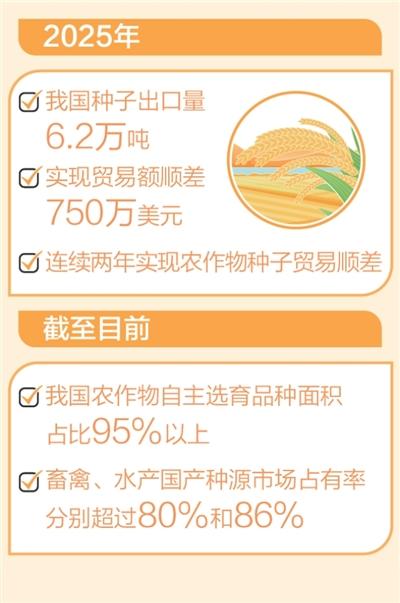
Core Insights - China's seed industry has achieved significant advancements, with a focus on self-sufficiency in seed production, leading to a robust agricultural foundation [1][2] Group 1: Seed Export and Trade Surplus - By 2025, China's seed export volume is projected to reach 62,000 tons, resulting in a trade surplus of $7.5 million, marking the second consecutive year of surplus following 2024's first-time export exceeding imports [1] - The area of self-bred crop varieties in China accounts for over 95%, with domestic market shares for livestock and aquatic seeds exceeding 80% and 86%, respectively [1] Group 2: Technological Innovation and Development - The seed industry has entered the world's top tier in terms of technological innovation, supported by key projects and national research plans, establishing a comprehensive breeding innovation system [2] - The area of self-selected corn varieties has increased from 91% in 2020 to 94%, while vegetable self-selected varieties have risen from 87% to 91% [2] Group 3: Future Goals and Strategic Plans - The "14th Five-Year Plan" emphasizes the implementation of seed industry revitalization actions, aiming to enhance seed quality and ensure food security by 2030 [3] - Continuous efforts will be made to improve seed supply capabilities and promote the emergence of high-yield, quality, and specialized seeds [3]
“中国粮”主要用上了“中国种”
Ren Min Ri Bao· 2026-01-21 23:31
Core Viewpoint - The latest data from the Ministry of Agriculture and Rural Affairs indicates that by 2025, China's seed export volume will reach 62,000 tons, achieving a trade surplus of $7.5 million, marking the second consecutive year of surplus in crop seed trade following the first surplus in 2024 [1] Group 1: Seed Export and Trade Surplus - By 2025, China's hybrid rice seed exports are projected to be 36,000 tons, a 90% increase compared to ten years ago, with cotton seed exports nearing 17,000 tons [1] - Currently, over 95% of the area for independently bred crop varieties in China is accounted for, with domestic market shares for livestock and aquatic seed sources exceeding 80% and 86%, respectively [1] Group 2: Agricultural Innovation and International Cooperation - China's hybrid rice and other seed varieties have been exported to over 50 countries and regions, showcasing the country's agricultural innovation and international cooperation [1] - The seed industry revitalization action has achieved all its five-year effectiveness goals, with significant improvements in the yield and quality of major crops like rice and wheat [2] Group 3: Technological Advancements in Seed Industry - The past five years have seen the implementation of key technological breakthroughs in seed sources, including major projects in biological breeding and genetic improvement of livestock, establishing world-class biological genetic resource banks [4] - The "14th Five-Year Plan" emphasizes the need for continued innovation in the seed industry, aiming to enhance the quality and availability of high-yield, green, and specialized seeds to ensure food security in China [4]
农业“芯片”守护中国饭碗
Jing Ji Ri Bao· 2026-01-17 01:52
Core Viewpoint - The article highlights the significant advancements in China's seed industry over the past five years, emphasizing the country's efforts to achieve self-sufficiency and innovation in seed technology, as well as the successful implementation of the Seed Industry Revitalization Action Plan [1][2][6]. Group 1: Seed Industry Development - Over 95% of crop varieties are now independently bred, with domestic market shares for livestock and aquaculture seeds exceeding 80% and 85% respectively [2] - The national seed supply guarantee rate has reached 80%, showcasing improved seed supply capabilities [2] - The establishment of key national seed breeding bases has optimized the layout of seed production, ensuring that "Chinese grain" primarily uses "Chinese seeds" [2][3] Group 2: Technological Innovation - Significant advancements in seed technology have been made, with the introduction of new crop varieties that are resistant to diseases and better suited for local conditions [3][4] - The use of smart greenhouses for testing rice varieties has improved the efficiency of seed quality assessment [4] - The overall level of technological innovation in the seed industry has entered the world's top tier, with ongoing projects aimed at addressing core technological challenges [4][5] Group 3: International Cooperation - China's seed industry has expanded its international cooperation, with seed exports expected to exceed imports for the first time in 2024, achieving a trade surplus [6][7] - Various companies are actively participating in the Belt and Road Initiative, promoting domestic seed varieties globally [7] - The focus on international collaboration is driving the entire agricultural industry to expand beyond single product exports to a comprehensive service model [7] Group 4: Future Directions - The next phase will focus on addressing industry needs by accelerating the breeding of high-yield, quality, and specialized seed varieties [5][6] - Plans are in place to enhance seed resource identification, improve seed quality, and strengthen the innovation capabilities of leading enterprises [6][7]
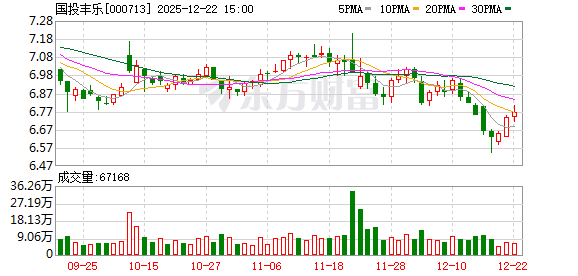
国投丰乐:2023年、2024年连续两年种业收入创历史新高
Zheng Quan Ri Bao· 2025-12-22 09:39
Core Viewpoint - The company, Guotou Fengle, has established itself as a leading player in the seed industry in China, with a strong focus on technological innovation and strategic partnerships to enhance its growth and contribution to national food security [2] Company Overview - Guotou Fengle has been deeply engaged in the seed industry for several decades and is recognized as one of the first "integrated breeding and promotion" seed companies in the country [2] - The company is classified as a key leading enterprise in agricultural industrialization and has received multiple accolades, including being a "Ten-Year AAA Credit Enterprise" and a high-tech enterprise [2] Financial Performance - The company anticipates achieving record-high seed revenues in both 2023 and 2024, indicating a positive growth trajectory in its seed business [2] Strategic Initiatives - The company aims to fulfill its responsibilities in supporting national food security strategies by focusing on technological innovation as a core driver [2] - Plans include strengthening collaborations with core biotechnology firms and research institutions to expedite the development, approval, and commercialization of transgenic corn varieties [2] - The company intends to deepen the application of digital technologies in breeding and production processes [2] - There are also plans for mergers and acquisitions to consolidate quality resources and accelerate the rapid development of its core seed business [2]

都市中的种业之旅,来广东种博会佛山分会场
Nan Fang Nong Cun Bao· 2025-12-03 14:31
Core Viewpoint - The 24th Guangdong Seed Industry Expo in Foshan focuses on promoting seed technology innovation to lead modern agricultural development, showcasing 740 new agricultural varieties and key technologies [4][5][6]. Group 1: Event Overview - The event is themed "Promoting Seed Technology Innovation to Lead Modern Agricultural Development" and features a main venue along with specialized sub-venues for fisheries and corn [25][64]. - It serves as a platform for observing the innovative development of modern urban agriculture in Foshan and Guangdong [9][10]. - The event has cumulatively showcased over 9,500 varieties since its inception in 2007, generating social and economic benefits exceeding 6 billion [53][54]. Group 2: Agricultural Innovations - The event includes a display of 686 new varieties from various categories such as leafy vegetables, fruits, and corn [37]. - It features advanced agricultural technologies, including techniques for high-efficiency planting and integrated pest management [46][50]. - The creative agriculture area integrates modern seed industry, regional culture, and technology interaction, enhancing visitor engagement [3][41]. Group 3: Local Government Initiatives - Foshan aims to be a leader in seed industry innovation and has achieved significant milestones, including the promotion of over 5 million sets of the "Guanghong No. 3" chicken variety [21][22]. - The local government emphasizes collaboration among various stakeholders to enhance resource sharing and technological exchange [18][19]. - The event also marks the launch of a project to systematically catalog agricultural genetic resources in the city [23][24].

国投丰乐(000713) - 000713国投丰乐投资者关系管理信息20251201
2025-12-01 10:28
Group 1: Financial Performance and Growth - The company reported a slight increase in contract liabilities year-on-year, primarily due to seed prepayments, with significant contributions from corn varieties such as Tie 391 and transgenic varieties Tie 391K, Fengle 520, and others [2][3] - The company plans to raise up to 1.089 billion CNY through stock issuance to enhance its financial strength and optimize its capital structure [5] - The company has committed to extending the lock-up period for its shares to October 25, 2028, to bolster market confidence [6] Group 2: Research and Development - The company focuses on independent research and development, establishing testing bases across key regions, and collaborating with institutions like the Beijing Academy of Agriculture and Forestry Sciences [3] - This year, one corn variety has passed national approval, with nine varieties in preliminary review and six in provincial review, aiming for several new high-yield and disease-resistant varieties in the next five years [3] - The company is enhancing its R&D capabilities by collaborating with top research institutions to accelerate the development of new rice varieties [6] Group 3: Strategic Development and Partnerships - The company aims to scale its operations by integrating core technologies and enhancing partnerships with biotechnology firms for transgenic corn variety development [4] - The company is pursuing mergers and acquisitions in the seed industry, focusing on corn and rice seed sectors, while also considering opportunities in soybean and vegetable seed markets [4] - The company has established a cooperative framework with six biotechnology firms to expedite the development of transgenic varieties [7]
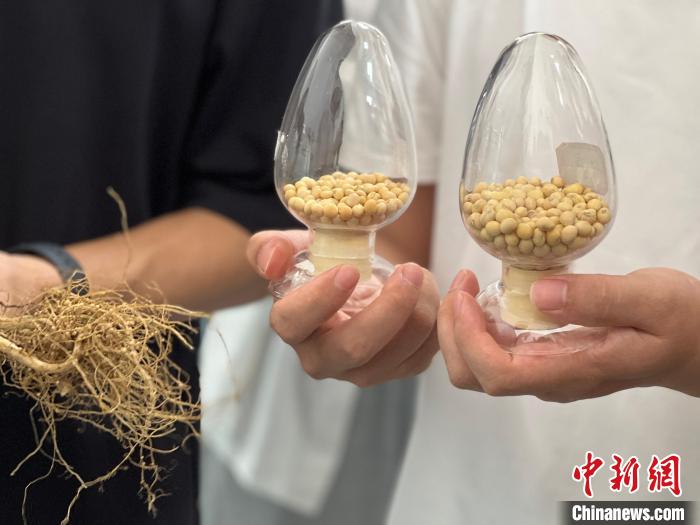
(活力中国调研行)皖北“粮仓”蹦出粒粒鼓黄豆
Zhong Guo Xin Wen Wang· 2025-07-07 03:57
Core Insights - The article highlights the advancements in soybean production in Suzhou, Anhui, focusing on the use of root nodule bacteria to enhance yield and nutritional value [1][3]. Group 1: Agricultural Innovations - The use of root nodule bacteria has led to an average yield increase of 10% and a protein content increase of 1% to 2%, while reducing nitrogen fertilizer usage by 5% to 20% [1][3]. - The application of root nodule bacteria in soybean cultivation is still low in China compared to major soybean-producing countries like Argentina and Brazil, which have an application rate of 85% [3]. - Since 2020, a collaboration between China Agricultural University and local enterprises has promoted the industrialization of root nodule bacteria technology, covering over 800 million mu (approximately 53 million acres) across 17 provinces [3]. Group 2: Research and Development - Suzhou has established itself as a hub for seed technology innovation, with multiple research institutions and seed enterprises setting up operations in the region [4]. - The Nanjing Agricultural University Soybean Breeding Center has developed 32 high-yield, high-quality soybean varieties, increasing protein content by over 9% and yield by over 10% [4]. - The establishment of a smart agriculture digital platform in the Seed Technology Valley has enhanced the precision of seed breeding and propagation through real-time monitoring and intelligent analysis of key agricultural data [4]. Group 3: Seed Industry Landscape - Suzhou has 175 certified seed enterprises, ranking second in Anhui province, and annually breeds nearly 100 crop varieties, contributing significantly to national seed resources [5].