
中科曙光scaleX万卡超集群

Search documents
海光信息(688041):光合组织2025AI创新大会,引领计算协同新纪元
Changjiang Securities· 2025-12-24 10:42
Investment Rating - The investment rating for the company is "Buy" and is maintained [8] Core Insights - The 2025 AI Innovation Conference showcased over 50 AI innovation achievements, highlighting the growth of the domestic AI computing industry in various sectors [2][5] - The company is positioned to become a comprehensive platform for AI computing in China, leveraging its strengths in high-end CPU and DCU businesses [12][12] - The conference aimed to address industry fragmentation by promoting open ecosystems and collaborative innovation among various enterprises [12] Summary by Relevant Sections Event Description - The 2025 AI Innovation Conference took place from December 17 to 19, 2025, featuring significant AI innovations across core components, intelligent terminals, and industry applications [2][5] Event Commentary - The conference emphasized the need for open ecosystems to overcome barriers in the AI industry, such as high-end computing supply shortages and software-hardware compatibility issues [12] - The launch of the scaleX supercluster represents a key breakthrough in building large-scale intelligent computing infrastructure [12] Financial Projections - Projected total revenue for 2025 is 14,372 million, with a net profit of 4,181 million [17] - The company anticipates a steady increase in revenue and profit margins over the next few years, with a net profit margin of approximately 29% by 2027 [17]

当开放架构遇上“产业大集”:国产AI生态进入“群体跃迁”时刻
Tai Mei Ti A P P· 2025-12-22 10:54
Core Viewpoint - The competitive rules of China's AI industry are being rewritten, shifting the focus from hardware performance to ecological collaboration efficiency as a new measure of competitiveness in the AI computing industry [1][4]. Group 1: Industry Trends - The HAIC2025 event showcased over 2,500 upstream and downstream enterprises, indicating a trend towards breaking down "technology walls" and "ecological walls" to achieve a "group leap" in the AI computing industry [1][3]. - The concept of "open architecture" is becoming essential for overcoming industry bottlenecks, as it promotes shared key technologies and lowers the barriers for research and application [4][6]. Group 2: Open Architecture and Collaboration - The AI computing open architecture aims to transform the industry from "physical stacking" to "chemical fusion," addressing issues such as high-end computing power shortages and high innovation thresholds [6][10]. - The launch of the scaleX super cluster, capable of deploying 10,240 AI accelerator cards and exceeding 5 EFlops in total computing power, demonstrates the technical feasibility and advantages of the open architecture [4][6]. Group 3: Partner Practices and Innovations - Companies like Qingdao Thunder Technology and Unisplendour have successfully utilized the open architecture to lower R&D costs and enhance product compatibility, leading to innovations in various industry scenarios [7][8]. - The collaborative model of "multi-vendor cooperation and shared foundation support" has proven effective in driving the domestic AI ecosystem into a "group leap" phase, with significant advancements in sectors like gaming and healthcare [7][9]. Group 4: Future Outlook - The establishment of the "AI Computing Open Architecture Joint Laboratory" aims to invest 1 billion yuan over three years, involving over 150 member units and 1,000 R&D personnel to enhance domestic AI capabilities [12]. - The ongoing reinforcement of the open architecture's "linking" role is expected to lead to a higher quality "group leap" in the domestic AI ecosystem, providing solid support for the implementation of the "Artificial Intelligence +" strategy [12].

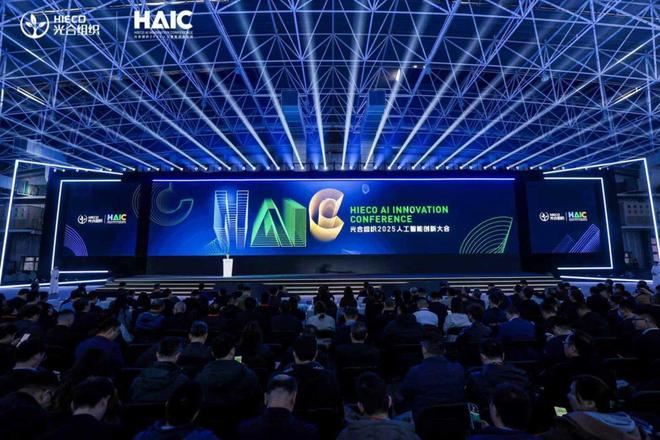
直击HAIC 2025:开放架构破“墙”而立 国产AI计算生态协同出击
Zheng Quan Ri Bao· 2025-12-18 15:41
Core Insights - The HAIC 2025 conference showcased advancements in AI computing, emphasizing a shift from single product displays to a comprehensive presentation of domestic computing capabilities [1] - The industry is transitioning from a "model-driven" approach to an "engineering-driven" one, focusing on overcoming hardware supply limitations and fostering an open architecture for collaboration [2] Group 1: Hardware Innovations - The scaleX万卡超集群 system, introduced by 中科曙光, features 16 super nodes supporting 10,240 AI accelerator cards, achieving over 5 EFLOPS of total computing power and a 20-fold increase in cabinet computing density [3] - The system's design allows for compatibility with multiple brands of accelerator cards and optimizes over 400 mainstream models, indicating a significant leap in domestic AI computing capabilities [3] Group 2: System-Level Breakthroughs - The focus on system-level architecture is crucial for enhancing domestic computing power, with a reported growth rate exceeding 10 times in the past two years [4] - The evolution from single cabinets to万卡集群 represents a systemic engineering innovation, marking a shift in AI computing competition towards system engineering capabilities and software collaboration [4] Group 3: Open Ecosystem Development - The conference highlighted the importance of "open" and "ecosystem" as key themes, addressing challenges in software layers and the need for affordable, efficient computing for SMEs and research institutions [5][6] - The push for an open architecture aims to unify interfaces and standards, reducing the burden of ecological fragmentation and enhancing collaboration across different technologies [6] Group 4: Strategic Collaborations - The event served as a platform for strategic partnerships among companies like 中科曙光 and 商汤集团, focusing on AI computing system optimization and collaborative innovation in various applications [8] - Initiatives such as the "光耀百城2.0" aim to promote scalable solutions in manufacturing, energy, and research sectors, with a focus on lowering barriers for SMEs [8] Group 5: Future Outlook - Experts predict that 2025 will be a pivotal year for domestic AI computing, transitioning from isolated breakthroughs to systemic outputs, with significant advancements expected in 2026 [9] - The conference illustrated the collective efforts of the Chinese AI computing industry to seek openness and overcome bottlenecks, with the万卡集群 becoming a foundational element for large model training [9]