
中高端智能手机

Search documents
氧化钕一周狂飙近5万,谁在为机器人的“粮食”涨价买单?
Sou Hu Cai Jing· 2026-01-30 07:23
Core Viewpoint - The rare earth market is experiencing significant price increases, particularly for neodymium oxide, driven by rising demand from high-end manufacturing and China's strategic resource supply controls [1][4]. Price Movements - Neodymium oxide prices surged nearly 50,000 yuan per ton from January 23 to January 28, with a weekly increase of over 7%, reaching 732,500 yuan per ton [3][4]. - Prices for praseodymium oxide and neodymium metal also rose during the same period, indicating a broader trend in rare earth pricing [3]. Demand Drivers - Neodymium iron boron permanent magnets, essential for modern high-end manufacturing, are increasingly in demand, particularly in humanoid robots and electric vehicles [6][7]. - By 2035, demand for neodymium iron boron in humanoid robots and low-altitude economy sectors is projected to reach 33,000 tons, accounting for 5.5% of total demand [7]. Supply Constraints - Systematic tightening of supply is a key factor behind the price surge, with China's rare earth mining growth rate expected to be only 5.9% in 2025, below market expectations [8]. - Political instability in Myanmar and export bans in Vietnam are further constraining supply, while China's regulatory measures enhance its control over rare earth resources [8]. Cost Transmission - The rising prices of rare earth materials are impacting the entire supply chain, with neodymium iron boron manufacturers facing significant cost increases [9][10]. - The cost pressures are expected to reach downstream motor manufacturers and ultimately affect end consumers, with potential price increases for high-end smartphones and electric vehicles [12][13]. Global Competition - The price increases reflect a global competition for strategic resources, with the U.S. and Japan taking steps to diversify their supply chains and reduce reliance on China [15]. - China's dominance in rare earth processing, with a purity level of 99.999%, creates a substantial competitive barrier against Western countries [15].


罗永浩713万元股权被冻结
第一财经· 2026-01-22 05:09
Core Viewpoint - The article discusses the recent developments regarding Luo Yonghao, including the freezing of his shares in Smartisan Technology and his public appearances amidst controversies related to the restaurant chain Xibei [1][2][3]. Group 1: Smartisan Technology Developments - On January 20, 2023, Luo Yonghao's shares in Smartisan Technology (Chengdu) Co., Ltd. were frozen, amounting to over 7.13 million RMB, with the freeze lasting from January 20, 2026, to January 19, 2029 [1]. - Smartisan Technology, founded in May 2012, focuses on the design, research, and sales of mid-to-high-end smartphones and related ecosystem products, with a registered capital of approximately 31.498 million RMB [1]. Group 2: Luo Yonghao's Public Image and Controversies - Luo Yonghao has been in the spotlight due to the controversy surrounding Xibei, where it was reported that the chain would close 102 stores, accounting for 30% of its total locations [2]. - On January 18, 2023, Luo made a public appearance at the Bilibili Top UP Master Ceremony, where he declined a lifetime achievement award, stating that he feels his career is just beginning [3]. - Previously, Luo announced on social media that he would drop legal actions against Xibei's CEO, indicating a shift in focus towards resolving practical issues rather than engaging in disputes [3].

刚刚,罗永浩被冻结约714万股权
Feng Huang Wang Cai Jing· 2026-01-22 03:51
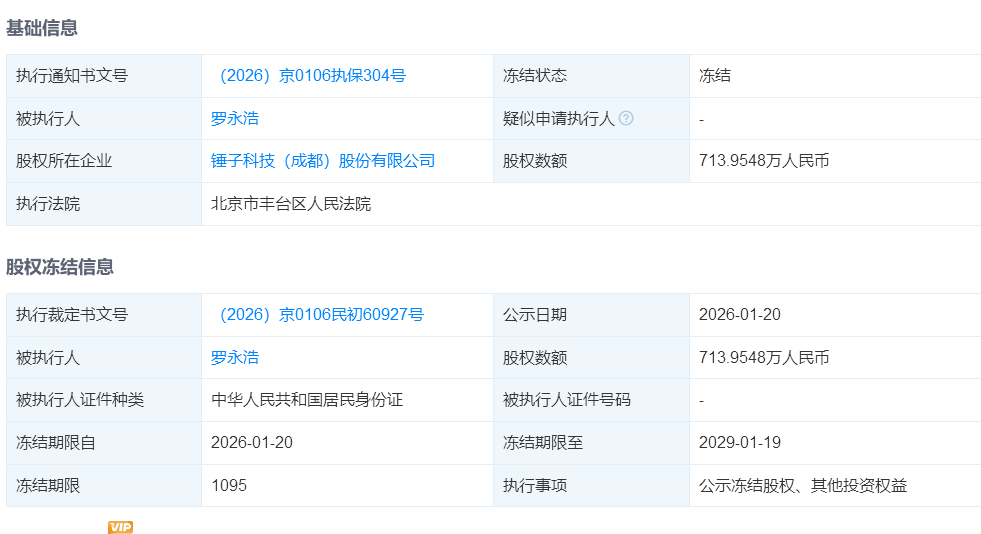
Core Viewpoint - The news highlights that Luo Yonghao's equity in Smartisan Technology (Chengdu) Co., Ltd. has been judicially frozen, amounting to approximately 7.14 million RMB, with the freeze lasting from January 20, 2026, to January 19, 2029, as ordered by the Beijing Fengtai District People's Court [1][2]. Group 1: Equity Freeze Details - Luo Yonghao is the beneficiary owner and actual controller of Smartisan Technology, holding about 22.67% of the company's shares [3]. - The frozen equity is part of Luo's holdings in the core entity of Smartisan Technology, which was established in May 2012 and focuses on the design, research, and sales of mid-to-high-end smartphones and related products [3]. - This is not the first instance of equity freeze for Luo Yonghao, as he has multiple previous records of equity freezes due to debt disputes [4]. Group 2: Legal and Financial Context - Smartisan Technology currently faces several legal risks, including two records of being an untrustworthy executor and multiple debt-related disputes, with total execution amounts exceeding 21.42 million RMB [5]. - A significant part of Smartisan's debt issues includes a 15 million RMB loan lawsuit with Zihui Venture Capital, which was upheld in a second trial, requiring Smartisan to repay the principal and interest [5]. - In September 2024, Luo publicly stated that he had cleared all personal debts totaling 824 million RMB, which was higher than the initially reported 600 million RMB, primarily due to legal compensation and penalties [8].
刚刚,罗永浩被冻结约714万股权
凤凰网财经· 2026-01-22 03:49
Core Viewpoint - The article highlights the recent judicial freezing of approximately 7.14 million RMB worth of equity held by Luo Yonghao in Smartisan Technology (Chengdu) Co., Ltd., indicating ongoing legal and financial challenges faced by the company [1][2][4]. Group 1: Equity Freezing Details - Luo Yonghao's equity in Smartisan Technology has been frozen from January 20, 2026, to January 19, 2029, by the Beijing Fengtai District People's Court [1][2]. - The frozen equity amounts to 713.9548 million RMB, representing about 22.67% of the company's shares, making Luo the beneficial owner and actual controller of the company [3][4]. - This is not the first instance of equity freezing for Luo, as he has multiple records of equity freezes due to debt disputes, with previous freezes lasting from November 16, 2023, to November 15, 2026 [4]. Group 2: Company Background and Financial Issues - Smartisan Technology (Chengdu) Co., Ltd. was established in May 2012, with a registered capital of approximately 314.98 million RMB, focusing on the design, research, and sales of mid-to-high-end smartphones and related products [3]. - The company currently faces several legal risks, including two records of being a dishonest executor and multiple debt-related disputes, with total execution amounts exceeding 21.42 million RMB [7][8]. - In September 2024, Luo publicly stated that he had repaid all personal debts totaling 824 million RMB, which was higher than the initially reported 600 million RMB, primarily due to legal compensation and penalties [8].

美银证券:小米首季调整后盈利超预期 升目标价至66港元
news flash· 2025-05-28 04:16
Core Viewpoint - Bank of America Securities reports that Xiaomi's adjusted profit for the first quarter exceeded expectations by 5% and 18% compared to the bank's and market consensus, driven by higher gross margins and operational cost control [1] Financial Performance - Gross margin surpassed the bank's and market consensus expectations by 1.6 and 1.4 percentage points, reaching 22.8%, which contributed to actual operating revenue exceeding the bank's forecast by 27% [1] Smartphone Strategy - Xiaomi's management maintains a relatively conservative forecast for industry shipment volumes but emphasizes a focus on promoting mid-to-high-end smartphone deliveries in certain regions to enhance average selling price (ASP) and support gross margin growth [1] Long-term Goals - The management aims to become the third-largest home appliance brand in China by 2025 and is optimistic about long-term growth potential [1] Electric Vehicle Outlook - Xiaomi's management expresses confidence in electric vehicle demand, noting that supply remains a major bottleneck. The SU7 and YU7 share the same platform, which will help in flexibly adjusting production capacity and component allocation, supporting gross margin expansion [1] Target Price Adjustment - The bank raised Xiaomi's target price from HKD 63 to HKD 66, based on a comprehensive valuation approach, estimating the core business at HKD 30 per share (based on a projected P/E ratio of 22 times for next year) and the electric vehicle business at HKD 36 per share, using a 5 times price-to-sales ratio for the second half of 2026 to the first half of 2027 [1]
