丰田bZ3

Search documents
【联合发布】一周新车快讯(2026年1月1日-1月9日)
乘联分会· 2026-01-12 09:28
Core Viewpoint - The article provides an overview of upcoming vehicle models from various manufacturers, detailing their specifications, market segments, and expected launch dates, highlighting the competitive landscape in the automotive industry for 2026 [2][5][10]. Group 1: Upcoming Models Overview - FAW Toyota will launch the Toyota bZ3 on December 31, 2025, targeting the B NB segment with a price range of 10.98 to 15.98 million yuan [10]. - Geely Auto is set to release the Geely Emgrand on January 1, 2026, in the A NB segment, priced at 7.29 million yuan [18]. - Lynk & Co will introduce the Lynk 08 EM-P on January 1, 2026, as a B SUV with a price of 20.58 million yuan [25]. - Smart will launch the smart 1 on January 1, 2026, in the AO SUV segment, priced at 13.99 million yuan [34]. - SAIC Passenger Vehicle will release the MG7 on January 6, 2026, in the B NB segment, with prices ranging from 13.79 to 17.89 million yuan [41]. - Beijing Hyundai will launch the Hyundai Santa Fe on January 6, 2026, in the B SUV segment, with a price range of 19.58 to 26.88 million yuan [49]. - GAC Toyota will introduce the Toyota Camry on January 7, 2026, in the B NB segment, with prices ranging from 19.58 to 26.88 million yuan [57]. - Dongfeng Honda will launch the Honda HR-V on January 8, 2026, in the A SUV segment, with prices between 15.99 and 17.59 million yuan [65]. - Xpeng Motors will release multiple models including the P7+, G7, G6, and G9 on January 8, 2026, with prices ranging from 18.68 to 27.88 million yuan [71][82][96]. - BYD will introduce the Qin PLUS DM-i and other models on January 8 and 9, 2026, with prices ranging from 7.98 to 12.68 million yuan [102][110][118]. Group 2: Technical Specifications - The Toyota bZ3 features a pure electric engine with a power output of 135 kW and a torque of 303 N·m, offering a range of up to 610 km [10]. - The Geely Emgrand is equipped with a 1.5L engine, producing 88 kW and 150 N·m of torque [18]. - The Lynk 08 EM-P has a 1.5T plug-in hybrid engine with a total power output of 300 N·m [25]. - The smart 1 offers a pure electric engine with a power output of 175 kW and a torque of 300 N·m, with a range of 410 km [34]. - The MG7 features a 1.5T engine with a power output of 138 kW and a torque of 300 N·m [41]. - The Hyundai Santa Fe is powered by a 2.0T engine, producing 182 kW and 353 N·m of torque [49]. - The Honda HR-V has a 1.5T engine with a power output of 134 kW and a torque of 240 N·m [65]. - The Xpeng P7+ offers both range-extended and pure electric versions, with the latter providing a range of 725 km [71]. - BYD's Qin PLUS DM-i features a 1.5L plug-in hybrid engine with a total power output of 210 km range [102].







机构:12月新能源汽车降价幅度14.7%
第一财经· 2026-01-09 01:22
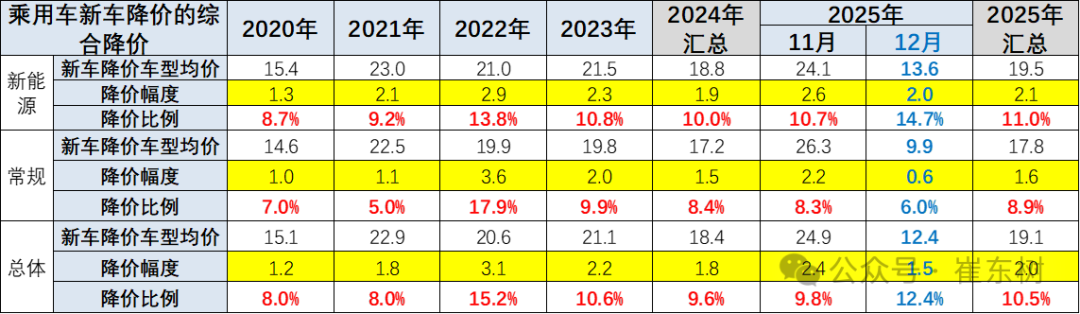
Core Viewpoint - The article discusses the significant price reductions in the automotive market, particularly in the new energy vehicle (NEV) sector, highlighting a price war that has emerged despite the year 2025 being labeled as a "year of anti-involution" [3]. Summary by Sections Price Reductions in the NEV Market - In December 2025, the average price of discounted NEVs was 136,000 yuan, with an average price drop of 20,000 yuan, representing a decline of 14.7% [3][4]. - For the entire year of 2025, the average price of discounted NEVs was 195,000 yuan, with an average price reduction of 21,000 yuan, resulting in an 11% decrease [3][4]. - The price reduction in 2025 for NEVs was the highest in nearly three years, only surpassed by the 13.8% drop in 2022 [3]. Overall Automotive Market Trends - In December 2025, the average price of discounted passenger vehicles was 124,000 yuan, with an average price drop of 15,000 yuan, equating to a 12.4% decline [3][4]. - The overall average price of discounted vehicles for the year was 191,000 yuan, with a total average price reduction of 18,000 yuan, leading to a 10.5% decrease [4]. Specific Vehicle Price Changes - The Toyota bZ3 saw a significant price cut from a previous high of 169,800 yuan to a new price of 109,800 yuan, marking a 35% reduction [5]. - The bZ3's "limited-time renewal price" dropped to 93,800 yuan, indicating aggressive pricing strategies to boost sales [5]. Industry Financial Performance - From January to November 2025, the automotive industry generated revenues of 1,002.23 billion yuan, an 8.1% year-on-year increase, while costs rose by 9% to 884.05 billion yuan [7]. - The industry's profit for the same period was 44.03 billion yuan, reflecting a 7.5% increase, but the profit margin stood at 4.4%, which is lower than the average profit margin of 6% for downstream industrial enterprises [7]. - An industry expert predicts that as weaker brands exit the market and industry concentration increases, procurement and allocation costs will optimize, leading to a stabilization and potential recovery of profit margins starting in the third quarter of 2026 [7].
机构:12月新能源汽车降价幅度14.7%
Di Yi Cai Jing· 2026-01-09 01:22
Core Viewpoint - The year 2025 is marked by significant price reductions in the automotive market, particularly in the new energy vehicle (NEV) sector, leading to a price war despite being referred to as the "year of anti-involution" [1]. Group 1: Price Reductions in the Automotive Market - In December 2025, the average price of new energy vehicles that were discounted was 136,000 yuan, with an average price reduction of 20,000 yuan, representing a decline of 14.7% [1]. - The overall average price of discounted passenger cars in December was 124,000 yuan, with an average reduction of 15,000 yuan, resulting in a decline of 12.4% [1]. - For the entire year of 2025, the average price of discounted new energy vehicles was 195,000 yuan, with an average reduction of 21,000 yuan, leading to an 11% decline [1]. Group 2: Historical Comparison and Trends - Data from 2020 to 2025 indicates that the price reduction for new energy vehicles in 2025 was the highest in nearly three years, only surpassed by the 13.8% reduction in 2022 [2]. - The average price of new energy vehicles in 2025 was 195,000 yuan, with a reduction of 2,100 yuan, and a reduction ratio of 11% [2]. - The average price of conventional vehicles in 2025 was 178,000 yuan, with a reduction of 1,600 yuan, and a reduction ratio of 8.9% [2]. Group 3: Specific Vehicle Price Changes - The Toyota bZ3 electric vehicle saw a significant price drop from a previous high of 169,800 yuan to a new guide price of 109,800 yuan, a reduction of 60,000 yuan or 35% [3]. - The bZ3 model, developed collaboratively by Toyota, BYD, and FAW Toyota, had total sales of less than 20,000 units from January to November 2025, reflecting a decline compared to the previous year [3]. Group 4: Industry Financial Performance - In the first eleven months of 2025, the automotive industry generated revenues of 1,002.23 billion yuan, an increase of 8.1% year-on-year, while costs rose by 9% to 884.05 billion yuan [3]. - The industry's profit for the same period was 44.03 billion yuan, marking a 7.5% year-on-year increase, with a profit margin of 4.4%, which remains lower than the average profit margin of 6% for downstream industrial enterprises [3]. Group 5: Future Outlook - According to industry experts, the automotive sector is expected to stabilize in terms of profit margins starting from the third quarter of 2026, driven by the elimination of weaker brands and increased industry concentration [4].
12月新能源汽车降价幅度14.7%
Di Yi Cai Jing· 2026-01-09 01:01
Core Insights - The year 2025 is characterized by intensified challenges of "increasing revenue without increasing profit" in the automotive industry, particularly due to ongoing price wars [1][3] - The average price of new energy vehicles (NEVs) dropped significantly, with a 14.7% decrease in December 2025, averaging 136,000 yuan, and an annual average drop of 11% for NEVs [1][2] Price Trends - In December 2025, the average price of new energy vehicles was 136,000 yuan, with an average price drop of 20,000 yuan [1] - The overall average price of passenger cars in December was 124,000 yuan, with a price drop of 15,000 yuan, reflecting a 12.4% decrease [1][2] - For the entire year of 2025, the average price of new energy vehicles was 195,000 yuan, with an average price drop of 21,000 yuan [2] Sales Performance - The Toyota bZ3 saw a significant price reduction of 60,000 yuan, with a 35% drop from its highest price, contributing to the overall decline in average prices [3] - The sales of the Toyota bZ3 from January to November 2025 were under 20,000 units, showing a decline compared to the previous year, with several months recording sales below 2,000 units [3] Industry Financials - The automotive industry reported revenues of 1,002.23 billion yuan from January to November 2025, an 8.1% year-on-year increase, while costs rose by 9% to 884.05 billion yuan [3] - The profit for the automotive industry was 44.03 billion yuan, reflecting a 7.5% year-on-year increase, resulting in a profit margin of 4.4%, which is lower than the average profit margin of 6% for downstream industrial enterprises [3] Future Outlook - An industry expert predicts that with the elimination of weaker brands and increased industry concentration, procurement and allocation costs will optimize, leading to a more stable profit margin starting from Q3 2026 [4]

消失的门把手:创新,还是为了不同而不同?
晚点Auto· 2025-05-16 14:27
Core Viewpoint - The article discusses the evolution and challenges of hidden door handles in the automotive industry, highlighting their aesthetic appeal and the associated safety concerns that have led to regulatory scrutiny [3][4][5]. Group 1: Product Innovation and Market Trends - Hidden door handles were initially designed for aesthetics and aerodynamics, becoming more common in mainstream vehicles due to technological advancements and cost reductions [4][5]. - Tesla played a significant role in popularizing hidden door handles with the Model S, which integrated this design to enhance the vehicle's technological appeal and performance [5][6]. - The adoption of hidden door handles has increased, with approximately 60% of the top 100 new energy vehicles in China featuring this design [15]. Group 2: Safety and Regulatory Concerns - Recent issues with hidden door handles include problems such as hand pinching, freezing in winter, and sensor failures, prompting regulatory bodies to intervene [5][6]. - The Ministry of Industry and Information Technology in China proposed new safety standards for automotive door handles, addressing concerns about strength, control logic risks, and emergency escape scenarios [6][15]. - The complexity of hidden door handles increases the potential for failure, especially in emergency situations where traditional mechanical systems may be more reliable [13][15]. Group 3: Cost and Engineering Challenges - The implementation of hidden door handles significantly increases vehicle weight and costs, with estimates suggesting a 7-8 kg increase and BOM costs that can be 4-7 times higher than traditional systems [14][15]. - Some manufacturers are adopting hybrid designs, such as semi-hidden handles, to balance aesthetics and functionality while mitigating risks associated with fully electronic systems [14][15]. - The lack of unified industry standards for hidden door handles raises concerns about safety and reliability, as different manufacturers may have varying levels of quality and emergency features [16][17]. Group 4: Future Developments and Innovations - Suppliers are developing safer hidden door handle solutions, including mechanical systems that do not rely on electrical power, ensuring functionality in emergencies [20][21]. - The automotive industry is urged to prioritize safety and quality over cost-cutting measures, as the current trend of focusing on price may lead to increased risks in product reliability [27].


“消失” 的汽车门把手
晚点LatePost· 2025-05-16 13:33
Core Viewpoint - The article discusses the evolution and challenges of hidden door handles in the automotive industry, highlighting their aesthetic appeal versus practical safety concerns and regulatory scrutiny [2][3][11]. Summary by Sections Evolution of Hidden Door Handles - Initially designed for aesthetics and aerodynamics, hidden door handles became more common in mainstream vehicles due to technological advancements and cost reductions [2]. - Tesla's Model S was the first electric vehicle to feature hidden door handles, which contributed to its success and established a design trend in the EV market [2]. Technical Challenges and Regulatory Response - Hidden door handles have faced issues such as hand pinching, freezing in winter, and sensor failures, leading to safety concerns [3]. - The Ministry of Industry and Information Technology in China proposed new safety standards for automotive door handles, addressing risks related to strength, control logic, and emergency escape [3][11]. Performance vs. Complexity - The aerodynamic benefits of hidden door handles are minimal, with improvements in drag coefficient only between 0.001 to 0.002 Cd, translating to a mere 1 to 3 kilometers of range increase [4]. - The complexity and cost of hidden door handles are significantly higher than traditional designs, raising questions about their overall value [4][12]. Design Variants and Safety Considerations - Hidden door handles can be categorized into fully hidden and semi-hidden types, with varying mechanisms for operation [5][7]. - The reliance on electronic systems increases potential failure points, especially in emergency situations where mechanical backup is crucial [7][11]. Market Adoption and Consumer Perception - Approximately 60% of the top 100 electric vehicle models in China feature hidden door handles, indicating a growing trend despite safety concerns [11]. - Some manufacturers adopt a hybrid approach, combining hidden designs with traditional mechanical features to balance aesthetics and safety [10][12]. Future Developments and Innovations - Suppliers are exploring safer hidden door handle solutions, such as mechanical self-triggering mechanisms that do not rely on electrical power [17][18]. - The automotive industry is urged to prioritize safety and functionality over cost-cutting measures, reflecting a need for a shift in design philosophy [24].

你的车门安全吗?工信部出手破解隐藏式车门把手隐患
Bei Ke Cai Jing· 2025-05-09 11:42
Core Viewpoint - The Ministry of Industry and Information Technology (MIIT) is initiating a revision of the national standard for automotive door handles due to safety concerns associated with hidden door handles widely used in electric vehicles. The proposed standards aim to enhance safety features, ensuring that door systems can be opened in emergencies such as power failure or collisions [1][4][17]. Group 1: Safety Concerns - Hidden door handles have been linked to various safety issues, including insufficient strength, potential control logic risks, and difficulties in operation due to lack of visible markings, which can hinder escape during emergencies [4][9][16]. - Incidents have occurred where hidden door handles contributed to rescue difficulties, such as a serious accident involving a Wanjie M7 Plus, where the door handle failed to operate after a high-speed collision, complicating rescue efforts [4][5][6]. - The MIIT's proposed standards will include requirements for mechanical or power failure protection to ensure door systems remain operable during accidents, thereby facilitating rescue and escape [8][9][17]. Group 2: Industry Response - The automotive industry is recognizing the need to shift from a focus on aesthetic and technological appeal of hidden door handles to prioritizing safety. Companies like BYD and Great Wall Motors are actively participating in the development of safety standards [16][17]. - There have been calls from industry leaders to improve the design of hidden door handles to enhance usability in various conditions, including extreme weather [16][17]. - The trend towards hidden door handles has been driven by their sleek design and perceived technological advantages, but the recent focus on safety may lead to a reevaluation of their design priorities [10][11][14].