临时拨款法案

Search documents
独家洞察 | 美国史上最长政府停摆终结,但财政的“坑”依旧在
慧甚FactSet· 2025-11-24 06:51
Core Viewpoint - The recent U.S. government shutdown, lasting 43 days, has ended with a temporary funding bill, but underlying issues such as rising debt and political conflicts remain unresolved, posing risks for future stability [1][4][8]. Group 1: Government Shutdown and Economic Impact - The shutdown concluded on November 12, with a temporary funding bill allowing most government agencies to operate until January 30, 2026, but core disagreements on healthcare spending persist, indicating potential future shutdowns [3][5]. - The Congressional Budget Office (CBO) estimates that the six-week shutdown will reduce Q4 GDP by 1.5 percentage points, resulting in a net loss of approximately $11 billion [1][6]. Group 2: Debt and Fiscal Risks - The shutdown has highlighted the escalating U.S. debt crisis, with public debt projected to rise from 122% of GDP in 2024 to 143% by 2030, significantly above the average for developed economies [4]. - During the shutdown, U.S. government debt increased from $37.4 trillion to $38 trillion, exacerbating fiscal risks and limiting investments in critical areas such as education and infrastructure [4][8]. Group 3: Market Reactions and Future Outlook - Post-shutdown, the market is focused on the timely release of economic data, particularly for October, which may be delayed or noisy, complicating the Federal Reserve's decision-making regarding interest rates [6][7]. - The Treasury General Account (TGA) balance has surged from $300 billion in July to nearly $1 trillion in November, suggesting improved liquidity conditions as the government reopens [7]. - Political tensions between the Republican and Democratic parties remain, with a 30% market expectation of another shutdown by the end of January 2026, as both parties may leverage the situation for negotiations [7][8].


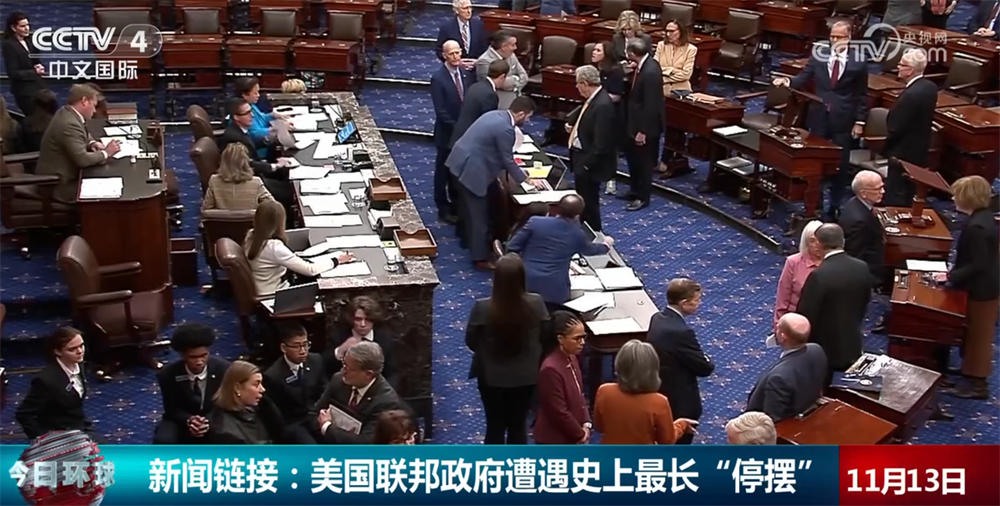
美国联邦政府遭遇史上最长“停摆” 民众不得不承担“否决政治”代价
Yang Shi Wang· 2025-11-13 03:51
Core Points - The current U.S. federal government shutdown has lasted over 6 weeks, breaking the previous record of 35 days [1] - The shutdown is a result of the inability of Congress to pass a new annual budget due to intense partisan conflicts, leading to attempts at temporary funding measures [1] - The House of Representatives, controlled by Republicans, passed a temporary funding bill, but it failed to pass in the Senate due to disagreements over healthcare provisions [3] - The Senate has held 14 votes on the temporary funding bill without success, leading to the government shutdown as of October 1 [5] - The shutdown has caused significant disruptions, including absenteeism among air traffic controllers and delays in food assistance programs affecting millions of Americans [7] - Only 3 out of the required 12 annual budget appropriations have been passed, indicating a potential for future shutdowns if negotiations do not progress [9]