人工智能AI ETF

Search documents
770亿美元“弹药”蓄势待发!韩国“蚂蚁军团”携巨量资金回流 力撑韩股再续涨势
Zhi Tong Cai Jing· 2026-02-13 03:53
Group 1 - South Korean retail investors are preparing to return to the domestic stock market with a record amount of funds, aiming to chase returns in one of the hottest markets globally [1] - The available funds for stock purchases reached a historical high of 111 trillion KRW (approximately 77 billion USD), indicating a shift in investment direction among retail investors [1] - The Korean benchmark Kospi index has surged 31% year-to-date, outperforming global indices, with local institutions being the largest net buyers in this rally [1] Group 2 - President Lee Jae-myung is focusing on boosting stock market valuations and encouraging local retail investors, known as the "ant army," to shift funds from real estate and overseas markets to domestic stocks [2] - The number of active stock trading accounts in South Korea has surpassed 100 million for the first time, reflecting the effectiveness of promotional efforts by brokerages [2] - The introduction of the "Reshoring Investment Account" policy allows investors to receive up to 100% capital gains tax exemption if they reinvest profits from overseas stocks into the domestic market [2] Group 3 - South Korean regulators are preparing to approve single-stock ETFs to attract retail investors seeking leveraged returns, with a leverage cap set at two times [3] - The most favored stocks among retail investors include Hyundai Motor, SK Hynix, and Samsung Electronics, benefiting from strong corporate earnings driven by the AI boom [3] - The Korean market is experiencing a revival due to government-led initiatives and robust earnings in sectors like semiconductors, meeting investor expectations [3]

零跑汽车新设电子公司,含智能机器人业务
Qi Cha Cha· 2026-01-28 08:32
Group 1 - The core point of the article is the establishment of a new electronic company, Jinhua Lingai Electronics Co., Ltd., which is fully owned by Leap Motor (09863.HK) and focuses on various manufacturing and research areas, including smart robotics [1] Group 2 - The registered capital of Jinhua Lingai Electronics Co., Ltd. is 120 million yuan [1] - The business scope of the new company includes manufacturing electronic components, smart vehicle equipment, automotive parts, cloud computing devices, and research on intelligent robots [1] - The legal representative of the new company is Zhou Hongtao [1]

大“揭秘”!这家ETF巨头全球排名,持续上升!
Zhong Guo Ji Jin Bao· 2025-11-21 02:24
Core Insights - The article highlights the rise of Chinese public fund companies in the global ETF market, with China becoming a significant player in the industry [1][3][10] - Specifically, Huaxia Fund has improved its ranking among global ETF providers, reaching 18th place with an ETF management scale of $126.8 billion as of Q3 2025, marking a continuous upward trend since 2022 [1][3][10] - The growth of the Chinese ETF market is underscored by its total scale of approximately 5.5 trillion yuan, surpassing Japan and establishing China as the largest ETF market in Asia [1][2] Industry Growth Potential - Bloomberg's ETF team predicts that China will be a key growth engine for the Asian ETF market over the next decade, with assets expected to reach $8 trillion by 2035, surpassing current European levels [2] - The strong policy support for ETFs and the increasing adoption rate among retail investors are expected to drive significant capital inflows and attract more foreign institutional participation [2] Huaxia Fund's Competitive Advantages - Huaxia Fund has established a comprehensive ecosystem characterized by "scale foundation + research empowerment + product ecology + long-termism," which has contributed to its sustained ranking improvements [3][10] - The fund has the largest equity index scale in the industry, amounting to 904.7 billion yuan as of November 19, 2025, and has been recognized as the "Passive Investment Golden Bull Fund Company" for eight consecutive years [4][5] - Huaxia Fund offers the most diverse range of ETF products, with 116 ETFs covering various categories, including core broad-based, thematic, commodity, and cross-border markets [4][12] Innovative Investment Strategies - Huaxia Fund employs a dual empowerment strategy of "active equity + passive ETF," redefining the value of ETFs beyond mere index replication [9][10] - The fund's proactive approach in index selection and compilation allows it to align closely with industry trends, ensuring timely and relevant product offerings [9][10] - The "Lego-style" asset allocation strategy enables Huaxia Fund to meet diverse investor needs, creating a robust investment ecosystem that spans all asset classes and scenarios [10][12]
大“揭秘”!这家ETF巨头全球排名,持续上升!
中国基金报· 2025-11-21 02:16
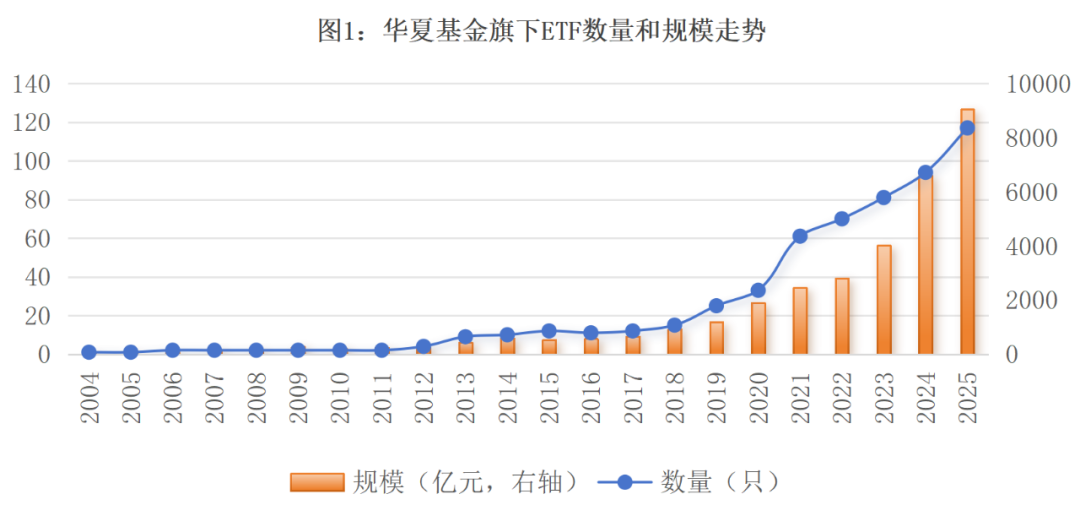
Core Insights - The article highlights the rise of China in the global ETF market, with two Chinese public fund companies making it to the top 20 ETF providers globally, particularly noting the significant progress of Huaxia Fund [1][6] - Huaxia Fund's ETF management scale reached $126.8 billion as of Q3 2025, moving up from 19th to 18th place in the global rankings, showcasing its growth trajectory since entering the top 20 in 2022 [1][6] - The Chinese ETF market has surpassed Japan, becoming the largest in Asia, with a total scale of approximately 5.5 trillion yuan, which strengthens China's leading position in the Asia-Pacific region [1][6] Group 1: Huaxia Fund's Growth - Huaxia Fund has maintained its position as the largest in the domestic ETF market for over 20 years, starting with the launch of the first domestic ETF in 2004 [6][11] - The fund's success is attributed to its comprehensive product ecosystem, which includes 116 ETF products covering a wide range of asset classes and investment strategies [8][18] - As of June 2025, Huaxia Fund had the highest number of clients in the industry, with 3.74 million accounts [9] Group 2: Market Dynamics - The global ETF market is characterized by a "Matthew Effect," where the top three firms (BlackRock, Vanguard, State Street) control 61% of the market share, highlighting the competitive landscape [6] - The report from Bloomberg predicts that China will be a significant growth engine for the Asian ETF market over the next decade, with assets expected to reach $8 trillion by 2035 [2] - The strong policy support and increasing adoption rates among retail investors in China are expected to drive substantial capital inflows and attract more foreign institutional participation [2] Group 3: Innovative Strategies - Huaxia Fund employs a dual empowerment strategy of "active equity + passive ETF," redefining the value of ETFs beyond mere index replication [12][13] - The fund's proactive approach in index selection and product development allows it to stay ahead of market trends, launching innovative products in emerging sectors like AI and 5G [13][14] - The "Lego-style" asset allocation strategy aims to create a comprehensive ecosystem that meets diverse investor needs, enhancing its competitive edge in the market [15][18]
加仓!继续加仓
Zhong Guo Ji Jin Bao· 2025-11-04 06:20
Group 1 - On November 3, the stock ETF market saw a net inflow of approximately 5.974 billion yuan, with significant contributions from industry-themed ETFs, particularly the brokerage sector, which attracted over 3.6 billion yuan in a single day [2][5] - The total scale of all stock ETFs in the market reached 4.64 trillion yuan as of November 3, with the Korean semiconductor ETF leading the market with a 4.62% increase [3][4] - The brokerage sector, referred to as the "bull market flag bearer," experienced a notable inflow of 1.767 billion yuan in ETF funds on the same day, with specific ETFs from Guotai Fund and Huabao Fund seeing substantial inflows [5][6] Group 2 - The industry-themed ETFs and Hong Kong market ETFs were the top gainers in terms of net inflow, with 3.675 billion yuan and 3.54 billion yuan respectively [5] - Several industry-themed ETFs, including those focused on banking, liquor, and chemicals, also saw significant inflows, with the banking ETF alone attracting 678 million yuan [5][6] - Despite the overall positive trend in industry-themed ETFs, broad-based ETFs experienced significant outflows, particularly the Shanghai Stock Exchange 50 ETF, which saw a net outflow of 1.195 billion yuan [7][8]
加仓!继续加仓
中国基金报· 2025-11-04 06:13
Core Viewpoint - On November 3, the A-share market experienced a "V" shaped reversal, with stock ETFs seeing a net inflow of approximately 5.974 billion yuan, indicating a strong interest in sector-specific ETFs, particularly in the brokerage sector, while broad-based ETFs faced significant outflows [2][3]. Summary by Categories ETF Market Overview - As of November 3, the total scale of 1,240 stock ETFs in the market reached 4.64 trillion yuan [4]. - The stock ETF market saw a net inflow of 5.974 billion yuan on November 3, with sector-specific ETFs attracting significant capital [5]. Sector-Specific ETF Performance - The brokerage sector, referred to as the "bull market flag bearer," attracted substantial inflows, with a total of 1.767 billion yuan flowing into securities company ETFs on that day [6]. - Notable inflows included 1.098 billion yuan into the Guotai Fund's securities ETF and 0.382 billion yuan into the Huabao Fund's brokerage ETF [6]. - The innovative drug ETFs also saw significant inflows, with the Hong Kong Stock Connect innovative drug ETF from Huatai Fund attracting 0.944 billion yuan [6]. Top Performing ETFs - The top-performing ETFs on November 3 included the China-Korea Semiconductor ETF, which rose by 4.62%, and several others in the photovoltaic and biotechnology sectors, all gaining over 4% [4]. - The leading inflows were recorded in the following ETFs: - Securities ETF: 1.098 billion yuan - Hong Kong Stock Connect innovative drug ETF: 0.944 billion yuan - A500 ETF: 0.914 billion yuan [7]. Broad-Based ETF Performance - Broad-based ETFs experienced significant outflows, with the Shanghai Stock Exchange 50 ETF leading the losses at 1.195 billion yuan [10]. - Other ETFs with notable outflows included the CSI 300 ETF and the CSI 500 ETF, with outflows of 0.656 billion yuan and 0.523 billion yuan, respectively [12]. Recent Trends - Despite the outflows on November 3, the CSI 300 index ETF has seen a total inflow exceeding 7.5 billion yuan over the past five days, indicating a potential recovery trend [13].