
游戏ETF

Search documents
正名之后,更见底色,华夏基金ETF背后的“长期主义”
点拾投资· 2026-03-23 03:14
Core Viewpoint - The article discusses the unprecedented "renaming battle" in China's ETF market, where over 1,400 ETFs must complete renaming by the end of March, marking the end of the "name dividend" era and the beginning of a standardized branding phase for ETF products [1]. Group 1: Historical Context and Development - In 2004, China’s first ETF, the Huaxia SSE 50 ETF, was launched by Huaxia Fund, marking the beginning of the ETF market in China [3]. - Huaxia Fund took five years to develop the ETF, conducting extensive investor education and outreach, which laid the groundwork for the future growth of the ETF market [3]. - By January 2026, Huaxia Fund's ETF management scale exceeded 1 trillion yuan, making it the first fund manager in China to reach this milestone [3]. Group 2: Product Strategy and Market Position - Huaxia Fund's ETF product lineup has grown to 122, covering a wide range of categories including core broad-based, popular industry themes, cross-border markets, and Smart Beta strategies [7]. - The "asset management Lego" concept allows investors to construct portfolios flexibly, with flagship products providing stability and growth opportunities [7]. - Huaxia Fund has shown a keen ability to capture emerging industries, with significant growth in ETFs related to robotics and artificial intelligence [8]. Group 3: Service and Innovation - The launch of the "Red Rocket" platform in 2024 represents Huaxia Fund's commitment to investor education and service, providing a comprehensive online service for index investment [11]. - The platform has served over 15 million users and attracted thousands of professional financial advisors, indicating its broad market appeal [11]. Group 4: Competitive Landscape and Fee Strategy - The collective renaming of ETFs aligns with Huaxia Fund's strategy of standardization and transparency, which aims to lower investment decision-making barriers for investors [13]. - Huaxia Fund has reduced management fees for 35 ETFs to the lowest market rate of 0.15% per year, demonstrating its competitive edge and commitment to investor benefits [13]. - This low-fee strategy is based on a scale effect, where larger scale leads to higher operational efficiency and lower fees, benefiting investors [13]. Group 5: Global Positioning - By 2025, China's ETF market surpassed 6 trillion yuan, becoming the largest in Asia and the second largest globally, with Huaxia Fund's international ranking improving to 18th among global ETF providers [16]. - The rise of Huaxia Fund reflects the broader growth of China's asset management industry on the global stage, challenging established players in the ETF market [16].


权益ETF周度跟踪:工业有色和稀土获逆势布局-20260308
HUAXI Securities· 2026-03-08 07:52
Report Industry Investment Rating No information provided in the given content. Core Viewpoints of the Report - Combining the "Gain/Loss - Crowding" quadrant chart and ETF fund flow, there are gaming opportunities in the industrial non - ferrous metals and rare earth sectors [1]. - The oil and gas and power grid equipment sectors led the gains from March 2 - 6, becoming the market's main lines, while the gaming and media sectors had significant declines [1]. - Industrial non - ferrous metals and rare earths received reverse capital increases, presenting potential opportunities, while the power grid equipment may be volatile in the short term, and the oil and gas sector's future is highly uncertain [1]. Summary by Directory 1. Market Review: Oil and Gas and Power Grid Equipment Led the Gains - **Overall Market Trend**: From March 2 - 6, the market declined and then stabilized. As of March 6, 2026, the closing price of the Wind All - A Index was 6783.03, a 2.30% drop from February 27 [6]. - **Performance of Major Indexes**: Large - cap stocks outperformed. The Shanghai Composite Index and CSI 300 Index fell 0.93% and 1.07% respectively, while the STAR 50 Index and CSI 1000 Index had larger declines of 4.95% and 3.64% [7]. - **ETF Fund Flow**: Stock - type ETFs had a net outflow of 7.349 billion yuan from March 2 - 6, a narrower outflow compared to February 24 - 26. Broad - based index ETFs had a net outflow of 42.875 billion yuan, while theme index ETFs had a net inflow of 23.533 billion yuan, and industry index ETFs had a net inflow of 13.731 billion yuan [10][11]. - **Market Focus**: The market focused on the oil and gas and power grid equipment sectors. The oil and gas index rose 9.50% with a crowding degree of 3.7%, reaching a new high since 2020. The power grid equipment index rose 5.49%, and its crowding degree increased from the 98.7% percentile to the 99.7% percentile since 2020. The gaming and media sectors fell 7.44% and 7.04% respectively, and their crowding degrees decreased for the second consecutive week. The rare earth and industrial non - ferrous metals sectors fell 7.00% and 4.74% respectively, with a slight decrease in crowding degree [14][15]. 2. Future Focus: Rare Earths and Industrial Non - Ferrous Metals May Present Gaming Opportunities - **Fund Flow Analysis**: Industrial non - ferrous metals and rare earths received reverse capital increases. The Industrial Non - Ferrous Metals ETF Wanjia and Rare Earth ETF Jiashi fell 4.91% and 7.15% respectively, but had net inflows of 559 million yuan and 1.991 billion yuan [22]. - **Power Grid Equipment**: The power grid equipment ETF had a net inflow of 5.284 billion yuan from March 2 - 5, accounting for 17.49% of its fund size. However, its crowding degree reached 3.92%, at the 99.7% percentile since 2020, and there may be a risk of adjustment [23]. - **Oil and Gas**: The oil and gas ETF had a net inflow of 5.108 billion yuan from March 2 - 5. The sector's future depends on the development of the US - Iran situation [26]. - **Gaming and Media**: The media ETF and gaming ETF fell 7.29% and 6.99% respectively, with net outflows of 1.505 billion yuan and 538 million yuan. If the HALO trading trend remains unchanged, these two industries will continue to face pressure [26].
行业轮动ETF策略周报-20260302
金融街证券· 2026-03-02 07:15
1. Report Industry Investment Rating - No relevant information provided 2. Core Viewpoints of the Report - The strategy is based on the reports "Strategy Portfolio Report under Industry Rotation: Quantitative Analysis from the Perspective of Industry Style Continuity and Switching" (20241007) and "Research on the Overview and Allocation Methods of the Stock - type ETF Market: Taking the ETF Portfolio Based on the Industry Rotation Strategy as an Example" (20241013), constructing a strategy portfolio based on industry and theme ETFs [2] - From 20260224 - 20260227, the cumulative net return of the strategy was about 0.44%, and the excess return relative to the CSI 300 ETF was about - 0.71%. From October 14, 2024 to now, the cumulative out - of - sample return of the strategy was about 38.54%, and the cumulative excess return relative to the CSI 300 ETF was about 13.71% [5] - In the week of 20260302, the model recommends allocating sectors such as real estate development, cement, and batteries. In the next week, the strategy will newly hold products such as Building Materials ETF, Battery ETF Huitianfu, Bank ETF, and Game ETF, and continue to hold products such as Real Estate ETF and Tourism ETF [13] 3. Summary by Relevant Catalogs 3.1 Strategy Update - The strategy constructs a portfolio based on industry and theme ETFs, with reference to two previous research reports [2] 3.2 ETF Portfolio Information | Fund Code | ETF Name | ETF Market Value (billion yuan) | Holding Status | Heavy - held SW Industry and Weights | Weekly Timing Signal | Daily Timing Signal | | --- | --- | --- | --- | --- | --- | --- | | 159707 | Real Estate ETF | 6.65 | Continue to hold | Real estate development (100%) | - 1 | - 1 | | 159745 | Building Materials ETF | 26.61 | Add | Cement (45.24%) | 1 | 1 | | 159796 | Battery ETF Huitianfu | 84.32 | Add | Batteries (64.18%) | - 1 | - 1 | | 512800 | Bank ETF | 114.46 | Add | Joint - stock banks (42.01%) | - 1 | - 1 | | 159869 | Game ETF | 122.27 | Add | Games (83.85%) | 1 | - 1 | | 159766 | Tourism ETF | 78.92 | Continue to hold | Aviation and airports (33.21%) | 0 | 0 | | 515220 | Coal ETF | 94.06 | Add | Coal mining (88.96%) | 1 | 1 | | 159328 | Home Appliance ETF E Fund | 1.21 | Add | White goods (43.01%) | - 1 | - 1 | | 515650 | Consumption 50 ETF | 36.27 | Add | Baijiu (28%) | - 1 | 0 | | 515760 | Zhejiang State - owned Assets ETF Huaxia | 1.44 | Add | City commercial banks (20.13%) | 0 | 0 | [3] 3.3 Performance Tracking - From 20260224 - 20260227, the cumulative net return of the strategy was about 0.44%, and the excess return relative to the CSI 300 ETF was about - 0.71% - From October 14, 2024 to now, the cumulative out - of - sample return of the strategy was about 38.54%, and the cumulative excess return relative to the CSI 300 ETF was about 13.71% [5] 3.4 Portfolio Adjustment and Recommendations - In the week of 20260302, the model recommends allocating sectors such as real estate development, cement, and batteries - In the next week, the strategy will newly hold products such as Building Materials ETF, Battery ETF Huitianfu, Bank ETF, and Game ETF, and continue to hold products such as Real Estate ETF and Tourism ETF [13]
权威发布,最新解读
Zhong Guo Ji Jin Bao· 2026-02-28 03:56
Core Viewpoint - The report highlights China's economic resilience and progress in 2025, emphasizing the importance of adapting to complex domestic and international challenges while achieving significant growth and development milestones [2]. Economic Growth and Development - In 2025, China's GDP grew by 5.0%, surpassing 140 trillion yuan for the first time, reflecting a continuous upward trajectory during the "14th Five-Year Plan" period [2][3]. - Per capita GDP reached 99,665 yuan, a 5.1% increase from the previous year, maintaining an average exchange rate of approximately 13,953 USD [2]. - The contribution of domestic consumption to economic growth was 67.3%, with final consumption expenditure contributing 52.0%, an increase of 5.0 percentage points from the previous year [3]. Technological and Industrial Advancements - R&D expenditure increased by 8.1%, reaching 2.80% of GDP, surpassing the OECD average for the first time, with basic research funding accounting for 7.08% [2]. - The value added of high-tech manufacturing grew by 9.4%, representing 17.1% of total industrial value added [2]. - Digital product manufacturing value added increased by 9.3%, with significant growth in smart products such as industrial control computers and 5G smartphones [2]. Infrastructure and Market Development - The construction of new infrastructure accelerated, with mobile communication base station production increasing by 13.5%, and the number of 5G base stations reaching 4.84 million [2]. - The total retail sales of consumer goods exceeded 50 trillion yuan, marking a 3.7% increase from the previous year [3]. - The logistics system improved, with cargo transport volume and turnover increasing by 3.2% and 4.6%, respectively [3]. High-Quality Development and Reforms - The establishment of a unified national market progressed, with the negative list for market access reduced to 106 items [3]. - The average urban unemployment rate was 5.2%, below the target of 5.5%, with 12.67 million new urban jobs created [3]. - The proportion of clean energy consumption reached 30.4%, with significant reductions in energy consumption per unit of GDP and carbon emissions [3]. Social Welfare and Living Standards - The average disposable income of urban residents increased by 5.0%, aligning with economic growth, while the ratio of urban to rural disposable income narrowed to 2.31 [3]. - The number of people covered by basic pension and medical insurance reached 1.08 billion and 1.33 billion, respectively, with improvements in social security and services [3]. - The education and healthcare sectors saw significant advancements, with the nine-year compulsory education retention rate reaching 96.1% [3].
今日看点|国务院政策例行吹风会将举行,介绍2025年国务院部门办理全国人大代表建议和全国政协提案工作有关情况
Jing Ji Guan Cha Bao· 2026-02-27 01:02
Group 1 - The State Council will hold a regular policy briefing to discuss the handling of suggestions from the National People's Congress and the Chinese People's Political Consultative Conference for 2025 [1] - The China Securities Index Co., Ltd. will release the China-Hong Kong Stock Connect Robotics Theme Index and the China-U.S. Stock Connect 30 Index on February 27, providing more investment options for the market [2] - Two companies will have their restricted shares unlocked today, with a total of 63.84 million shares worth 677 million yuan being released. The companies involved are Yinglite and JunChuang Technology, with unlocking ratios of 16.17% and 0.08% respectively [3] - Three companies have announced stock repurchase progress, with Guangzhou Restaurant repurchasing 100 million yuan, JinFeng Technology repurchasing 5.0543 million yuan, and Metro Design repurchasing 3.969 million yuan [4] Group 2 - The German CPI and seasonally adjusted unemployment rate for February will be published [5]




赛摩智能(300466.SZ):暂不涉及人形机器人相关产品和业务
Ge Long Hui· 2026-02-26 13:24
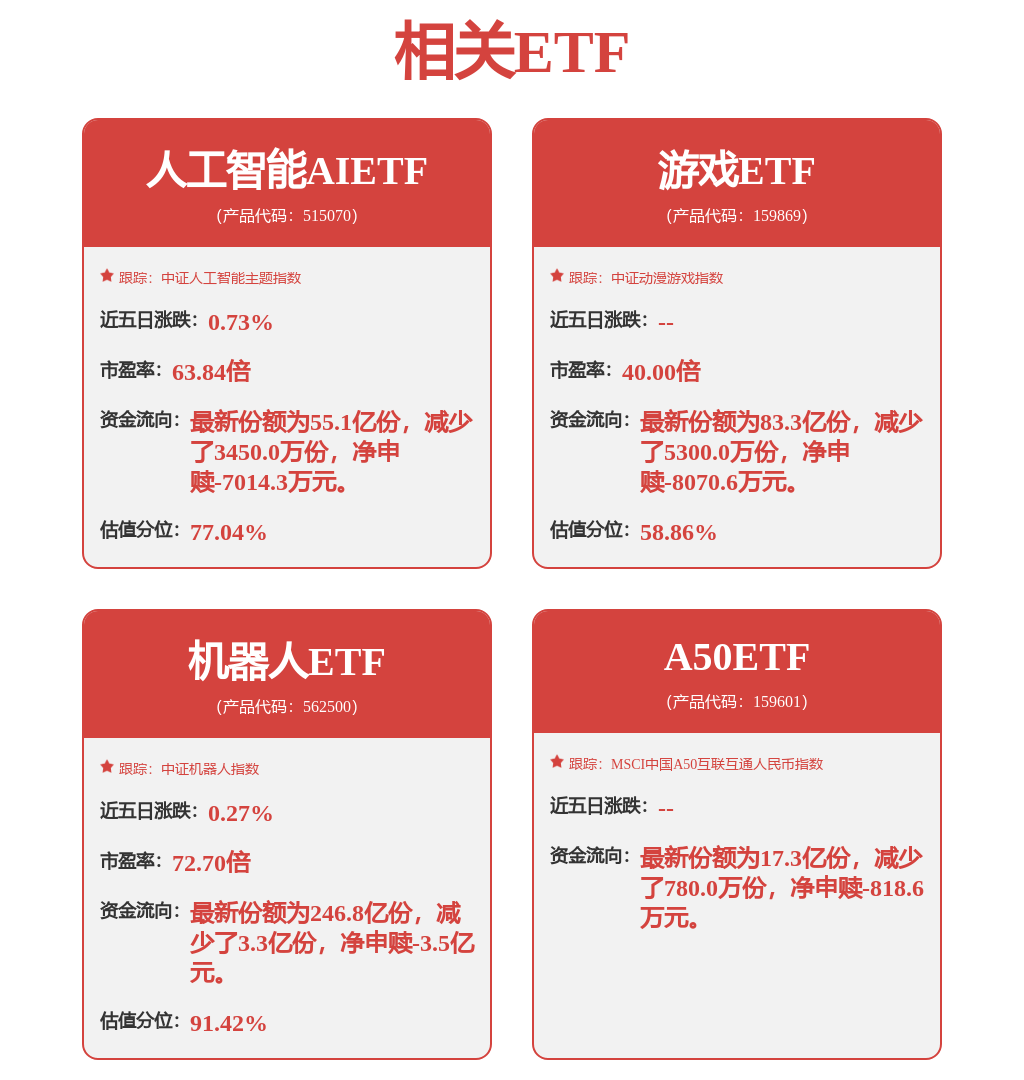
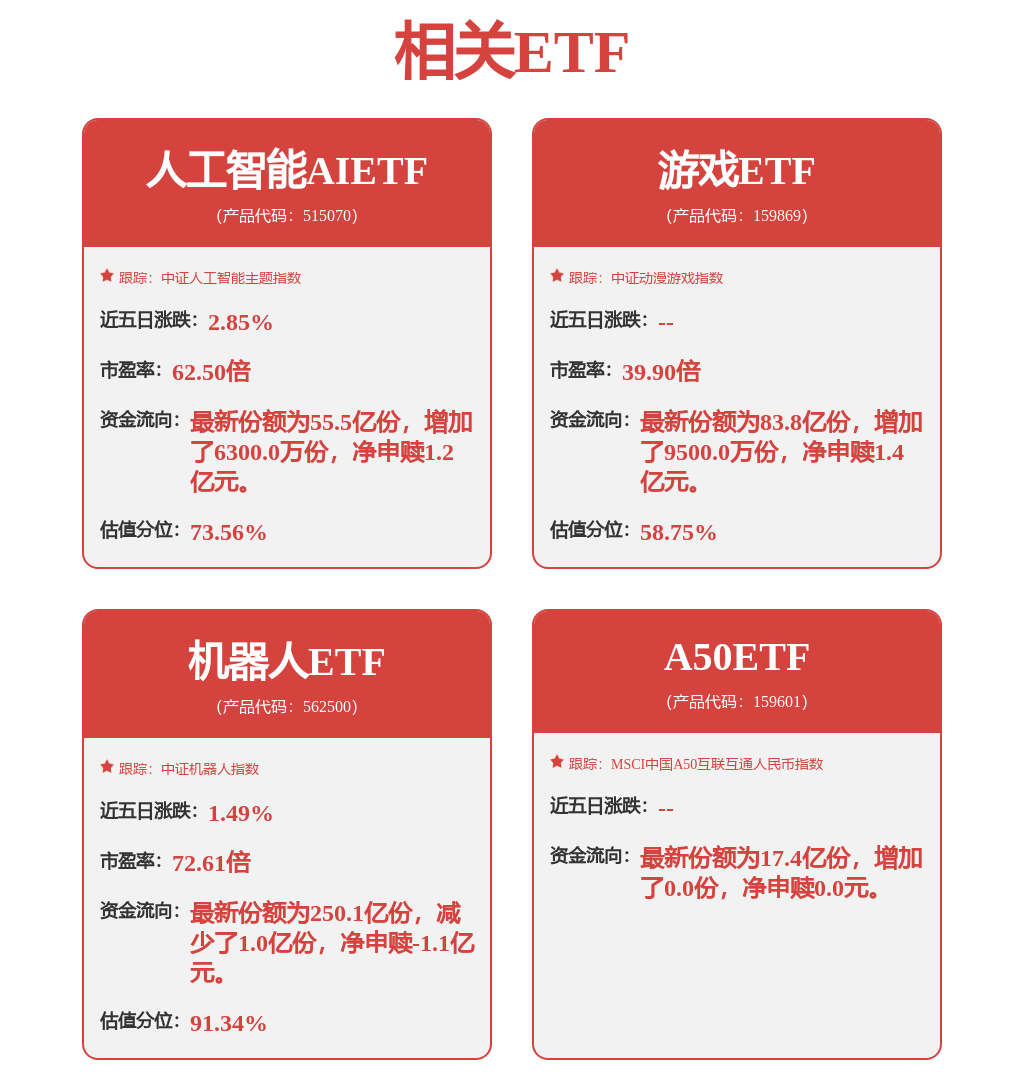
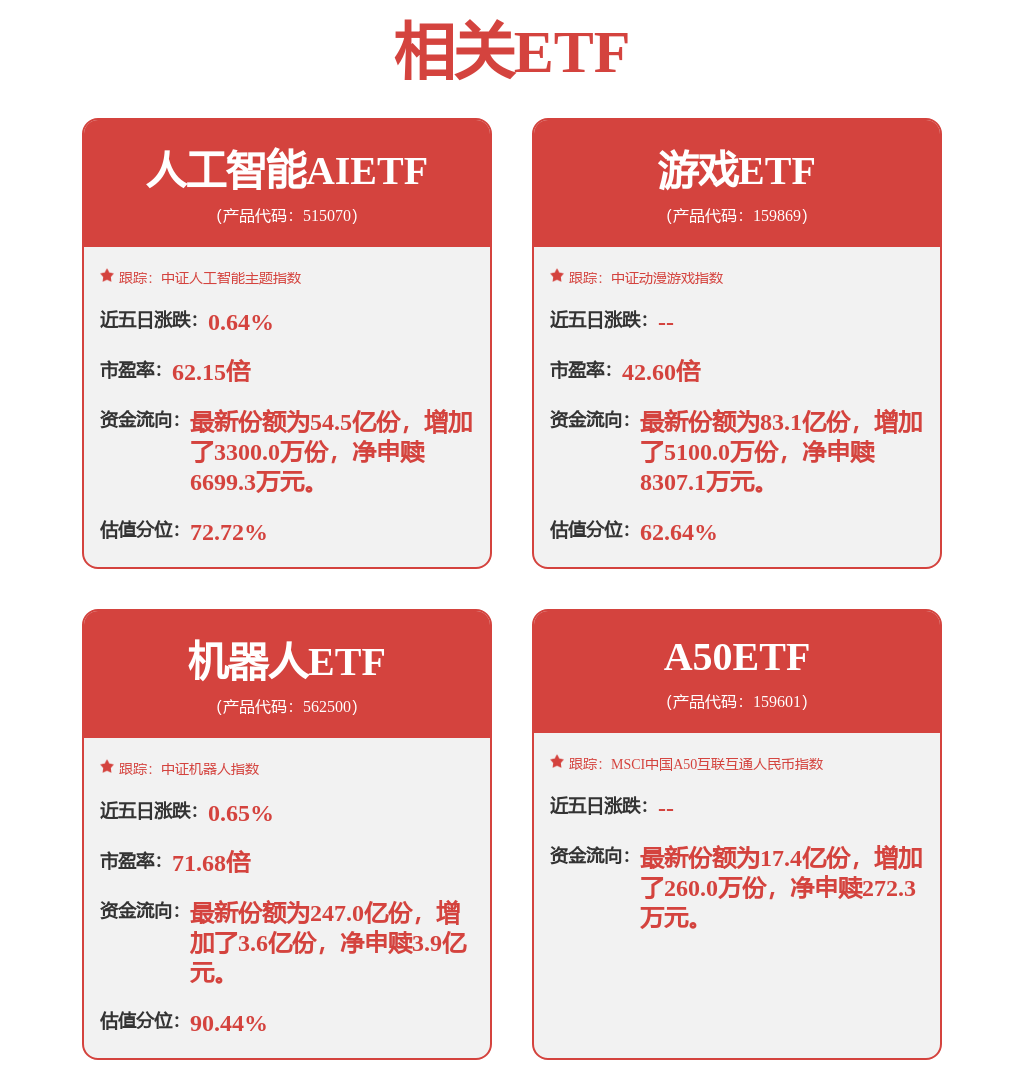
Group 1 - The core viewpoint of the article is that Saimo Intelligent (300466.SZ) has stated it is not currently involved in humanoid robot-related products and business [1] Group 2 - The Artificial Intelligence ETF (Product Code: 515070) tracks the CSI Artificial Intelligence Theme Index and has seen a recent increase of 6.3 million shares, with a net subscription of 120 million yuan [3][4] - The Gaming ETF (Product Code: 159869) tracks the CSI Animation and Gaming Index, with a recent increase of 9.5 million shares and a net subscription of 140 million yuan [4] - The Robotics ETF (Product Code: 562500) tracks the CSI Robotics Index, experiencing a decrease of 10 million shares and a net redemption of 110 million yuan [4] - The A50 ETF (Product Code: 159601) tracks the MSCI China A50 Connect RMB Index, with no recent changes in shares or net subscriptions [5]


香港创新科技及工业局:致力推动创科发展 加快发展新质生产力
Zhi Tong Cai Jing· 2026-02-26 11:39
Core Viewpoint - The Hong Kong government is focusing on innovation and technology development, particularly in artificial intelligence (AI) and health technology, as outlined in the latest budget proposal, which aims to enhance productivity and support the growth of the innovation ecosystem [1][2]. Group 1: AI Development - The budget emphasizes the "AI+" development strategy, with initiatives including the establishment of 16 AI-related laboratories and a HKD 3 billion AI funding program [1]. - An AI research institute is set to commence operations in the second half of the year to support AI research and commercialization [1]. - A new "AI+ and Industry Development Strategy Committee" will be formed to focus on life sciences and embodied intelligence [2]. Group 2: Health Technology - The government is establishing a health technology research institute using a "1+3" model, which includes a main institute and three branches created in collaboration with local universities [2]. - The "Industry-Academia-Research 1+ Program" has supported 15 projects, and nearly 500 related enterprises have settled in three major innovation parks [2]. Group 3: New Industrial Development - The "New Industrialization Funding Program" has supported over 120 new smart production lines, attracting more than HKD 1 billion in private investment [2]. - The budget allocates approximately HKD 220 million for the establishment of a National Manufacturing Innovation Center, the first of its kind set up by the country overseas [3]. Group 4: Aerospace and Robotics - The Hong Kong Space Robotics and Energy Center is involved in the national Chang'e 8 mission, with its multifunctional lunar surface operation robot entering initial testing [4]. - The government is accelerating the construction of a third InnoHK research platform focusing on sustainable development, energy, advanced manufacturing, and materials [4]. Group 5: Talent Development - The government is promoting high-quality talent acquisition through various initiatives, including a "Tech Internship Program" that has provided nearly 20,000 internship opportunities [6]. - Over 3,000 outstanding researchers from around the world are collaborating in Hong Kong, supported by a HKD 3 billion "Frontier Technology Research Support Program" aimed at attracting top international talent [6].
驻宿务总领事张瑱走访慰问宿务中资企业
Shang Wu Bu Wang Zhan· 2026-02-25 13:34
Group 1 - The Consul General of China in Cebu, Zhang Zhen, visited the construction site of China State Construction Engineering Third Bureau and the Visayas regional office of Fenghuo Philippines Limited Liability Company, expressing New Year greetings to employees and acknowledging the achievements of the enterprises [1][2] - During the visit, the Consul General emphasized the importance of safety production, employee rights protection, and legal compliance in business operations, encouraging employees to overcome challenges and contribute to practical cooperation between China and the Philippines [2] - The visit also included a tour of Hikvision's Cebu office led by Consul Song Jinpei, highlighting the engagement of Chinese enterprises in the region [3] Group 2 - The report includes information on various ETFs, such as the AI ETF, which tracks the China Securities Artificial Intelligence Theme Index, showing a recent decline of 5.60% over five days, with a market capitalization of 5.24 billion shares and a net subscription of 92.546 million yuan [5] - The Gaming ETF, tracking the China Securities Animation and Gaming Index, experienced a slight decline of 0.31% over five days, with a market capitalization of 9.01 billion shares and a net redemption of 28.05 million yuan [5] - The Robotics ETF, following the China Securities Robotics Index, saw a decrease of 1.93% over five days, with a market capitalization of 23.45 billion shares and a net redemption of 22.224 million yuan [5]

小鹏汽车成立智能科技公司,含多项机器人业务
Qi Cha Cha· 2026-02-25 05:58
Group 1 - Xpeng Motors has established a new subsidiary, Guangzhou Penghang Intelligent Technology Co., Ltd., with a registered capital of 10 million yuan [1] - The new company is fully owned by Xpeng Motors and will focus on various aspects of robotics, including manufacturing, research and development, sales, and maintenance of industrial robots [1]
2026年政策密码
Jing Ji Guan Cha Bao· 2026-02-25 05:50
Group 1: Policy Focus for 2026 - The core focus for 2026 includes expanding domestic demand, restructuring economic drivers, and stabilizing the real estate market, as indicated by multiple government meetings [1] - Key terms for 2026 include "cultivating and strengthening new driving forces," emphasizing innovation and technology as central to economic growth, particularly in emerging industries like AI and digital economy [2][4] - The government aims to address "involution" in competition, promoting innovation and quality over price wars and resource wastage, with a focus on various sectors including aviation and new energy vehicles [3][4] Group 2: Consumer and Investment Strategies - The emphasis on boosting consumption is critical, with consumption contributing 52.0% to economic growth in 2025, and expected to grow steadily in 2026 due to policy support and improved consumer confidence [5] - Investment strategies for 2026 include stabilizing investment levels, with a noted 3.8% decline in fixed asset investment in 2025, and a focus on infrastructure and social welfare projects to enhance investment [8][9] Group 3: Human-Centric Investment - The concept of "investing in people" has emerged, focusing on directing resources towards human development and welfare, particularly for vulnerable groups [6][7] - This approach aims to enhance public service access and improve the quality of life for various demographics, including low-income families and the elderly [7] Group 4: Regulatory Environment - Strengthening compliance and regulatory measures is a priority, with increased scrutiny on platform economies and tax compliance expected in 2026 [10] - Companies will face higher compliance costs, necessitating investments in risk management and regulatory adherence, particularly in sectors utilizing AI and digital platforms [10]