
人民币计价金融产品

Search documents
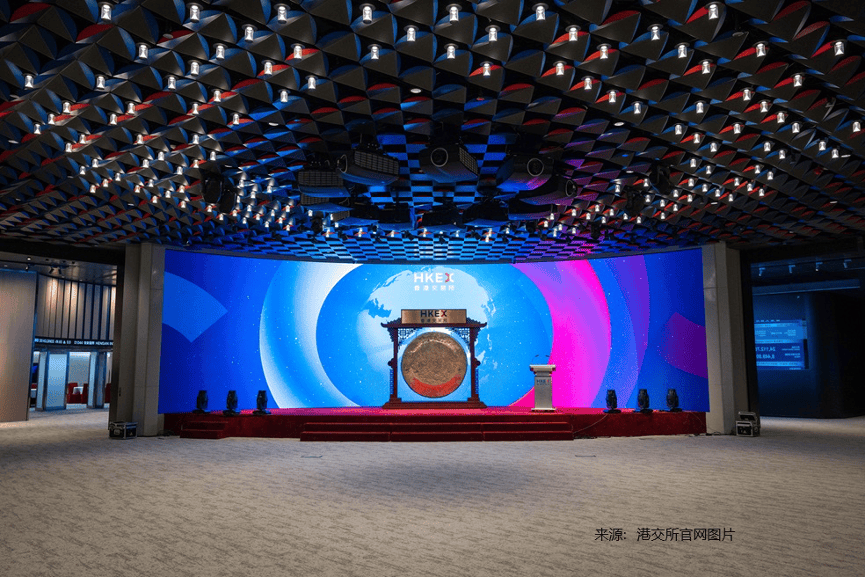
最新财政预算案,对港交所有何意义?
Sou Hu Cai Jing· 2026-02-25 12:28
Core Viewpoint - The Hong Kong government's recently announced budget for the fiscal year 2026/27 aims to reinforce Hong Kong's status as an international financial center, activate market vitality, and expand the financial sector, providing multiple policy benefits for the Hong Kong Stock Exchange (HKEX) [2] Policy Benefits and Market Reforms - The budget introduces several favorable policies for HKEX, including revisions to the listing requirements for "dual-class shares," facilitating secondary listings for overseas issuers, and optimizing the IPO process, which will allow a wider range of companies to access the Hong Kong capital market [3] - HKEX plans to enhance the listing framework for structured products and consult on the implementation of a "T+1" settlement cycle, which will significantly improve market efficiency and align with international standards [3] - The successful implementation of the "no market closure during bad weather" policy has ensured market liquidity and generated approximately 2.5 billion HKD in stamp duty revenue for the government [3] Deepening Connectivity and Expanding RMB Product Ecosystem - The budget emphasizes enhancing connectivity with the mainland, including the introduction of government bond futures and the inclusion of real estate investment trusts in cross-border trading [4] - Measures to promote RMB internationalization include increasing the total quota for RMB business funding to 200 billion RMB and regularly issuing RMB bonds to enrich the offshore RMB market [4] New Industry Listing Channels - The budget highlights the development of emerging industries such as aerospace, prompting HKEX to review listing regulations to attract more aerospace companies to list in Hong Kong [5] - The establishment of a 10 billion HKD "Innovation and Technology Industry Guidance Fund" aims to direct market capital into strategic emerging sectors like life sciences and artificial intelligence [6] Digital Asset Trading and Commodity Business Expansion - The budget supports the establishment of a licensing system for digital asset trading and custody, positioning HKEX to capture opportunities in the global digital asset market [7] - Plans to create an international gold trading market will enhance HKEX's commodity business, with a target of exceeding 2,000 tons in gold storage within three years [8] Growth in Family Offices and Asset Management - The number of family offices in Hong Kong has surpassed 3,300, prompting the government to optimize tax regulations to attract more family offices and funds [9] - The upgrade of HKEX's comprehensive fund platform is expected to enhance revenue through improved market efficiency and lower transaction costs [10] Global Network Expansion and Asset Management Business Development - HKEX is collaborating with the Hong Kong Monetary Authority to establish a multi-asset trading infrastructure that enhances cross-border collateral connectivity [11] - The government plans to submit a bill to facilitate the privatization of real estate investment trusts, further expanding HKEX's asset management business [12]


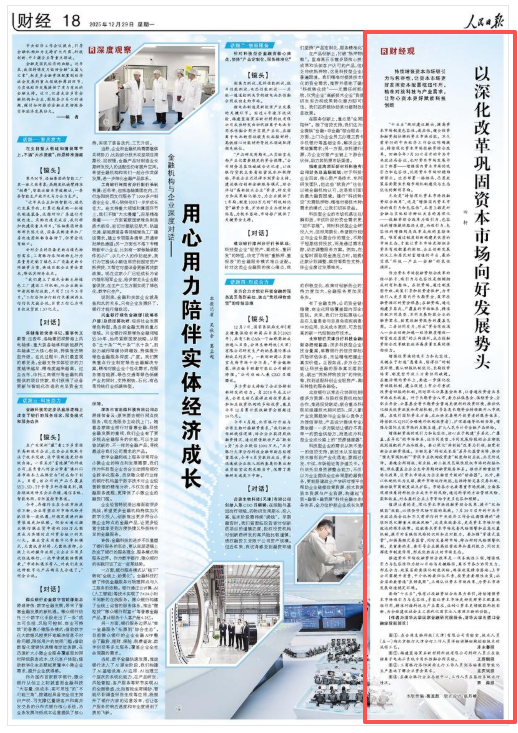
田轩:以深化改革巩固资本市场向好发展势头(财经观)
Xin Lang Cai Jing· 2025-12-29 01:36
Core Viewpoint - The article emphasizes the need to enhance the attractiveness and inclusiveness of the capital market to better serve as a hub for capital allocation, aligning with technological and industrial demands, and empowering technological innovation with patient capital [2][3][4]. Group 1: Capital Market Reforms - The "14th Five-Year Plan" suggests improving the inclusiveness and adaptability of capital market systems, and establishing a coordinated investment and financing function [2][3]. - Recent central economic work meetings have highlighted the continuous deepening of comprehensive reforms in capital market investment and financing [2][3]. - The focus is on long-term market mechanism construction and ecological optimization, as indicated by the consistent policy direction from recent political meetings [2][3]. Group 2: Investment Side Enhancements - Key strategies to enhance the investment side include optimizing return mechanisms, fostering long-term investments, and implementing institutional openness [4][11]. - Strengthening the investment return mechanism is crucial for activating domestic capital and ensuring that listed companies prioritize investor returns [4][11]. - Creating a more favorable investment environment for long-term funds, such as social security funds and insurance capital, is essential for increasing market participation [4][11]. Group 3: Financing Side Enhancements - The core of enhancing the financing side lies in constructing a "multi-layered, widely covered, and differentiated" market system to meet the financing needs of various types and stages of enterprises [5][12]. - Reforms in the "Two Innovation Boards" are aimed at broadening financing channels for innovative enterprises [5][12]. - Establishing a comprehensive financing service system that covers the entire lifecycle of enterprises is necessary, along with promoting market-oriented reforms in mergers and acquisitions [5][12]. Group 4: Risk Management - Continuous prevention and resolution of key area risks are emphasized as a fundamental requirement for the stability and long-term sustainability of the capital market [6][13]. - The need for improved risk warning and emergency response mechanisms is highlighted to enhance the identification and response capabilities for systemic risks [6][13]. - Encouraging companies to improve operational efficiency and profitability, while ensuring a competitive market ecology through effective delisting mechanisms, is essential [6][13]. Group 5: Collaborative Efforts - The success of capital market reforms relies on collaborative efforts from various stakeholders, including policy makers, listed companies, intermediaries, and investors [6][13]. - Creating a favorable social environment for capital market reforms is crucial for ensuring stable development [6][13]. - The ongoing reforms aim to enhance the capital market's role in effectively allocating resources and supporting technological innovation, contributing to the broader goals of national modernization [6][13].
中国、土耳其双边本币互换协议续签,建立人民币清算安排
Di Yi Cai Jing· 2025-06-13 12:39
Group 1 - The core viewpoint of the news is the completion of significant cooperation measures between the People's Bank of China and the Central Bank of Turkey, including the renewal of a bilateral currency swap agreement and the signing of a memorandum for establishing a RMB clearing arrangement in Turkey [1][2] - The renewed bilateral currency swap agreement has a scale of 35 billion RMB / 189 billion Turkish Lira, with a validity period of three years and the possibility of extension upon mutual agreement [1] - Since the global financial crisis in 2008, the People's Bank of China has signed bilateral currency swap agreements with 32 countries and regions, with a total scale of approximately 4.5 trillion RMB, which has played a crucial role in maintaining global financial stability and facilitating bilateral trade and investment [1] Group 2 - The establishment of the RMB clearing arrangement in Turkey is a significant achievement in the global layout of RMB clearing arrangements, with the People's Bank of China having authorized 34 RMB clearing banks in 32 countries [2] - The RMB clearing banks provide efficient fund clearing services for foreign financial institutions and support the development of diversified RMB products tailored to local market conditions, enhancing the overall RMB financial service system [2] - The upcoming RMB clearing bank in Turkey is expected to improve cross-border RMB service capabilities and clearing efficiency, meeting the currency settlement needs of enterprises in trade and investment activities [3]