以旧换新补贴计划

Search documents
机构预计楼市下行趋势将在2026年见底
2 1 Shi Ji Jing Ji Bao Dao· 2025-12-16 14:51
Group 1: Economic Outlook - The chief economist of Bank of America Securities for Greater China, Qiao Hong, forecasts China's GDP growth rate to reach 4.7% in 2026, with expectations for more counter-cyclical policies to support economic growth close to target levels [1] - The structure of economic growth in China is expected to change by 2026, with increased importance of domestic demand and a relative weakening of export-driven growth compared to 2025 [1] - The People's Bank of China is anticipated to implement two 10 basis point interest rate cuts in 2026, aiming for a moderately accommodative monetary policy to stimulate domestic demand [1] Group 2: Investment and Infrastructure - Despite the government's deployment of fiscal tools, including a 4% fiscal deficit and record local government special bonds of 4.4 trillion yuan, infrastructure investment faces challenges due to local government liquidity constraints [1] - Infrastructure investment is expected to rebound in the first quarter of 2026, driven by seasonal spending and incremental policy implementation, with a long-term shift in focus from traditional transportation networks to new infrastructure such as energy, 5G, data centers, and public service facilities [1] Group 3: Export and Consumption - China's export performance has exceeded expectations this year, maintaining positive growth for most of the past 20 months, supported by a global recovery in electronic products and strong exports to regions outside the U.S. [2] - The retail sales growth of consumer goods in China has been around 4% since 2025, primarily driven by government subsidy programs for major items like automobiles and home appliances, although growth has slowed recently due to high base effects from the previous year [2] - The government is expected to continue a subsidy program of approximately 300 billion yuan in 2026, potentially expanding the scope to include more small items, with measures to boost service consumption likely to be introduced in the second half of 2026 [2] Group 4: Real Estate Market - The downward trend in the mainland real estate market is expected to bottom out in 2026, with first-tier city housing prices likely to recover first, followed by a gradual transmission of recovery to second and third-tier city markets [2]
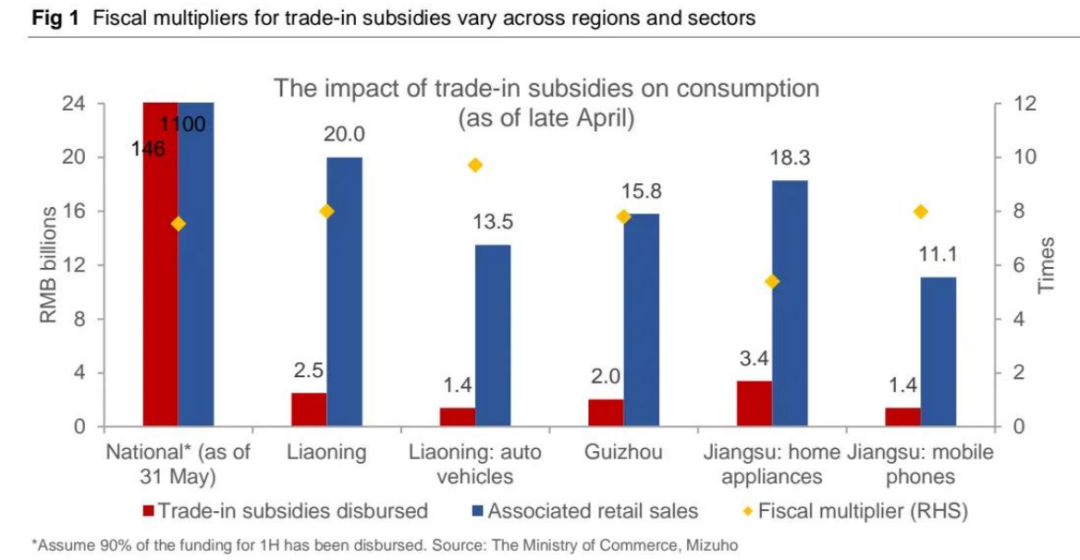
瑞穗:解码中国的财政刺激——从补贴到销售
Zhi Tong Cai Jing· 2025-07-04 14:48
Core Viewpoint - The report from Mizuho Asia Ltd. anticipates that the People's Bank of China will utilize targeted short-term and medium-term tools to supplement liquidity and guide a slight decrease in market repurchase rates in the coming weeks [1][7]. Group 1: Subsidy Program - The Chinese government has confirmed the issuance of the third batch of the "trade-in" subsidy program, expected to allocate approximately 70 billion RMB, which will account for half of the remaining budget for 2025 [2]. - The first two batches of funds released in January and April totaled 162 billion RMB, representing 54% of the annual budget, and have driven consumption of 1.1 trillion RMB, approximately 7 to 8 times the amount of subsidies issued [2][5]. - The upcoming funds are projected to stimulate retail sales exceeding 500 billion RMB in the third quarter of 2025 [2]. Group 2: Market Liquidity - The liquidity tightening observed recently is primarily attributed to a significant issuance of government bonds and typical quarter-end funding pressures, rather than the subsidy program [1][7]. - The net issuance of government bonds in May and June reached approximately 2.9 trillion RMB, which is substantial compared to the 162 billion RMB in subsidies issued [7]. - The People's Bank of China is expected to deploy a series of targeted policy tools, including Medium-term Lending Facility (MLF) and reverse repos, to replenish liquidity and guide interbank repurchase rates back to target levels [7].