
健身器材等

Search documents
六部门联合发文促消费,开启消费市场新篇章!
Quan Jing Wang· 2025-11-28 09:03
Core Viewpoint - The implementation plan aims to enhance the adaptability of consumer goods supply and demand, addressing the structural contradictions of oversupply in low-end products and insufficient supply in high-end products [2][3]. Policy Background - The current consumer market in China faces a dual challenge of low-end oversupply and high-end undersupply, necessitating a proactive approach from the supply side to align with changing consumer trends [2]. - The plan encourages enterprises to innovate and produce products that meet consumer preferences, thereby improving the quality and suitability of goods available to consumers [2]. Policy Core Goals - By 2027, the plan aims to optimize the supply structure of consumer goods, creating three trillion-level consumption sectors and ten hundred-billion-level consumption hotspots [3]. - By 2030, a high-quality development pattern characterized by positive interaction between supply and consumption is expected to be established, with a steady increase in consumption's contribution to economic growth [3][20]. Key Tasks Expanding Increment - Accelerate the application of new technologies and innovative models, promoting flexible production and user participation in design [5]. Deepening Existing Supply - Expand the supply of unique and new products, including green products, rural consumer goods, and health-related innovations [6]. Market Segmentation - Provide specific guidance for different consumer demographics, including products for children, students, and the elderly [7]. Scene Empowerment - Cultivate new consumption scenarios and business models, promoting platforms for product launches and shared consumption [8]. Environmental Optimization - Strengthen financial support for consumer goods enterprises through fiscal subsidies and specialized loans, while encouraging financial institutions to innovate consumer finance products [10]. Opportunities for Enterprises - The plan sets clear targets for three trillion-level and ten hundred-billion-level consumption hotspots, providing strategic guidance for corporate resource allocation and reducing decision-making uncertainty during transformation [11]. - The promotion of flexible manufacturing and customization is expected to enhance the efficiency and quantity of new product launches, offering a clear path for corporate upgrades [12]. New Market Spaces - The cultivation of new consumption scenarios is anticipated to open new market opportunities, particularly through the integration of AI technology in consumer products, which has shown significant growth [13]. - Innovations in the sports sector, including wearable devices and smart monitoring tools, are expanding the consumer landscape and enhancing customer engagement [13]. New Era of Consumption Market - The implementation of the plan signifies a new phase in China's consumption market, driven by dual supply and demand dynamics, which is expected to foster high-quality economic development [14].

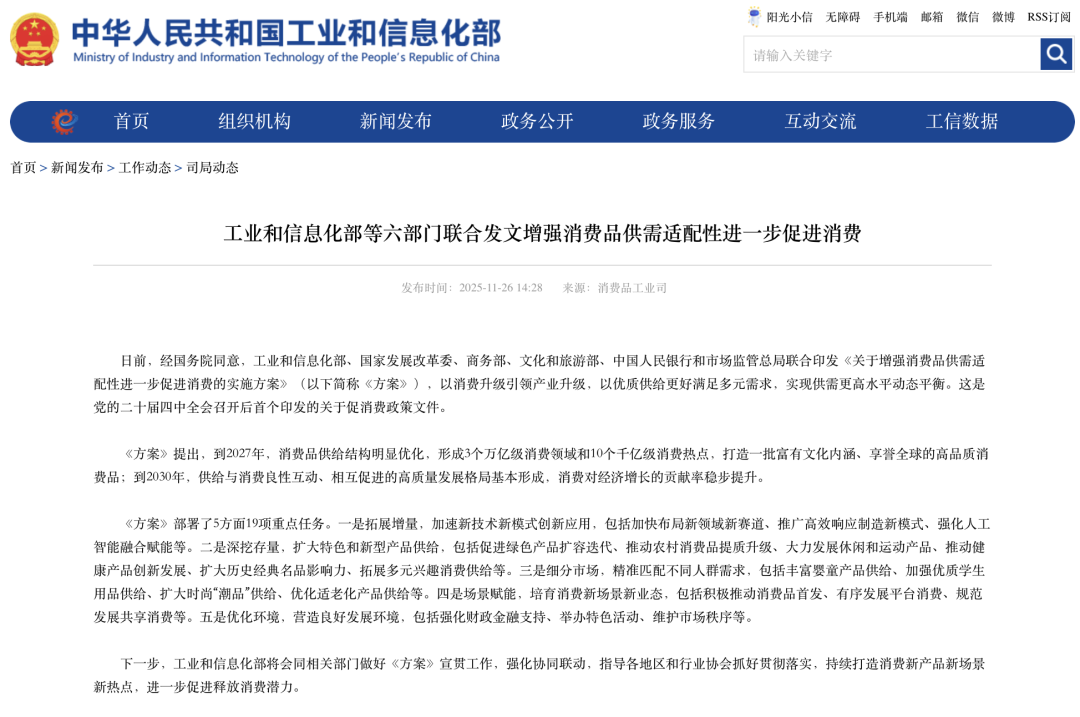
六部门发文!“供需适配”政策将催生哪些消费
Di Yi Cai Jing Zi Xun· 2025-11-27 12:21
Core Viewpoint - The implementation plan aims to enhance the adaptability of supply and demand in consumer goods, promoting consumption through structural reforms and innovation in key sectors, potentially generating trillions in new consumption markets by 2027 [2][4]. Group 1: Key Tasks and Focus Areas - The plan outlines 19 key tasks focusing on expanding new consumption, tapping into existing markets, segmenting markets, empowering scenarios, and optimizing the environment [2]. - By 2027, the plan anticipates the emergence of several trillion-yuan consumption markets in key areas, driven by supply-side structural reforms and technological advancements [2][4]. Group 2: Supply and Demand Dynamics - The plan emphasizes the need for consumer goods production to align with changing consumer preferences, ensuring that supply meets demand effectively [3]. - Current consumer goods variety in China has reached 230 million, with significant production in categories like home appliances and clothing [3]. Group 3: Market Opportunities - The plan identifies three trillion-yuan consumption areas, including elderly products, smart connected vehicles, and consumer electronics, with the elderly products market projected to grow from 2.6 trillion yuan in 2014 to 5.4 trillion yuan by 2024, reflecting a compound annual growth rate of 7.3% [5]. - Emerging billion-yuan consumption hotspots include baby products, smart wearables, cosmetics, fitness equipment, and outdoor goods, indicating strong growth potential in these sectors [5]. Group 4: Technological Integration - The plan highlights the integration of artificial intelligence to enhance consumer goods supply and adapt to market changes, aiming for a shift from quantity to quality in production [6][8]. - As of mid-2023, the user base for generative AI products in China reached 515 million, showcasing the rapid expansion of AI applications in consumer scenarios [8][9].
倍轻松: 深圳市倍轻松科技股份有限公司章程
Zheng Quan Zhi Xing· 2025-08-01 16:36
Core Points - Shenzhen Breo Technology Co., Ltd. is established as a joint-stock company in accordance with relevant laws and regulations, with a registered capital of 85,945,419 RMB [1][2] - The company was approved for registration by the China Securities Regulatory Commission and listed on the Shanghai Stock Exchange's Sci-Tech Innovation Board on July 15, 2021, with an initial public offering of 15,410,000 shares [1][2] - The company's business scope includes the research and sale of health care equipment, electronic products, and various medical devices, among other activities [1][2] Company Structure - The company is governed by its articles of association, which outline the rights and obligations of shareholders, directors, and senior management [1][2] - The legal representative of the company is the director or general manager, who is responsible for the company's civil activities [1][2] - Shareholders are liable for the company's debts only to the extent of their subscribed shares, while the company is liable for its debts with all its assets [1][2] Share Issuance and Management - The company's shares are issued in the form of stocks, with all shares being ordinary shares [2][3] - The total number of shares issued by the company is 85,945,419, and the issuance follows principles of openness, fairness, and justice [2][3] - The company can increase its capital through various methods, including issuing shares to unspecified objects or existing shareholders [2][3] Shareholder Rights and Responsibilities - Shareholders have the right to receive dividends, participate in shareholder meetings, and supervise the company's operations [4][5] - Shareholders are obligated to comply with laws and the company's articles of association, and they cannot withdraw their capital except as permitted by law [8][9] - The company must maintain a shareholder register, which serves as proof of share ownership [4][5] Corporate Governance - The company is required to hold annual and temporary shareholder meetings, with specific procedures for convening and voting [10][11] - The board of directors is responsible for managing the company and must report to the shareholders at the annual meeting [10][11] - The articles of association stipulate that any external guarantees provided by the company must be approved by the shareholders [11][12] Compliance and Legal Obligations - The company must adhere to legal requirements regarding information disclosure and must report any significant events to the relevant authorities [6][7] - Shareholders have the right to request legal action against directors or senior management if they violate laws or the articles of association [6][7] - The company must ensure that its operations do not harm the interests of shareholders or creditors [8][9]
