先锋长期国债ETF(VGLT)

Search documents
鲍威尔多年隐忍后与特朗普硬刚!“卖出美国”重返,美股为何收于历史新高?
Sou Hu Cai Jing· 2026-01-13 06:59
Group 1 - The U.S. stock market reached a new historical high on January 13, driven by investor "buying the dip" despite concerns regarding the independence of the Federal Reserve [1] - The S&P 500 index rose by 0.2% to close at 6,977.32 points, while the Dow Jones Industrial Average also increased by 0.2% to 49,590.20 points, both marking record closing highs [1] - The Nasdaq Composite index saw a 0.3% increase, coming within 0.9% of its historical closing high from late October of the previous year [1] Group 2 - Concerns about the Federal Reserve's independence were reignited, with Fed Chair Jerome Powell stating that threats of criminal charges against him were "unprecedented" [1] - Powell indicated that public service sometimes requires standing firm in the face of threats, suggesting political pressure aimed at influencing monetary policy [1] - Morgan Stanley's Andrew Slimmon noted that the rise in U.S. stocks is fundamentally driven and is expected to continue until 2026, indicating a healthy part of a sustained bull market [3] Group 3 - The tension in the market led to a temporary resurgence of the "sell America" trade theme, particularly affecting the dollar and long-term U.S. Treasury yields [2] - Strong demand was observed in the 3-year and 10-year U.S. Treasury auctions, alleviating upward pressure on bond yields, with the 3-year yield at 3.604% and the 10-year yield at 4.184% [2] - Despite concerns, foreign investors bought more U.S. Treasuries than they sold last year, indicating a "hedge against America" strategy rather than a core concern for the year [2]
美股与经济脱节?这波涨势背后风险暗涌
Jin Shi Shu Ju· 2025-08-21 08:55
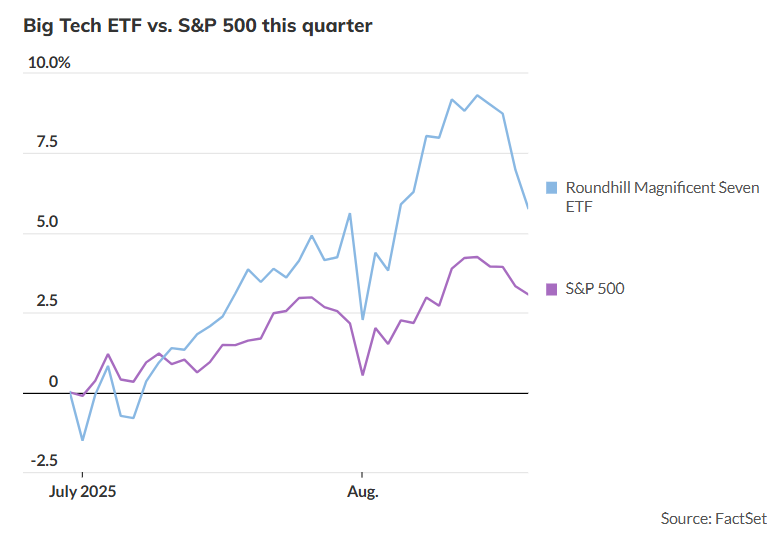
Core Viewpoint - The U.S. stock market is experiencing fluctuations but remains close to historical highs, with concerns about the sustainability of economic growth and the potential impact of tariffs on inflation [2][3]. Group 1: Market Performance - The S&P 500 index fell by 0.2%, the Nasdaq Composite dropped by 0.7%, while the Dow Jones Industrial Average was nearly flat with a gain of less than 0.1% [2]. - Despite a four-day decline, the S&P 500 is only 1.1% below its historical closing high set on August 14 [2]. - The iShares Core U.S. Aggregate Bond ETF (AGG) decreased by 0.1% this quarter, and the Vanguard Long-Term Treasury ETF (VGLT) fell by 1.3%, while the S&P 500 has risen by 3.1% in the same period [3]. Group 2: Economic Outlook - Elliott expressed that the combination of U.S. immigration and tariff policies is causing a greater economic drag than any potential benefits from the Inflation Reduction Act [3]. - The Federal Reserve's July meeting minutes indicated concerns about inflation and noted a slowdown in economic activity due to reduced consumer spending and declining residential investment [3]. - The labor market remains robust, with the unemployment rate stable at 4.2%, but there are signs of weakening in labor supply and demand [5]. Group 3: Market Expectations - Investors expect the Federal Reserve to lower the benchmark interest rate at the next policy meeting in September, with an 80.9% probability of a 25 basis point cut [4]. - There is a perceived disconnect between the stock market, which is near historical highs, and the economic conditions that suggest a significant slowdown [4][5]. - Tiffany Wilding from PIMCO highlighted that the performance of the S&P 500 may obscure the realities of the overall U.S. economy, with actual consumer spending expected to slow down [5]. Group 4: Market Breadth - The breadth of the S&P 500 index, measured by the percentage of stocks above their 200-day moving average, increased from approximately 19% to 68% last month [6]. - However, the breadth has not kept pace with the record gains of the S&P 500, indicating potential structural weaknesses in the market [6][7]. - The Roundhill ETF, which includes major tech stocks, fell by 3% this week but is up 5.8% for the quarter, reflecting the struggles of large-cap tech stocks [7].