全球市场业务

Search documents
STANCHART(02888) - 2025 Q4 - Earnings Call Transcript
2026-02-24 09:02
Financial Data and Key Metrics Changes - The underlying Return on Tangible Equity for 2025 was 14.7%, with record annual income of $20.9 billion, up 8% year-on-year [3][5] - Profit before tax increased by 18% to $7.9 billion, with earnings per share rising by 37% [11][20] - Full-year net interest income (NII) was $11.2 billion, up 1%, while non-NII increased by 13% year-on-year [12][13] Business Line Data and Key Metrics Changes - Corporate and Institutional Banking (CIB) income was $12.4 billion, up 4%, with Global Banking up 15% and Global Markets up 12% [21][22] - Wealth and Retail Banking (WRB) income was $8.5 billion, up 6%, driven by a 24% increase in Wealth Solutions [23][29] - The affluent segment saw a cumulative total of $52 billion in net new money for 2025, reflecting a 14% growth in affluent AUM [23][24] Market Data and Key Metrics Changes - Underlying customer deposits increased by 12% in the year, with growth in CASA and term deposits across WRB and CIB [19] - Risk-weighted assets were $258 billion, up 4% in 2025, with a CET1 ratio of 14.1% [20] Company Strategy and Development Direction - The company plans to shift to reporting on a reported basis, moving away from underlying financials to provide clearer financial outcomes [6][24] - The focus remains on sustainable growth, with a commitment to maintaining a high-performance culture and optimizing resources [7][28] - The company aims to create a distinctive and high-performing organization that delivers growth across all dimensions [36] Management's Comments on Operating Environment and Future Outlook - The management expressed confidence in the resilience of global trade and capital flows despite geopolitical tensions and market volatility [2][4] - The outlook for 2026 anticipates income growth at the lower end of the historical 5%-7% range, with a focus on maintaining a statutory return on tangible equity of greater than 12% [25][35] Other Important Information - A new $1.5 billion share buyback was announced, alongside a 65% increase in the full-year dividend per share [4][20] - The company has mobilized $157 billion in sustainable finance since 2021, aiming for $300 billion by 2030 [34] Q&A Session Questions and Answers Question: On investments in the wealth business and account opening capacity - Management confirmed that current capacity is sufficient to deliver 60,000 new clients per quarter, with ongoing investments to remove bottlenecks [39][41] Question: On episodic income performance in Q4 - Management noted that Q4 episodic income was weak due to large client transactions but emphasized that the overall business model remains strong [46][51] Question: On net interest income and HIBOR impact - Management indicated that the majority of the NII increase in Q4 was due to HIBOR movements, advising against using Q4 as a baseline for future projections [61][65] Question: On guidance for income growth and dividend payout ratio - Management confirmed that the guidance for 2026 reflects a strong outlook for non-interest income growth, with a dividend payout ratio around 30% of reported EPS [72][78]
瑞银:渣打集团(02888)上季业绩强劲 受交易服务、财富管理及全球银行业务驱动
智通财经网· 2025-10-30 09:25
Core Viewpoint - UBS report indicates that Standard Chartered Group (02888) is expected to outperform market consensus in adjusted pre-tax profit for Q3 2025 by 15% [1] Financial Performance - Net interest income is projected to exceed expectations by 2% [1] - Core non-interest income is expected to be 5% higher than anticipated, contributing to a total revenue growth of 4% [1] - Cost control is anticipated to be 1% better than expected, leading to a pre-provision profit that is 10% above forecasts [1] Impairment and Capital Ratios - Impairment losses are expected to be 23% lower than market consensus, including moderate provisions for Hong Kong commercial real estate [1] - Common Equity Tier 1 (CET1) capital ratio is projected at 14.2%, exceeding market expectations by 10 basis points, despite a quarterly decrease of 20 basis points due to the impact of the announced buyback plan [1] Revenue Drivers - Overall revenue outperformance is primarily driven by transaction services, global banking, and wealth management, although some growth is offset by a slowdown in global markets business [1] - UBS maintains a "Buy" rating on Standard Chartered [1]
瑞银:渣打集团上季业绩强劲 受交易服务、财富管理及全球银行业务驱动
Zhi Tong Cai Jing· 2025-10-30 09:24
Core Viewpoint - UBS report indicates that Standard Chartered Group (02888) is expected to outperform market consensus in adjusted pre-tax profit for Q3 2025 by 15% [1] Financial Performance - Net interest income is 2% above expectations, while core non-interest income exceeds by 5%, leading to a total revenue growth of 4% [1] - Cost control is better than expected by 1%, resulting in pre-provision profit being 10% higher than anticipated [1] - Impairment losses are 23% lower than market consensus, which includes moderate provisions for Hong Kong commercial real estate [1] Capital Position - Common Equity Tier 1 (CET1) capital ratio stands at 14.2%, exceeding market expectations by 10 basis points, although it decreased by 20 basis points quarter-on-quarter due to a 50 basis point drag from the announced buyback plan in Q2 [1] Business Drivers - Overall revenue outperformance is primarily driven by transaction services, global banking, and wealth management, although some growth was offset by a slowdown in global markets business [1] Rating - UBS maintains a "Buy" rating for Standard Chartered Group [1]
渣打集团(2888.HK):聚焦跨境大客户 交易银行+金融市场双轮驱动
Ge Long Hui· 2025-05-31 01:44
Core Viewpoints - Standard Chartered's Corporate and Institutional Banking (CIB) has a positive long-term target with a revenue growth CAGR of 5%-7% and continued improvement in RoRWA [1][2] - The bank is focusing on cross-border large clients and financial institutions, with the potential for revenue to double as clients operate in more markets and use more products [1][3] - The current uncertainty caused by tariffs may lead to a more complex and fragmented world, but not a complete decoupling of all countries, with a long-term trend towards international supply chain restructuring benefiting Standard Chartered [2][13] Event Overview - On May 15, Standard Chartered held an investor day for its CIB, outlining its goals and competitive advantages [1] Business Growth and Strategy - The CIB aims for a revenue growth CAGR of 5%-7% (excluding currency fluctuations) and a continued decrease in the cost-to-income ratio [1][2] - The bank's global cross-border business revenue is expected to rise to 70% from the current 61%, with financial institution client revenue increasing to 60% from 51% [1][2] Performance Metrics - In the short term, Standard Chartered achieved a 5% year-on-year growth in CIB for 2024 and Q1 2025, with global banking and markets seeing over 10% growth [2] - RoRWA has improved from 4.9% in 2019 to 7.8% in 2024, supported by stable profit growth and RWA optimization [2] Client Segmentation - Standard Chartered's CIB client base is primarily composed of multinational corporations and financial institutions, with cross-border clients contributing significantly to revenue [3][4] - The bank's focus on large multinational clients and financial institutions is driven by the higher average revenue per client, with clients using more products and operating in more markets leading to exponential revenue growth [6][8] Regional Performance - The fastest-growing regions for financial institution clients include Hong Kong, Europe, and the U.S., with transaction banking revenue growth rates exceeding 15% from 2019 to 2024 [4][5] - Trade and operational funding, payment and liquidity, and securities and brokerage services are the main revenue contributors within transaction services [8][9] Competitive Advantages - Standard Chartered has a significant first-mover advantage and a comprehensive product and service offering, creating a strong competitive moat [7][11] - The bank's extensive global network and deep market knowledge enable it to provide tailored services to clients, enhancing its competitive position [9][10] Future Outlook - The long-term trend of international supply chain restructuring and the "China+1" strategy is expected to accelerate, benefiting Standard Chartered as a key player in this environment [2][13] - The bank anticipates stable growth in global trade and financial market activities, supporting its CIB business to maintain a growth trend above 5% [2][12]
股价直线拉升!渣打集团Q1业绩超预期,维持今明两年业绩指引
Ge Long Hui· 2025-05-02 07:48
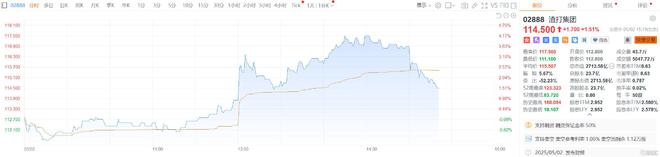
Core Viewpoint - Standard Chartered Group reported strong first-quarter performance driven by robust growth in wealth management, exceeding expectations [1][4] Financial Performance - The operating income for Q1 was $5.39 billion, a 5% year-on-year increase, surpassing the forecast of $5.32 billion [4] - Adjusted pre-tax profit reached $2.277 billion, up 7% year-on-year, exceeding the expected $2.15 billion [4] - Basic earnings per share increased by 9.8% to 62.7 cents, while reported earnings per share grew by 10.1% to 56.6 cents [4] - The wealth solutions business saw a significant growth of 28%, with both investment products and bank insurance recording double-digit growth [5] Market Reaction - Following the earnings report, Standard Chartered's stock price surged over 4% before settling at a 1.51% increase, priced at HKD 114.5 per share, with a total market capitalization of HKD 271.36 billion [1] - The stock has rebounded nearly 28% over the last 15 trading days and has increased over 116% since the beginning of 2023 [2] Business Segments - Global banking business grew by 17%, driven by increased lending and capital market activities [6] - Global markets business experienced a 14% growth, with both recurring and non-recurring income showing strong performance [6][7] Future Outlook - The company maintains its performance guidance for 2025 and 2026, expecting a compound annual growth rate of 5-7% in operating income from 2023 to 2026 [9] - The CEO expressed confidence in the bank's ability to create long-term sustainable value despite global economic uncertainties and trade tensions [9]