全生物降解地膜

Search documents
六个关键词看未来六年固废治理“行动计划”
Xin Hua She· 2026-01-16 04:22
Group 1: Core Action Plan - The "Solid Waste Comprehensive Governance Action Plan" aims for significant improvements in solid waste management by 2030, including effective control of historical stockpiles and curbing illegal dumping, with a target of 4.5 billion tons of comprehensive utilization of major solid waste and 510 million tons of recycling of main renewable resources annually [1] - The plan emphasizes the importance of enhancing solid waste governance capabilities and levels significantly [1] Group 2: Agricultural Waste Management - The plan promotes scientific use of agricultural films, encouraging the adoption of thicker, high-strength, and fully biodegradable films, along with improved collection of pesticide packaging waste [2] - It aims to advance the resource utilization of livestock and poultry manure, promote straw return to fields, and develop ecological circular agriculture through policy incentives [2][3] - The focus is on overcoming technical bottlenecks in manure application and straw decomposition, while enhancing the integration of technology, products, and equipment [2] Group 3: Illegal Dumping and Enforcement - There will be a strict crackdown on illegal dumping, with enhanced environmental law enforcement from waste generation to disposal, and severe penalties for serious violations [6] - The plan includes regular monitoring of progress in waste management across regions and emphasizes the importance of local responsibility in managing illegal dumping [6] Group 4: Circular Economy Development - The initiative encourages the direct utilization of industrial, construction, and agricultural solid waste without altering their properties, focusing on efficient extraction and overall utilization of valuable components [6] - It promotes the recycling of various waste products through detailed disassembly and extraction of recyclable materials, while also encouraging the development of remanufacturing industries [7] Group 5: Construction Waste Management - The plan calls for promoting green construction practices, integrating waste reduction and management costs into project budgets, and implementing classification and management of construction waste [10] - It emphasizes the need for regulatory oversight of transportation and disposal of construction waste, including the installation of GPS systems on transport vehicles [10] Group 6: "Waste-Free City" Initiative - The plan sets a target for 60% of cities to achieve "waste-free" status by 2027, with full coverage by 2035, expanding the initiative to around 200 cities during the 14th Five-Year Plan [13] - It aims to integrate the "Waste-Free City" initiative with the Solid Waste Comprehensive Governance Action Plan to enhance urban waste management [13][14]


财达证券每日市场观察-20260114
Caida Securities· 2026-01-14 01:49
Market Overview - The market experienced a decline on January 13, with the Shanghai Composite Index falling by 0.64%, the Shenzhen Component Index dropping by 1.37%, and the ChiNext Index decreasing by 1.96% [2] - The total trading volume reached 3.7 trillion yuan, an increase of approximately 60 billion yuan compared to the previous trading day [1] Sector Performance - Most sectors saw declines, with notable exceptions in oil, pharmaceuticals, and non-ferrous metals, while aerospace, electronics, communications, and computers faced the largest drops [1] - The aerospace sector's significant adjustment was influenced by multiple companies announcing share reductions, although this adjustment is not seen as severe compared to previous gains [1] Investment Opportunities - Despite the downturn in the aerospace sector, the overall market did not exhibit panic, with over 90 companies experiencing declines of 10% or more, primarily from the aerospace sector [1] - There is potential for short-term investment in other technology sectors, such as innovative pharmaceuticals and AI applications, as recent large-scale business development transactions in domestic innovative pharmaceutical companies indicate a high level of activity in this area [1] Policy Developments - The Ministry of Civil Affairs is working on measures to promote the silver economy, focusing on elderly care services, rehabilitation aids, and age-friendly products, aiming to optimize industry layout and attract social capital [3][5] - The Ministry of Industry and Information Technology has released an action plan for the high-quality development of industrial internet platforms, targeting the establishment of over 450 influential platforms by 2028 [4] Fund Dynamics - The first domestic fund management company has surpassed 1 trillion yuan in ETF assets, marking a significant milestone in the Chinese ETF market [10] - As of January 12, the total trading volume of ETFs reached 465.79 billion yuan, with stock ETFs accounting for 256.06 billion yuan of this total [12]
突出问题导向 推动末端治理向全过程防控转变——国务院政策例行吹风会解读《固体废物综合治理行动计划》
Xin Hua She· 2026-01-13 09:29
Core Viewpoint - The State Council has issued the "Solid Waste Comprehensive Governance Action Plan," emphasizing the importance of solid waste management in promoting a beautiful China and accelerating the green transformation of economic and social development [1] Group 1: Action Plan Overview - The action plan outlines the overall approach, work objectives, key tasks, and support measures for solid waste governance, addressing prominent issues in solid waste management with systematic and integrated policy measures [1][2] - It marks the first comprehensive deployment document for solid waste governance in China, complementing previous pollution prevention documents related to water, soil, and air [1] Group 2: Key Principles and Goals - The governance approach follows the principles of "reduction, resource utilization, and harmlessness," with a focus on enhancing resource utilization efficiency [2] - China generates over 11 billion tons of industrial solid waste and construction waste annually, necessitating a three-year special rectification action against illegal dumping [2] Group 3: Specific Initiatives - The "Zero Waste City" initiative will be expanded to around 200 cities during the 14th Five-Year Plan period, promoting collaborative efforts in key urban regions [3] - The Ministry of Agriculture will focus on solid waste management in agriculture, emphasizing the recycling of agricultural waste and the promotion of biodegradable materials [4] Group 4: Construction Waste Management - The Ministry of Housing and Urban-Rural Development will enhance construction waste management through source management, green construction practices, and the establishment of temporary storage facilities [5] - A comprehensive electronic management system will be implemented to ensure effective construction waste disposal [5] Group 5: Industrial Solid Waste Utilization - The comprehensive utilization rate of major industrial solid waste in China is reported to be 57%, with ongoing efforts to reduce waste generation and promote green manufacturing [5] - The Ministry of Industry and Information Technology will focus on advancing comprehensive utilization technologies and managing key waste categories [5]
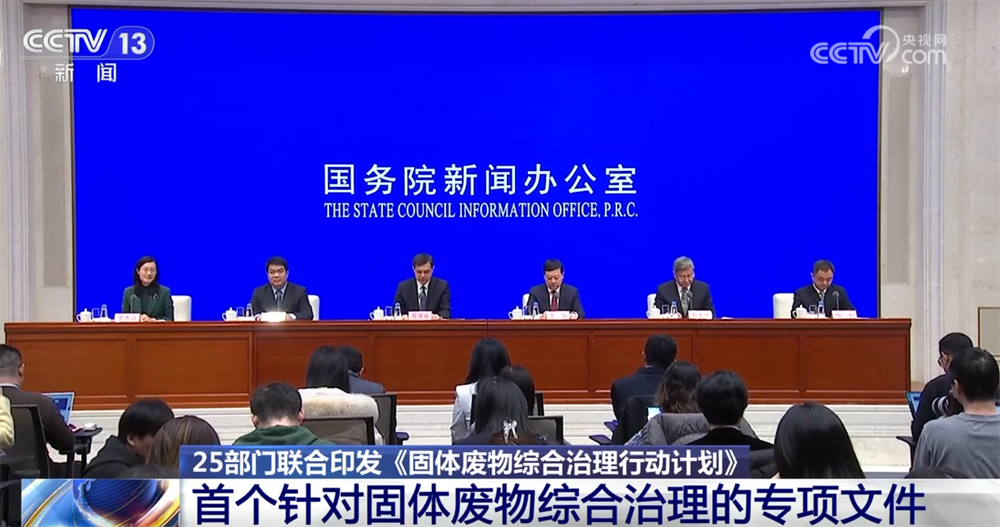
25部门联合印发、首个专项文件!固体废物综合治理打出“组合拳”
Yang Shi Wang· 2026-01-13 07:49
Core Viewpoint - The "Solid Waste Comprehensive Management Action Plan" is China's first systematic document for solid waste management, aiming for significant improvements in solid waste utilization and recycling by 2030 [1][5]. Group 1: Action Plan Overview - The action plan was jointly issued by 25 departments, outlining the overall strategy and work objectives for solid waste management in China [1]. - By 2030, the annual comprehensive utilization of major solid waste is expected to reach 4.5 billion tons, with the annual recycling of key renewable resources reaching 510 million tons [1]. Group 2: Focus Areas and Tasks - The action plan specifies management tasks across major waste-producing sectors, including industry, urban areas, and agriculture [3]. - Five special rectification tasks will be launched to address environmental risks related to illegal dumping and pollution from landfill sites [3]. Group 3: Agricultural Waste Management - In the agricultural sector, the plan promotes the use of thicker, high-strength plastic films and the scientific return of straw to enhance agricultural waste management [7]. - The Ministry of Agriculture and Rural Affairs emphasizes the need for better guidance on the scientific use of plastic films and the recycling of pesticide packaging waste [7]. Group 4: Current Utilization Rates - Recent data indicates that the comprehensive utilization rate of livestock manure has reached 80.1%, while straw utilization remains stable at over 88% [11]. - The disposal rate of agricultural films exceeds 85%, and the recycling rate of pesticide packaging waste is around 80% [11].
我国将大力推广加厚高强度地膜和全生物降解地膜
Yang Shi Xin Wen· 2026-01-13 05:31
Core Viewpoint - The Chinese government is promoting agricultural waste management through the use of advanced materials and practices in the agricultural sector [1] Group 1: Agricultural Waste Management Initiatives - The Ministry of Agriculture and Rural Affairs is focusing on the promotion of thick, high-strength plastic film and fully biodegradable plastic film to enhance agricultural waste management [1] - There will be an emphasis on the scientific guidance for the use of plastic film in agriculture, aiming to improve efficiency and sustainability [1] - The government plans to strengthen the recycling of pesticide packaging waste and continue the resource utilization of livestock and poultry manure [1] Group 2: Straw Management Practices - The initiative includes a scientific approach to straw returning to the field, which is part of the broader strategy for agricultural waste management [1]
农业农村部:将坚持产量产能、生产生态、增产增收一起抓 加快农业绿色发展
Xin Hua Cai Jing· 2026-01-13 03:12
Core Viewpoint - The Chinese government is actively promoting the comprehensive utilization of agricultural solid waste, achieving significant progress in resource recycling and green agricultural development [1][2]. Group 1: Achievements in Agricultural Waste Management - The comprehensive utilization rate of livestock and poultry manure has reached 80.1% - The straw utilization rate remains stable at over 88% - The disposal rate of agricultural films exceeds 85% - The recovery rate of pesticide packaging waste is at 80% [1]. Group 2: Future Work Focus - The Ministry of Agriculture and Rural Affairs will focus on four key areas: 1. Strengthening guidance on the scientific use of agricultural films and promoting biodegradable films 2. Continuing the resource utilization of livestock and poultry manure and advancing straw return to fields 3. Developing ecological circular agriculture through integrated farming models [1]. Group 3: Policy and Technological Support - Policies will be enhanced to support source control, improve collection and transportation capabilities, and elevate resource utilization levels - Key technological breakthroughs are needed in areas such as simplified manure application and rapid straw decomposition [2]. Group 4: Public Awareness and Education - Multi-channel public awareness campaigns will be conducted to promote green development concepts among agricultural producers and to highlight successful ecological circular agriculture models [2].
全生物降解地膜研发应用中心揭牌
Zhong Guo Hua Gong Bao· 2025-12-05 02:51
Core Viewpoint - The establishment of the fully biodegradable film research and application center in Fujian Province aims to promote environmentally friendly agricultural products, gradually replacing traditional polyethylene films while addressing challenges in material stability, product applicability, and safety [1] Group 1: Research and Development Focus - The center will concentrate on the creation of new fully biodegradable film products, development of crop-specific films, evaluation of product applicability, soil ecological safety, and degradation microbial agents [1] - The goal is to launch a series of new film products and establish supporting technical regulations and standards [1] Group 2: Environmental Impact - The initiative aims to systematically address the comprehensive impact of film application on soil, crops, and the environment, providing technological support for the green transformation of agriculture in Fujian Province [1]
全生物降解地膜研发应用中心揭牌
Zhong Guo Hua Gong Bao· 2025-12-05 02:47
Core Viewpoint - The establishment of the fully biodegradable film research and application center in Fujian Province aims to promote environmentally friendly agricultural products, gradually replacing traditional polyethylene films while addressing challenges in material stability, product applicability, and safety [1] Group 1: Research and Development Focus - The center will concentrate on the creation of new fully biodegradable film products, development of crop-specific films, evaluation of product applicability, soil ecological safety, and degradation microbial agents [1] - The goal is to launch a series of new film products and establish supporting technical regulations and standards [1] Group 2: Environmental Impact and Agricultural Transition - The initiative aims to systematically address the comprehensive impact of film application on soil, crops, and the environment [1] - It is positioned to provide technological support for the green transformation of agriculture in Fujian Province [1]
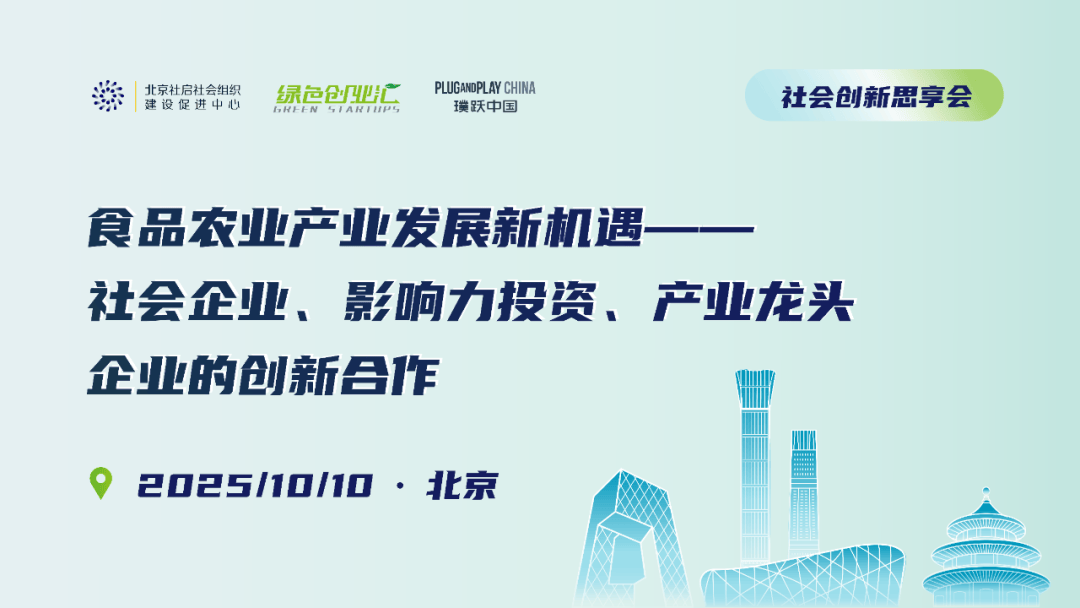
活动回顾丨跨界聚力·共创未来:社会企业、影响力投资与龙头企业共探食品农业可持续发展新路径
Sou Hu Cai Jing· 2025-10-16 12:03
Core Insights - The event "New Opportunities in Food and Agriculture Industry Development - Innovative Cooperation among Social Enterprises, Impact Investment, and Industry Leaders" was successfully held in Beijing, focusing on exploring industrial innovation and achieving a win-win situation between social and commercial values [2][5]. Group 1: Event Overview - The event was co-hosted by multiple organizations, including Beijing Social Organization Construction Promotion Center and Plug and Play China, gathering over 50 representatives from social enterprises, industry leaders, and impact investment institutions [2][5]. - The venue, AI Origin Community, is highlighted as a hub for AI technology and talent, featuring institutions like Tsinghua University's AI Institute [7][9]. Group 2: Key Themes and Discussions - The urgency of transformation in the food and agriculture industry was emphasized, driven by factors such as food security, climate change, and evolving consumer demands, with technology innovation identified as the core support for this transformation [14]. - The collaboration among social enterprises, industry leaders, and impact investors is crucial, with social enterprises providing innovative technologies, industry leaders offering practical scenarios and brand support, and impact investors filling funding gaps for early-stage projects [14]. Group 3: Case Studies and Innovations - Several innovative cross-industry collaborations were showcased, including: - Kangfen Bio's transformation of food processing by-products into high-value organic fertilizers and alternative feed through unique biotechnology [16]. - Zhi Nuo Technology's development of natural microbial pigments using synthetic biology, successfully applied in leading cashmere enterprises [17]. - Meicai's direct sourcing and smart logistics system that enhances farmer income while reducing costs for restaurant clients [17]. Group 4: Collaborative Discussions - A "World Café" session facilitated deep discussions among over 50 participants from various sectors, focusing on four core topics: - Innovative cooperation models between social enterprises and industry leaders [24]. - Scaling agricultural technology through partnerships [26]. - Diverse funding sources and innovative financing methods beyond impact investment [29]. - Building an ecosystem connecting enterprises, technology providers, research institutions, and funding sources [31]. Group 5: Innovative Solutions Presentation - Five social enterprises presented their sustainable value chain innovations, including: - Gengsheng New Materials' development of standardized planting soil from solid waste, significantly reducing soil restoration time [34]. - Qingyu Hall's use of IoT to enhance efficiency in the aquaculture industry [36]. - Huaxia Zhihui's active oxygen technology for plant disease control, utilizing only water and electricity [38]. - Zhongnong Chuangfa's biodegradable film technology for rice cultivation, addressing plastic pollution [40]. - Algae Chen's focus on commercializing microalgae for nutritional applications [42]. Group 6: Conclusion and Future Engagement - The event concluded with a call for continued engagement in upcoming initiatives, including the "Xiangguang Annual Meeting" and a closed-door seminar on rural revitalization [45]. - The collaborative efforts aim to inject new momentum into the green, inclusive, and sustainable development of the food and agriculture industry, emphasizing the importance of resilient partnerships in uncertain economic environments [45].
无人机当起“营养师”、“龙门吊”高效运秧 智慧农业夯实粮食丰产基础
Yang Shi Wang· 2025-05-07 07:23
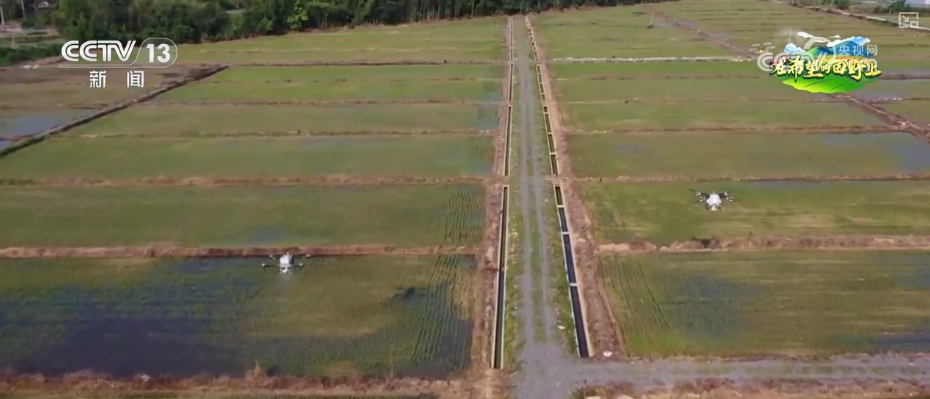
Group 1 - The rice in Jiangxi is entering the tillering stage, with agricultural technicians and farmers utilizing smart drones for efficient fertilization to ensure a bountiful harvest by 2025 [1][5] - In Longyuanba Village, drones are flying over rice fields, atomizing fertilizers for even distribution, while technicians monitor operational data such as fertilization amount and flight altitude [3][5] - The tillering stage is crucial for rice growth, and timely fertilization can promote early tillering and increase effective panicles, laying a foundation for a good harvest [5] Group 2 - The summer grain crops, particularly winter wheat, are entering the key yield formation period, coinciding with a high incidence of pests and diseases [5][7] - In Hejin City, a task force has been established to coordinate drone operations for pest control, aiming to protect over 240,000 acres of wheat [7][9] - Currently, there are 110 drones in Hejin City conducting pest control operations, expected to complete the task in 7 days [9] Group 3 - In Hai'an City, Jiangsu, there is a focus on promoting new agricultural technologies and equipment to enhance environmental sustainability and efficiency in farming [10] - The use of biodegradable film made from corn stalks provides suitable growth conditions for corn, with a degradation period of 3 to 4 months [14] - A large "gantry crane" seedling transportation system has been installed in Hai'an, facilitating mechanized operations for seedling placement and removal [16][18]