内存控制器

Search documents
内存价格暴涨,谁将迎来关键机遇?
3 6 Ke· 2026-01-07 02:55
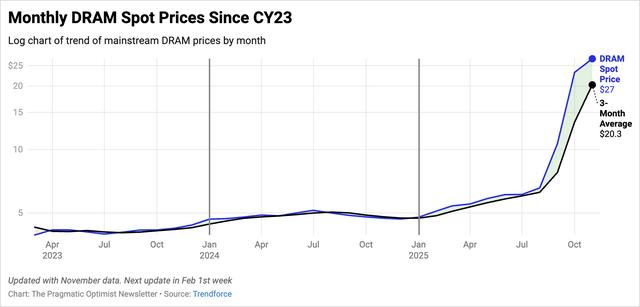
Core Viewpoint - The surge in DRAM prices is significantly impacting GPU manufacturers and data center GPU deployment costs, leading to increased sales cost pressures across the AI industry chain [1][4] Group 1: Memory Price Surge and Its Impact - DRAM prices skyrocketed by at least 4 times from August to November last year, creating substantial cost pressures for AI industry players, including major cloud service providers [1][2] - To mitigate rising memory costs, large-scale cloud service providers are accelerating cost-reduction strategies, including the adoption of new memory controller technologies [1][5] - Companies like Astera Labs and Marvell Technology are emerging as key players in the memory controller market, poised to benefit from the rising memory prices [1][2][15] Group 2: Company-Specific Insights - Astera Labs plans to expand its memory controller solution shipments by 2026 to capitalize on market opportunities arising from rising memory prices [2][7] - Marvell's data center business has reached a significant turning point, driven by its XPU business and network segments, as highlighted in its recent financial report [1][6] - Analysts believe that the current market consensus on Marvell's revenue expectations for fiscal years 2026 and 2027 does not fully account for the potential revenue from its Structura memory controller business [6][14] Group 3: Market Dynamics and Future Projections - The memory controller market is projected to provide substantial growth opportunities, with Astera Labs' AI interconnect business having a total addressable market (TAM) of approximately $12 billion, of which memory controllers account for 33% [7][11] - Analysts expect Astera Labs' revenue to increase by 109% in 2026, reaching $828 million, while Marvell's revenue is projected to grow by 22% to around $10 billion [12][14] - The market is currently overlooking the upcoming growth potential for both Astera Labs and Marvell, as their memory controller businesses are expected to contribute significantly to their revenues starting in 2026 [15]



内存价格暴涨,谁将迎来关键机遇?
美股研究社· 2026-01-06 11:25
Core Viewpoint - The surge in DRAM prices is significantly impacting GPU manufacturers and data center GPU deployment costs, leading to increased sales cost pressures across the AI industry chain [1][4][6]. Group 1: Memory Price Surge and Its Impact - DRAM prices skyrocketed by at least 4 times from August to November last year, creating substantial cost pressures for companies, including major cloud service providers [1][4]. - To mitigate the rising memory costs, large-scale cloud service providers are accelerating cost-reduction strategies, with a new technology called memory controllers gaining traction [1][7]. - Companies like Astera Labs and Marvell Technology are positioned as key players in the memory controller market, having launched commercial solutions that will benefit from the rising memory prices [1][3]. Group 2: Company Performance and Market Position - Marvell's data center business has reached a significant turning point, driven by its XPU business and networking segment [3]. - Astera Labs plans to expand its memory controller solution shipments by 2026 to capitalize on the market opportunities presented by rising memory prices [3][12]. - Analysts believe that the current market consensus on Marvell's revenue expectations for fiscal years 2026 and 2027 does not fully account for the incremental revenue from its Structura memory controller business [8][9]. Group 3: Memory Controller Technology - Memory controllers are high-speed, low-latency semiconductor components that enhance memory utilization efficiency for AI models running on CPUs and GPUs [7]. - Marvell's Structura memory controller can revitalize older DRAM models and meet the growing demands for memory bandwidth and speed in servers [7]. - Astera Labs has secured significant customer orders, including a partnership with Microsoft Azure, positioning it as a core supplier in the memory controller market [13]. Group 4: Future Growth Projections - Analysts project that Astera Labs' revenue will increase by 109% in 2026, reaching approximately $828 million, while Marvell's revenue is expected to grow by 22% to around $10 billion [12]. - The combined revenue from Astera Labs' and Marvell's memory controller and networking businesses is anticipated to contribute about $2 billion in revenue over the next three years [7]. - The memory controller market is expected to present hundreds of billions of dollars in opportunities, with both companies poised to capture significant market share due to their established solutions and customer bases [18].

他们,能威胁英伟达吗?
半导体行业观察· 2025-03-10 01:20
Core Insights - Nvidia holds a significant share in AI training and inference markets, but competition from hyperscale computing companies developing their own XPU raises questions about sustainability [1] - Broadcom and Marvell are positioned to benefit from the demand for custom CPUs and XPUs, collaborating with major cloud providers like AWS, Google, Meta, and Microsoft [2][3] - The cost-effectiveness of these custom solutions must be significantly lower than existing offerings from Intel, AMD, Nvidia, and AMD to be viable [3] Financial Performance - Broadcom reported Q1 FY2025 sales of $14.92 billion, a 24.7% increase year-over-year, with profits reaching $5.5 billion, up 4.2 times from the previous year [5] - Marvell's Q4 FY2025 sales were $1.82 billion, a 19.9% quarter-over-quarter increase, with a net income of $200 million, marking a significant turnaround from previous losses [16] AI Revenue Growth - Broadcom's AI chip sales reached $4.12 billion in Q1 FY2025, a 77% year-over-year increase, while other semiconductor sales declined by 19.2% [11] - Marvell's AI revenue for FY2025 is projected to be around $1.85 billion, with expectations to exceed $3 billion in FY2026, driven by custom AI XPU and optical products [18][20] Market Dynamics - The IT industry is characterized by demanding clients seeking high service levels at low costs, which influences the pricing and development of custom CPUs and XPUs [3] - Broadcom's AI business is comparable in scale to Marvell's entire business, but Marvell's data center segment is rapidly growing [3][5] Future Outlook - Broadcom anticipates stable revenue of $14.9 billion for Q2 FY2025, with a projected 19.3% year-over-year growth [14] - Marvell's success in securing new hyperscale clients and developing shared AI XPU designs will be crucial for future revenue growth [20]