努比亚Z80 Ultra

Search documents
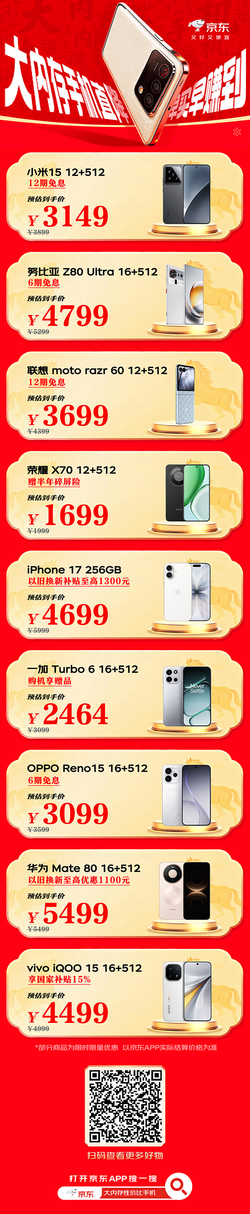
手机全面涨价在即 现在来京东购华为Mate 80 16GB+512GB仅需5499元
Sou Hu Wang· 2026-02-28 02:44
Group 1 - The core viewpoint of the article indicates that major smartphone brands are planning to raise product prices due to increased procurement costs of storage chips, with an expected price increase of 15%-25% for new models in the Chinese market starting from March 2026 [1] - Counterpoint Research forecasts that the average price of new smartphones in China will rise significantly compared to 2025 models, prompting consumers to consider purchasing high-memory flagship phones now [1] - Consumers are encouraged to take advantage of promotional offers on platforms like JD.com, where they can find high-cost-performance smartphones with discounts and trade-in options [5] Group 2 - Specific smartphone models and their estimated prices include Xiaomi 15 at 3149 yuan, Nubia Z80 Ultra at 4799 yuan, Lenovo Moto Razr 60 at 3699 yuan, Honor X70 at 1699 yuan, iPhone 17 at 4699 yuan, OnePlus Turbo 6 at 2464 yuan, OPPO Reno15 at 3099 yuan, Huawei Mate 80 at 5499 yuan, and iQOO 15 at 4499 yuan [2] - Various financing options are available for these models, such as interest-free installments and trade-in subsidies, enhancing their attractiveness to consumers [2]

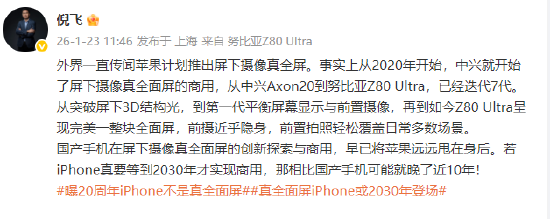
努比亚总裁倪飞:若iPhone真全面屏等到2030年实现商用,将比国产手机晚近10年
Xin Lang Cai Jing· 2026-01-23 03:58
Group 1 - The core viewpoint is that ZTE and Nubia have been leading the innovation in under-display camera technology, having commercialized it since 2020, while Apple is perceived to be lagging behind in this area [1][3] - ZTE has iterated its under-display technology through seven generations, from the Axon 20 to the Nubia Z80 Ultra, achieving a nearly invisible front camera and a seamless full-screen experience [1][3] - If Apple plans to introduce true full-screen technology by 2030, it may be nearly a decade behind the advancements made by Chinese manufacturers [1][3] Group 2 - ZTE's Vice President and Nubia's flagship product manager emphasized that the development of full-screen technology requires significant time and technical accumulation, which Nubia has achieved over seven generations [1][3] - The Nubia Z80 Ultra is highlighted as a leading product in the full-screen category, expected to dominate various rankings by 2025 [1][3]


未知机构:天风通信推荐中兴通讯珠峰CPU大客户放量自研芯片能力值得重视26年多产品-20260123
未知机构· 2026-01-23 02:20
Summary of Conference Call Records Company: ZTE Corporation Key Points - ZTE Corporation's self-developed chip capabilities are gaining market attention, with the company possessing the ability to develop core chips such as CPUs, switching chips, inter-card connection chips, and DPUs [1] - In 2026, multiple product iterations are expected to be launched, highlighting ZTE Micro's undervalued core competitiveness [1] - ZTE Micro's chip self-development capabilities are notable, with anticipated releases including a 51.2T switching chip and a 51.2T inter-card connection chip [1][1] - The company's CPU, the Summit chip, is expanding its market share among operators and has achieved mass application with major clients, which is significant [1] - ZTE is also focusing on breakthroughs in AI, particularly in the DPU and GPU sectors [1] Company: Nubia Technology Key Points - Nubia's smartphone division is enhancing its influence with flagship releases such as the Red Magic 11 Pro series and Nubia Z80 Ultra, integrating AI capabilities deeply with the Doubao model [2] - The company has launched the M153, further collaborating with Doubao to incorporate the Doubao mobile assistant, indicating a strong outlook for Nubia in the AI smartphone sector [2] - In the server domain, Nubia is experiencing high growth driven by breakthroughs with internet giants, with computing revenue increasing by 180% year-on-year, accounting for 25% of total revenue [2] - Server and storage revenue grew by 250% year-on-year, while data center product revenue increased by 120% [2] - Nubia's intelligent computing servers have entered the core business scenarios of major domestic internet and financial companies, including Alibaba, Tencent, ByteDance, Baidu, JD.com, Meituan, and Kuaishou [2] - The company is fully integrating AI and expanding its "connection + computing" strategy, with promising developments in the computing + AI terminal field [2] - Nubia is investing in AI direction, building a core competitiveness in "chips + complete machines + modular R&D + AI" [2][3] Additional Insights - Nubia is positioning itself as a rare leading enterprise in the computing field, spanning across "chips," "connectivity," and "terminals," which enhances its market competitiveness [5] - The introduction of intelligent computing supernode systems aims to support the creation of highly efficient large-scale intelligent computing clusters [4]
销量猛涨3倍!“AI广货”成为最潮年货
2 1 Shi Ji Jing Ji Bao Dao· 2026-01-21 00:09
Group 1: Live Streaming and Sales Performance - ZTE's Nubia brand experienced a significant increase in online engagement during a live stream, with online viewers doubling and sales tripling compared to daily averages [1] - OPPO reported a remarkable increase in interaction rates, follower growth, and viewing duration, with a 87% increase in viewing time compared to regular daily streams [1] - The "Guanghuo Hang Tianxia" spring promotional event saw a surge in traffic and sales for major smartphone brands, including Huawei, Vivo, OPPO, Honor, ZTE, and TCL [3] Group 2: Promotional Strategies and Consumer Engagement - Vivo's promotional strategy included substantial discounts, with potential subsidies reaching up to 2026 yuan, attracting consumers to the event [4] - The event featured a wide range of smartphone products priced between 2000 yuan and 6000 yuan, aiming to enhance consumer purchasing power [4] - The integration of live streaming with real-time consumer interaction was highlighted as a key factor in driving sales during the promotional event [4] Group 3: AI Technology and Product Innovation - AI hardware devices, including AI smartphones and toys, were prominent in the promotional event, indicating a shift towards AI-driven consumer electronics [3] - The Nubia Z80 Ultra smartphone integrates a local AI engine, allowing users to perform complex tasks through voice commands, enhancing user experience [9] - The event showcased various AI products, including health management robots and interactive AI toys, emphasizing the growing trend of emotional interaction in consumer electronics [12][10] Group 4: Global Market Expansion and Competitive Landscape - Honor's global market strategy has shown significant progress, with a projected shipment of 71 million units by 2025 and a 47% increase in overseas sales [15] - Vivo is expected to achieve global sales of 103.9 million units in 2025, with a market share of 8.2%, and has established a strong user base in India and Southeast Asia [15] - OPPO anticipates global sales of 102 million units in 2025, maintaining a competitive position in the global smartphone market with a focus on localization [17]


中兴通讯午间突发!AH股齐大跌 认购证跌超28%
Mei Ri Jing Ji Xin Wen· 2025-12-11 06:05
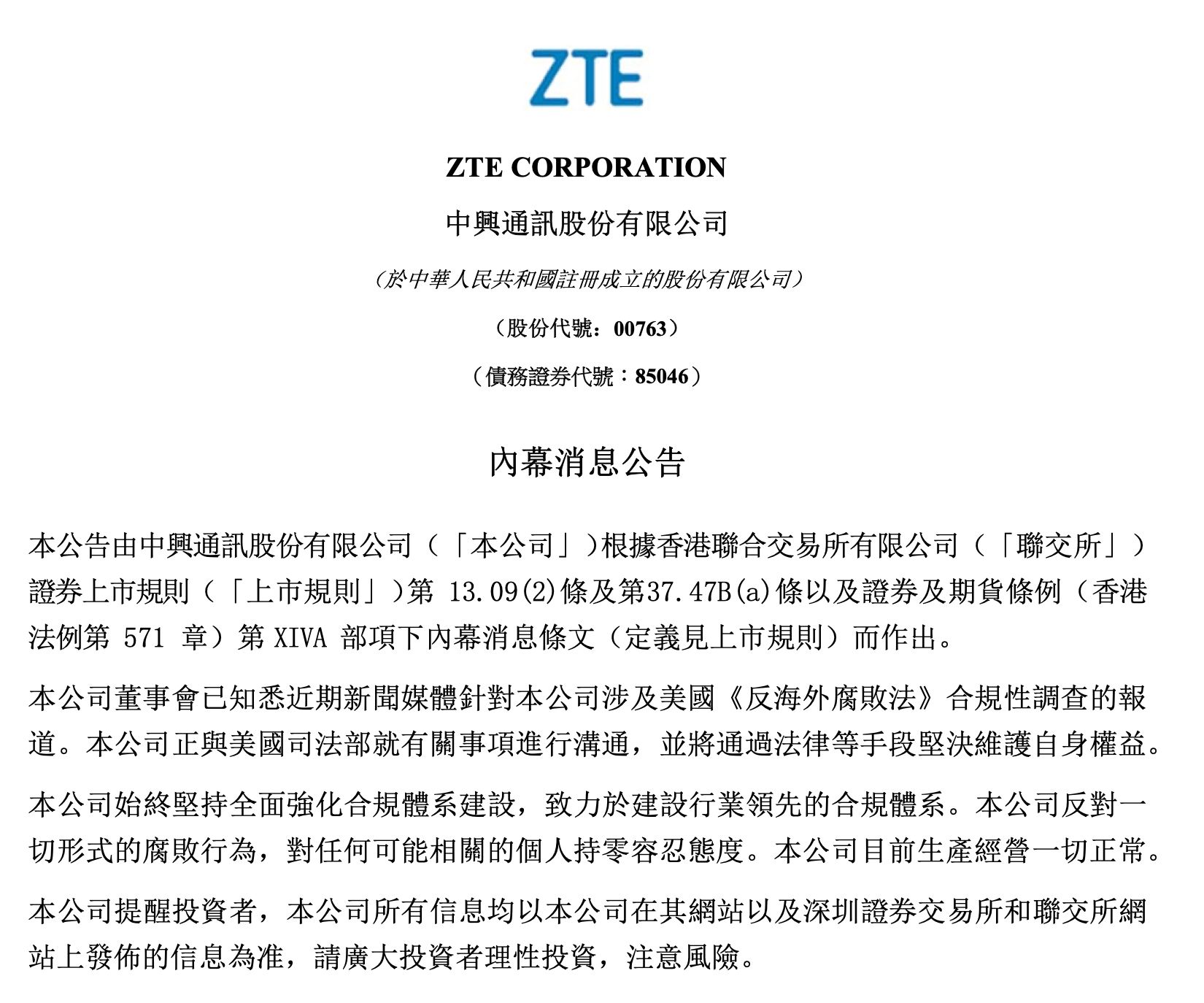
Core Viewpoint - ZTE Corporation is currently under investigation by the U.S. Department of Justice regarding compliance with the Foreign Corrupt Practices Act, and the company is committed to defending its rights through legal means while maintaining its operational normalcy [3][4]. Group 1: Compliance and Legal Matters - The company is aware of media reports concerning its compliance investigation and is in communication with the U.S. Department of Justice [3]. - ZTE emphasizes its commitment to strengthening its compliance system and opposes all forms of corruption, maintaining a zero-tolerance policy towards any related individuals [3]. Group 2: Stock Performance and Market Reactions - On December 11, ZTE's A-shares fell over 7% and H-shares dropped more than 9% during the morning session, with its subscription warrant "ZTE BNP Paribas 65 Call A" declining over 28% [4][9]. - Following the announcement of the "Doubao" mobile assistant by ByteDance, ZTE's stock initially surged, with A-shares hitting a daily limit and H-shares rising nearly 14%, but subsequently, both A and H shares fell over 20% from their highs [4]. Group 3: Financial Instruments and Market Dynamics - The "ZTE BNP Paribas 65 Call A" warrant was issued at a price of 0.29 HKD with an exercise price of 40 HKD, and its value has significantly decreased due to the drop in ZTE's H-share price [6]. - Analysts note that the warrant will only have value if ZTE's H-share price exceeds the exercise price at expiration, otherwise it will become worthless [6]. Group 4: Future Outlook and Analyst Sentiment - Analysts remain optimistic about ZTE's future, highlighting its leading capabilities in chip design and development, particularly in the fields of computing and switching chips [7]. - ZTE's self-developed chips and solutions are being utilized by major domestic companies, indicating a strong position to benefit from the domestic computing power development trend [8].
上线就售罄,努比亚押宝“豆包AI”真能改命吗?
3 6 Ke· 2025-12-05 11:09
Core Viewpoint - The collaboration between ByteDance and ZTE to launch the AI phone, featuring the Doubao assistant, has generated significant market excitement, pushing ZTE's stock to a halt on the A-share market and causing a nearly 14% surge in Hong Kong shares. However, the long-term impact on ZTE's market position remains uncertain as the smartphone industry is highly competitive and dynamic [1][3][10]. Group 1: Market Reaction and Initial Success - ZTE's stock surged due to the announcement of the AI phone, with trading volume exceeding 13.1 billion [1]. - The Doubao assistant represents ByteDance's first deep integration into smartphone capabilities, marking a potential shift in the Android ecosystem's power dynamics [1][10]. - The initial release of the Nubia M153, equipped with the Doubao assistant, sold out quickly, indicating strong consumer interest [1]. Group 2: Competitive Landscape - ZTE has struggled to maintain a competitive presence in the smartphone market over the past decade, with its Nubia brand not ranking among the top five smartphone manufacturers in China [16]. - The current top five smartphone manufacturers in China, according to IDC data, are Vivo, Apple, Huawei, Xiaomi, and Oppo/Glory, with ZTE's market share being less than 1% [16][17]. - ZTE lacks advantages in both offline and online sales channels, with major competitors dominating these markets [18]. Group 3: Product and Ecosystem Challenges - ZTE's product offerings have been criticized for lacking innovation and competitiveness, particularly in areas like imaging and system performance [19]. - The Doubao assistant may enhance ZTE's appeal, but it does not address the company's fundamental weaknesses in product capabilities and market positioning [25]. - The AI phone's success is contingent on ZTE's ability to leverage the Doubao assistant effectively, but the assistant is not exclusive to ZTE, as other manufacturers are also pursuing similar AI integrations [11][26]. Group 4: Long-term Viability and Strategic Positioning - The introduction of the Doubao assistant may create a temporary boost for ZTE, but the long-term sustainability of this advantage is questionable as the smartphone market evolves towards ecosystem-based competition [30][31]. - ZTE's lack of a clear brand position and ecosystem capabilities limits its ability to capitalize on the AI trend effectively [29][32]. - The competition for control over AI integration in smartphones is just beginning, with ZTE positioned as a minor player in this evolving landscape [31][33].
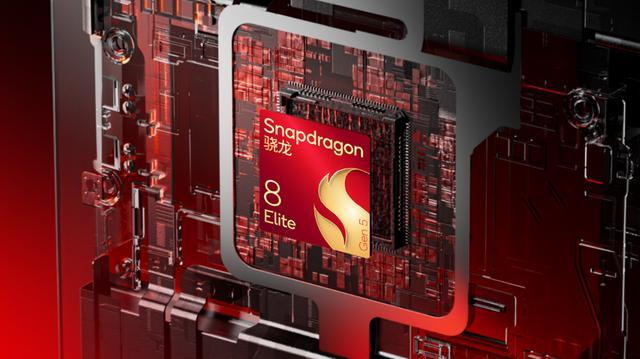
第五代骁龙8至尊版:以前沿技术创新助力旗舰智能手机体验全面升级
Huan Qiu Wang Zi Xun· 2025-12-04 11:58
Core Insights - Qualcomm's fifth-generation Snapdragon 8 Gen 2 mobile platform sets a new performance benchmark for flagship smartphones, showcasing exceptional performance, energy efficiency, and AI processing capabilities [1][17] - The platform has been adopted by 12 flagship smartphone models, including Xiaomi 17 series, Honor Magic8 series, and others, marking a significant advancement in mobile technology [1][17] Performance Enhancements - The Snapdragon 8 Gen 2 is built on a 3nm process and features a custom third-generation Qualcomm Oryon CPU, a new architecture Adreno GPU, and an enhanced Hexagon NPU, achieving significant breakthroughs in peak performance and energy efficiency [3][17] - The CPU shows a 20% increase in single-core performance, 17% in multi-core performance, 32% in response speed, and a 35% improvement in energy efficiency compared to the previous generation [3][17] Graphics and Gaming - The new Adreno GPU reaches a peak frequency of 1.2GHz and introduces dedicated high-speed memory, resulting in up to 38% performance improvement in mobile gaming and a 10% reduction in overall power consumption [4][17] - The platform supports high-load gaming scenarios with enhanced graphics capabilities, providing a smoother and more immersive user experience [4][17] AI Capabilities - The Hexagon NPU offers a 37% increase in overall AI performance and supports processing speeds of up to 220 Tokens/s, enabling advanced features like real-time image recognition and natural language processing [4][17] Flagship Smartphone Models - The Xiaomi 17 series, launched on September 25, features the Snapdragon 8 Gen 2, optimizing performance and power consumption for enhanced user experience [8] - Honor Magic8 series, released on October 15, leverages the platform's AI capabilities for advanced photography and smart interactions [9] - The Red Magic 11 Pro series, aimed at gamers, combines the Snapdragon 8 Gen 2 with proprietary gaming technology for superior performance [10] - Other models like iQOO 15, Realme GT8 Pro, Nubia Z80 Ultra, and Redmi K90 Pro Max also highlight the platform's versatility in gaming and imaging [11][12][13][14][15][16] Market Impact - The rapid adoption of the Snapdragon 8 Gen 2 by multiple flagship models within a month of its release indicates strong market recognition and sets a new standard for mobile device performance [17]

努比亚Z80 Ultra登顶2025安卓好评榜首
Xin Lang Cai Jing· 2025-12-04 02:05
Core Insights - The November 2025 Android smartphone user satisfaction ranking has been released, highlighting the Nubia Z80 Ultra with an impressive 99.99% satisfaction rate, nearly achieving a perfect score [2][3] - Huawei's flagship models, the Mate 70 RS and Mate 70 Pro+, both secured a satisfaction rate of 98.46%, ranking them second, showcasing strong brand recognition in the high-end market [2][3] - Huawei's Mate 70 Pro Enjoy Edition also performed well with a satisfaction rate of 98.24%, allowing Huawei to occupy three positions in the top five, making it the standout brand in this ranking [2][3] Market Performance - The mid-range market is also showing strong performance, with the OPPO K13 Turbo 5G achieving a satisfaction rate of 98.26%, indicating ongoing improvements in user experience for mid-range devices [4] - The top ten models in the ranking represent a diverse array of brands, including realme, Honor, OnePlus, and Samsung, reflecting the competitive landscape and varied development within the Android ecosystem [4]
昔日“手机单反”陷品控争议:努比亚能靠“豆包AI”翻盘吗?
凤凰网财经· 2025-12-03 04:55
Core Viewpoint - The collaboration between ByteDance and ZTE to launch an AI smartphone has generated significant market interest, leading to a strong initial performance in the consumer electronics sector, but subsequent stock price corrections highlight ongoing challenges for ZTE and its Nubia brand [1][2]. Group 1: Market Reaction and Product Launch - On December 1, the AI smartphone concept sparked a surge in the consumer electronics sector, with ZTE's stock hitting the daily limit and trading volume exceeding 13.1 billion yuan [1]. - Following the initial excitement, ZTE's AH shares experienced a pullback, with H shares dropping over 6% [2]. - The Nubia M153, priced at 3,499 yuan, was launched with limited availability and quickly sold out, indicating strong initial demand [2]. Group 2: Industry Insights and Competitive Landscape - An industry insider noted that large model assistants may become standard in smartphones, but the competitive landscape will not provide unique advantages as various brands adopt different models [6]. - The integration of AI does not inherently resolve existing issues in smartphone performance, such as camera quality and battery life, which consumers should approach with realistic expectations [6]. Group 3: Nubia's Brand Challenges - Nubia, established in 2012, aimed to penetrate the high-end market but has struggled to maintain a significant market share, often hovering around 1% [7][8]. - Recent product launches have faced criticism for quality control and marketing issues, with the Nubia Z80 Ultra experiencing a problematic launch event [9][10]. - Nubia's high-end aspirations are hindered by a lack of differentiation and a narrow user base, making it difficult to compete against brands that dominate the mid-range market [15]. Group 4: Consumer Feedback and Quality Control Issues - User complaints highlight significant quality control issues, including camera focus problems and software bugs, leading to dissatisfaction with Nubia products [20][21]. - The Nubia Z80 Ultra has not resolved previous issues, with users reporting touch screen failures and overall poor performance [21][34]. - The brand's reputation is further damaged by negative feedback regarding customer service and warranty claims, with many users expressing frustration over unaddressed product defects [34].
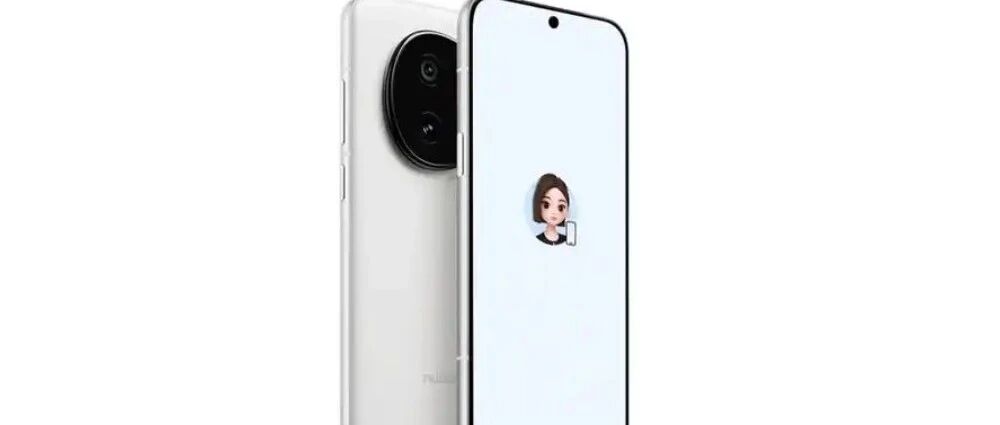
聚焦手机AI“超级入口”,中兴Nebula小模型让手机秒变“小秘”?
量子位· 2025-11-04 05:06
Core Insights - The article highlights the emergence of mobile GUI Agents as a competitive focus in the industry, driven by advancements in AI technology and the potential to reshape traffic distribution, creating a market opportunity worth hundreds of billions [1][61]. - Companies like Meituan, ZTE, ByteDance, and others are actively developing and deploying these technologies, with ZTE's Nebula-GUI model achieving significant recognition in benchmark tests [1][2][61]. Group 1: Market Opportunity and Competition - The introduction of GUI Agents is seen as a new frontier in mobile services, with the potential to create a market worth hundreds of billions [1]. - Major players such as Apple, Huawei, and Meituan are investing in this space, indicating a strong competitive landscape [1]. - ZTE's Nebula-GUI model has been recognized for its performance, achieving a score of 84.38 in benchmark tests, particularly excelling in complex tasks like automated ordering and ticket booking [2][3]. Group 2: Technological Advancements - ZTE has developed an end-to-end data preparation system to address challenges in data acquisition for training GUI Agents, significantly improving data quality and efficiency [8][10]. - The Nebula-GUI model has been integrated into over 30 mainstream apps, achieving an average accuracy of over 90% in common scenarios [3]. - The model's capabilities include features like "one-sentence ordering" and "one-sentence photo-taking," enhancing user experience by transforming smartphones into personal assistants [3][61]. Group 3: Data Preparation and Quality - ZTE's automated data pipeline and integrated data annotation tools have improved data annotation efficiency by three times, addressing the scarcity of high-quality Chinese GUI data [12][14]. - The company has created a large-scale Chinese GUI dataset, integrating millions of English GUI samples to enhance the model's training [26][27]. - The automated data preparation system has allowed for a significant increase in the scale and quality of training data, which is crucial for the performance of GUI Agents [8][20]. Group 4: Model Training and Performance - ZTE's approach includes a dual-layer reinforcement learning paradigm that enhances the model's decision-making capabilities and adaptability in dynamic environments [43][55]. - The model has shown an average accuracy exceeding 95% in single-step operations, with some simple commands achieving 99% accuracy [31]. - The introduction of self-reflection and error-correction capabilities has transformed the model from a passive executor to an active task manager, improving its robustness in real-world applications [36][61].