
努比亚M153

Search documents
豆包,严正声明
Xin Lang Cai Jing· 2026-02-28 02:10
Core Viewpoint - Doubao Mobile has issued a strong statement against malicious rumors regarding security vulnerabilities in its assistant software, emphasizing its commitment to user information security and the absence of any verified reports of such vulnerabilities [1][2]. Group 1: Security and Vulnerability Management - Doubao Mobile emphasizes that it has not received any detailed reports of vulnerabilities related to its assistant software and has a public platform for reporting security issues, offering substantial rewards for valid reports [1][2]. - The company condemns the organized spread of security scare tactics as a form of black public relations, which harms user interests and violates business ethics [2]. - Doubao Mobile has upgraded its protective measures against the attack methods demonstrated in the viral videos, which require user initiation to trigger any potential risks [1][2]. Group 2: AI Technology and Product Development - The Doubao assistant is part of a broader trend in AI terminal technology, with similar features being adopted by competitors like Google [2]. - The assistant is still in the testing phase, and the company is committed to refining the product and enhancing security measures continuously [2]. - Doubao Mobile has clarified that its assistant will not perform sensitive operations without user authorization, ensuring that users maintain control over critical actions [3][4]. Group 3: Regulatory Compliance and User Rights - Doubao Mobile plans to implement regulatory adjustments to its AI capabilities, particularly in scenarios involving financial applications and competitive gaming, to respect user interactions and maintain fairness [3]. - The company asserts that the AI assistant operates within the legal framework of data usage, as actions are performed with the explicit authorization of the device owner [4].
谷歌的“豆包手机”来了?
Guan Cha Zhe Wang· 2026-02-27 05:20
Core Insights - Samsung officially launched the Galaxy S26 series at the Galaxy Unpacked 2026 event, but the highlight was Google's introduction of the Gemini AI agent, which can automate complex tasks like ordering food and hailing rides in the background [1][3]. Group 1: Gemini AI Features - Gemini AI represents a significant evolution in Android, transforming the mobile assistant from merely answering questions to actively completing tasks for users [3]. - The AI can handle multi-step tasks seamlessly, such as processing a pizza order from a group chat by analyzing preferences and executing the order through various applications without user intervention [3][5]. - Initial supported scenarios for Gemini include ride-hailing (e.g., Uber), food delivery (e.g., DoorDash, Grubhub), and grocery shopping, with users able to activate it using natural language commands [3][5]. Group 2: Technical Mechanisms - Gemini operates through a "secure virtual window" mechanism, isolating AI operations within a sandbox environment to ensure user security while executing tasks [5][6]. - It employs a GUI Agent technology that allows the AI to understand and interact with application interfaces, enabling it to perform tasks without needing pre-defined API integrations [5][6]. - The AI's multi-step reasoning and planning capabilities allow it to create execution plans for complex tasks, ensuring it can adapt to various scenarios and handle unexpected situations [6]. Group 3: Market Context and Competition - The capabilities of Gemini AI closely mirror those demonstrated by ByteDance's Doubao mobile assistant just three months prior, indicating a competitive landscape in mobile AI technology [8][9]. - Doubao's early market entry and successful demonstration of similar functionalities have positioned it as a strong competitor in the mobile assistant space [9][10]. - The collaboration between Apple and Google to integrate Gemini into Siri indicates a broader industry consensus on the importance of mobile AI assistants, with significant financial backing for this initiative [10][11]. Group 4: Future Outlook - The introduction of Gemini AI is expected to enhance productivity by reducing app-switching and manual coordination for users, particularly in enterprise settings [12]. - The market for AI-enabled smartphones is projected to grow significantly, with an estimated 147 million units expected to ship in China by 2026, representing a 31.6% year-on-year increase [12]. - Samsung plans to release the Gemini AI feature in a beta version on March 11, 2026, with initial availability in the U.S. and South Korea, aiming to double the number of devices supporting Gemini to 800 million [12][13].



高通CEO安蒙:智能体AI手机只是开始,智能可穿戴设备正在成个人AI伙伴
Huan Qiu Wang· 2026-02-05 11:17
Core Insights - Qualcomm's CEO, Cristiano Amon, highlighted the significance of AI in mobile technology during the Q1 FY2026 earnings call, emphasizing the launch of ByteDance's first AI smartphone powered by the Snapdragon 8 Gen 2 platform as a milestone towards AI-native smartphones [1] - The evolution of smart wearable devices into personal AI companions is seen as the next category in mobile computing, driven by AI becoming the new user interface [1] Group 1 - ByteDance's Doubao team collaborated with ZTE to launch the Nubia M153 smartphone, which features the Snapdragon 8 Gen 2 platform, enhancing AI service experiences with proactive and contextual understanding capabilities [1] - The Snapdragon 8 Gen 2, launched in October 2024, offers personalized multimodal generative AI capabilities, supporting voice, context, and image understanding, significantly improving user experiences across productivity and creative tasks [3] - Many smartphone brands, including Xiaomi, Honor, OnePlus, and Nubia, have released flagship devices featuring the fifth-generation Snapdragon 8 Gen 2, enhancing user experiences [3] Group 2 - Qualcomm has initiated an "AI Acceleration Program" in collaboration with ZTE, Xiaomi, Honor, China Mobile, China Unicom, and China Telecom to promote the large-scale implementation of on-device AI, aiming to integrate AI experiences into more devices [3] - The collective efforts of industry players are expected to expand the reach of AI to various terminal products, allowing more users to benefit from innovative AI experiences [3]


AI入口争夺战:巨头加码技术底座建设
Mei Ri Jing Ji Xin Wen· 2026-01-28 14:24
Core Insights - The competition for AI entry points among major internet giants like Alibaba, ByteDance, and Tencent is intensifying, with each company adopting distinct strategies [2][10] - Alibaba has launched its flagship reasoning model Qwen3-Max-Thinking, which significantly enhances the native agent capabilities of its Qwen app, aiming to become a leading AI assistant [1][3] - ByteDance has introduced the Doubao Model 1.8, which focuses on multi-modal understanding and improved agent capabilities, enhancing its applications in various scenarios [5][6] - Tencent is taking a decentralized approach, emphasizing user-defined AI interactions and prioritizing enterprise productivity over consumer-focused AI entry points [7][8] Alibaba's Strategy - Alibaba's Qwen3-Max-Thinking model boasts over one trillion parameters and has achieved state-of-the-art performance in 19 benchmark tests, showcasing its advanced reasoning and agent capabilities [3][4] - The Qwen app has integrated over 400 AI functionalities, making it the first AI assistant capable of handling complex real-life tasks [4] - The model's ability to think and use tools like a professional enhances user experience, allowing for more intelligent and fluid interactions [3][4] ByteDance's Approach - ByteDance's Doubao Model 1.8 is optimized for multi-modal agent scenarios, improving its ability to follow complex instructions and execute tasks effectively [5][6] - The collaboration with ZTE on the Nubia M153 AI phone aims to validate the feasibility of "end-side large models + system-level agents" [6] Tencent's Position - Tencent's strategy focuses on a decentralized AI ecosystem, allowing users to define when and how to engage with AI, which contrasts with the centralized approaches of Alibaba and ByteDance [7][8] - Tencent's AI applications, such as the "Yuanbao" social AI feature, are designed to enhance user engagement while maintaining a focus on enterprise solutions [8][9] Industry Trends - The evolution of agent capabilities is seen as a critical factor in the AI landscape, with potential to create new application scenarios and software forms [9][10] - The competition is shifting from a focus on technology alone to a differentiation in operational models and compliance with safety standards [10]

中国手机市场,活活打成一场“消耗战”
3 6 Ke· 2026-01-19 11:20
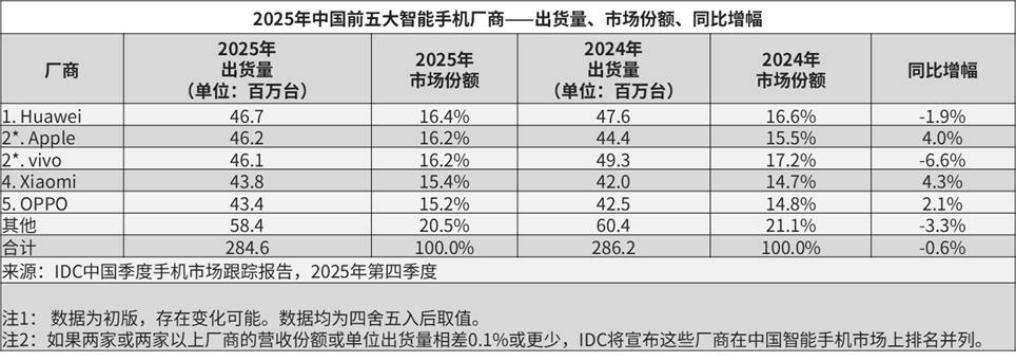
Core Insights - The Chinese smartphone market experienced a slight decline in 2025, with total shipments around 285 million units, a year-on-year decrease of 0.6% compared to a 5.6% growth in 2024 [1] - Key trends include a solidified high-end market, intense competition in the mid-range segment, and the entry of external players, prompting traditional manufacturers to innovate and expand their business boundaries [1] Market Dynamics - Huawei regained the top position in the Chinese smartphone market in 2025, with a shipment of 46.7 million units, a 1.9% decrease from 2024 [6][5] - Apple followed closely with 46.2 million units shipped, marking a 4% increase year-on-year, and capturing a market share of 16.2% [6][5] - The top five manufacturers—Huawei, Apple, vivo, Xiaomi, and OPPO—showed minimal differences in market share, all exceeding 15%, with only a 330,000 unit gap between the first and fifth [4][3] Competitive Landscape - The competition among the top five manufacturers has intensified, with no significant gaps in market share, indicating a shift towards a more competitive environment [2][4] - Xiaomi is focusing on high-end markets and aims to increase its average selling price (ASP) while exploring new growth avenues through its automotive business [8][22] - OPPO and vivo are facing challenges in their traditional offline channels due to the rise of e-commerce and aggressive competition from peers [9] Market Segmentation - The mid-range market (2000-4000 yuan) is characterized by fierce competition, with brands pushing flagship technologies into this segment, leading to a homogenization of products [11] - The high-end market remains stable, with no significant shifts in market dynamics, as brands struggle to introduce disruptive technologies that could challenge established players like Apple and Huawei [12] Technological Evolution - The smartphone industry is transitioning into an era of "joint definition," where both hardware and AI capabilities are being integrated to enhance user experience [15][21] - Two main technological paths are emerging: one led by internet companies focusing on AI-driven hardware, and another by traditional manufacturers integrating AI into their existing hardware [17][20] Industry Expansion - Traditional smartphone manufacturers are diversifying their business models, exploring new growth avenues such as electric vehicles and AI products [22] - New entrants, particularly from the internet and AI sectors, are reshaping the competitive landscape, with companies like ByteDance seeking partnerships to leverage their AI capabilities in the smartphone market [25][26]

继AI手机之后,豆包AI眼镜也将进入出货阶段
Xin Lang Cai Jing· 2026-01-05 08:41
Group 1 - ByteDance's "Doubao" AI glasses are set to enter the shipping phase, with a starting price expected to be under 2000 yuan and weighing less than 50 grams [1] - The no-screen version of the AI glasses is planned for release in Q1 2024, while the version with a display is expected in Q4 2024 [1] - The product is a collaboration between ByteDance and Longqi Technology, with clear division of responsibilities for UI and app development [1] Group 2 - The AI glasses are considered the next key terminal after smartphones, with major internet companies like Alibaba, ByteDance, and Baidu also developing similar products [5] - The global smart glasses market saw a 110% year-on-year increase in shipments in the first half of 2025, with AI glasses accounting for 78% of total shipments [6] - The AI glasses market is projected to reach a scale of hundreds of billions, indicating significant growth potential [6]

“连接+算力”双轮驱动 中兴通讯加速拥抱AI产业浪潮
Shang Hai Zheng Quan Bao· 2025-12-26 19:09
Core Viewpoint - ZTE Corporation has evolved from a follower to a leader in the telecommunications industry over 40 years, expanding its focus from network equipment to becoming a key player in the AI era, emphasizing "network, computing power, terminal, and new energy" [4][5][6] Group 1: Company Evolution and Market Position - Founded in 1985, ZTE started as a small team and has grown to serve over one-third of the global population, with annual revenue exceeding 100 billion yuan [5] - ZTE has established itself as a major player in the global telecommunications market, competing with companies like Huawei, Ericsson, and Nokia [6] - Since 2019, ZTE has focused on 5G technology and is now actively developing 5G-A technology, maintaining the second position globally in 5G base station and core network shipments [6][7] Group 2: Technological Advancements - ZTE is pushing the boundaries of 5G-A technology, focusing on six key scenarios to enhance communication capabilities [7] - The company has collaborated with over 1,000 industry leaders to create more than 100 scenario solutions across various sectors during the 14th Five-Year Plan period [7] Group 3: Computing Power Development - ZTE has shifted its strategic focus from "full connectivity" to "connectivity + computing power," with computing revenue growing by 180% and accounting for 25% of total revenue in the first three quarters of 2025 [8] - The company has introduced a range of AI computing solutions, including high-performance servers and storage systems, to support large-scale AI model training [9] Group 4: Terminal Innovations - ZTE is enhancing its presence in the smart terminal market, launching AI-integrated products and collaborating with major AI model developers to innovate user interaction [10][11] - The company plans to introduce a series of AI home products by April 2025, aiming to create a comprehensive smart home ecosystem [10]


消费电子行业周报:AppleGlass于2026年发布,XREAL1S将搭载X1空间计算芯片-20251224
Huaxin Securities· 2025-12-24 14:33
Investment Rating - The report maintains a recommendation for investment in the consumer electronics sector, particularly highlighting opportunities in AI glasses and related technologies [1]. Core Insights - Apple plans to release its first smart glasses, Apple Glass, in 2026, which will feature the same SiP chip as the Apple Watch, emphasizing lightweight design and low power consumption [3][4]. - The XREAL 1S, a new consumer-grade AR glasses product, was launched on December 18, 2025, featuring the X1 spatial computing chip and innovative 2D to 3D conversion capabilities, targeting a younger audience [5][15]. - The AR/AI glasses industry is expected to experience significant growth, with major companies entering the market, indicating a potential shift in consumer electronics towards new smart devices [5][15]. Summary by Sections Industry Performance - The consumer electronics sector has shown varied performance over different time frames, with a 1-month decline of 0.4%, a 3-month decline of 5.6%, and a 12-month increase of 35.5% [2]. Key Companies and Earnings Forecast - Notable companies in the sector include: - GoerTek (未评级) with an EPS forecast of 0.79 for 2024 and a PE ratio of 37.52 [8][17]. - Luxshare Precision (未评级) with an EPS forecast of 1.86 for 2024 and a PE ratio of 31.45 [8][17]. - Yujing Technology (Buy) with an EPS forecast of -1.83 for 2024 and a PE ratio of -19.43 [8][17]. - Rockchip (未评级) with an EPS forecast of 1.42 for 2024 and a PE ratio of 124.30 [8][17]. - Hengxuan Technology (未评级) with an EPS forecast of 3.86 for 2024 and a PE ratio of 78.57 [8][17]. Industry Dynamics - The smartphone market in China saw a 13% increase in sales for foreign brands in October 2025, with total smartphone sales reaching 32.27 million units, a growth of 8.7% [20]. - Apple is planning to expand its iPhone product line significantly, with at least seven new models expected by 2027, indicating a strategic shift in its product offerings [21][24].
豆包手机后思考:AGI会在中国率先跑出来吗?
3 6 Ke· 2025-12-24 09:40
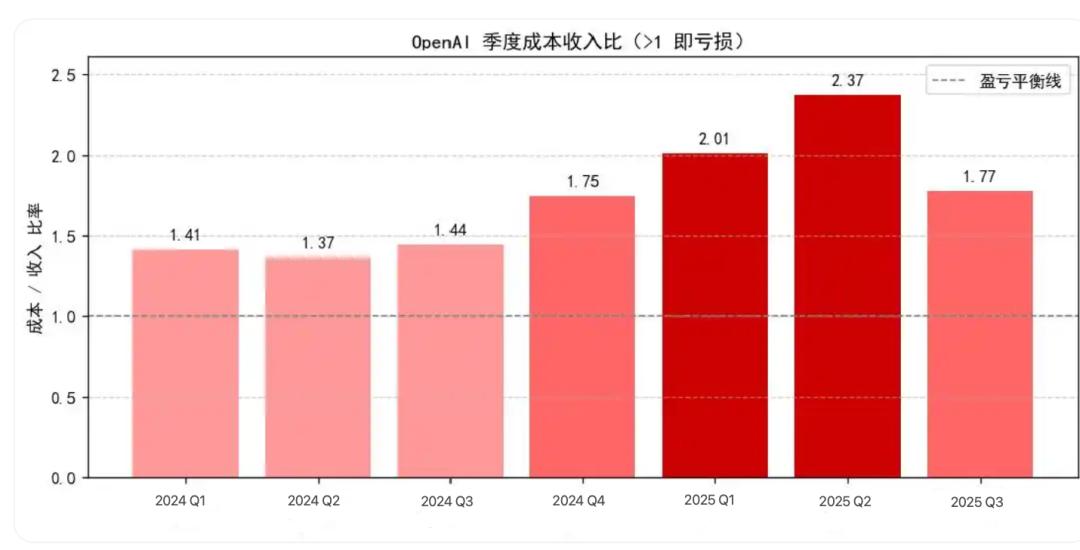
Core Insights - The article discusses the rapid advancement of AI technology in the Chinese market, particularly focusing on the launch of the Nubia M153, which integrates AI assistants with system-level execution capabilities, allowing AI to perform tasks autonomously rather than just providing suggestions [1][2][3] - The emergence of AI agents signifies a shift from AI being merely a thinking entity to one that can take action, raising questions about the readiness of existing digital ecosystems to accommodate such capabilities [2][3][4] - The Chinese market is positioned as a unique testing ground for AI agents due to its high application density, user acceptance, and a more unified governance system, potentially allowing it to lead in this technological transformation [3][18][23] AI Value Consensus: Transition from "Thinking" to "Action" - "Thinking" AI is reaching a ceiling, as evidenced by OpenAI's financial struggles, where costs are outpacing revenue significantly [4][6] - The cost structure of AI models is becoming unsustainable, with increasing computational demands not matched by revenue growth, indicating a need for AI to evolve towards actionable capabilities [6][7] - The focus is shifting towards AI's ability to act, as the next value point lies in its capacity to execute tasks rather than just process information [6][7] The Role of Mobile Devices in AI Action - Mobile devices are central to the AI action landscape, with Chinese users averaging 6.2 hours of smartphone use daily, performing over 120 digital actions [8] - The operating systems of mobile devices inherently possess the necessary permissions and infrastructure for AI to execute actions, making them ideal platforms for testing AI's commercial value [8][11] Competition for AI Execution Rights - Three main players are vying for control over AI execution capabilities: model service providers (e.g., Alibaba, Baidu, Tencent), terminal manufacturers (e.g., OPPO, Xiaomi), and native AI companies like Doubao [9][10][12] - Model service providers leverage their existing application ecosystems to integrate AI capabilities, while terminal manufacturers focus on system-level integration to expand AI's operational scope [10][11] - Native AI companies are taking a more aggressive approach by directly targeting system-level action entry points, although they face significant resistance from existing application ecosystems [12][13] Structural Challenges and Industry Transformation - The introduction of AI agents raises fundamental questions about operational permissions, commercial models, and accountability mechanisms, as traditional frameworks may not apply [14][15] - The current digital ecosystem is primarily designed for human users, which poses challenges for AI's operational integration, highlighting a need for infrastructure that supports AI actions [14][15] - As various stakeholders begin to adapt to the need for AI to operate autonomously, the industry is undergoing a structural transformation that could redefine value distribution and operational frameworks [17][18] China's Market as a Testing Ground for AI Agents - The rapid evolution of AI models and their capabilities is creating a competitive landscape, with significant advancements in model performance observed in recent years [21][22] - China's market conditions, including high service density and user acceptance of automation, provide a conducive environment for AI agents to thrive, contrasting with more fragmented markets like the U.S. [22][23] - The successful implementation of AI agents in China could lead to the development of a new operational system for AI that could be scaled globally, moving beyond mere model parameters to a comprehensive framework for AI action [23][24]
GenAI系列报告之66:字节AI:流量突围,MaaS及应用抢先
Shenwan Hongyuan Securities· 2025-12-23 09:16
Investment Rating - The report maintains a positive outlook on the AI industry, particularly focusing on ByteDance's advancements in AI technology and applications [2]. Core Insights - ByteDance's Doubao model 1.8 enhances multi-modal agent capabilities and cost efficiency, achieving state-of-the-art performance in various AI tasks [10][14]. - The introduction of the Nubia M153 AI phone marks a significant step in integrating AI with mobile technology, emphasizing the need for higher memory and bandwidth to support advanced AI functionalities [23][50]. - The report highlights the rapid user growth of ByteDance's AI applications, with Doubao reaching 170 million monthly active users and initiating monetization strategies through e-commerce integrations [62]. Summary by Sections 1. Model: Doubao 1.8 Enhancements - Doubao 1.8 focuses on improving agent capabilities, multi-modal understanding, and context management, achieving industry-leading performance in complex tasks [10][21]. - The model supports long-context management and multi-modal generation, enhancing its applicability in various scenarios [21][16]. 2. Edge AI: AI Phone Assistants and Innovative Hardware - The Nubia M153 AI phone, launched in collaboration with ZTE, features high specifications tailored for AI applications, including a Snapdragon 8 processor and 16GB RAM [23][24]. - The report discusses the competitive landscape for system-level agents, emphasizing the shift from app-driven to task-driven interactions [37][38]. - Other innovative hardware initiatives include AI toys and smart glasses, aimed at expanding ByteDance's AI ecosystem [53][55]. 3. AI Applications: User Growth and Monetization - Doubao and Jimeng have seen significant user growth, with Doubao achieving 170 million monthly active users as of September 2025 [62]. - Doubao has begun monetization efforts by integrating e-commerce functionalities within its platform, enhancing user engagement and revenue potential [62]. 4. AI Cloud: Aggressive Investment and Market Position - ByteDance's Volcano Engine leads the MaaS market with competitive pricing and robust model capabilities, although it still trails behind Alibaba Cloud in overall market share [3][4]. - The report notes the importance of maintaining model capability and pricing strategies to convert user engagement into revenue streams [3][4]. 5. Strategic Advantages and Organizational Adjustments - ByteDance's strategic focus includes leveraging its app ecosystem to enhance model training and resource allocation for AI development [3][4]. - The organizational structure is being adjusted to prioritize foundational research and the exploration of AI capabilities [3][4].