医药ETF易方达

Search documents
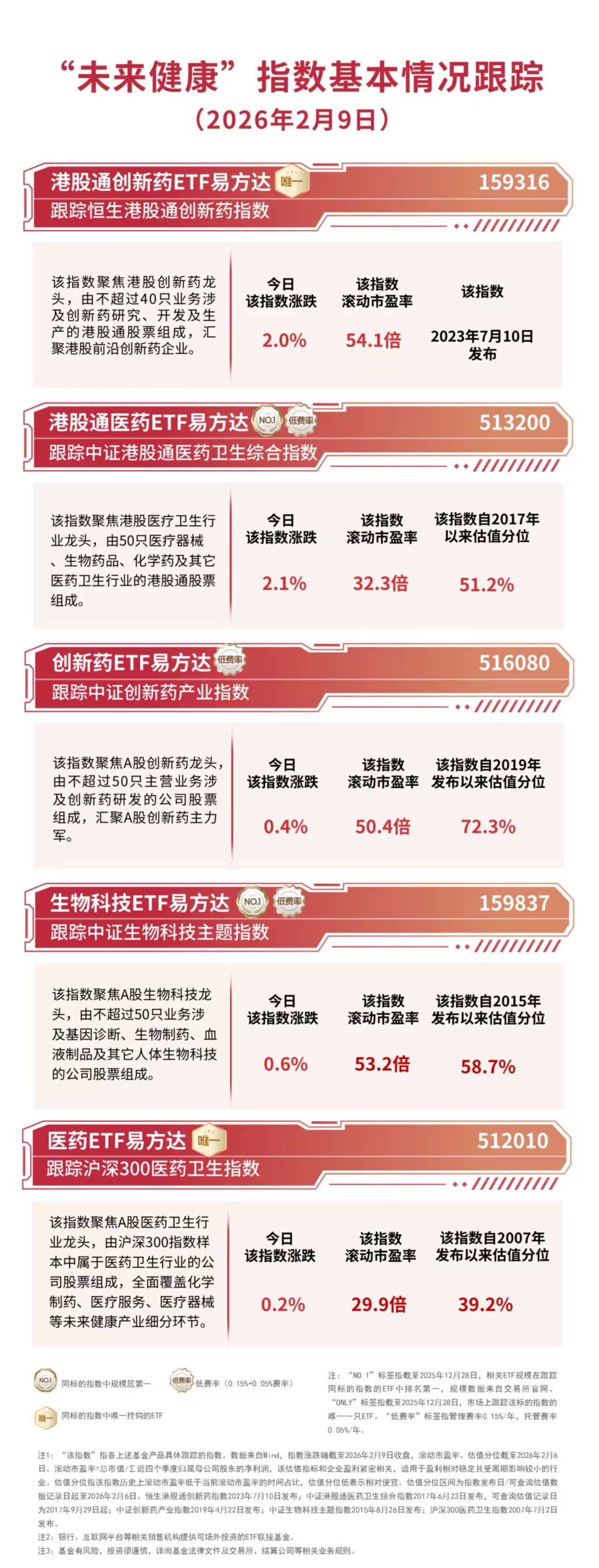
港股医药板块集体走强,港股通创新药ETF易方达(159316)、港股通医药ETF易方达(513200)标的指数涨超2%
Mei Ri Jing Ji Xin Wen· 2026-02-09 12:40
Core Viewpoint - The pharmaceutical industry is experiencing growth due to persistent human demand and unmet needs, alongside increased R&D investments by companies, marking the transition to an "innovation-driven" revenue era in China [1]. Group 1: Index Performance - The CSI Hong Kong Stock Connect Pharmaceutical and Health Comprehensive Index rose by 2.1% [1]. - The Hang Seng Hong Kong Stock Connect Innovative Drug Index increased by 2.0% [1]. - The CSI Biotechnology Theme Index saw a rise of 0.6% [1]. - The CSI Innovative Drug Industry Index grew by 0.4% [1]. - The CSI 300 Pharmaceutical and Health Index experienced a slight increase of 0.2% [1]. Group 2: Index Composition - The index focuses on leading innovative drug companies in A-shares, comprising no more than 50 stocks involved in innovative drug R&D [5]. - The index tracks leading biotechnology companies in A-shares, including no more than 50 stocks related to gene diagnostics, biopharmaceuticals, and other human biotechnology [7]. - The index covers leading companies in the pharmaceutical and health industry within the CSI 300, including segments like chemical pharmaceuticals, medical services, and medical devices [9]. Group 3: Valuation Metrics - The rolling P/E ratio for the innovative drug index is 50.4 times, with a valuation increase of 72.3% since its inception [6]. - The rolling P/E ratio for the biotechnology index is 53.2 times, with a valuation increase of 58.7% since its inception [8]. - The rolling P/E ratio for the CSI 300 Pharmaceutical and Health Index is 29.9 times, with a valuation increase of 39.2% since its inception [10].

罕见“落袋为安”!超1300亿,“跑了”
Zhong Guo Ji Jin Bao· 2026-01-29 06:02
Group 1 - On January 28, the A-share market showed mixed performance with a net outflow of over 130 billion yuan from stock ETFs [1] - The total scale of 1,320 stock ETFs in the market reached 4.3 trillion yuan, with a reduction of 21.7 billion fund shares and a net outflow of approximately 131.2 billion yuan [2] - Industry-themed ETFs and commodity ETFs saw significant net inflows of 17.7 billion yuan and 7.2 billion yuan, respectively, on the same day [2] Group 2 - The SGE Gold 9999 index product had the highest net inflow on January 28, amounting to 6.4 billion yuan, with over 19.1 billion yuan flowing into it over the past five trading days [2] - A total of 53 ETFs experienced net inflows exceeding 1 billion yuan, with the top three being the Huaxia Fund's non-ferrous metals ETF, Penghua Fund's chemical ETF, and Huaxia Fund's gold stock ETF, which saw inflows of 1.4 billion yuan, 1.2 billion yuan, and 1.1 billion yuan, respectively [2][3] - Leading fund companies like E Fund continued to attract net inflows into their ETFs, including 1.1 billion yuan into the gold ETF and 410 million yuan into the pharmaceutical ETF [2] Group 3 - Broad-based ETFs experienced the largest net outflow, totaling 147.2 billion yuan, with the CSI 300 index products seeing a net outflow of 97.5 billion yuan [4] - Market sentiment at the beginning of the year is relatively high, but regulatory measures are expected to cool the market in the short term, while overall opportunities are anticipated to outweigh risks [4] - The investment outlook for A-shares remains positive, with expectations of moderate profit recovery by 2026, emphasizing the importance of dynamic asset allocation in ETFs [4]
超630亿元,“跑了”
Zhong Guo Ji Jin Bao· 2026-01-23 06:08
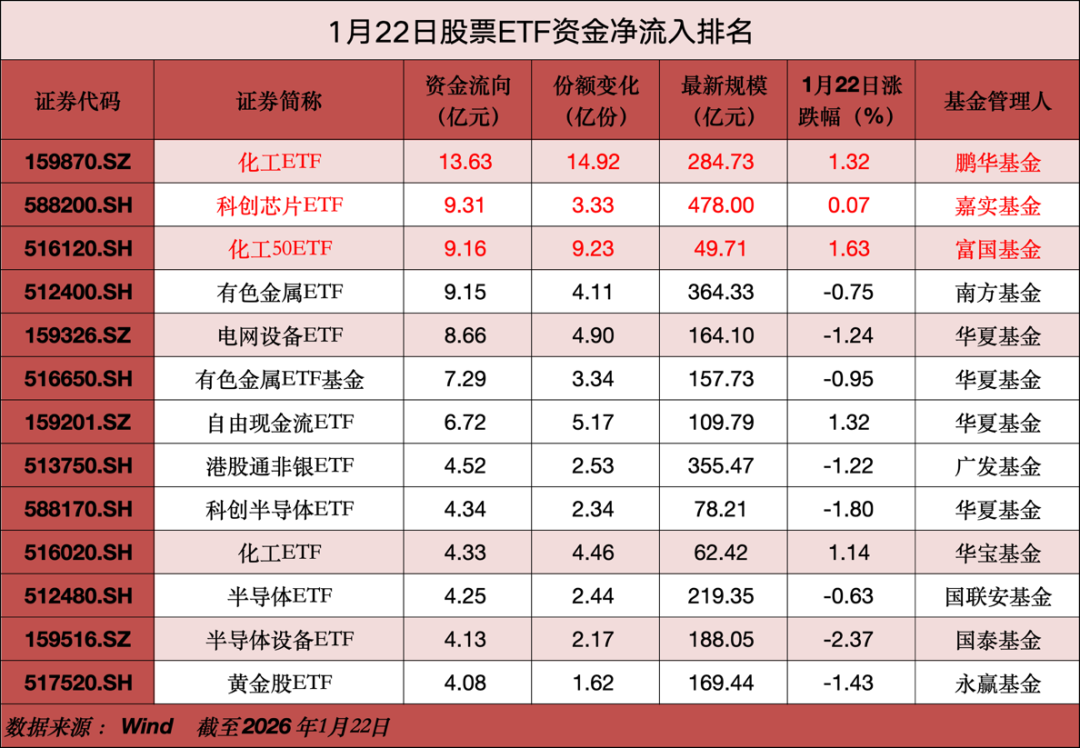
Group 1 - On January 22, A-shares showed mixed performance with major indices fluctuating, leading to a significant net outflow of 63.31 billion yuan from stock ETFs [1][2] - Industry-themed ETFs and commodity ETFs attracted substantial inflows, with net inflows of 12.04 billion yuan and 1.99 billion yuan respectively, while broad-based ETFs experienced significant outflows [2][4] - The semiconductor sector saw the most notable inflow, with a net inflow of 3.86 billion yuan, particularly driven by the Jiashi Fund's Sci-Tech Chip ETF, which had a net inflow of 0.93 billion yuan [2][3] Group 2 - The chemical sector also experienced significant inflows, with a net inflow of 2.97 billion yuan, led by Penghua Fund's chemical ETF with a net inflow of 1.36 billion yuan [2][3] - Other sectors such as electric grid equipment, non-ferrous metals, gold, and pharmaceuticals also saw notable inflows, with the Huaxia Fund's electric grid equipment ETF attracting a net inflow of 0.87 billion yuan [2][3] - In contrast, broad-based ETFs faced heavy outflows, with the CSI 300 ETF experiencing the largest outflow of 46.76 billion yuan, followed by the CSI 1000 ETF with an outflow of 16.6 billion yuan [4][5]
最新!超990亿元,“跑了”!
Zhong Guo Ji Jin Bao· 2026-01-22 06:59
Group 1 - The core point of the article highlights a significant outflow of funds from stock ETFs, exceeding 990 billion yuan, with broad-based ETFs collectively experiencing a net outflow of over 1 trillion yuan [2][3] - On January 21, the total net outflow from the stock ETF market (including cross-border ETFs) reached 994.94 billion yuan, with broad-based ETFs seeing a decline in scale by 940.9 billion yuan [3] - The SGE Gold 9999 index recorded the highest net inflow of 19.29 billion yuan, while the CSI 300 index faced the largest net outflow of 581.98 billion yuan on the same day [3] Group 2 - The top-performing ETFs in terms of net inflow included the Electric Grid Equipment ETF and the Chemical ETF, with net inflows of 14.38 billion yuan and 8.26 billion yuan, respectively [6][7] - Notable inflows were also observed in the Gold Stock ETF and the Semiconductor ETF, with net inflows of 5.74 billion yuan and 5.20 billion yuan, respectively [6] - The report indicates that the Electric Grid Equipment ETF and the Semiconductor ETF from Huaxia Fund saw significant inflows, reflecting investor interest in these sectors [3][4] Group 3 - The article mentions that the CSI 300 ETF and the CSI 1000 ETF were among the largest "bloodletting" ETFs, with substantial net outflows of 168.28 billion yuan and 138.52 billion yuan, respectively [5][7] - The overall market sentiment remains cautiously optimistic, with expectations for a continued upward trend in the Chinese stock market, particularly in growth sectors such as AI and industrial metals [8] - The investment strategy suggested includes focusing on core growth assets, which are currently at historical median valuations, providing potential for valuation recovery [8]