电新

Search documents
最新!超990亿元,“跑了”!
Zhong Guo Ji Jin Bao· 2026-01-22 06:59
Group 1 - The core point of the article highlights a significant outflow of funds from stock ETFs, exceeding 990 billion yuan, with broad-based ETFs collectively experiencing a net outflow of over 1 trillion yuan [2][3] - On January 21, the total net outflow from the stock ETF market (including cross-border ETFs) reached 994.94 billion yuan, with broad-based ETFs seeing a decline in scale by 940.9 billion yuan [3] - The SGE Gold 9999 index recorded the highest net inflow of 19.29 billion yuan, while the CSI 300 index faced the largest net outflow of 581.98 billion yuan on the same day [3] Group 2 - The top-performing ETFs in terms of net inflow included the Electric Grid Equipment ETF and the Chemical ETF, with net inflows of 14.38 billion yuan and 8.26 billion yuan, respectively [6][7] - Notable inflows were also observed in the Gold Stock ETF and the Semiconductor ETF, with net inflows of 5.74 billion yuan and 5.20 billion yuan, respectively [6] - The report indicates that the Electric Grid Equipment ETF and the Semiconductor ETF from Huaxia Fund saw significant inflows, reflecting investor interest in these sectors [3][4] Group 3 - The article mentions that the CSI 300 ETF and the CSI 1000 ETF were among the largest "bloodletting" ETFs, with substantial net outflows of 168.28 billion yuan and 138.52 billion yuan, respectively [5][7] - The overall market sentiment remains cautiously optimistic, with expectations for a continued upward trend in the Chinese stock market, particularly in growth sectors such as AI and industrial metals [8] - The investment strategy suggested includes focusing on core growth assets, which are currently at historical median valuations, providing potential for valuation recovery [8]


公募基金总规模首次突破37万亿元 震荡市中权益基金仍获申购
Sou Hu Cai Jing· 2025-12-30 05:30
Group 1 - The core viewpoint of the articles highlights the significant growth in China's public fund management industry, with total net asset value reaching a historical high of 37.02 trillion yuan by the end of November, marking eight consecutive months of growth [1] - As of the end of November, there are 165 public fund management institutions in China, including 150 fund management companies and 15 asset management institutions with public qualifications [1] - The growth in public fund size in November was primarily driven by money market funds, which increased by nearly 130 billion yuan, and bond funds, which grew by over 30 billion yuan compared to the end of October [1] Group 2 - Despite a nearly 2% decline in the A-share market in November, the net value of equity funds saw a decrease, with the total size of equity funds reaching 5.8 trillion yuan, down 2.2% from the previous month [2] - The latest data shows that the total share of equity funds at the end of November reached 3.82 trillion shares, reflecting a month-on-month growth of 2.09% [2] - Investor interest in equity and mixed funds remains strong, with both categories seeing significant share increases of 783.11 billion shares and 108.46 billion shares, respectively, compared to the end of October [2]
宏观固收周报:A股高位震荡,债市窄幅波动-20251223
Shanghai Securities· 2025-12-23 13:17
Group 1: Industry Investment Rating - No information about the industry investment rating is provided in the report. Group 2: Core View - The A-share market is in a high-level oscillation, and the bond market has narrow fluctuations. The A-share market may continue to oscillate at a high level in the future. It is recommended to pay attention to investment opportunities in directions such as satellites, chemicals, new energy, photovoltaics, chips, computing power, and artificial intelligence. The bond market may continue to have narrow fluctuations, and the 10-year Treasury bond yield above 1.80% has allocation value. The gold price is expected to maintain a strong oscillation trend [3][12]. Group 3: Summary of Market Performance Stock Market - U.S. stock indices showed mixed performance, with the Nasdaq up 0.48%, the S&P 500 up 0.10%, and the Dow Jones Industrial Average down -0.67%. The Nasdaq China Technology Index fell -1.96%. The Hang Seng Index dropped -1.10% [3]. - Most A-share sectors declined, with the Wind All A Index down -0.15%. Among them, the CSI A100, CSI 300, and CSI 1000 decreased by -0.82%, -0.28%, and -0.56% respectively, while the CSI 2000 and Wind Micro-cap stocks increased by 0.30% and 3.12% respectively. In terms of sector style, Shanghai blue-chips rose while growth stocks fell, and Shenzhen blue-chips and growth stocks both declined. The North Exchange 50 Index decreased by -0.13%. In terms of industry performance, 20 out of 30 CITIC industries rose, with the leading sectors being commerce and retail and catering and tourism, with a weekly increase of more than 4.0%. ETFs related to tourism, satellites, aerospace, and chemicals also performed well, with a weekly increase of over 4.0% [4][5]. Bond Market - China's Treasury bond yields declined slightly. The 10-year Treasury bond futures contract rose 0.15% compared to December 12, 2025. The yield of the 10-year active Treasury bond decreased by 0.88 BP to 1.8308%. Yields of all maturity varieties decreased [6]. - U.S. Treasury bond yields mostly declined, and the yield curve became flatter. As of December 19, 2025, the 10-year U.S. Treasury bond yield decreased by -3 BP to 4.16%. Only the 6-month maturity yield increased, while the rest decreased [8][9]. Currency Market - The U.S. dollar strengthened, and the RMB appreciated against the U.S. dollar. The U.S. dollar index rose 0.32%. The U.S. dollar against the euro, pound, and yen changed by 0.25%, -0.07%, and 1.16% respectively. The U.S. dollar against the offshore and onshore RMB exchange rates decreased by 0.28% and 0.20% respectively [10]. Commodity Market - Gold and silver prices generally rose. London gold spot prices fell 0.22% to $4337.60 per ounce, while COMEX gold futures prices rose 1.19% to $4354.00 per ounce. Domestic gold prices rose, with Shanghai gold spot up 1.17% to 975.51 yuan per gram and futures up 1.10% to 977.88 yuan per gram. London silver spot prices rose 1.98% to $65.79 per ounce; COMEX silver futures prices rose 9.39% to $66.79 per ounce. Domestic silver prices showed term differentiation, with Shanghai silver spot up 3.08% to 15359 yuan per kilogram and futures down 4.40% to 14811 yuan per kilogram [11]. Group 4: Other Market Conditions - Capital prices showed mixed trends. As of December 19, 2025, R007 rose 0.73 BP to 1.5148%, and DR007 decreased 2.78 BP to 1.4413%, with the spread between the two widening. The central bank's open market operations had a net injection of 190 billion yuan [7].
【国泰第一时间20251212】中央经济工作会议点评
Xin Lang Cai Jing· 2025-12-12 08:07
Core Viewpoint - The Central Economic Work Conference held on December 10-11 in Beijing emphasizes the need to fully tap economic potential, combining policy support with reform and innovation, and focusing on both material and human investment to address external challenges [1][4]. Macroeconomic Policy - The conference calls for a more proactive macroeconomic policy that enhances forward-looking, targeted, and coordinated measures, aiming to continuously expand domestic demand and optimize supply [1][8]. - It stresses the importance of maintaining a necessary fiscal deficit and total debt scale while optimizing fiscal expenditure structure and addressing local fiscal difficulties [2][8]. - A moderately loose monetary policy is advocated, with a focus on promoting stable economic growth and reasonable price recovery, utilizing various policy tools to maintain liquidity [2][8]. Key Tasks - The conference outlines several key tasks, including: 1. Prioritizing domestic demand and building a strong domestic market, with initiatives to boost consumption and increase central budget investment [3][9]. 2. Fostering innovation and enhancing new growth drivers, including improving intellectual property protection in emerging fields [3][9]. 3. Promoting coordinated development and urban-rural integration, while ensuring a stable real estate market and managing local government debt risks [3][9]. Overall Attitude - The conference reflects a more optimistic and determined attitude towards future economic challenges, shifting from a focus on recognizing difficulties to consolidating and expanding economic stability [4][10]. - There is a strong emphasis on structural adjustments and reforms, with a focus on quality and efficiency improvements in macroeconomic governance [4][10]. Future Outlook - The outlook for the A-share market suggests a favorable environment for investment as policy and liquidity converge positively, with expectations for a spring market rally [6][12]. - The bond market is also expected to benefit from the conference's outcomes, with a focus on maintaining fiscal policy stability and potential interest rate cuts in early 2024 [6][12].
加仓!连续加仓
中国基金报· 2025-12-05 03:54
Core Viewpoint - The stock ETF market in China experienced a significant net inflow of over 4.3 billion yuan on December 4, with a cumulative increase of 10.8 billion yuan over the past three days, indicating a strong interest in broad-based ETFs despite market volatility [2][5]. Group 1: Market Overview - On December 4, the A-share market showed mixed performance, with the Shanghai Composite Index down 0.06% and the ChiNext Index up over 1% [2]. - The stock ETF market saw a total increase of 1.789 billion shares, with a net inflow of 43.15 billion yuan, primarily driven by broad-based ETFs and Hong Kong market ETFs [5]. - The total scale of all stock ETFs in the market reached 4.56 trillion yuan as of December 4 [4]. Group 2: Fund Inflows - The net inflow for broad-based ETFs was 33.54 billion yuan, while Hong Kong market ETFs saw a net inflow of 12.2 billion yuan [5]. - The CSI A500 Index ETF led the inflows with 9.21 billion yuan, while the Shanghai market corporate bond index saw the largest outflow of 5.01 billion yuan [6]. - Recent inflows into the Hang Seng Technology Index exceeded 1.8 billion yuan, and the SGE Gold 9999 Index saw inflows of over 1.1 billion yuan [7]. Group 3: Top Performing ETFs - The top ETFs by net inflow included the Chinese Internet ETF with 5.33 billion yuan, the CSI A500 ETF with 4.56 billion yuan, and the SSE 50 ETF with 4.37 billion yuan [8]. - Notable inflows were also observed in the STAR Market ETF and the CSI 1000 ETF, with net inflows of 3.89 billion yuan and 2.99 billion yuan, respectively [8]. Group 4: Fund Outflows - The industry-themed ETFs experienced significant outflows, totaling 12.02 billion yuan, with the Bank ETF and Gold Stock ETF each seeing outflows exceeding 3 billion yuan [12][13]. - Other ETFs with notable outflows included the Chemical ETF and the Military Industry Leader ETF, both exceeding 2 billion yuan in outflows [13]. Group 5: Market Sentiment - Despite some industry-themed ETFs experiencing outflows, institutions remain optimistic about structural opportunities in the A-share market, anticipating clearer policy and fundamental expectations in December [15]. - Analysts suggest focusing on growth sectors such as AI, electric new energy, and industrial metals, while also considering potential policy-driven opportunities in sectors like hotels, logistics, and aviation as the year-end approaches [15].

多只绩优权益基金限购,释放什么信号?
Guo Ji Jin Rong Bao· 2025-12-04 00:41
Group 1 - Multiple public equity funds have announced the suspension of large subscriptions as the year-end approaches, including several high-performing funds that ranked well over the past year [1][2][3] - The suspension of large subscriptions is seen as a measure to prevent fund sizes from exceeding optimal investment strategies and market capacity, reflecting a shift from pursuing scale to focusing on high-quality development [4][5] - Notable funds that have implemented subscription limits include 中欧红利优享, 中欧价值回报, and 安信远见成长, with recent one-year net value increases of 44.47%, 41.62%, and 39.09% respectively [3][4] Group 2 - The market remains volatile, and the actions of fund companies to limit subscriptions indicate a strategy to manage growth and protect fund performance [4] - Investment firms are preparing for a "cross-year market" with expectations of a rebound in industry allocations and a focus on emerging technologies and undervalued sectors [5][6] - December is anticipated to be a period of resonance among policies, liquidity, and fundamentals, with a focus on growth sectors such as AI and electric vehicles, as well as potential policy-driven opportunities in hospitality and logistics [5][6]
超175亿 跑了!
Zhong Guo Ji Jin Bao· 2025-11-26 06:08
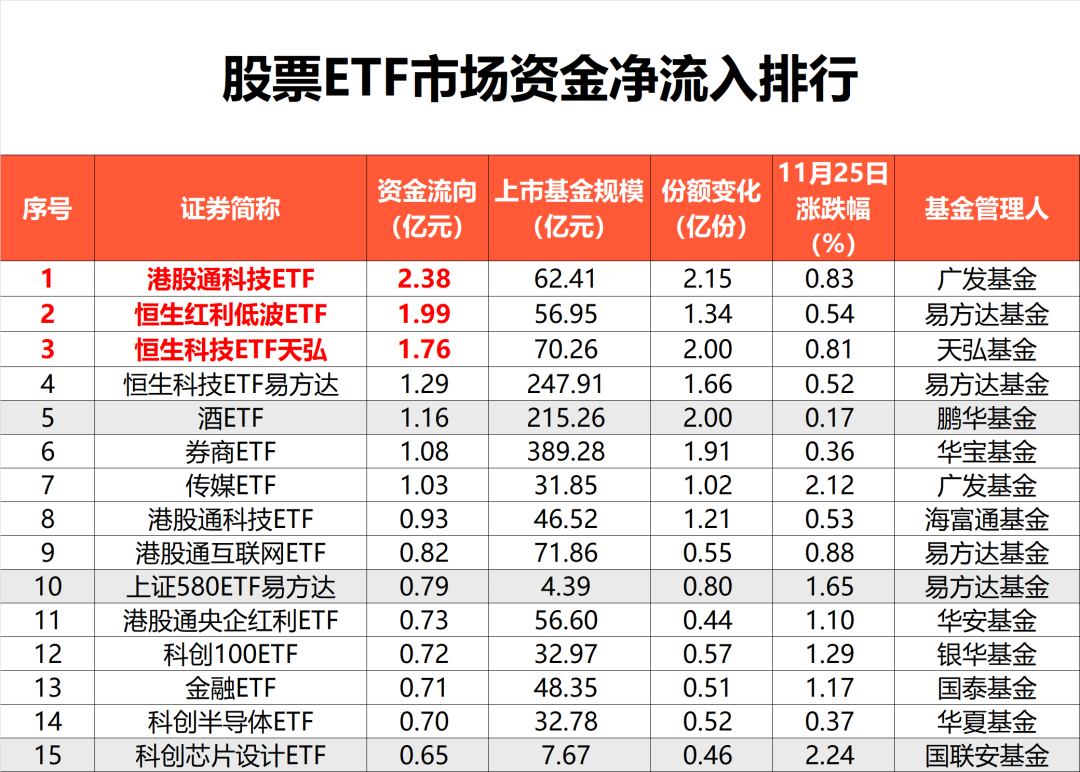
Group 1 - The core point of the article highlights a significant net outflow of over 17.5 billion yuan from the stock ETF market amid a collective rise in A-share indices, indicating a trend of "selling into strength" by investors [1][3][10] - The total scale of the stock ETF market reached 4.54 trillion yuan, with a reduction of 8.241 billion units in total shares, reflecting a net outflow of over 17.5 billion yuan on the day of the market surge [3][6] - The Hong Kong market ETFs and commodity ETFs saw notable net inflows of 1.214 billion yuan and 415 million yuan respectively, while the ChiNext ETF and CSI 500 ETF experienced significant net outflows [3][7] Group 2 - The CSI 500 ETF led the outflows with a net withdrawal of 3.332 billion yuan, followed by the ChiNext ETF and CSI 1000 ETF with outflows of 2.39 billion yuan and 1.534 billion yuan respectively [7][9] - Major fund companies like E Fund and Huaxia Fund reported substantial net inflows in their ETFs, with E Fund's Hang Seng Dividend Low Volatility ETF attracting nearly 200 million yuan [6][10] - Institutional investors remain optimistic about the A-share market's future, anticipating a potential spring rally driven by sectors such as AI, electric vehicles, and industrial metals, alongside policy expectations around the year-end and Spring Festival [10]
股指期货热点:当下股指衍生品交易该如何抉择?
Nan Hua Qi Huo· 2025-08-29 07:06
Report Industry Investment Rating - Not provided Core Viewpoints - The recent stock market rally is driven by funds, sentiment, and structural benefits, forming a positive cycle where increased funds lead to higher trading volumes and greater upward momentum. However, there is a risk of a callback, and key indicators to watch for a shift in sentiment include a contraction in trading volume, a decline in basis, and a drop in implied volatility of options. Currently, trading volume remains around 3 trillion, and while optimism persists, risk management is necessary for single - sided long positions in futures. [1] - The market sentiment is generally positive, and after mid - August, optimism about the long - term stock market trend has increased. Strategies should be mainly long - oriented, but attention should be paid to key indicators for sentiment changes. In terms of style, weight - based stocks are showing advantages, and different trading strategies are recommended for different scenarios. [24] Summary by Directory 1. Recent Stock Market Trend Analysis - Since April, the stock index has shown an overall oscillating upward trend. After the sharp decline in April, the trading volume of broad - based indices gradually returned to normal with the entry of the national team. The rapid upward movement since late June is due to the easing of the Middle - East situation and various structural benefits. From June 20th to now, sectors such as TMT, new energy, non - banking finance, and steel have seen significant gains. [2] - The current rally is driven by the support of the national team, the release of structural benefits, positive sentiment, and the influx of funds. The trading volume of the two markets has climbed from around 1 trillion to about 3.1 trillion, approaching the high of last year. The proportion of margin trading in the total trading volume has also increased from about 8% to around 11.6%. [2] - In terms of stock index style, due to the influx of funds, small - cap stocks represented by the CSI 1000 are stronger as both hot money and leveraged funds prefer small - cap stocks with high elasticity and the support of technology concepts. [3] 2. Futures Index Observation and Analysis - With the rise of the stock market and the strong performance of small - cap stocks, the futures index has the following changes: the inter - period spread (next - quarter - current month) first dropped significantly and then rose rapidly; small - cap futures index IM has shown better performance, but there are signs of a recent style shift; the basis of the futures index has generally increased. [8] - The inter - period spread has not deviated from its operating rules. The stronger performance of the far - month contracts since mid - August may reflect an optimistic shift in market expectations for the far - term trend, influenced by factors such as the rebound from low spreads and the change in market expectations from short - term to long - term. Additionally, arbitrage trading at low spread levels has also contributed to the spread rebound. [8][9] - In terms of cross - varieties, small - and medium - cap futures indices have been stronger during the rally, but there are signs of a style shift since the end of August. This may be due to low - point arbitrage trading, the high valuation of small - cap stocks leading to a potential shift of funds to weight - based stocks, and the heavy trading of weight - based stocks in broad - based indices. [15][16] - The basis of the futures index has been rising due to positive sentiment and is currently at a high level for the year. Although there is still room for growth compared to last year's high, considering the low starting point and significant increase, there is a need to be vigilant about a cooling of sentiment. [18] 3. Stock Index Option Observation and Analysis - The implied volatility of options has increased significantly since mid - August, indicating that the market's long - term expectations have deviated from the previous consensus, and optimism about the long - term trend has increased. The stock index has also made breakthroughs, which may have attracted more funds and boosted sentiment. Currently, the implied volatility of stock index options is at a relatively high - middle level in history with room for further increase. [22] 4. Strategy Recommendations - In terms of futures, single - sided long positions should be held with risk management. In terms of style, it is recommended to focus on IF, but if the Fed cuts interest rates in September and liquidity expectations rise, small - cap stocks may show advantages again, and a temporary shift to IM can be considered. For long - term holding, IF is still recommended. Cross - variety arbitrage can focus on long IF and short IM, especially when the spread is at a low level. In terms of inter - period trading, follow the long - term rule of negative correlation between the stock market and the inter - period spread, and take the opportunity to short far - month contracts and long near - month contracts when the two show positive correlation. [24] - For options, due to the high uncertainty of the stock index trend and implied volatility, it is recommended to combine with spot trading, mainly using the insurance strategy (spot + buying put options) to obtain stock market gains while avoiding the risk of a market decline. [25]
知名首席分析师张一弛跳槽,入职华创证券!曾因海通证券“首席内斗”受关注
Sou Hu Cai Jing· 2025-08-13 07:03
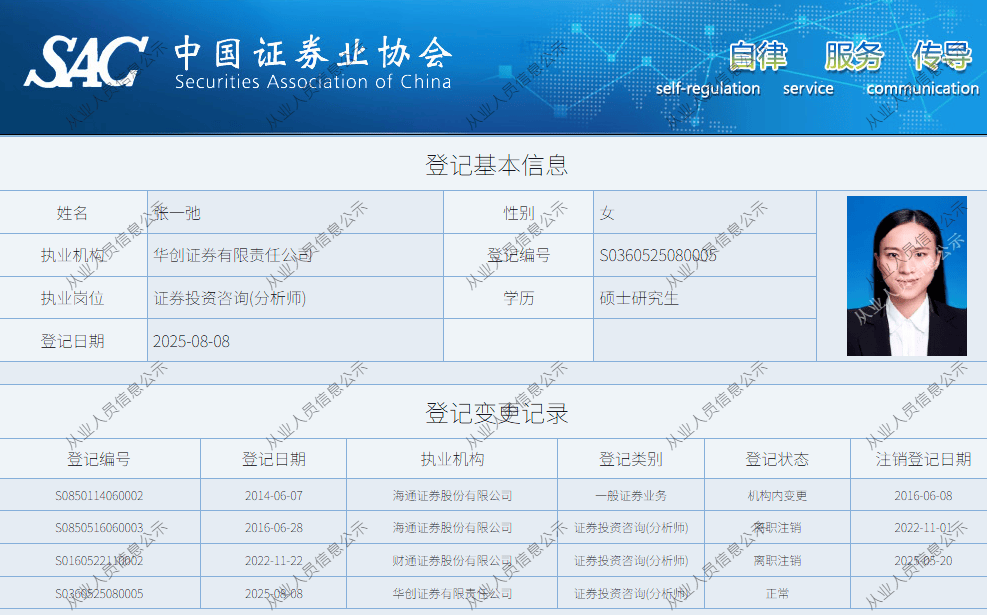
Group 1 - Zhang Yichi, a well-known analyst in the electric new energy sector, left Caitong Securities on May 20 and joined Huachuang Securities on August 8 [1] - Zhang Yichi's role at Huachuang Securities is as the head of midstream manufacturing and overseas research, focusing on electric new energy, robotics, AIDC, and overseas research [2] - Zhang Yichi has a strong academic background with a Bachelor's degree in Material Physics from Beijing University of Science and Technology, a Master's in Energy Technology from Cambridge University, and a Master's in Financial Economics from the London School of Economics [7] Group 2 - Zhang Yichi has 10 years of experience as a chief analyst, achieving top rankings in the public utilities and electric equipment new energy sectors [7] - During her tenure at Haitong Securities from 2014 to 2022, she was involved in a notable internal conflict over coverage of BYD, which was resolved amicably [7] - Huachuang Securities, established in January 2002, is a wholly-owned subsidiary of Huachuang Yuxin, which reported a total revenue of 3.352 billion yuan and a net profit of 62 million yuan in 2024 [8]


今天,A股“一变”、“三不变”
新华网财经· 2025-07-17 09:35
Core Viewpoint - The A-share market is experiencing a significant increase in risk appetite, with a notable rise in stock prices and trading volumes, while maintaining a focus on key sectors such as computing power, innovative pharmaceuticals, and diversified finance [1][3]. Market Characteristics - The market has shown three distinct characteristics recently: 1. The index's central point has steadily risen, with the Shanghai Composite Index moving from around 3300 points in May-June to approximately 3500 points since late June, accompanied by increased trading volume [3]. 2. Sector rotation has accelerated, with a clear focus on sectors like computing power, innovative pharmaceuticals, diversified finance, photovoltaic, military industry, and humanoid robots, all supported by significant narratives and event catalysts [3][7]. 3. There is a heightened focus on leading stocks, with many reaching new highs, indicating strong market sentiment [11]. Sector Performance - The computing power sector, particularly in optical modules and PCBs, has seen substantial gains, with stocks like New Yisheng and Shenghong Technology performing well [3][11]. - The innovative pharmaceutical sector has also strengthened, with companies like Chengdu Xian Dao and MediWest experiencing significant price increases [5][6]. - Military stocks, including military equipment and aviation engines, have surged, with companies like Zongheng and Chenxi Aviation showing strong performance [7]. - The humanoid robot sector is gaining traction, supported by recent procurement announcements from major companies like China Mobile [7][10]. Institutional Outlook - Institutions remain optimistic about the market's future, with expectations of continued upward trends in both equity and bond markets. The current valuation of the CSI 300 index is approximately 10% below its reasonable value midpoint, suggesting potential for further appreciation [14]. - Analysts from CITIC Securities and other firms indicate that the market is likely to continue its upward trajectory, driven by improved macroeconomic conditions and structural growth in new sectors [15].