科创芯片ETF易方达

Search documents
科创芯片设计指数涨超4%,关注科创芯片设计ETF易方达(589030)等产品投资价值
Sou Hu Cai Jing· 2026-02-12 10:30
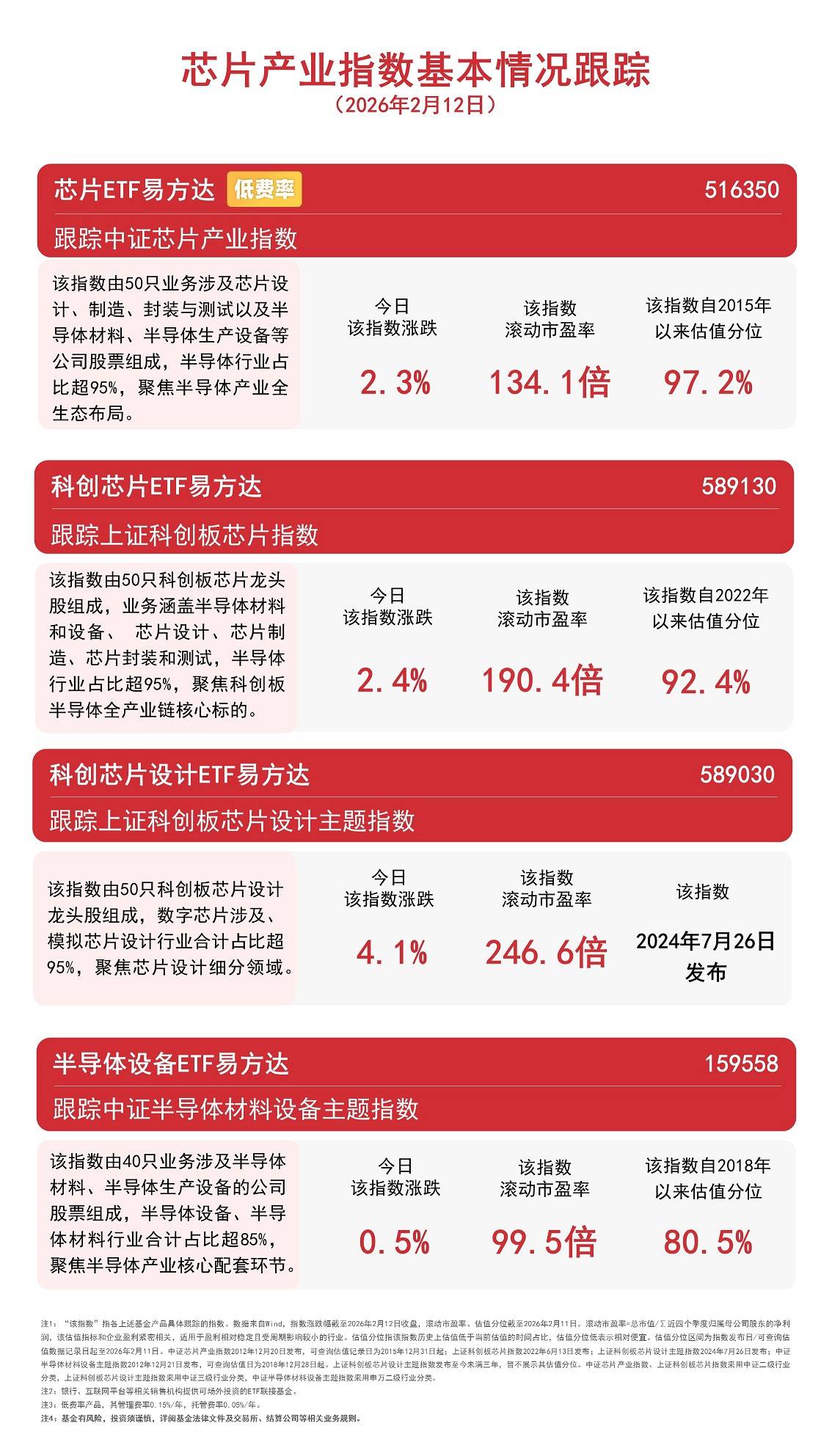
Group 1 - The Shanghai Stock Exchange Sci-Tech Innovation Board Chip Design Theme Index rose by 4.1%, while the Shanghai Stock Exchange Chip Index increased by 2.4%, and the CSI Chip Industry Index went up by 2.3% [1] - Dongwu Securities believes that the factors currently suppressing the market will gradually weaken, and combined with the seasonal effect of spring, the market is expected to start rebounding, potentially lasting for several trading days after the holiday [1] - Investment strategies should focus on technology sectors that have been overvalued during the recent adjustment, including domestic chips, semiconductor equipment, storage chips, computing communication, and cloud computing [1] Group 2 - The CSI Chip Industry Index consists of 50 stocks involved in chip design, manufacturing, packaging and testing, as well as semiconductor materials and production equipment, with the semiconductor industry accounting for over 95% [3] - The Sci-Tech Chip ETF tracks the Shanghai Stock Exchange Sci-Tech Innovation Board Chip Index, which includes 50 leading chip stocks from the Sci-Tech Innovation Board, focusing on the entire semiconductor industry chain [3] - The CSI Semiconductor Materials and Equipment Theme Index is composed of 40 stocks related to semiconductor materials and production equipment, with these sectors making up over 85% of the index [5]

芯片板块短期调整不改周期上行,持续关注科创芯片设计ETF易方达(589030)等产品布局机会
Sou Hu Cai Jing· 2026-02-11 10:43
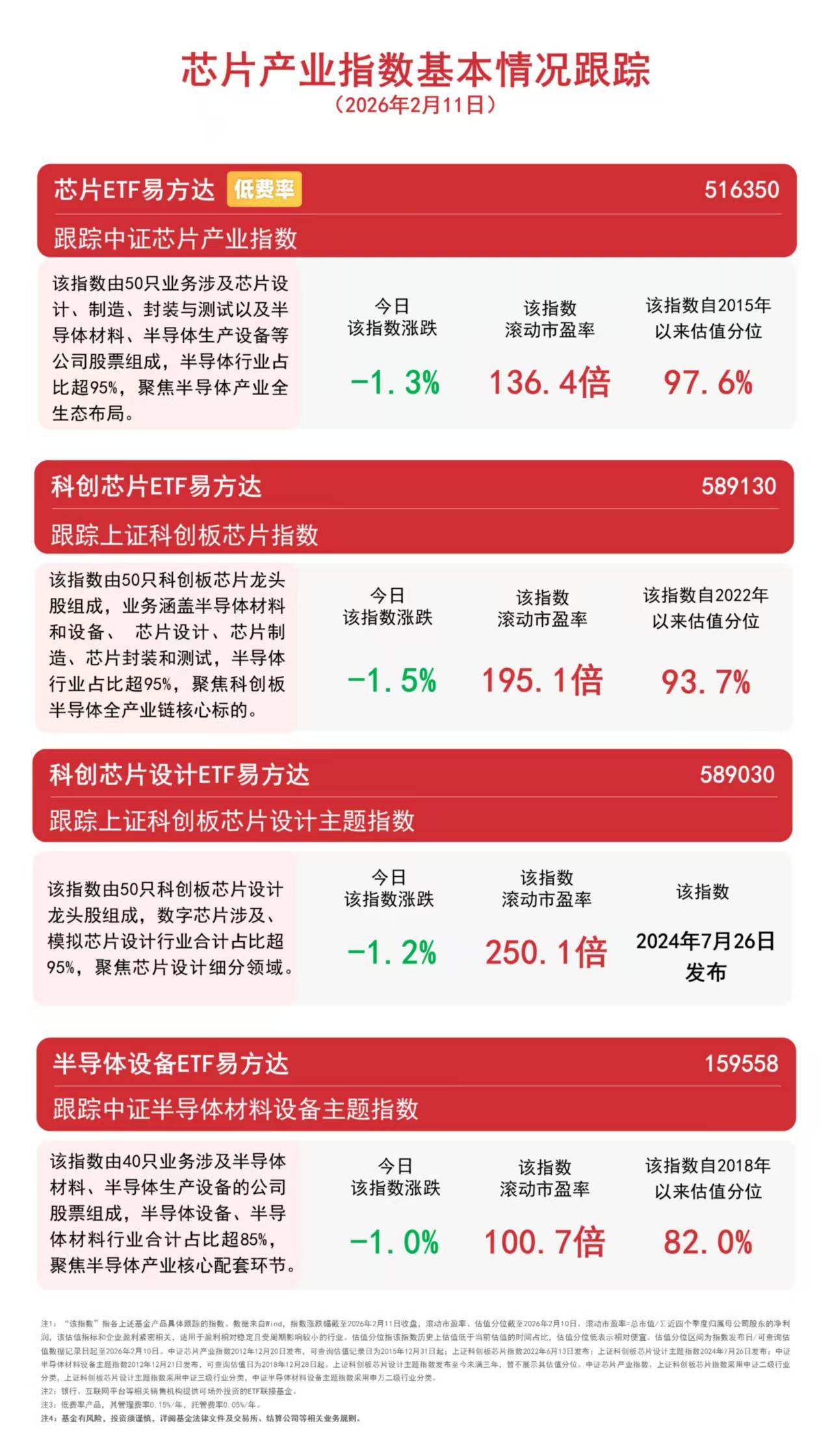
Group 1 - The core viewpoint of the articles indicates a downward trend in semiconductor-related indices, with the China Securities Semiconductor Materials and Equipment Theme Index down by 1.0%, the Shanghai Stock Exchange Sci-Tech Innovation Board Chip Design Theme Index down by 1.2%, the China Securities Chip Industry Index down by 1.3%, and the Shanghai Stock Exchange Sci-Tech Innovation Board Chip Index down by 1.5% [1] - China Galaxy Securities believes that the current moment marks a new starting point for the next cycle in the storage chip sector, driven by rapid growth in AI server demand and domestic substitution, and sees investment opportunities in related listed companies within the domestic storage industry chain [1] Group 2 - The China Securities Chip Industry Index consists of 50 stocks involved in chip design, manufacturing, packaging and testing, as well as semiconductor materials and production equipment, with over 95% of the index focused on the semiconductor industry [3] - The index has experienced a decline of 1.3% and has a rolling price-to-earnings ratio of 136.4 times since its inception [3] - The Shanghai Stock Exchange Sci-Tech Innovation Board Chip Index, which includes 50 leading chip stocks, also focuses on semiconductor materials and equipment, chip design, manufacturing, and packaging, with over 95% of the index dedicated to the semiconductor industry [3] - This index has decreased by 1.5% and has a rolling price-to-earnings ratio of 195.1 times since its inception [3]
半导体板块领涨,科创芯片ETF易方达(589130)、科创芯片设计ETF易方达(589030)标的指数均涨超2%
Mei Ri Jing Ji Xin Wen· 2026-02-03 02:44
Group 1 - The semiconductor sector is experiencing a recovery after two days of significant market pullback, with the Sci-Tech Chip Index rising by 2.0% and the Chip Design Index increasing by 2.4% [1] - Notable stock performances include Huafeng Measurement Control rising over 8%, and Zhongwei Semiconductor increasing by over 12% [1] - TSMC's 2nm production capacity has been fully booked by major global tech companies, with AMD planning to produce 2nm CPUs starting in 2026, and Google and AWS expected to adopt this technology in Q3 and Q4 of 2027 respectively [1] Group 2 - China Galaxy Securities indicates that leading internet companies are maintaining high investments in AI, driving a new semiconductor cycle, while rising prices of raw materials like copper and gold are causing "semiconductor inflation" [1] - The Shanghai Sci-Tech Chip Index covers various segments of the semiconductor industry, with digital chip design and semiconductor equipment accounting for approximately 65% of the index [1] - The Shanghai Sci-Tech Chip Design Theme Index focuses on the chip design sector, with digital chip design making up over 75% and analog chip design around 20% [1] Group 3 - The E Fund Sci-Tech Chip ETF (589130) and E Fund Sci-Tech Chip Design ETF (589030) are tracking the aforementioned indices and have seen continuous net inflows, providing investors with convenient tools to capitalize on domestic AI chip development opportunities [2]
多只ETF、LOF罕见跌停
Xin Lang Cai Jing· 2026-01-30 12:51
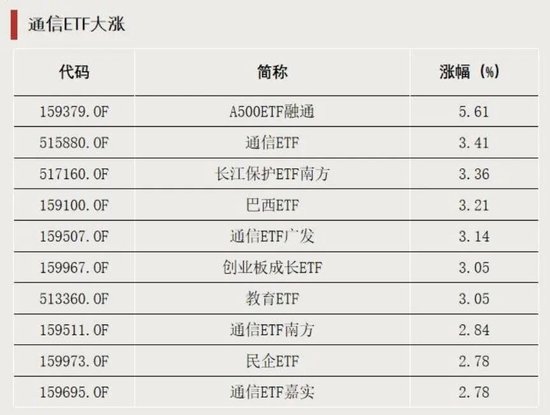
Group 1 - The precious metals, industrial metals, and minor metals sectors experienced a significant decline, with multiple gold and colored ETFs hitting the limit down [1][2][9] - Several LOF funds that had previously hit the limit up faced a limit down after resuming trading, indicating market volatility [10][18] - On January 29, gold and colored ETFs attracted substantial net inflows, while semiconductor-related ETFs also saw reverse positioning [11][15] Group 2 - The communication ETF sector showed a general increase, with several ETFs related to communication and artificial intelligence rising significantly [12][13] - Low-valuation sectors such as agriculture, forestry, and paper-making led the market gains, contrasting with the overall decline in precious metals [12] - The trading volume for gold ETFs surged, with the gold ETF reaching a transaction volume of 257.78 billion, significantly higher than the previous week's average of 71.07 billion [4][14] Group 3 - On January 29, various ETFs related to colored metals and gold saw net inflows exceeding 10 billion, indicating strong investor interest [15][17] - The semiconductor sector, despite its recent declines, attracted significant reverse investments, with notable inflows into semiconductor equipment ETFs [16][17] - The core logic supporting gold prices remains unchanged, driven by high geopolitical risks and the weakening of the dollar's credibility due to high U.S. government deficits [8][19]
又有300亿,“跑了”
Zhong Guo Ji Jin Bao· 2026-01-30 05:51
Core Viewpoint - The A-share market experienced a mixed performance on January 29, with significant outflows from stock ETFs, totaling nearly 30 billion yuan, indicating a trend of capital withdrawal from broad-based ETFs [2][4][3]. Group 1: ETF Market Overview - On January 29, stock ETFs saw a net outflow of 29.86 billion yuan, with 61 ETFs recording inflows exceeding 1 billion yuan [4][6]. - The total net outflow from stock ETFs since 2026 has surpassed 750 billion yuan, highlighting a persistent trend of capital leaving this segment [3]. - The broad-based ETFs, including those tracking the CSI 300, SSE 50, and others, experienced the most significant outflows, with six ETFs seeing net outflows exceeding 5 billion yuan, and one ETF exceeding 10 billion yuan in a single day [4][6]. Group 2: Sector Performance - Among the ETFs, industry-themed and commodity ETFs saw net inflows of 22.14 billion yuan and 5.39 billion yuan, respectively, while broad-based ETFs faced a net outflow of 52.02 billion yuan [4]. - The SGE Gold 9999 index recorded the highest net inflow of 4.05 billion yuan on January 29, while the CSI 300 index ETF had the largest outflow of 31.63 billion yuan [4]. Group 3: Fund Management Insights - Leading fund companies, such as E Fund and Huaxia Fund, reported significant inflows in specific ETFs, with E Fund's Sci-Tech Chip ETF seeing a net inflow of 936 million yuan on January 29 [7]. - Huaxia Fund's Nonferrous Metal ETF and Gold Stock ETF led the inflows with 1.497 billion yuan and 1.335 billion yuan, respectively [7]. Group 4: Market Outlook - Analysts expect the A-share and Hong Kong markets to maintain high trading activity levels, driven by macroeconomic stability and positive expectations for economic indicators [8]. - Despite uncertainties in global geopolitical dynamics and domestic economic challenges, the valuation levels of A-share and Hong Kong equity assets remain attractive compared to major global indices [8].

罕见“落袋为安”!超1300亿,“跑了”
Zhong Guo Ji Jin Bao· 2026-01-29 06:02
Group 1 - On January 28, the A-share market showed mixed performance with a net outflow of over 130 billion yuan from stock ETFs [1] - The total scale of 1,320 stock ETFs in the market reached 4.3 trillion yuan, with a reduction of 21.7 billion fund shares and a net outflow of approximately 131.2 billion yuan [2] - Industry-themed ETFs and commodity ETFs saw significant net inflows of 17.7 billion yuan and 7.2 billion yuan, respectively, on the same day [2] Group 2 - The SGE Gold 9999 index product had the highest net inflow on January 28, amounting to 6.4 billion yuan, with over 19.1 billion yuan flowing into it over the past five trading days [2] - A total of 53 ETFs experienced net inflows exceeding 1 billion yuan, with the top three being the Huaxia Fund's non-ferrous metals ETF, Penghua Fund's chemical ETF, and Huaxia Fund's gold stock ETF, which saw inflows of 1.4 billion yuan, 1.2 billion yuan, and 1.1 billion yuan, respectively [2][3] - Leading fund companies like E Fund continued to attract net inflows into their ETFs, including 1.1 billion yuan into the gold ETF and 410 million yuan into the pharmaceutical ETF [2] Group 3 - Broad-based ETFs experienced the largest net outflow, totaling 147.2 billion yuan, with the CSI 300 index products seeing a net outflow of 97.5 billion yuan [4] - Market sentiment at the beginning of the year is relatively high, but regulatory measures are expected to cool the market in the short term, while overall opportunities are anticipated to outweigh risks [4] - The investment outlook for A-shares remains positive, with expectations of moderate profit recovery by 2026, emphasizing the importance of dynamic asset allocation in ETFs [4]
最新!超990亿元,“跑了”!
Zhong Guo Ji Jin Bao· 2026-01-22 06:59
Group 1 - The core point of the article highlights a significant outflow of funds from stock ETFs, exceeding 990 billion yuan, with broad-based ETFs collectively experiencing a net outflow of over 1 trillion yuan [2][3] - On January 21, the total net outflow from the stock ETF market (including cross-border ETFs) reached 994.94 billion yuan, with broad-based ETFs seeing a decline in scale by 940.9 billion yuan [3] - The SGE Gold 9999 index recorded the highest net inflow of 19.29 billion yuan, while the CSI 300 index faced the largest net outflow of 581.98 billion yuan on the same day [3] Group 2 - The top-performing ETFs in terms of net inflow included the Electric Grid Equipment ETF and the Chemical ETF, with net inflows of 14.38 billion yuan and 8.26 billion yuan, respectively [6][7] - Notable inflows were also observed in the Gold Stock ETF and the Semiconductor ETF, with net inflows of 5.74 billion yuan and 5.20 billion yuan, respectively [6] - The report indicates that the Electric Grid Equipment ETF and the Semiconductor ETF from Huaxia Fund saw significant inflows, reflecting investor interest in these sectors [3][4] Group 3 - The article mentions that the CSI 300 ETF and the CSI 1000 ETF were among the largest "bloodletting" ETFs, with substantial net outflows of 168.28 billion yuan and 138.52 billion yuan, respectively [5][7] - The overall market sentiment remains cautiously optimistic, with expectations for a continued upward trend in the Chinese stock market, particularly in growth sectors such as AI and industrial metals [8] - The investment strategy suggested includes focusing on core growth assets, which are currently at historical median valuations, providing potential for valuation recovery [8]
基金申赎政策分化 策略调整释放资产配置新信号
Xin Lang Cai Jing· 2026-01-21 20:32
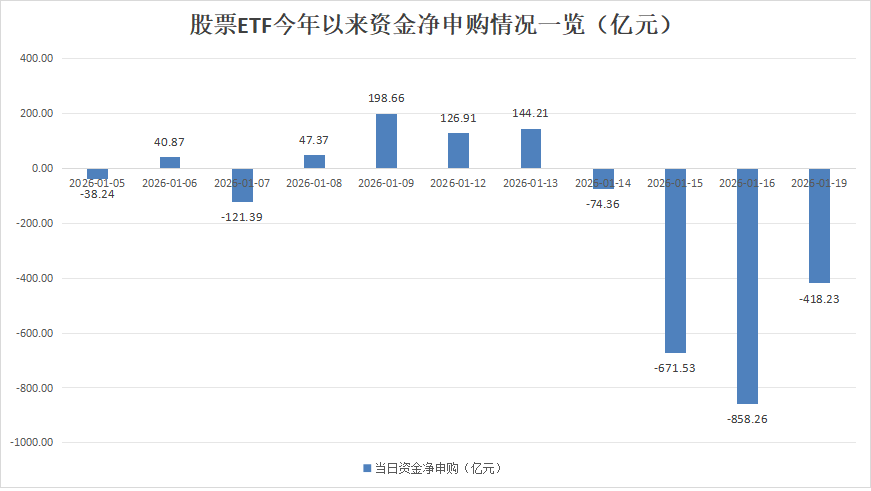
Core Viewpoint - The public fund market is experiencing a significant divergence in subscription and redemption policies, reflecting the differing market environments and investment strategies of various fund types [1][2]. Group 1: Fund Subscription Policies - China Europe Fund has announced the resumption of large subscriptions for its two-year holding period mixed fund, indicating a recovery in confidence regarding equity assets [2]. - In contrast, China Merchants Fund has implemented restrictions on large subscriptions for its pure bond fund, limiting daily subscriptions to 100 RMB, highlighting a cautious approach in the bond market [2][5]. Group 2: Market Trends and Fund Flows - As of January 19, the total scale of 1,307 stock ETFs reached 4.61 trillion RMB, with a net outflow of 418.23 billion RMB in the previous day, primarily from broad-based ETFs [3]. - Conversely, industry-themed ETFs and commodity ETFs saw net inflows of 155.04 billion RMB and 22.44 billion RMB, respectively, indicating a divergence in fund flows that impacts subscription policies [3]. Group 3: Underlying Logic of Policy Divergence - The differential adjustments in subscription policies reflect fund managers' cautious judgments on asset allocation, with a positive outlook on equity markets supported by significant inflows into specific ETFs [4]. - The current low yield environment for bonds, with 10-year government bond yields at historical lows, has led to a decrease in the attractiveness of bond assets, prompting fund managers to limit large subscriptions to protect investor interests [4][5]. Group 4: Implications for Investors - The divergence in fund subscription policies signals clear allocation messages for investors, suggesting that the resumption of large subscriptions in equity funds indicates favorable conditions for building or increasing positions [7]. - The stable LPR rates and government initiatives to promote technological self-reliance align with the trend of capital flowing into technology-themed ETFs, further supporting the equity market [7].
净流出,超400亿元!
Zhong Guo Ji Jin Bao· 2026-01-20 06:22
Core Viewpoint - The stock ETF market experienced significant net outflows, exceeding 400 billion yuan on January 19, marking the third consecutive day of substantial outflows, totaling over 1.9 trillion yuan in the past three trading days [1][2]. Group 1: Market Performance - The A-share market continued its volatile trend, with the Shanghai Composite Index rising by 0.29% to 4114.00 points, while the CSI 300 Index increased by 0.05% [2]. - Trading volume in the Shanghai and Shenzhen markets decreased to 2.73 trillion yuan, with weaker performance from large-cap stocks and stronger performance from growth-style sectors [2]. Group 2: ETF Fund Flows - The total scale of all stock ETFs (including cross-border ETFs) reached 4.61 trillion yuan, with a net outflow of 418.23 billion yuan on January 19 [2]. - Industry and commodity ETFs saw net inflows of 155.04 billion yuan and 22.44 billion yuan, respectively, while broad-based ETFs experienced net outflows of 586.07 billion yuan, leading to a decrease in their scale by 694.95 billion yuan [4]. Group 3: Specific ETF Performance - The top net inflows were observed in industry ETFs, with the Huaxia Electric Grid Equipment ETF leading at over 25 billion yuan, followed by the Penghua Chemical ETF with over 11 billion yuan [6]. - Four major CSI 300 ETFs collectively saw net outflows exceeding 300 billion yuan, with the Southern CSI 1000 ETF experiencing over 50 billion yuan in outflows [5][6]. Group 4: Market Sentiment and Outlook - Analysts noted that the recent net outflows from broad-based ETFs have contributed to a cooling effect on the previously hot market, aiding in the stable operation of the A-share market [7]. - The market is expected to maintain a volatile pattern in the short term, with potential support from funds adjusting their positions, while long-term sentiment remains optimistic [7].