
黄金ETF易方达

Search documents
多空博弈加剧金价波动,黄金ETF如何把控布局节奏
Sou Hu Cai Jing· 2026-02-10 03:50
Core Viewpoint - The global gold market is experiencing significant volatility, with ongoing battles between bulls and bears, leading to fluctuations in gold prices. The focus is on the strategic allocation of gold ETFs as a convenient tool for investors to access gold assets [1]. Group 1: Market Volatility and Price Drivers - Recent fluctuations in gold prices are driven by an imbalance in the forces of supply and demand, influenced by various macroeconomic and market factors [8]. - Key supporting factors for gold prices include changes in global macroeconomic policies, which lower the opportunity cost of holding gold, and ongoing geopolitical uncertainties that drive investors towards gold as a safe-haven asset [5][8]. - Short-term factors suppressing gold prices include market sentiment and capital flows, with profit-taking leading to increased selling pressure and cautious positioning among investors due to concerns over policy shifts [8][9]. Group 2: Gold ETF Allocation Strategy - Gold ETFs are favored by ordinary investors for their low entry barriers, high liquidity, and transparency, making them an ideal tool for hedging market risks [11]. - Investors are advised to focus on long-term allocation value rather than short-term speculation, as gold can effectively diversify investment portfolios and enhance resilience against volatility [11][12]. - It is crucial to monitor macroeconomic policies and geopolitical developments to identify strategic allocation opportunities, adjusting positions based on market conditions [12].

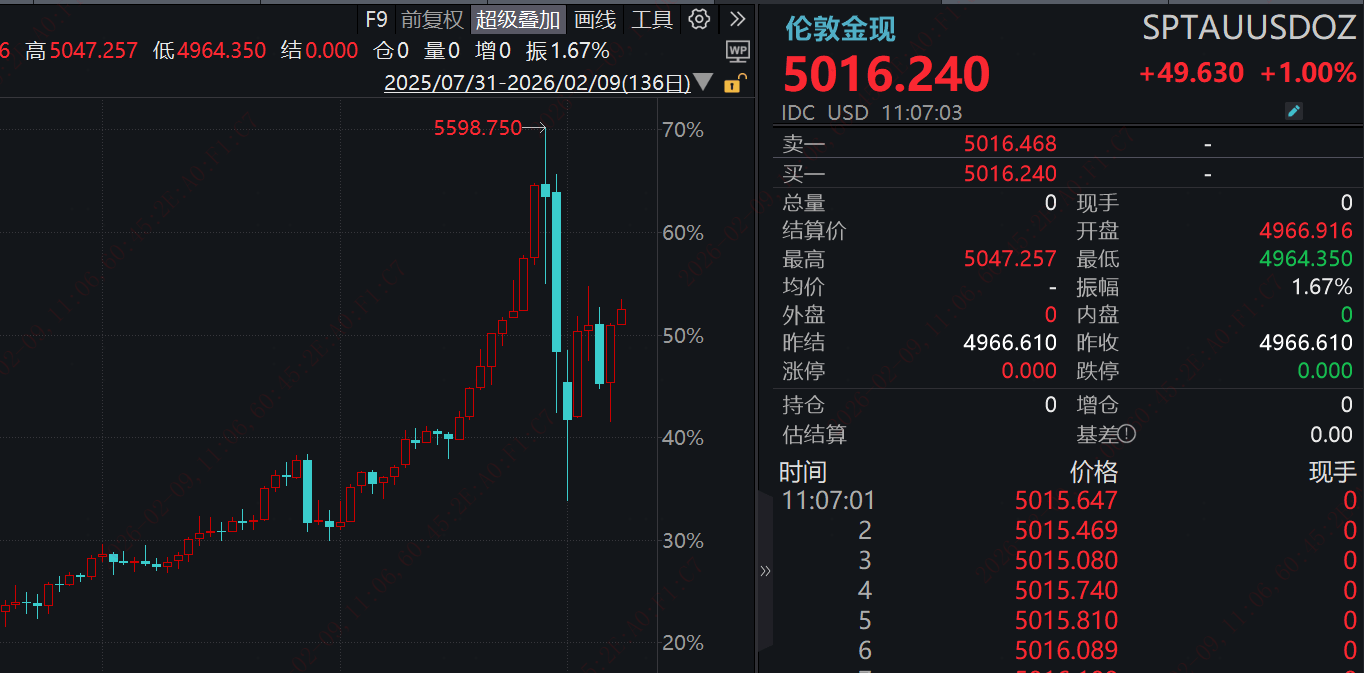
现货黄金重上5000美元,黄金ETF易方达涨3.30%
Sou Hu Cai Jing· 2026-02-09 03:19
Group 1 - The core logic of gold prices has shifted from short-term interest rate speculation to hedging against long-term dollar credit risks and the restructuring of the global monetary system [2] - The recent volatility in precious metals is expected to stabilize, with gold finding a bottom around 4400 USD for London gold and 1000 CNY for Shanghai gold [2] - The significant drop in precious metals prices is primarily driven by technical factors rather than fundamental deterioration, with strong macroeconomic support for gold prices remaining intact [3] Group 2 - The recent decline in tin prices is noted, with a week-on-week decrease of 15.81%, attributed to inventory depletion and ongoing supply issues from Indonesia and Myanmar [3] - The gold ETF from E Fund (159934) offers a convenient investment method for investors with securities accounts, allowing T+0 trading of gold [3]

石油石化ETF上涨;1月14只ETF扩容逾百亿丨ETF晚报
2 1 Shi Ji Jing Ji Bao Dao· 2026-02-04 12:00
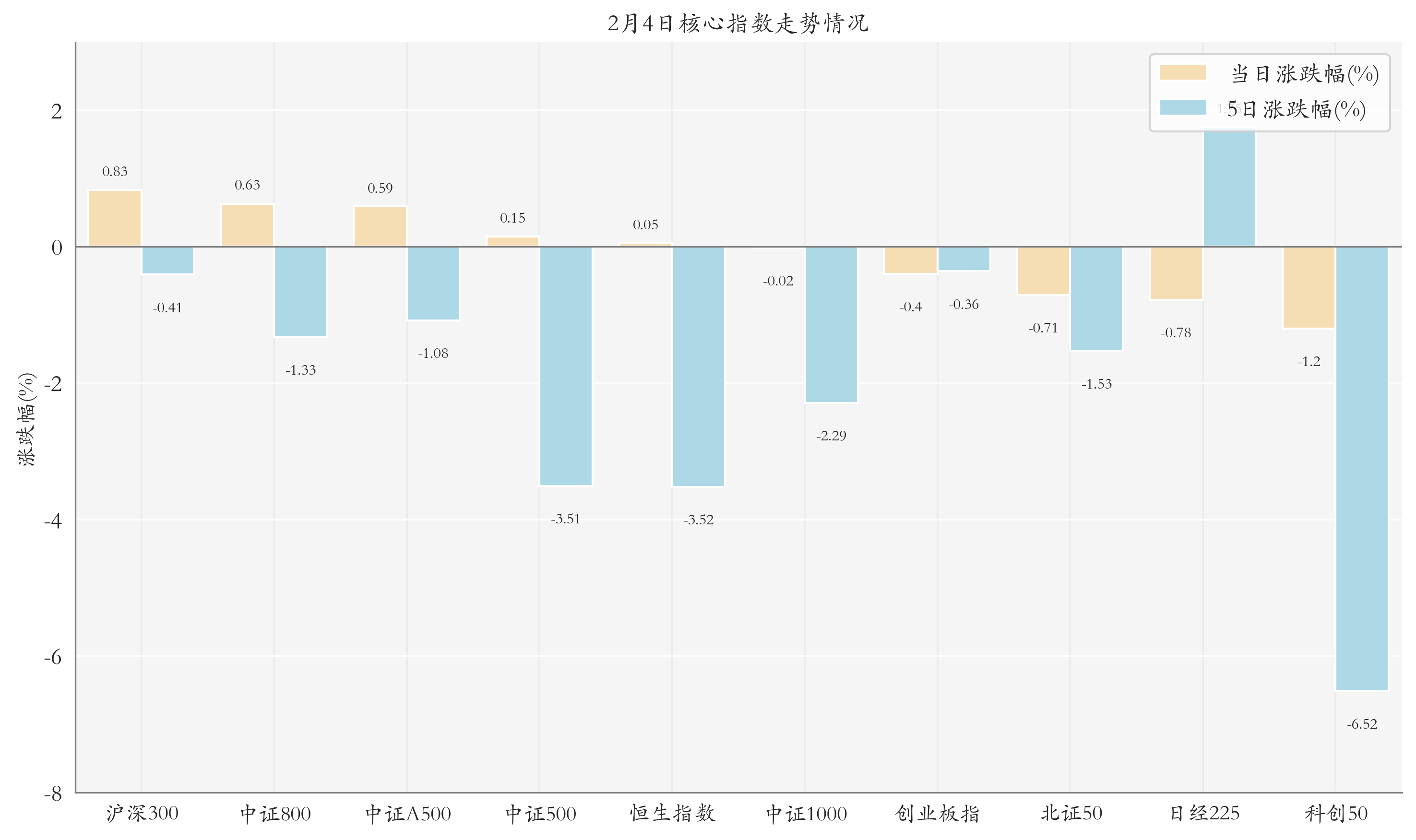
ETF Industry News - The Shanghai Composite Index has returned to 4100 points, with multiple ETFs in the oil and petrochemical sector experiencing significant gains, including the Energy ETF Guangfa (159945.SZ) up by 5.99% and the Energy ETF (159930.SZ) up by 5.33% [1] - On February 3, the A-share market saw a reversal with a net inflow of nearly 10 billion yuan into stock ETFs, marking one of the few days of net inflow since January. Major ETFs tracking the CSI 500, CSI 300, and STAR 50 indices saw significant inflows, while thematic ETFs in sectors like non-ferrous metals and photovoltaics experienced net outflows [2] - As of January 31, 2026, 14 ETFs have expanded by over 10 billion yuan, with a notable shift towards industry-themed ETFs and commodity ETFs, indicating a consensus among investors on sectors supported by industrial policies and positive fundamentals [3] Market Overview - On February 4, the A-share market showed mixed performance, with the Shanghai Composite Index rising by 0.85% to close at 4102.2 points, while the ChiNext Index fell by 0.4%. The top performers among major indices included the CSI 300 and CSI 800 [4] - In terms of sector performance, coal, building materials, and real estate sectors led the gains with daily increases of 7.58%, 3.48%, and 2.97% respectively, while media, communication, and computer sectors lagged behind [7] ETF Market Performance - The average daily return for commodity ETFs was the highest at 3.70%, while stock-themed index ETFs had the lowest average return at -0.08% [10] - The top-performing ETFs included the Coal ETF (515220.SH) with a return of 9.07%, followed by the Energy ETF Guangfa (159945.SZ) and the Energy ETF (159930.SZ) with returns of 5.99% and 5.33% respectively [13] - The top three ETFs by trading volume were the A500 ETF Southern (159352.SZ) with a trading volume of 7.732 billion yuan, the CSI 500 ETF (159338.SZ) with 6.968 billion yuan, and the A500 ETF Fund (512050.SH) with 14.236 billion yuan [16]
穿越短期震荡,从产业链视角拆解黄金资产核心投资价值
Jin Rong Jie· 2026-02-04 10:12
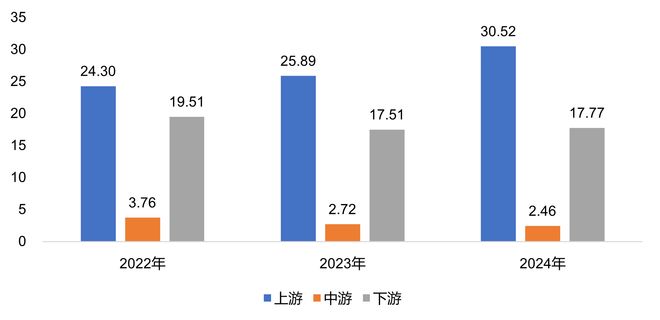
Core Viewpoint - The recent volatility in the gold market, with prices fluctuating between $5,598.75 and $4,402.06 per ounce, highlights the importance of understanding the underlying value of gold through its industry chain [1] Group 1: Industry Chain Overview - The gold industry chain consists of three main segments: upstream exploration and mining, midstream refining and processing, and downstream consumption and investment, which together form the complete path from "underground treasure" to "value carrier" [1] - The upstream segment, which includes gold mining and ore processing, has high resource barriers and industry concentration, with profitability influenced by resource reserves, ore grade, and extraction costs [1] - As of 2024, the global economically extractable gold reserves are approximately 280,000 tons, with only 64,000 tons remaining for extraction, indicating a static extraction lifespan of only 18 years, emphasizing the core value of upstream mining companies [1] Group 2: Profit Distribution in the Industry Chain - Upstream mining companies typically occupy the profit high ground in the industry chain, with an average gross margin of 26.9% from 2022 to 2024, significantly higher than the downstream's 18.3% and midstream's 3.0% [2] - Investors interested in the upstream gold mining sector can track industry dynamics through indices like the Solactive Global Gold Mining Select Index, which includes stocks of companies highly correlated with gold mining across key markets [2] Group 3: Midstream and Downstream Dynamics - The midstream segment focuses on refining and processing gold, converting output from upstream into tradable standard gold products, and is characterized by relatively low profit margins [4] - The downstream segment directly connects investors and end consumers, with investment and consumption demand being the two main pillars driving the gold demand landscape [5] - Recent trends show a rapid increase in investment demand as investors seek to hedge against macroeconomic uncertainties, with products like gold ETFs providing convenient and low-cost asset allocation tools [5] Group 4: Long-term Value Perspective - Despite short-term price fluctuations, the core value logic of the gold industry chain remains intact, supported by upstream resource scarcity, midstream processing capabilities, and downstream consumption and investment demand [7]
纽约期金突破5100美元,上海金ETF、黄金ETF易方达、金ETF南方、黄金ETF、黄金ETF华夏、金ETF等涨超4%
Ge Long Hui· 2026-02-04 07:26
Group 1 - The core viewpoint of the articles indicates a significant rise in gold prices, with spot gold surpassing $5080 per ounce and New York futures exceeding $5100 per ounce, driven by a decline in the dollar index and market sentiment [1][2] - Gold ETFs, including those from various fund companies, have seen increases of over 4%, reflecting the strong performance of gold as an asset class [1] - The traditional research framework for gold pricing, which relies on the dollar and real interest rates, has lost its explanatory power, with non-framework factors gaining prominence [2] Group 2 - Central banks, particularly in non-Western countries, are accelerating gold purchases to replace foreign exchange reserves, indicating a growing consensus of distrust in the dollar [2] - The supply rigidity of gold mining, combined with large-scale central bank purchases, is expected to create a physical shortage and support long-term price increases, with projections suggesting prices could reach $8000 [2] - Short-term trading risks are highlighted, with a current "naked long" market state and high volatility, suggesting potential for a market correction [2][3] Group 3 - Recent volatility in precious metals is attributed to the nomination of Kevin Warsh as the next Federal Reserve Chair, which has led to a rebound in the dollar index and profit-taking in the market [3] - Despite short-term fluctuations, the long-term support factors for gold remain intact, and it is expected to return to a steady upward trend after market adjustments [3] - Silver, due to its dual industrial and financial attributes, has experienced significant price increases but is now under pressure, suggesting a cautious approach for investors [3]
ETF午评 | 金价连续第二日反弹,黄金ETF易方达、黄金ETF博时涨3.92%
Ge Long Hui· 2026-02-04 03:57
Market Performance - The three major A-share indices showed mixed performance in the morning session, with the Shanghai Composite Index closing flat, the Shenzhen Component Index down 0.92%, and the ChiNext Index down 1.74% [1] - The North China 50 Index fell by 1.19%, and the total trading volume in the Shanghai and Shenzhen markets reached 16,297 billion yuan, an increase of 127 billion yuan compared to the previous day [1] - Over 2,900 stocks in the market experienced declines [1] Sector Performance - Sectors that saw gains included coal mining and processing, airport and shipping, photovoltaic equipment, real estate, natural gas, port shipping, construction materials, banking, hydrogen energy, and retail [1] - Conversely, sectors that faced declines included precious metals, AI applications, computing power leasing, semiconductors, and CPO concept stocks [1] ETF Performance - Gold prices rebounded for the second consecutive day, surpassing 5,000 USD, with gold ETFs from E Fund and Bosera both rising by 3.92% [1] - International oil prices increased, leading to a 3.22% rise in the Jiasheng Oil and Gas ETF [1] - The Hong Kong dividend strategy ETFs were active, with the Bosera Hong Kong Dividend ETF rising by 1.67% [1] - However, Hong Kong stocks continued to decline, with the Hong Kong Technology ETF, Hong Kong Internet ETF from E Fund, and the Hong Kong Technology 30 ETF falling by 3.73%, 3.73%, and 3.57% respectively [1] - The New Economy ETF from Yinhua dropped by 2.83% [1]
1月14只ETF扩容逾百亿 释放什么信号?
2 1 Shi Ji Jing Ji Bao Dao· 2026-02-03 13:07
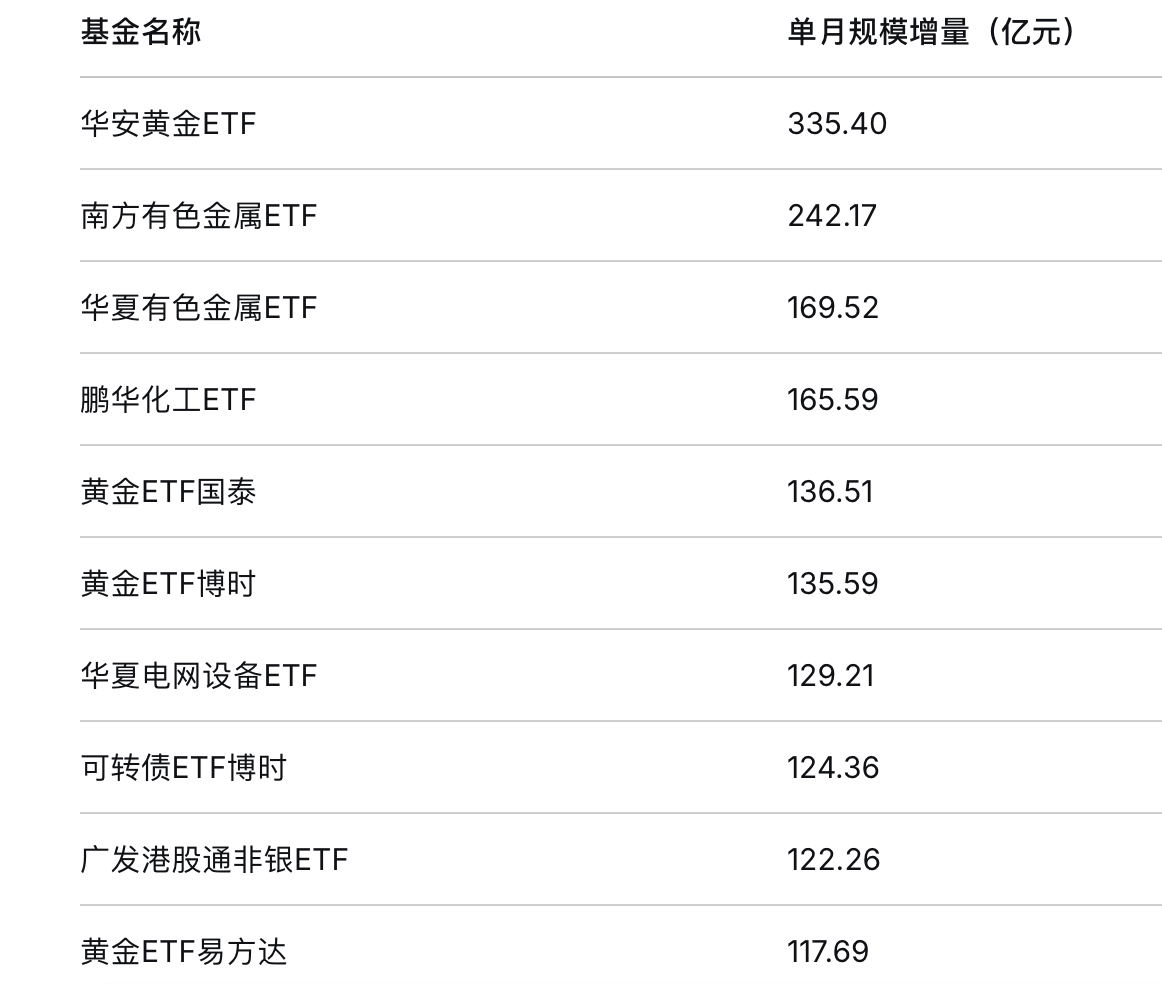
Core Insights - In early 2026, ETF fund flows showed significant divergence, with core broad-based ETFs experiencing large net outflows, while industry-themed ETFs gained popularity and saw substantial inflows [1][9] - The preference for industry-themed ETFs highlights a consensus among investors regarding the support from industrial policies and the positive fundamentals in specific sectors [1][6] ETF Performance - As of January 31, 2026, 14 ETFs had their scales increase by over 10 billion yuan, including 7 stock ETFs, 4 commodity ETFs, 2 cross-border ETFs, and 1 bond ETF [3] - Notable increases in scale included the Huaan Gold ETF (335.4 billion yuan), Southern Nonferrous Metals ETF (242.17 billion yuan), and Huaxia Nonferrous Metals ETF (169.52 billion yuan) [4][7] - The stock ETFs that saw significant scale growth were primarily industry-focused, indicating a market signal for bullish sentiment in related sectors [5][6] Market Trends - The overall ETF fund flow in January 2026 reflected a structural shift, with significant net outflows from core broad-based ETFs and inflows into industry-specific ETFs and gold [9][10] - The A-share market experienced a transition from exuberance to cooling, with the Shanghai Composite Index surpassing 4100 points before entering a consolidation phase [9][11] Investment Strategies - Institutions suggest that the market in February will likely experience volatility, with a focus on "growth and cyclical" dual strategies while being cautious of overheating sectors [11][12] - Recommended investment strategies include focusing on global manufacturing recovery, traditional industry improvements, and technology growth, particularly in AI applications and robotics [12][13]
多只ETF、LOF罕见跌停
Xin Lang Cai Jing· 2026-01-30 12:51
Group 1 - The precious metals, industrial metals, and minor metals sectors experienced a significant decline, with multiple gold and colored ETFs hitting the limit down [1][2][9] - Several LOF funds that had previously hit the limit up faced a limit down after resuming trading, indicating market volatility [10][18] - On January 29, gold and colored ETFs attracted substantial net inflows, while semiconductor-related ETFs also saw reverse positioning [11][15] Group 2 - The communication ETF sector showed a general increase, with several ETFs related to communication and artificial intelligence rising significantly [12][13] - Low-valuation sectors such as agriculture, forestry, and paper-making led the market gains, contrasting with the overall decline in precious metals [12] - The trading volume for gold ETFs surged, with the gold ETF reaching a transaction volume of 257.78 billion, significantly higher than the previous week's average of 71.07 billion [4][14] Group 3 - On January 29, various ETFs related to colored metals and gold saw net inflows exceeding 10 billion, indicating strong investor interest [15][17] - The semiconductor sector, despite its recent declines, attracted significant reverse investments, with notable inflows into semiconductor equipment ETFs [16][17] - The core logic supporting gold prices remains unchanged, driven by high geopolitical risks and the weakening of the dollar's credibility due to high U.S. government deficits [8][19]
金价逼近5600美元,部分金矿股见光死|市场观察
Di Yi Cai Jing· 2026-01-29 06:14
Core Viewpoint - The gold price is nearing $5,600 per ounce, but gold mining stocks are experiencing a pullback, indicating market skepticism about the sustainability of high gold prices [1][2] Group 1: Gold Price and Market Performance - On January 29, the London spot gold price approached $5,600 per ounce, while gold mining stocks in both A-shares and Hong Kong showed a trend of retreating after initial gains [1] - Specific stocks such as Zhaojin Mining (01818.HK) and Zijin Mining International (02259.HK) saw declines exceeding 2% [1] - In the A-share market, leading stocks like Shandong Gold (600547.SH) and Chifeng Jilong Gold Mining (600988.SH) reported increases of 3.89% and 4.55%, respectively [1] Group 2: ETF and Investment Trends - The gold stock ETF (517520) experienced a high turnover of 2.618 billion yuan in half a day, surpassing the previous day's total of 2.019 billion yuan [1] - The tracked gold stock index (931238) has yielded nearly 172% over the past year as of January 28 [1] - The E Fund Gold ETF (159934) rose by 5.13% with a transaction volume of 2.838 billion yuan, approaching the previous day's turnover of 3.624 billion yuan [1] Group 3: Analyst Insights - Analysts suggest that despite the current high gold prices, gold mining stocks are not performing in tandem, reflecting market expectations of a lack of sustainability in high gold prices [2] - The volatility in external markets, particularly the decline in the US dollar index, has contributed to the rise in gold prices [2] - Given the significant short-term gains in both gold prices and mining stocks, some technical indicators are showing signs of being overbought, indicating a potential short-term pullback [2]


罕见“落袋为安”!超1300亿,“跑了”
Zhong Guo Ji Jin Bao· 2026-01-29 06:02
Group 1 - On January 28, the A-share market showed mixed performance with a net outflow of over 130 billion yuan from stock ETFs [1] - The total scale of 1,320 stock ETFs in the market reached 4.3 trillion yuan, with a reduction of 21.7 billion fund shares and a net outflow of approximately 131.2 billion yuan [2] - Industry-themed ETFs and commodity ETFs saw significant net inflows of 17.7 billion yuan and 7.2 billion yuan, respectively, on the same day [2] Group 2 - The SGE Gold 9999 index product had the highest net inflow on January 28, amounting to 6.4 billion yuan, with over 19.1 billion yuan flowing into it over the past five trading days [2] - A total of 53 ETFs experienced net inflows exceeding 1 billion yuan, with the top three being the Huaxia Fund's non-ferrous metals ETF, Penghua Fund's chemical ETF, and Huaxia Fund's gold stock ETF, which saw inflows of 1.4 billion yuan, 1.2 billion yuan, and 1.1 billion yuan, respectively [2][3] - Leading fund companies like E Fund continued to attract net inflows into their ETFs, including 1.1 billion yuan into the gold ETF and 410 million yuan into the pharmaceutical ETF [2] Group 3 - Broad-based ETFs experienced the largest net outflow, totaling 147.2 billion yuan, with the CSI 300 index products seeing a net outflow of 97.5 billion yuan [4] - Market sentiment at the beginning of the year is relatively high, but regulatory measures are expected to cool the market in the short term, while overall opportunities are anticipated to outweigh risks [4] - The investment outlook for A-shares remains positive, with expectations of moderate profit recovery by 2026, emphasizing the importance of dynamic asset allocation in ETFs [4]