
华夏布拉德斯科巴西伊博维斯帕ETF(QDII)

Search documents
“巴西ETF”,上市交易喽!
Sou Hu Cai Jing· 2025-11-12 15:57
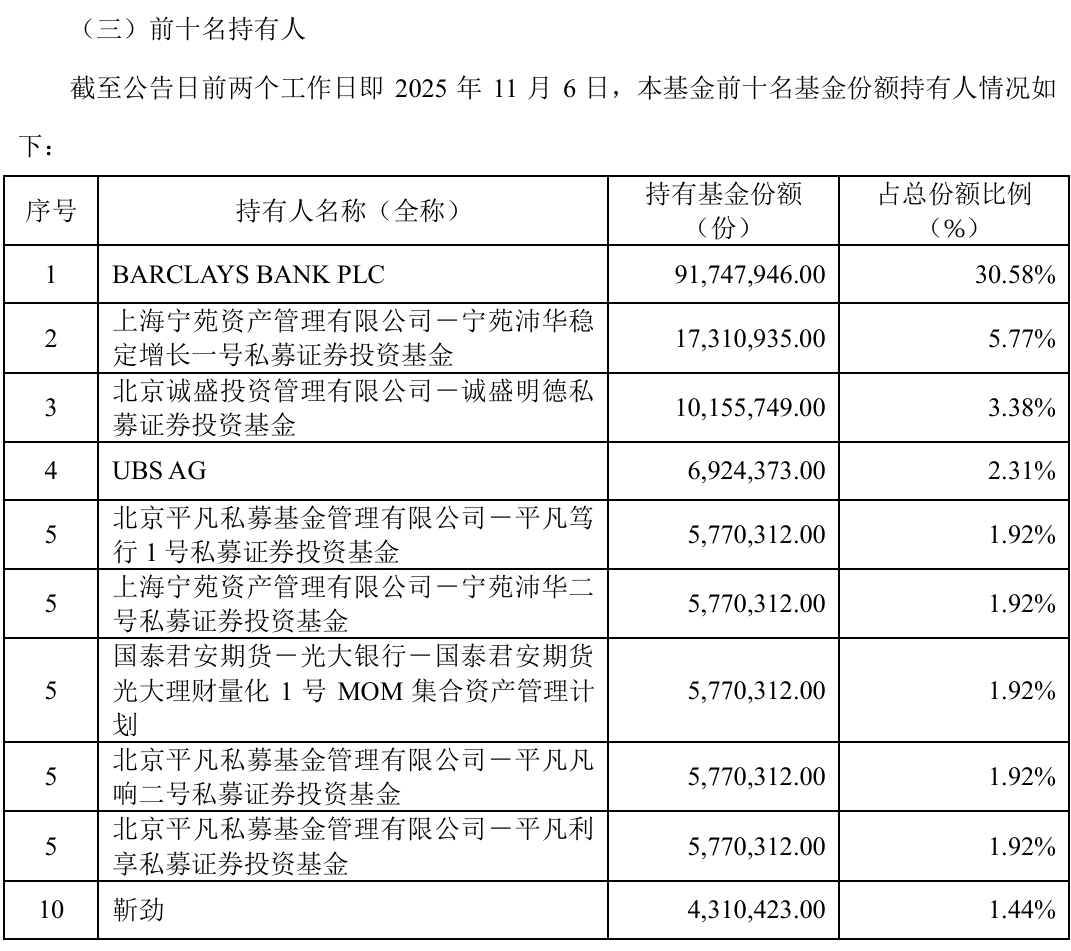
Core Insights - The launch of two Brazilian ETFs by Huaxia Fund and E Fund is generating significant market interest, with both funds reaching their fundraising limits within a day [1][2] - The subscription rates for the ETFs are notably high, with E Fund's ETF at 11.823% and Huaxia Fund's ETF at 11.53867900% [1] - Major foreign institutions, including Barclays Bank PLC and UBS AG, are among the top holders of these ETFs, indicating strong foreign interest in Brazilian equities [3][4] Fundraising and Subscription Details - Both ETFs set a fundraising cap of 300 million yuan, and the subscription was completed in just one day [1] - E Fund's Brazilian ETF (520870) had 12,313 subscription accounts, while Huaxia Fund's ETF (159100) had 9,081 accounts, with average subscription amounts ranging from 200,000 to nearly 300,000 yuan [1] - The top holders of Huaxia Fund's ETF include Barclays Bank PLC with 30.58% and Shanghai Ningyuan Asset Management with 5.77% [2] Performance and Valuation - Recent performance of the Brazilian stock market has been positive, with E Fund's ETF showing a net value of 1.0154, reflecting a 1.51% increase [4][6] - Huaxia Fund's ETF reported a reference net value of 1.017, slightly higher than E Fund's, indicating competitive performance [6] - Both ETFs are expected to be actively traded post-listing, with T+0 trading support, which may lead to speculative trading behavior [6]

进军“足球王国”!跨境ETF再出“新品”,配售创近5年新低
Zheng Quan Shi Bao Wang· 2025-11-06 05:13
Core Insights - The issuance of two Brazilian ETFs has seen a record low subscription ratio of less than 12%, marking the lowest level in nearly five years for cross-border ETFs [1][2][3] - The total scale of cross-border ETFs has reached nearly 900 billion yuan, expanding from the initial focus on the US to include markets such as Saudi Arabia, Japan, South Korea, and Singapore [1][4] Summary by Sections Brazilian ETFs - The E Fund Itaú Brazil IBOVESPA ETF had a subscription ratio of 11.823%, with over 300 million shares applied for, while the Huaxia Bradesco Brazil IBOVESPA ETF had a subscription ratio of 11.54% [2][3] - The low subscription ratios are attributed to a set fundraising cap of 300 million yuan for each product and high investor enthusiasm, with total subscription funds exceeding 5 billion yuan [3] Cross-Border ETF Trends - As of November 5, there are 185 cross-border ETFs with a total scale of 897.968 billion yuan, with 52.76% of this growth occurring since 2025 [4][5] - The majority of these ETFs focus on mature markets, with significant products tracking indices from Hong Kong and the US [4] Global Investment Landscape - The trend of cross-border ETFs reflects a growing demand for diversified and global investment opportunities among investors [5][6] - The dual-directional flow of funds is emphasized, with Chinese investors accessing overseas assets and foreign investors gaining exposure to Chinese markets through ETFs [6][7]
进军“足球王国”!跨境ETF再出“新品”,配售创近5年新低
券商中国· 2025-11-06 04:08
Core Insights - The issuance of the first two Brazilian ETFs has seen a low subscription ratio of less than 12%, marking the lowest level since 2021 and highlighting the evolving landscape of cross-border ETFs [1][3][4] Group 1: Brazilian ETFs - The subscription ratio for the E Fund Itaú Brazil IBOVESPA ETF is 11.823%, while the Huaxia Bradesco Brazil IBOVESPA ETF has a ratio of 11.54%, both reflecting a significant oversubscription with total funds exceeding 5 billion yuan [3][4] - The low subscription ratios are attributed to a set fundraising cap of 300 million yuan for each product and high investor enthusiasm, with total subscription funds exceeding 5 billion yuan [4] - The trend of low subscription ratios is not isolated, as seen in the first two Saudi ETFs launched in June 2024, which also faced fundraising caps due to QDII quota limitations [4] Group 2: Cross-Border ETF Trends - The total scale of cross-border ETFs has reached nearly 900 billion yuan, with emerging markets becoming a focal point for investment [1][6] - Since 2025, the scale of cross-border ETFs has increased by 473.75 billion yuan, accounting for 52.76% of the total, with 47 new products launched [6] - The majority of cross-border ETFs focus on Hong Kong and US markets, with 24 ETFs exceeding 10 billion yuan in scale, indicating a strong market interest [6] Group 3: Global Investment Trends - The trend of "global layout" is becoming increasingly evident, driven by investor demand for diversification and the opening of mechanisms like the Shanghai-Hong Kong Stock Connect [9] - Cross-border ETFs facilitate a two-way flow of capital, allowing both foreign and domestic investors to access each other's markets [11] - Emerging markets, including India, Vietnam, and Russia, are expected to become future focal points for fund companies, as they have shown strong market performance [12]

跨境ETF规模逼近9000亿元 两只巴西ETF发行配售比创近5年新低
Zheng Quan Shi Bao· 2025-11-05 21:51
Group 1 - The core point of the article highlights the low subscription ratios of the first two Brazilian ETFs, which are below 12%, marking the lowest since 2021 and reflecting the current trend in cross-border ETF development [1][2][3] - The two Brazilian ETFs, managed by E Fund and Huaxia Fund, have subscription ratios of approximately 11.82% and 11.54% respectively, with total subscription funds exceeding 5 billion yuan [2][3] - The low subscription ratios are attributed to a combination of a relatively low fundraising cap of 300 million yuan and high investor enthusiasm, indicating a strong market interest in these new products [3] Group 2 - The global trend of cross-border ETFs is becoming increasingly evident, with the total number of cross-border ETFs reaching 185 and a combined scale of approximately 897.97 billion yuan as of November 5 [4] - The market has seen a significant increase in cross-border ETFs focusing on emerging markets, particularly in regions like the Middle East and South America, with new products being launched to cater to diverse investor needs [5][6] - The dual-directional flow of funds through cross-border ETFs is emphasized, showcasing the mutual benefits for both domestic and international investors, as seen in the recent ETF interconnectivity initiatives between China and Brazil [7][8]
跨境ETF规模逼近9000亿元两只巴西ETF发行配售比创近5年新低
Zheng Quan Shi Bao· 2025-11-05 18:36
Core Insights - The issuance of the first two Brazilian ETFs has seen a record low subscription ratio of less than 12%, marking the lowest since 2021, highlighting the challenges in the cross-border ETF market [1][2] Group 1: Brazilian ETFs Issuance - The two Brazilian ETFs, managed by E Fund and Huaxia Fund, reported subscription ratios of approximately 11.82% and 11.54% respectively, with total subscription funds exceeding 5 billion yuan [1][2] - The low subscription ratio is attributed to a fundraising cap of 300 million yuan for each product and high investor enthusiasm [2] Group 2: Cross-Border ETF Market Trends - The total scale of cross-border ETFs has approached 900 billion yuan, with a notable increase in products focusing on emerging markets [1][4] - As of November 5, there are 185 cross-border ETFs with a combined scale of 897.97 billion yuan, indicating a growing trend towards global diversification in ETF offerings [4][6] Group 3: Global ETF Connectivity - The cross-border ETF market is characterized by a two-way flow of capital, allowing both foreign and domestic investors to access each other's markets [7] - Recent developments include the launch of mutual ETFs in Brazil and Singapore, enhancing the connectivity between these markets and China's [8]
跨境投资热情不减 两只巴西ETF遭抢购
Zhong Guo Zheng Quan Bao· 2025-11-04 20:36
Core Insights - Two Brazil-focused cross-border ETFs have seen significant demand, with subscription amounts quickly surpassing their fundraising limits, indicating strong investor interest in emerging market investment products [1][2][3] Group 1: ETF Launch and Performance - On October 31, two Brazil ETFs were publicly launched, with each having a fundraising cap of 300 million RMB, and both exceeded this limit on the first day of subscription [2] - The subscription confirmation ratios for the two ETFs were approximately 11.5% for the Huaxia Fund and 11.8% for the E Fund, reflecting the high demand [3] - The Huaxia Fund's Brazil ETF attracted around 2.6 billion RMB in subscriptions, while the E Fund's Brazil ETF garnered over 2.5 billion RMB on the same day [3] Group 2: Growth of Cross-Border ETFs - The total scale of cross-border ETFs has approached 900 billion RMB, with significant growth from 565.5 billion RMB at the end of Q2 to approximately 884 billion RMB by the end of Q3 this year [7] - The introduction of these Brazil ETFs adds to the growing variety of cross-border ETFs, which now include products tracking markets in Hong Kong, the US, Japan, and the Middle East [4][5] Group 3: Investor Sentiment and Market Trends - Investor enthusiasm for cross-border ETFs is evident, with discussions on sales platforms highlighting concerns about allocation ratios and the desire for more shares [5] - The trend of investing in cross-border ETFs is becoming increasingly popular, allowing ordinary investors to participate in global markets with relatively small amounts of capital [7]
跨境投资热情不减两只巴西ETF遭抢购
Zhong Guo Zheng Quan Bao· 2025-11-04 20:17
Group 1 - Two Brazil-focused cross-border ETFs launched on October 31, attracting significant investor interest with subscription amounts exceeding the initial fundraising cap of 300 million RMB [1][2] - The subscription confirmation ratios for the two ETFs were approximately 11.5% for Huaxia Fund's ETF and 11.8% for E Fund's ETF, indicating strong demand for emerging market investment products [1][2] - The total scale of cross-border ETFs has approached 900 billion RMB, reflecting a growing trend among ordinary investors to participate in global asset allocation [1][4] Group 2 - The rapid growth of cross-border ETFs is evident, with the total scale increasing from approximately 424 billion RMB at the end of 2022 to about 884 billion RMB by the end of Q3 2023, effectively doubling in size [4] - New emerging market ETFs, such as those tracking the Saudi Arabian market and the Emerging Asia ETF, have been introduced, further diversifying the offerings available to investors [3] - The popularity of cross-border ETFs has led to increased trading activity, but also to potential risks such as high premium rates and liquidity issues due to strict subscription limits imposed by QDII quotas [4][5]
基金周报:首批巴西 ETF 申报,多只贵金属基金限购-20251020
Guoxin Securities· 2025-10-20 06:30
- The report introduces the "SSE STAR Market Innovation Growth Strategy Select Index," which focuses on selecting 80 listed companies with strong technological innovation capabilities and good growth potential from various industries on the STAR Market[13][14] - The index incorporates traditional factors such as market capitalization and fundamentals, while also considering R&D capabilities and profitability[13][14] - The index innovatively integrates the SPDB's technology innovation evaluation system, which is based on three categories of indicators: "technological innovation strength, team innovation strength, and equity innovation strength"[14] - The median excess return of index-enhanced funds last week was 0.24%, and the median return of quantitative hedge funds was -0.06%[33] - Year-to-date, the median excess return of index-enhanced funds was 3.78%, and the median return of quantitative hedge funds was 0.68%[33] - The top-performing index-enhanced fund for the week was the "Shenwan Lingxin CSI 500 Index Enhanced A," with a weekly excess return of 3.20%[53] - The top-performing quantitative hedge fund for the week was the "ICBC Absolute Return A," with a weekly return of 1.17%[54]
多只贵金属基金限购【国信金工】
量化藏经阁· 2025-10-20 04:08
Market Review - The A-share market saw a decline across major indices, with the Shanghai Composite Index down by 1.47%, CSI 300 down by 2.22%, and CSI 1000 down by 4.62% [5][11]. - The banking, coal, and food and beverage sectors performed well, with returns of 4.99%, 4.27%, and 0.85% respectively, while the electronics, media, and automotive sectors lagged with returns of -7.10%, -6.28%, and -6.24% [17][18]. - The central bank's net reverse repurchase was 347.9 billion yuan, with a total of 1.021 trillion yuan maturing, resulting in a net market injection of 673.1 billion yuan [19]. Fund Performance - Last week, the performance of active equity, flexible allocation, and balanced mixed funds was -4.5%, -3.5%, and -2.6% respectively [5][30]. - Alternative funds have shown the best performance this year, with a median return of 34.48%, while active equity, flexible allocation, and balanced mixed funds had median returns of 25.02%, 18.92%, and 11.66% respectively [5][36]. Fund Issuance - A total of 10 new funds were established last week, with a total issuance scale of 9.548 billion yuan, an increase from the previous week [3][41]. - Among the new funds, 4 were equity mixed funds and 3 were passive index funds, with issuance scales of 4.033 billion yuan and 1.613 billion yuan respectively [42][41]. ETF Developments - On October 13, two ETFs tracking the Brazilian Ibovespa index were filed by Huaxia Fund and E Fund, marking a significant step in the interconnection between Chinese and Brazilian capital markets [7]. - The newly launched ETFs include the Huaxia Bradesco Brazil Ibovespa ETF and the E Fund Itaú Brazil IBOVESPA ETF, which cover major commodity giants like Vale and Petrobras [7]. Precious Metals Fund Restrictions - Due to the recent surge in precious metal prices, including record highs for gold and silver, several fund managers have implemented purchase limits to ensure stable fund operations [8][9]. - For instance, the Huatai-PineBridge Gold and Precious Metals Fund announced a limit of 20,000 yuan for single-day purchases per account starting October 15 [9]. New Index Launch - The Shanghai Stock Exchange launched the Innovation Growth Strategy Selected Index on October 15, focusing on 80 companies with strong technological innovation capabilities from the Sci-Tech Innovation Board [10]. - This index aims to enhance capital empowerment for technology innovation and reflects the overall performance of companies with both innovation and growth characteristics [10].

头部基金,争相申报巴西主题QDII
Zheng Quan Shi Bao· 2025-10-16 02:46
Core Viewpoint - Major Chinese public funds are launching QDII products tracking Brazilian market indices, indicating a growing interest in the South American market due to strong economic ties and investment opportunities [1][2]. Group 1: QDII Products and Market Performance - Two new QDII ETFs, 华夏布拉德斯科巴西伊博维斯帕ETF and 易方达伊塔乌巴西IBOVESPAETF, have been submitted for approval, tracking the Ibovespa index, which reflects the overall performance of the Brazilian stock market [2][3]. - The Ibovespa index has seen a significant increase, rising approximately 18% this year and reaching a historical high of 147,578.39 points on September 30 [4]. Group 2: Strategic Partnerships and Market Expansion - 华夏基金 and 汇添富基金 are collaborating with Bradesco, a major Brazilian asset management company, while 易方达基金 partners with Itaú Asset Management, enhancing their presence in the South American market [3][8]. - Chinese public funds are also exploring opportunities in other South American countries like Chile, leveraging local partnerships to expand their influence and recognition in the region [1][8]. Group 3: Trade Relations and Economic Impact - In 2024, the bilateral trade volume between China and Brazil is projected to reach $188.1 billion, with China being Brazil's largest trading partner for 16 consecutive years [6]. - Brazilian agricultural exports, including beef, corn, soybeans, and coffee, are experiencing strong growth in the Chinese market, further solidifying economic ties [4][6]. Group 4: Future Investment Plans - Companies like 蜜雪冰城 and 瑞幸咖啡 are planning significant investments in Brazil, with 蜜雪冰城 committing to invest at least 4 billion RMB in agricultural procurement over the next 3-5 years [4][5]. - 瑞幸咖啡 aims to purchase a total of 240,000 tons of coffee beans from Brazil between 2025 and 2029, valued at 10 billion RMB [5].