华泰柏瑞新金融地产A

Search documents
跌麻了才明白:真正能拿住的收益,长这样……
聪明投资者· 2026-03-26 07:03
Core Viewpoint - The article discusses the current market conditions and emphasizes the importance of understanding what level of returns can be sustained by investors, highlighting that high risk does not necessarily equate to high returns [3][4]. Group 1: Investment Strategies and Fund Performance - Yang Peihong's analysis indicates that funds with a maximum drawdown between 15% and 30% over the past six years achieved an average return of 72.25%, translating to an annualized return of approximately 9.6% [4]. - A selection of active equity funds with a maximum drawdown of less than -20% and an annualized return exceeding 8% over the past five years resulted in 11 qualifying products [5]. - Among the funds analyzed, eight products are highlighted for their performance under the specified criteria [7]. Group 2: Fund Managers and Their Strategies - Fund managers Jiang Cheng, Xu Yan, and Yang Xinxin have been consistently tracked, with each achieving annualized returns exceeding 10% under the maximum drawdown condition of 20% [9]. - Jiang Cheng's fund, Zhongtai Xingyuan, has a return of 190.23% since its management began in December 2018, with an annualized return of 15.69% [10]. - Xu Yan's fund, Dachen Competitive Advantage, has a return of 125.24% since December 2019, with an annualized return of 13.89% [15]. Group 3: Risk Management and Investment Philosophy - Xu Yan emphasizes safety as the primary discipline in fund management, stating that avoiding bubbles leads to smaller drawdowns, albeit with potential performance pressures during certain periods [19]. - The article notes that Jiang Cheng's drawdown control is a result of his stringent valuation criteria, which helps maintain a balance between risk and return [14]. - Fund manager Yu Bo focuses on risk identification and employs a systematic approach to manage positions, adjusting equity exposure based on market conditions [44][48]. Group 4: Sector and Asset Allocation - The funds analyzed predominantly invest in sectors such as banking, chemicals, construction, and real estate, with a focus on high capital adequacy and low-cost debt [13]. - The article highlights the importance of selecting undervalued stocks with strong fundamentals, as emphasized by fund manager Wu Xuan, who has consistently outperformed the market over the past nine years [26][27]. - The investment strategies of fund managers involve a mix of top-down and bottom-up approaches, focusing on valuation and market conditions to guide asset allocation [35].


金融产品每周见:金融地产行业基金:从投资能力分析到基金经理画像-20260306
Shenwan Hongyuan Securities· 2026-03-06 02:27
1. Report Industry Investment Rating No relevant content provided. 2. Core Viewpoints of the Report - Based on fund holdings, financial and real estate industry funds can be classified into three categories: "Finance and Real Estate + Satellite", "Sub - sector Tracks", and "Sector Rotation". Most fund managers adopt the "Sub - sector Tracks" strategy [4]. - Three aspects of the overall investment ability analysis of financial and real estate industry funds: 1) Compared with the sector index, financial and real estate industry funds perform slightly weaker, which is related to the low differentiation within the financial and real estate sectors; 2) The relatively good - at industries are banking and non - bank finance, while the relatively weak - at industry is real estate; 3) Fund managers of financial and real estate industry funds have stronger stock - picking abilities for financial and real estate stocks compared to those of all - industry funds [4]. - Seven dimensions to compare financial and real estate industry funds with different style characteristics: 1) There is a negative correlation between turnover rate and performance; 2) High - performing financial and real estate theme products pay more attention to ROE; 3) The market - value style of financial and real estate funds' stock holdings is generally large - cap; 4) The left - and right - side investment positions of financial and real estate funds are at the median level of the market; 5) Find fund managers with high - confidence stock - picking abilities through the skewness and kurtosis coefficients of stock - picking return distribution; 6) Characterize fund managers' environmental adaptability through finding similar funds and analyzing their performance in favorable and unfavorable environments; 7) The performance distribution of sub - sector rotation is scattered. There are no obvious similarities in the stock holdings of high - performing products in the past year, and the performance of each product in each quarter varies greatly [4]. - How to screen the observation list of financial and real estate industry funds: Screen with reference to the following quantitative indicators: 1) Excess performance momentum; 2) Performance in favorable and unfavorable environments; 3) Stock - picking ability; 4) Left - and right - side investment ability; 5) Other considerations: The tenure of the fund manager should be as long as possible, and the fund size should not be too large or too small [4]. 3. Summary According to Relevant Catalogs 3.1 Financial and Real Estate Industry Fund Classification - **Classification Methods**: Classify based on the allocation and rotation ratios of funds in the primary and secondary industries of the financial and real estate sectors in the past three years, including "Finance and Real Estate + Satellite" (average allocation ratio between 60% - 70%), "Sector Rotation" (average allocation ratio below 60%), "Sub - sector Tracks" (average allocation ratio of sub - sectors > 50% and the latest allocation ratio > 60%), "Financial and Real Estate Rotation" (average unilateral annualized turnover rate of primary industries within the financial and real estate sectors > 60%), and "Financial and Real Estate Equilibrium" (other financial and real estate industry funds) [12]. - **Classification Results and Representative Funds**: Financial and real estate industry funds mainly adopt the "Sub - sector Tracks" strategy, with prominent scale and quantity. Most of these funds are concentrated in large - finance and banking. There are also a small number of "Finance and Real Estate + Satellite" and "Sector Rotation" products. Currently, there are few products focusing on sub - sectors such as real estate, securities, and insurance [19]. - **Overall Situation of Financial and Real Estate Index Funds**: In the past year, the scale of financial and real estate index funds has been much larger than that of financial and real estate active equity funds. In 2025, the scale of financial and real estate index funds increased significantly, especially in Q3 of 2025. Most of the large - scale financial and real estate index funds are ETF products, and many of them track the securities company index, while some also track non - bank - related or Hong Kong - related financial indices [20][24]. - **Overview of All Tracked Indices of Financial and Real Estate Index Funds**: The report lists various indices tracked by financial and real estate index funds, including the scale, number of tracking funds, and the largest - scale tracking fund for each index [25]. 3.2 Holding Characteristics: Can Financial and Real Estate Industry Funds Create Positive Excess Returns? - **Overall Performance vs. Passive Index**: As a whole, financial and real estate industry funds cannot outperform passive indices. This is because the financial and real estate sectors have performed well since 2024, and the low differentiation within the sectors makes it difficult for industry funds to create higher Alpha in an upward environment [30]. - **Excess Returns at the Industry Level**: Financial and real estate industry funds are relatively good at banking and non - bank finance but relatively weak at real estate [31]. - **Stock - picking Ability for Financial and Real Estate Stocks**: Fund managers of financial and real estate industry funds have stronger stock - picking abilities for financial and real estate stocks compared to those of all - industry funds. The weaker performance of the funds compared to the index is mainly due to insufficient positions [35]. - **Holding Characteristics Compared with Balanced Funds**: Financial and real estate industry funds and balanced funds tend to have similar preferences for sub - sectors, but financial and real estate industry funds focus on banking and insurance earlier. In terms of individual stock allocation, financial and real estate industry funds and balanced funds focus on the same key stocks, but financial and real estate industry funds currently focus more on banking, while balanced funds also have relatively high allocations in some real estate and diversified finance stocks [41]. - **Cluster Analysis of Financial and Real Estate Industry Funds**: Through cluster analysis, financial and real estate industry funds can be roughly divided into five types, including those with rotation styles, real - estate - chain theme funds, large - finance theme funds with different港股 allocation ratios, etc. [45]. 3.3 Comparison of Financial and Real Estate Funds with Different Style Characteristics - **Turnover and Trading Dimension**: There is a negative correlation between turnover rate and performance. In the past year, high - performing products generally adopted low - turnover investment strategies. In the past two years, there are high - performing products in both moderate - turnover and low - turnover categories [48]. - **Stock - holding Style Dimension**: High - performing financial and real estate theme products pay more attention to ROE. The market - value style of financial and real estate funds' stock holdings is generally large - cap, and most high - performing products in the past two years are of large - cap or medium - large - cap styles [52][56]. - **Stock - holding Popularity Dimension**: The proportion of the financial and real estate sector in the market - preferred stocks has increased significantly since 2024, and the structure has changed significantly. Most high - performing products focused on market - preferred stocks in 25H1 [60]. - **Left - and Right - side Dimension**: The left - side buying coefficients of financial and real estate funds are at the median level of active equities. There are high - performing products in both left - side and right - side investment strategies [63]. - **Stock - picking Ability Dimension**: By calculating the stock - picking return distribution of financial and real estate funds, products with moderately right - skewed, moderately peaked, and high mean/standard - deviation values are selected. Funds such as E Fund Financial Industry A, BOC Financial and Real Estate A, and Fullgoal Financial and Real Estate Industry A have more suitable stock - picking ability indicators [69]. - **Favorable and Unfavorable Environment Dimension**: Different types of products show different market - environment adaptability results. Most financial and real estate theme funds perform better in favorable environments than in unfavorable environments, and there are also some products with balanced performance in both environments [72]. - **Sub - sector Rotation Dimension**: The sector - rotation performance of financial and real estate theme funds is highly polarized. There are actively rotating products, products that淡化 rotation, and products that rotate moderately [75]. - **High - performing Products in the Past Year**: The top - ten high - performing financial and real estate theme products in the past year mostly had a performance of over 15%, and some leading products achieved a return of over 20%. There are no significant similarities in the stock holdings of these products, and their performance in each quarter also varies greatly [79]. - **QDII Active Financial and Real Estate Funds**: There are currently three QDII active equity funds focusing on global real - estate investment opportunities, with different investment characteristics in terms of investment regions and stock - holding concentration [83]. 3.4 Financial and Real Estate Theme Fund Observation List - **Selection Criteria**: Select products based on quantitative indicators such as excess performance momentum, performance in favorable and unfavorable environments, stock - picking ability, left - and right - side investment ability, and also consider factors such as the tenure of the fund manager and fund size. For new fund managers, the time - length and size requirements can be appropriately relaxed [88]. - **Observation List and Data Summary**: The report lists the observation list of financial and real estate funds, including information such as fund classification, code, manager, scale, and performance indicators [89]. - **Short - term Supplementary List**: Considering products that have shifted towards the financial and real estate sectors in the short term, a supplementary list is added, which focuses more on the one - year performance of the funds [90].
成长价值基金池:超额收益显著提升
Minsheng Securities· 2025-08-12 08:30
Group 1 - The core investment strategy focuses on buying competitively advantageous companies at reasonable prices to earn compound growth, emphasizing strong business models and financial robustness [1][8] - The growth value fund pool has shown a significant annualized return of 16.88% from February 2, 2015, to August 7, 2025, outperforming the equity fund index by 9.36% [1][10] - The fund pool has maintained a high annualized Sharpe ratio of 0.82, indicating effective risk-adjusted returns, and has consistently outperformed the equity fund index in most years [10][13] Group 2 - The excess returns are primarily driven by stock selection, with notable contributions from industry rotation and dynamic adjustments [2][13] - The growth value funds are defined based on their relative undervaluation characteristics, focusing on funds with positive exposure to the PB-ROE factor [2][21] - The selected growth value funds exhibit high and stable dynamic returns, with a focus on industry and stock selection [22] Group 3 - The report lists a selection of growth value funds, highlighting their respective managers, sizes, and year-to-date returns, with some funds showing returns exceeding 50% [3][22] - The fund pool has increased its allocation to the financial sector while reducing exposure to TMT, indicating a strategic shift in response to market conditions [18][20] - The report emphasizes the importance of matching individual companies' operational stages with industry trends for effective stock selection [25]
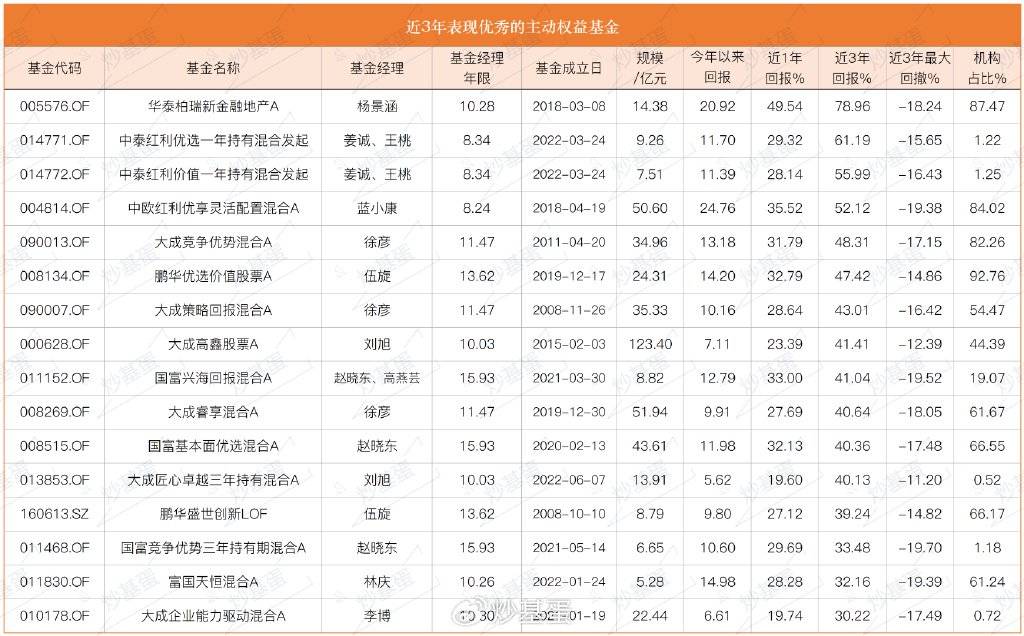
三年回撤小于20%的基金经理,只有这么几位了
Sou Hu Cai Jing· 2025-08-07 07:18
Market Overview - Recent market performance has been strong, with US stocks experiencing a significant drop last Friday due to "data revision," yet continuing to rise this week, reaching new highs for the year [1] - The Shanghai Composite Index also hit a new closing high for the year, indicating a vibrant market environment [1] - Key indicators of market activity include a trading volume of 1.73 trillion and margin financing data surpassing 2 trillion for the first time in ten years [1] Investment Trends - The market is currently favoring sectors such as technology (AI, robotics, innovative pharmaceuticals) and banking, leading to profitable opportunities [1] - There is a notable structural market trend this year, with actively managed equity funds outperforming passive funds [2][3] - The average return of equity mixed funds has increased by 15.81%, while the CSI 300 Index has only risen by 4.28% [1] Fund Performance - A review of actively managed equity funds shows that only 16 funds met the criteria of having over 500 million in size, a three-year return exceeding 30%, and a maximum drawdown within 20% [6] - The selected funds are primarily managed by experienced fund managers, most of whom have over ten years of experience [7] Notable Fund Managers - Yang Chonghan from Huatai-PB focuses on financial sectors, achieving a return of 20.93% this year, outperforming the banking index which rose by 13.59% [8] - Jiang Cheng, known for value investing, has two funds that focus on dividend stocks, particularly in the banking sector, showing strong performance in both volatile and rising markets [8] - Xu Yan from Dacheng has three funds listed, maintaining a consistent performance with a stock holding ratio around 60% [9] Fund Selection Criteria - The selection criteria for the funds included a minimum size of 500 million, a three-year return of over 30%, and a maximum drawdown of 20% [5] - The analysis suggests that the defensive capabilities of these funds are strong, with a focus on minimizing drawdowns while still achieving reasonable returns [13]