原味鸡汉堡

Search documents
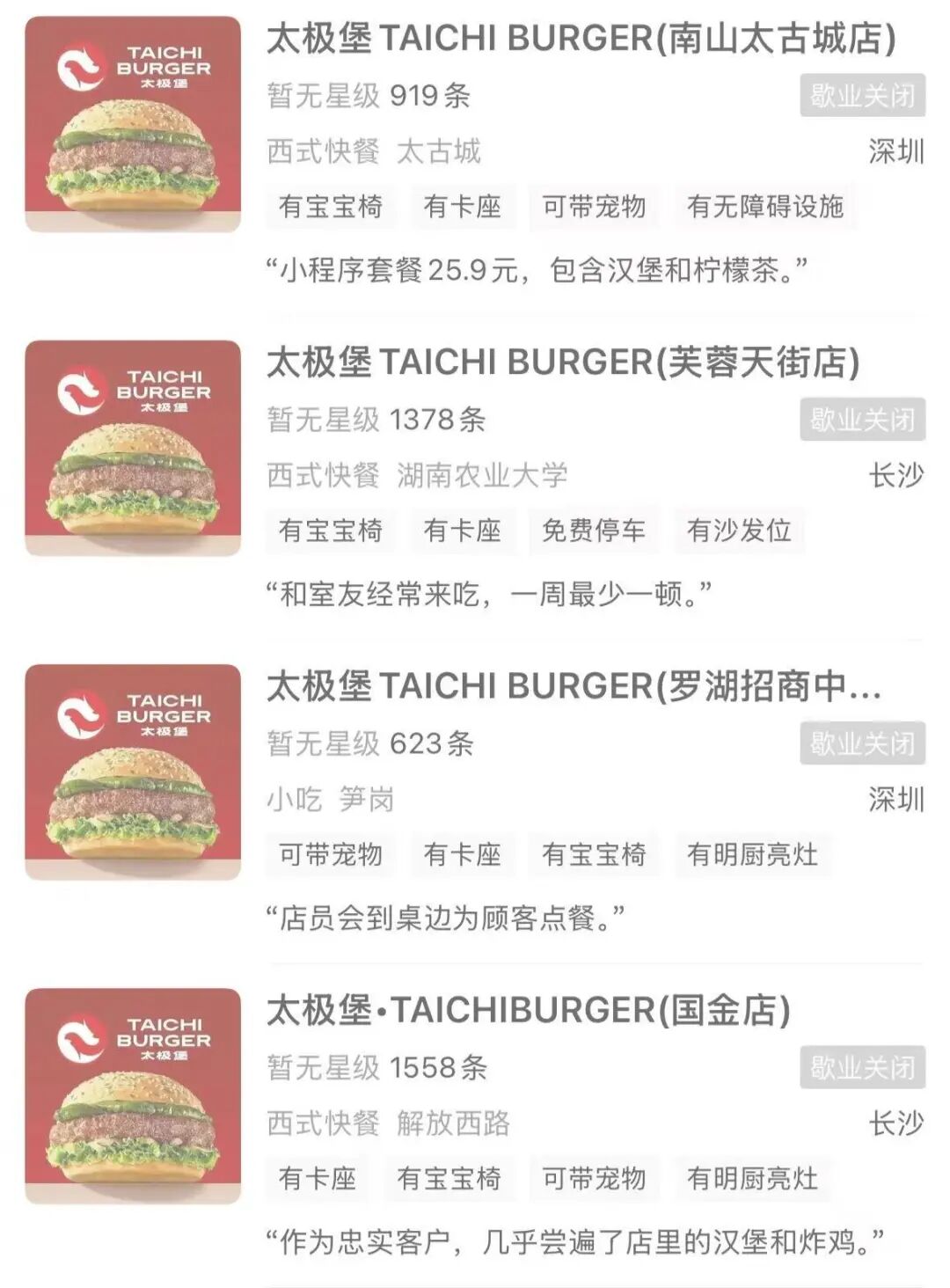
创立仅1年,又一网红汉堡品牌多地关店?
3 6 Ke· 2025-12-01 12:26
Core Viewpoint - The rapid rise and subsequent closure of multiple locations of the burger brand Taiji Burger, which was established in 2024, raises questions about its sustainability and market strategy in a competitive landscape [1][8]. Company Overview - Taiji Burger was launched on November 30, 2024, in Changsha, aiming to redefine burgers with an "Oriental burger" concept and high-end positioning [8]. - The brand initially gained popularity through its unique design and product offerings, including a new Chinese-style menu featuring high-quality ingredients [10][11]. Expansion and Closure - Despite opening 17 locations within a year, Taiji Burger has faced significant closures, with reports indicating that nearly 60% of its stores have shut down in a short period [13][14]. - In Changsha, out of six original locations, only two remain operational, while in Shenzhen, five out of ten stores are closed [14]. Challenges Faced - High operational costs due to manual preparation processes and a large store model in prime urban areas have created financial strain [15][18]. - The brand's average customer price of around 30 yuan is at a disadvantage in a market increasingly dominated by low-cost competitors [19][22]. Competitive Landscape - The hamburger market is highly competitive, with major players like KFC and McDonald's expanding aggressively, while local brands are also gaining traction with cost-effective strategies [22][23]. - Taiji Burger's position in the market is further challenged by established brands that have created significant supply chain advantages and customer loyalty [23][25]. Future Outlook - The future of Taiji Burger remains uncertain, with the potential for further store closures unless the brand can optimize its business model or innovate its product offerings [25].

百胜中国2024年营收规模、同店跌幅创新高:增长动能与战略挑战并存
Xin Lang Zheng Quan· 2025-04-22 07:15
Core Insights - Yum China reported a record revenue of $11.3 billion for 2024, marking a 3% year-on-year increase, with restaurant revenue contributing approximately 94% of total revenue [2] - The company faces challenges in same-store sales, which declined by 3%, indicating pressure on profitability despite overall revenue growth [2][3] - The strategic focus on expanding into lower-tier cities and increasing franchise store ratios is aimed at overcoming geographical limitations and enhancing market penetration [4] Revenue Growth and Profit Structure - Total revenue reached $11.3 billion, with restaurant income at $10.651 billion, primarily driven by KFC's $8.5 billion revenue, accounting for 75% of total revenue [2] - KFC's same-store sales fell by 4%, while Pizza Hut's dropped by 10%, reflecting a reliance on store expansion rather than same-store performance [2] - The company added 1,751 new stores, bringing the total to 16,400, covering over 2,200 towns [2] Profitability and Cost Management - Core operating profit increased by 12% to $1.19 billion, but KFC's operating margin decreased by 0.8 percentage points to 16.9% due to rising labor costs and changes in product mix [3] - Pizza Hut improved its profit margin by 0.2 percentage points to 12% through menu adjustments and the "WOW store" model [3] - The company announced a $1.5 billion shareholder return plan, including $248 million in dividends and $1.24 billion in stock buybacks, supported by a strong operating cash flow of $1.4 billion [3] Strategic Transformation and Future Challenges - Yum China is accelerating its penetration into lower-tier cities, with franchise stores expected to increase to 40-50% for KFC and 20-30% for Pizza Hut [4] - The company faces management challenges with rapid expansion, as the payback period for new stores has extended from 2 years to 2-3 years [4] - Digital initiatives have shown promise, with over 670 million members and digital orders accounting for 90% of sales, but rising costs in innovation, particularly in the coffee segment, pose risks [4] Compliance and Market Position - The transgenic oil incident in Tianjin highlighted compliance weaknesses, potentially increasing food safety compliance costs amid stricter regulations [5] - The company lost 2 percentage points in market share in the 10-20 yuan price segment to local competitors, indicating heightened price sensitivity among consumers [5] - The balance between high quality and affordability will be crucial for maintaining market leadership in a competitive landscape [5]

百胜中国屈翠容:深度消费者洞察+人工智能技术辅助 实现品牌创新发展之路
Cai Jing Wang· 2025-03-25 12:58
Core Insights - The CEO of Yum China, Qu Cuirong, emphasized the resilience of the Chinese market and the necessity for companies to understand consumer needs deeply to drive high-quality innovation [1][3]. Group 1: Market Potential and Consumer Insights - The Chinese market remains vast and competitive, with both international and local brands intensifying their competition [3]. - Recent changes in consumer behavior indicate that younger consumers are increasingly valuing emotional connections in both physical and virtual experiences [3]. - An example of successful product innovation is the 2024 KFC "Original Chicken Burger," which combines nostalgic elements to evoke childhood memories, showcasing the importance of emotional value in product design [3]. Group 2: Digital Transformation and AI Integration - Yum China has been on a digital transformation journey since 2015, establishing a membership system with over 500 million members, which supports extensive data accumulation for future digital and AI applications [4]. - The company initiated an "end-to-end" digital strategy in 2020, enhancing operations from customer-facing systems to supply chain management [4]. - AI technology has been implemented to improve store sales forecasting and automated replenishment, as well as to ensure transparency and safety in ingredient sourcing and distribution [4]. - Starting in 2023, Yum China began integrating generative AI technology, which has already been applied in various scenarios, such as streamlining recruitment processes [4]. Group 3: Strategic Focus and Operational Efficiency - In response to a rapidly changing and competitive environment, Yum China adheres to a strategy of "efficiency and innovation," focusing on delivering high-quality products that provide emotional value to consumers [5]. - The company aims to maintain operational efficiency while offering products that are enjoyable and valuable, encapsulated in the philosophy of "Good Food, Good Fun, Internal Beauty, External Beauty" [5].